





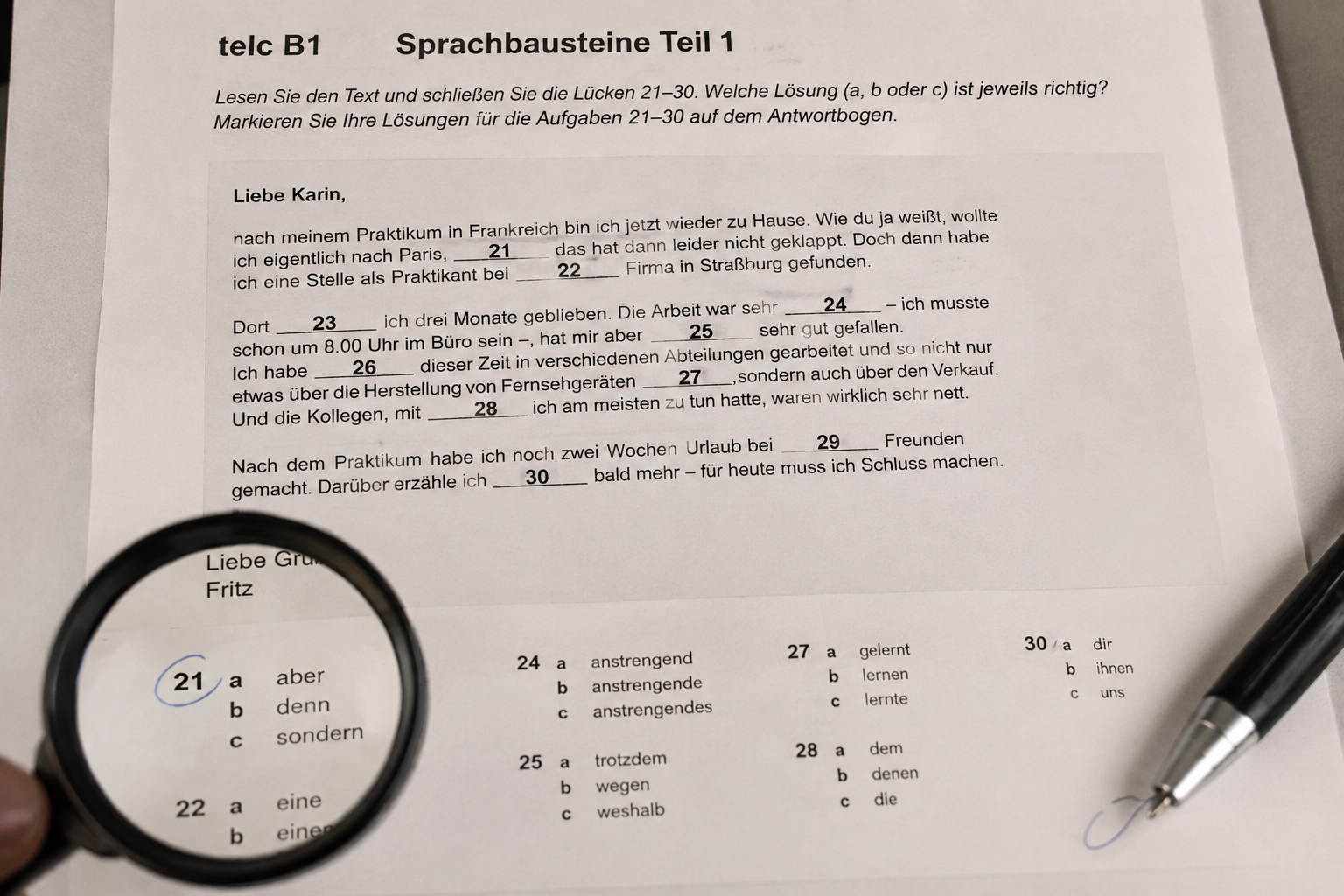
Sprachbausteine Part 1:
structure, assessment and typical mistakes
How is Sprachbausteine Part 1 in the telc Deutsch B1 exam structured? How many points are there, how much time do you have, and which mistakes cost the most points? Here you get a clear overview and the most important tips.
What is Sprachbausteine Part 1?
Sprachbausteine (language structures) is the second subtest in the written part of the telc Deutsch B1 exam. It comes directly after the reading comprehension (Leseverstehen) and consists of two parts: Part 1 tests grammar, Part 2 tests vocabulary.
In Part 1 you read a short text with ten gaps. This is almost always a letter or an email from everyday life. At each gap you choose from three options (a, b or c) the word that fits grammatically into the sentence. So it is not about new words, but about the right form: the right pronoun, the right preposition, the right verb form and so on.
In Part 1 only one solution is ever correct. The other two options are real words, but they do not fit grammatically or in terms of content. Exactly this makes the task difficult: all three variants look possible at first glance.
Structure: what the task looks like
The structure is the same in every exam. You get:
- a coherent text (mostly a personal or semi-formal letter or an email);
- ten gaps, numbered from 21 to 30;
- for each gap three answer options: a, b or c.
Important to understand: the grammar is not isolated in the gap, but in the whole sentence. You often have to read what stands before and after the gap to find the right form.
A simple example
So that you see the principle, here a short example:
Ich wohne jetzt schon seit drei Jahren in (21) Stadt. (I have been living in this city for three years now.)
a) diese b) dieser c) diesen
Correct is b) dieser. The preposition in here indicates a place (question: Wo? / where?), so the dative comes. die Stadt becomes dieser Stadt in the dative. The variants diese (nominative/accusative) and diesen (masculine accusative) do not fit.
This is how each of the ten gaps works: you recognise which grammar is asked and choose the fitting form.
Assessment: points, time and weighting
Sprachbausteine is written together with the reading comprehension. Both subtests share one common time window of 90 minutes. There is no separate time only for the Sprachbausteine: you divide the 90 minutes yourself. In practice it is wise to plan about 10 to 15 minutes for Part 1, because the other tasks need more reading time.
The points for Sprachbausteine look like this in the official telc practice test:
| Subtest | Aim | Task type | Points |
|---|---|---|---|
| Sprachbausteine, Part 1 | grammar | 10 multiple-choice tasks (a, b, c) | 15 |
| Sprachbausteine, Part 2 | vocabulary | 10 matching tasks (a to o) | 15 |
| Sprachbausteine total | – | – | 30 |
Part 1 thus brings 15 points in the raw score. There is no separate pass mark only for the Sprachbausteine: the points count towards the overall result of the written part. To pass the written exam you need at least 60 percent across all written subtests together.
Sprachbausteine Part 1 is short, but it is worth it. These points can often be gained more easily through targeted grammar training than, for example, points in the listening comprehension. Whoever knows the typical grammar gaps answers many questions in under a minute.
Which grammar is tested?
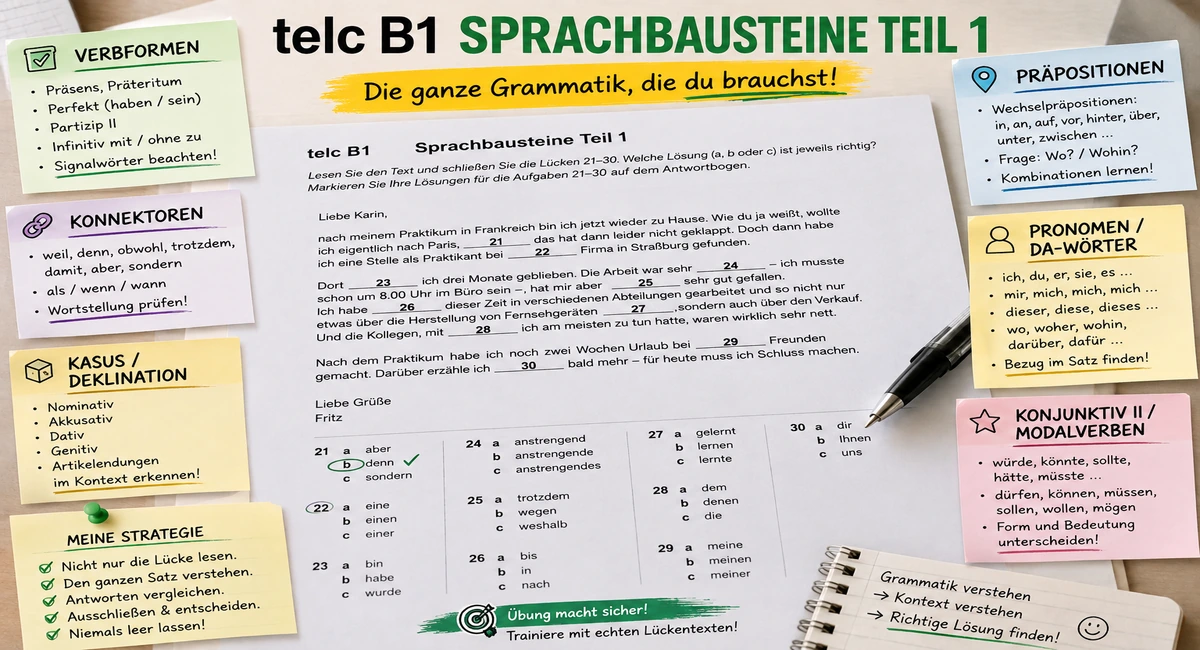
In Part 1 the same grammar areas keep coming up. If you master these confidently, you are already very well prepared. Here the most important areas at a glance:
| Area | What it is about |
|---|---|
| Verbformen (verb forms) | right tense and form: Präsens, Präteritum, Perfekt (present, simple past, present perfect); Partizip II (past participle); infinitive with and without zu; auxiliary haben or sein |
| Konnektoren (connectors) | connecting words like aber, denn, weil, obwohl, trotzdem, damit, sondern and the right word order with them |
| Kasus and Deklination (case and declension) | Nominativ, Akkusativ, Dativ, Genitiv with articles, possessive articles and adjectives |
| Präpositionen (prepositions) | right preposition and right case, especially the two-way prepositions (an, auf, in etc.) |
| Pronomen (pronouns) | personal pronouns, relative pronouns and pronominal adverbs like darauf, davon, daran |
| Konjunktiv II (subjunctive II) | polite and unreal forms: wäre, hätte, würde + infinitive |
| Modalverben and Partikeln (modal verbs and particles) | können, müssen, wollen, möchten as well as small words like schon, noch, nur, einfach |
Three areas come up especially often: Verbformen (verb forms), Konnektoren (connectors) and Kasus/Deklination (case/declension). If you are confident here, you gain the most points.
Typical mistakes in Part 1
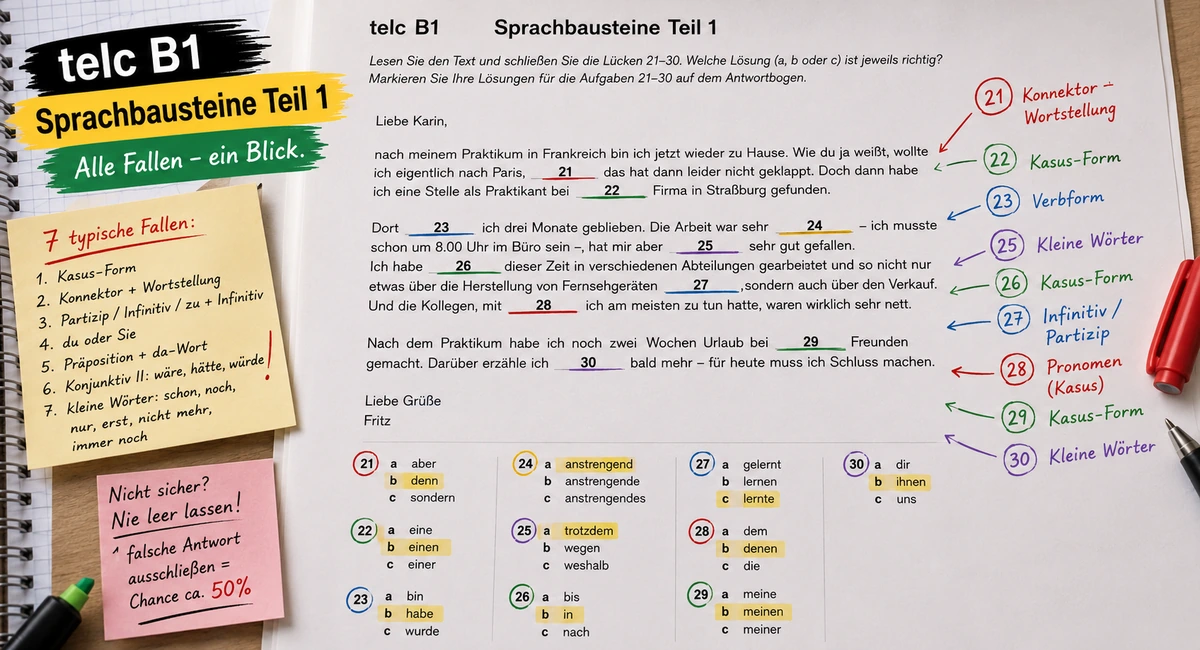
Many points are lost not because the grammar is too hard, but because people fall into typical traps. Here are the most common mistakes – explained with our own examples.
Mistake 1: reading only the gap, not the whole sentence
The right form often depends on a word that stands further away. Whoever reads only around the gap misses it. Always read the whole sentence, ideally also the sentence before.
Mistake 2: choosing the dictionary form
A very common trap: you choose the form you know from the dictionary (nominative), although the sentence requires a different case.
Ich danke dir für (...) Hilfe. (I thank you for your help.) – a) dein b) deine c) deiner
Correct: b) deine. danken für needs the accusative, die Hilfe becomes deine Hilfe. The dictionary form dein is wrong here.
Mistake 3: choosing the connector only by meaning
Words like aber, denn, weil and trotzdem can sound similar, but they change the word order differently. Pay attention to where the verb stands.
Es war kalt, (...) ich nahm keine Jacke mit. (It was cold, ... I did not take a jacket with me.) – a) trotzdem b) obwohl c) weil
Correct: a) trotzdem. After trotzdem the verb stands in second position (trotzdem nahm ich ...). obwohl and weil would send the verb to the end of the sentence – that does not fit here.
Mistake 4: confusing the address du and Sie
In the letter there is either du or Sie. This address decides pronouns and imperative – and that throughout the whole text. Careful: the address does not depend on the tone, but on the form. A friendly letter can still use Sie.
In a letter addressing Sie: Ich möchte (...) herzlich einladen. (I would like to cordially invite you.) – a) dich b) Sie c) euch
Correct: b) Sie. The whole letter is on Sie – so only the polite Sie fits.
Mistake 5: confusing participle, infinitive and zu-infinitive
Very often you have to decide between forms like gemacht (past participle), machen (infinitive) and zu machen. Check: is there a haben/sein (then present perfect → Partizip II)? Is there a modal verb (then infinitive without zu)?
Ich habe gestern einen Brief (...). (Yesterday I wrote a letter.) – a) schreiben b) geschrieben c) zu schreiben
Correct: b) geschrieben. habe ... geschrieben is present perfect, so you need the Partizip II (past participle).
Mistake 6: leaving fields empty
Never leave a gap empty. Even if you are unsure: first cross out an option that is certainly wrong. Then you have a 50-50 chance.
Read the whole sentence, think of the case, pay attention to the word order with connectors, keep the address (du/Sie) consistent – and do not leave any gap empty.
This is how you proceed step by step
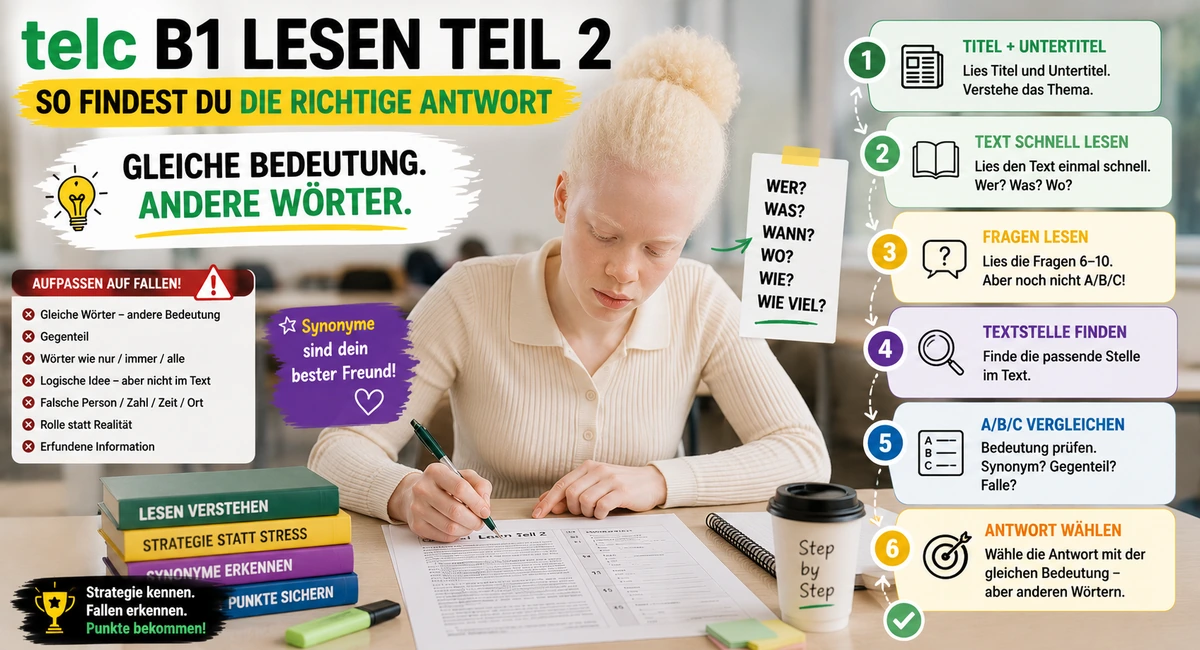
With a fixed procedure you make fewer mistakes and save time. These four steps help with every gap:
- Step 1: First read the whole sentence – not just the gap.
- Step 2: Ask yourself: which grammar is tested here? A pronoun? A preposition? A verb form? A connector?
- Step 3: Cross out the options that certainly do not fit.
- Step 4: Choose a, b or c – and transfer the solution to the answer sheet (Antwortbogen) immediately.
Do not train with single, isolated grammar sentences, but always with whole gap texts. Only this way do you get used to the real exam format. After every exercise read the explanation and ask yourself: which grammar was that? Write new words in your vocabulary notebook.
FAQ on Sprachbausteine Part 1
Source for structure, task type and points: official telc practice test Zertifikat Deutsch / telc Deutsch B1, telc gGmbH, Frankfurt a. M. You find the official practice test free on the telc website at www.telc.net.





There are no comments for this article. Leave your comment