





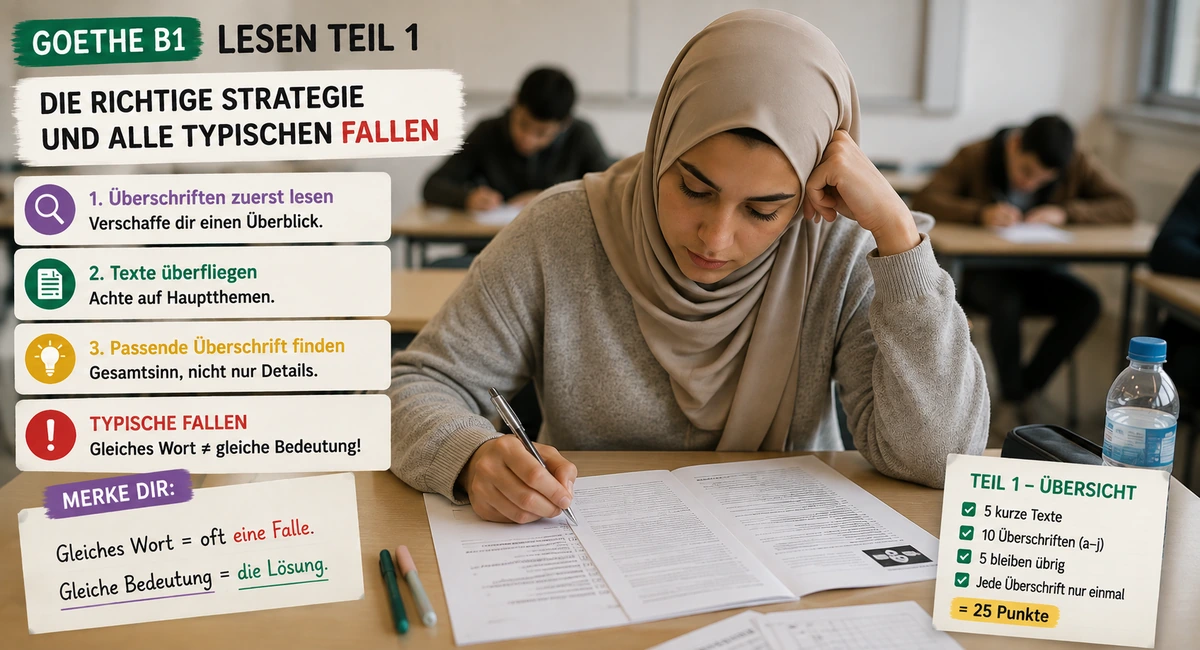
Goethe B1 Reading Part 1:
the right strategy and all typical traps
How do you solve Goethe B1 Reading Part 1 correctly? Here you find a clear step-by-step strategy and the complete map of all traps – so that you reach the maximum score.
What is Reading Part 1 about?
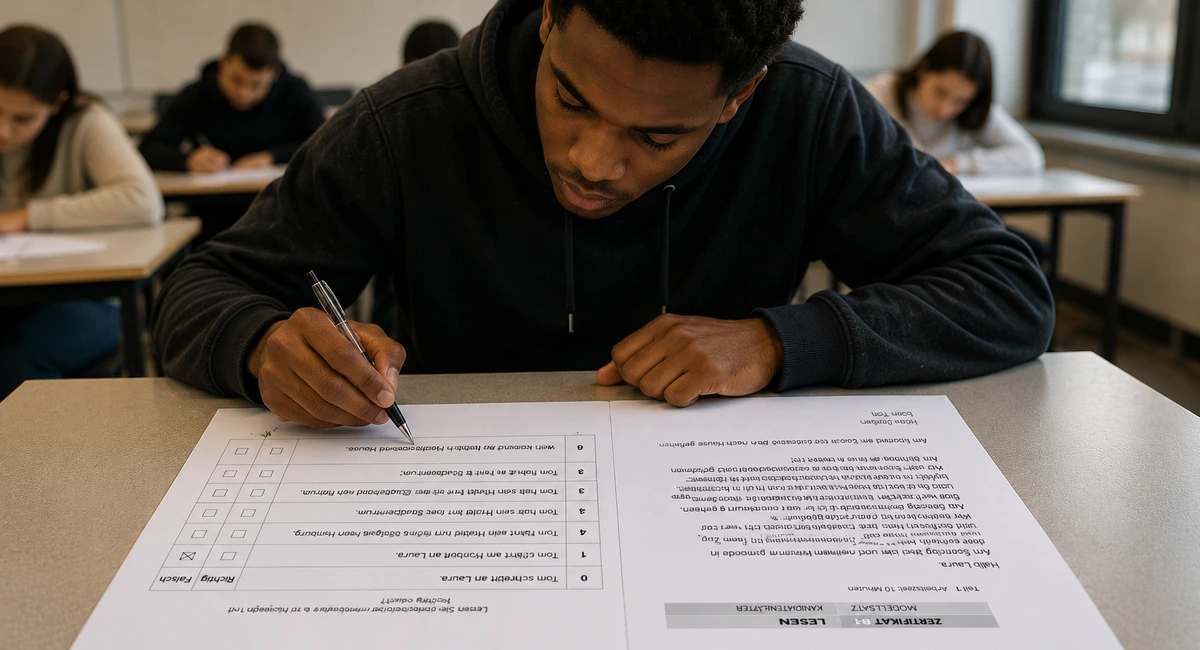
In Goethe B1 Reading Part 1 you read a personal text – for example an email, a blog post or a letter. After that there are six statements. For each statement you decide: Richtig or Falsch.
That sounds simple. But exactly here lies the problem: many statements sound correct at first and are in reality wrong. The exam builds in traps on purpose. Whoever knows the traps and works with a clear method makes far fewer mistakes.
In this article we show you two things: first, a clear strategy for how to proceed step by step, and second, the complete map of all traps. This way you are optimally prepared.
The best strategy – step by step
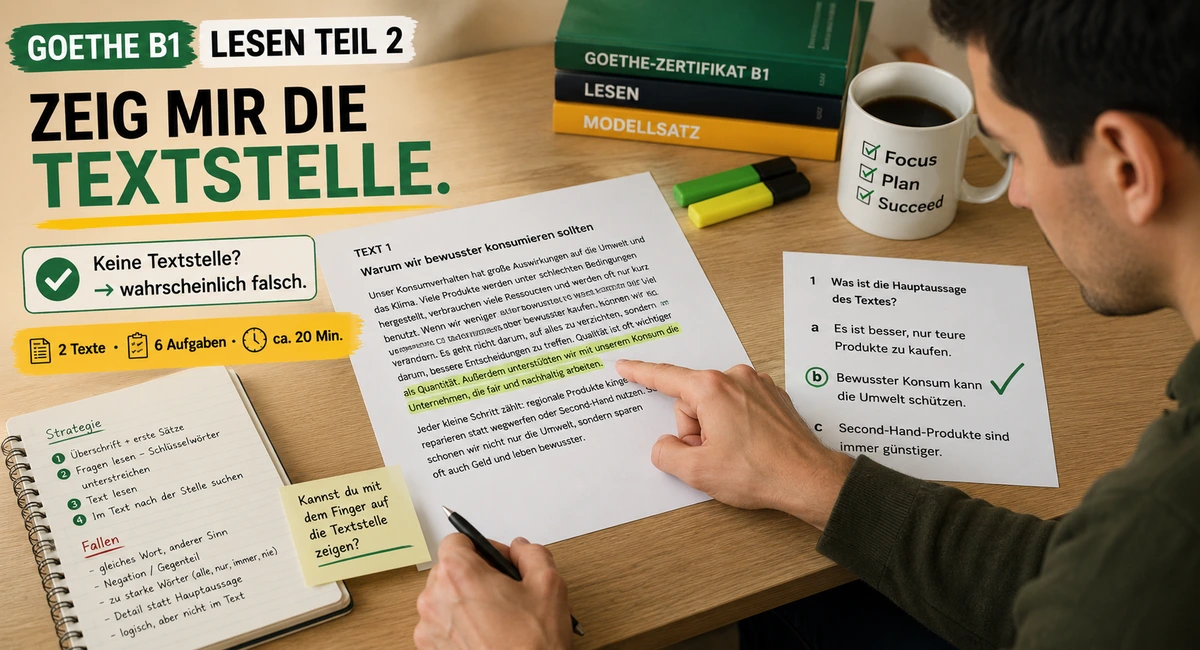
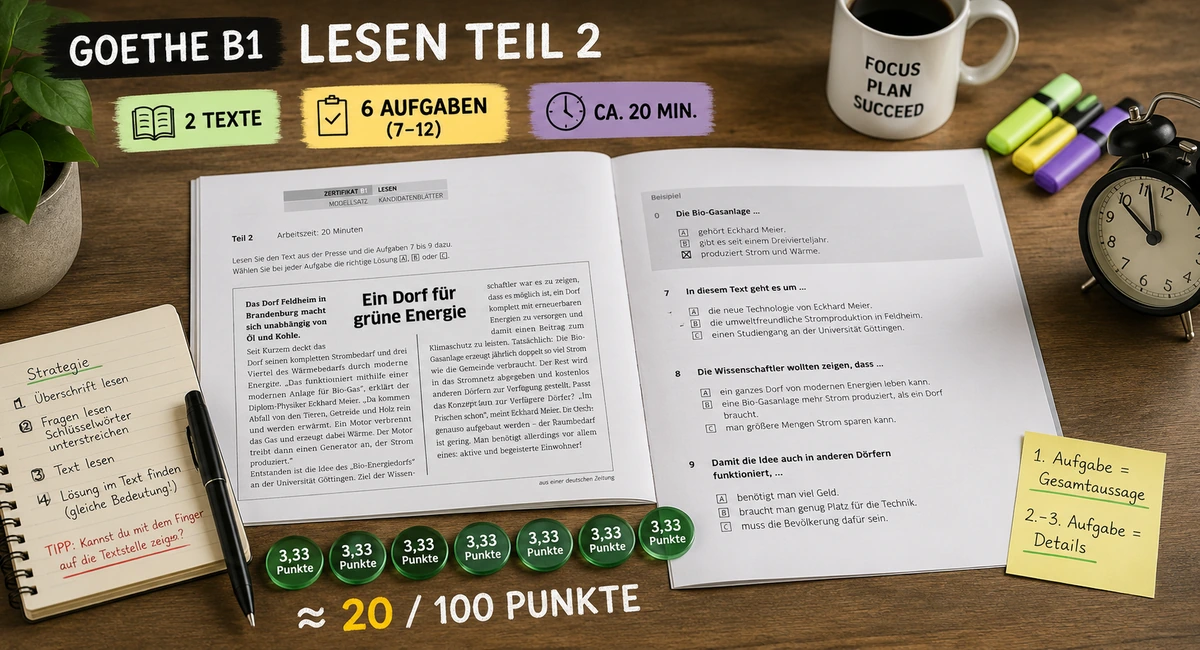
Many learners read the whole text first and then the tasks. That costs a lot of time. There is a better method. The question is often: should you read the tasks first, underline the important words and then look for them in the text? The answer is: yes, exactly like that. But with one important addition that you see in step 4.
➔ Step 1: read the statements first
Read the six statements first – even before you read the text. This way you know exactly what you have to pay attention to in the text.
➔ Step 2: underline key words
Underline the most important words in each statement. These are:
- the person (who? – I, the brother, an employee ...);
- the action (what happens?);
- signal words (immer, nie, alle, nur, sofort, schon immer);
- numbers and time expressions (am Montag, zwei Stunden, drei Personen).
➔ Step 3: read the text and find the place
Now read the text from top to bottom. Important: the statements follow the order of the text. Task 1 fits the beginning, task 6 the end. For each statement look for the matching place in the text – where your key word or a similar word appears.
➔ Step 4: compare the meaning (not only the word!)
This is the most important step. When you have found the place, do not look only for the same word. Compare the meaning. Ask yourself:
- Does the text say the same thing – often with other words (synonym)? ➤ then the statement is Richtig.
- Does the text say the opposite, something different, or does it belong to a different person? ➤ then the statement is Falsch.
➔ Step 5: decide and move on
Tick your answer. If you are unsure, tick something anyway and move on. At the end you can come back. Never leave a task empty – wrong answers do not cost an additional point.
Read the statements ➤ underline key words ➤ find the place in the text ➤ compare the meaning (not only the word!) ➤ decide.
The golden rule: the meaning counts, not the same word
This is the most important rule for this whole task format. Please remember it well:
When a statement is true, the text almost always says the same thing – but with other words (synonym or paraphrase). When the same word appears in the text and in the statement, that is often a trap.
Why is that so? The exam wants to test whether you really understand – and not just compare words. Therefore the authors write the correct answer with other words. And they build traps by putting a familiar word from the text into a wrong statement.
A simple example (invented):
- In the text: Am Wochenende war ich von morgens bis abends im Garten.
- Correct statement: Sie hat den ganzen Tag im Garten gearbeitet. ✓ (other word, same meaning)
- Wrong trap: Sie war nur kurz im Garten. ✗ (the opposite, although the word Garten is the same)
So: the familiar word only helps you to find the place. Whether it is true or false is always decided by the meaning.
The complete map of the traps
There are some typical traps that occur again and again. If you know these, you recognise them immediately. Here is the complete map – with simple, invented examples.
➔ Trap 1: same word, different meaning
A word from the statement also appears in the text, but in the text it means something else.
➤ Strategy: always read the whole sentence, not only the one word.
➔ Trap 2: a different person acts
The statement says the main person does something. But in the text someone else does it (the brother, a colleague ...).
Example: In the text: Mein Freund hat das Essen gekocht. Statement: Sie hat das Essen gekocht. ✗ Falsch – it was the friend.
➤ Strategy: always ask: who really does this?
➔ Trap 3: taking part is not organising
Someone takes part in something or tells about it. But the statement says this person organises or leads it.
➤ Strategy: check: did the person only take part or really lead it themselves?
➔ Trap 4: intention is not action
The person wanted to do something, but did not do it. Signal: eigentlich wollte ich ..., aber ...
Example: In the text: Ich wollte noch einkaufen, aber die Geschäfte waren zu. Statement: Sie ist noch einkaufen gegangen. ✗ Falsch.
➤ Strategy: ask: did the person really do it?
➔ Trap 5: Konjunktiv II – a wish is not reality
With wäre, hätte, könnte the person often describes only a wish. So something did not happen.
Example: In the text: Ich hätte gern noch eine Stunde gelesen. Statement: Sie hat eine Stunde gelesen. ✗ Falsch – she would have liked to, but she did not.
➤ But careful: the Konjunktiv can also be correct! If the statement describes the wish itself (Sie wäre gern länger geblieben), then it is Richtig. The difference: does the statement describe the fact (✗) or the wish (✓)?
➔ Trap 6: the opposite (hidden negation)
The text says something positive, the statement something negative – or the other way round.
Example: In the text: Der Film hat mir sehr gefallen. Statement: Der Film hat ihr nicht gefallen. ✗ Falsch.
➤ Strategy: pay close attention to small words like nicht, kein, nie.
➔ Trap 7: signal words (immer, nie, alle, nur, sofort)
Words like immer, nie, alle, nur, sofort, schon immer make a statement very absolute. In the text there is often something weaker, for example manchmal or erst danach.
Example: In the text: Manchmal koche ich am Abend. Statement: Sie kocht jeden Abend. ✗ Falsch.
➤ Strategy: with these words read very carefully – they are often traps.
➔ Trap 8: the wrong reason
The statement names a reason. But in the text the reason is a different one.
Example: In the text: Ich habe das kleine Auto genommen, weil es günstiger war. Statement: Sie hat das Auto wegen der Farbe gewählt. ✗ Falsch.
➤ Strategy: ask: which reason does the text really name?
➔ Trap 9: wrong detail, wrong number, wrong time
A small detail is changed – a number, a day, a place, a thing.
Example: In the text: Wir kamen am Dienstag an. Statement: Sie kamen am Donnerstag an. ✗ Falsch.
➤ Strategy: compare numbers, days and places very precisely.
➔ Trap 10: a word from a different place (double bottom)
A phrase from the statement appears in the text – but with a different person or with the opposite meaning. This is the most difficult trap.
Example: In the text: Mein Kollege war von Anfang an dagegen. Statement: Sie war von Anfang an dafür. ✗ Falsch – the phrase von Anfang an appears in the text, but with a different person and with the opposite.
➤ Strategy: ask: to whom does this phrase belong in the text – and in which sense?
| Trap | How do you recognise it? | What should you do? |
|---|---|---|
| 1. Same word, different meaning | familiar word in the statement | read the whole sentence in the text |
| 2. A different person acts | name or pronoun | ask: who really does this? |
| 3. Taking part ≠ organising | organisiert, geleitet, veranstaltet | took part or led it themselves? |
| 4. Intention ≠ action | wollte, eigentlich, aber | ask: really done? |
| 5. Konjunktiv II (wish) | wäre, hätte, könnte | fact or only a wish? |
| 6. Opposite / negation | nicht, kein, nie | positive or negative? |
| 7. Signal words | immer, alle, nur, sofort, schon immer | check very carefully |
| 8. Wrong reason | weil, denn, deshalb | which reason does the text name? |
| 9. Wrong detail / number / time | numbers, days, places | compare precisely |
| 10. Word from a different place | familiar phrase, different context | to whom? in which sense? |
These mistakes you should avoid
Many learners lose points for the same reasons. Avoid these typical mistakes:
- Only looking for the same word. A familiar word does not automatically mean Richtig. Check the meaning.
- Confusing the people. In the text there are often several people. Pay close attention to who does what.
- Overlooking signal words. Immer, alle, sofort are often the reason for a wrong statement.
- Misunderstanding the Konjunktiv. Hätte, wäre, könnte often means: it did not happen.
- Staying too long on one task. Mark an answer and move on. At the end you can come back.
- Leaving a task empty. Better guess – there are no minus points.
Checklist – and off you go!
Before you start practising, here is everything at a glance once more. With this checklist in your head you get the maximum score.
- ✓ Read the six statements first.
- ✓ Underline the key words in each statement (person, action, signal words, numbers).
- ✓ Read the text from top to bottom – the statements follow the order.
- ✓ Find the matching place in the text for each statement.
- ✓ Compare the meaning – not only the word.
- ✓ Think of the traps: different person? wish? signal word? opposite?
- ✓ Answer every task – leave nothing empty.
Now you are ready. Practise with real tasks and apply the strategy directly. This way you become faster and more confident all the time.
👉 Practise Goethe B1 Reading now




There are no comments for this article. Leave your comment