





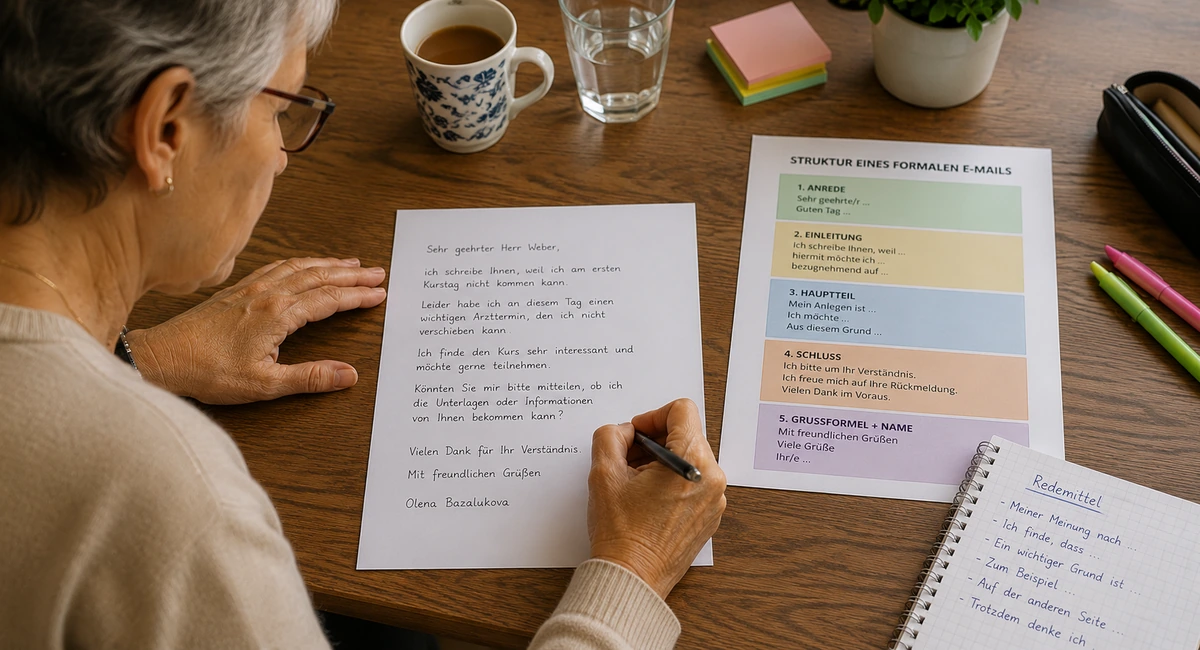
B1 ÖSD Writing Part 2:
topics, universal sentences and set phrases
Which topics appear in Writing Part 2? Here you find universal sentences and many set phrases with examples, with which you can write a good comment on almost any topic.
Which topics appear in Part 2?
Writing Part 2 is always about a topic that many people discuss. So they are not private topics, but questions from everyday life and from society. Usually you have watched a programme on television beforehand or read a post on the internet.
The topics come from a few big areas. If you know these areas, you are well prepared:
| Topic area | Example topics |
|---|---|
| Health and nutrition | healthy nutrition, sport in everyday life, living vegetarian, organic food |
| Media and internet | social networks, streaming music, online shopping, artificial intelligence |
| Job and work | home office, flexible working hours, teamwork, internship abroad |
| School and learning | all-day school, homework, learning foreign languages, learning online |
| Environment and traffic | environmental protection, car-free city centre, public transport |
| Society and family | getting married, moving out of the parental home, children and the mobile phone, pets |
You do not have to be an expert. You only have to give your own opinion and name an example. First read the introductory text carefully, then you immediately know which topic it is about.
Universal sentences: a structure for every comment
There are sentences that fit almost any topic. You only have to insert the topic. Such a fixed structure helps you to write quickly and calmly. Build your text in four steps:
- Einleitung (introduction): Das Thema ... finde ich sehr interessant.
- Meinung und Begründung (opinion and reasoning): Meiner Meinung nach ..., weil ...
- Beispiel (example): Vor Kurzem habe ich ...
- Andere Seite und Schluss (other side and ending): Auf der anderen Seite ... Trotzdem denke ich: ...
This is what the structure looks like with a topic
Here is an example on the topic Sport im Alltag (sport in everyday life). You can see: only the highlighted places change, the rest stays almost the same.
Das Thema Sport im Alltag finde ich sehr interessant. Meiner Meinung nach ist regelmäßige Bewegung sehr wichtig, weil man danach mehr Energie hat. Vor Kurzem habe ich angefangen, jeden Morgen zu Fuß zur Arbeit zu gehen. Auf der anderen Seite hat nach einem langen Tag nicht jeder Lust auf Sport. Trotzdem denke ich: Schon ein kurzer Spaziergang tut gut.
Learn this structure by heart. In the exam you save a lot of time this way and forget no important part.
Set phrases for introducing and for the opinion
With these set phrases you begin your comment and state your opinion clearly. After each set phrase you see an example.
For introducing
- Das Thema ... finde ich sehr wichtig.
→ Das Thema Umweltschutz finde ich sehr wichtig. - Ich finde die Frage ... sehr interessant.
→ Ich finde die Frage, ob Kinder ein Handy brauchen, sehr interessant. - In letzter Zeit wird viel über ... diskutiert.
→ In letzter Zeit wird viel über gesunde Ernährung diskutiert. - Viele Menschen fragen sich, ob ...
→ Viele Menschen fragen sich, ob Reisen wirklich glücklich macht.
Stating the opinion
- Meiner Meinung nach ...
→ Meiner Meinung nach ist Bewegung sehr gesund. - Ich bin der Meinung, dass ...
→ Ich bin der Meinung, dass jeder eine Fremdsprache lernen sollte. - Ich finde, dass ...
→ Ich finde, dass Homeoffice viele Vorteile hat. - Ich bin dafür / dagegen, dass ...
→ Ich bin dafür, dass das Stadtzentrum autofrei wird.
State your opinion clearly already at the beginning. Then the reader immediately knows what you think, and your text feels confident.
Set phrases for giving reasons and for examples
An opinion without a reason is too little. Always explain why you think this way, and name an example.
Giving reasons
- ... weil ...
→ Ich mag den Wochenmarkt, weil die Produkte dort frisch sind. - ... denn ...
→ Ich lerne gern online, denn ich spare viel Zeit. - ... deshalb ...
→ Plastik ist schlecht für die Natur, deshalb benutze ich Stofftaschen. - Ein wichtiger Grund ist, dass ...
→ Ein wichtiger Grund ist, dass man so neue Leute kennenlernt. - Außerdem ...
→ Außerdem macht gemeinsames Arbeiten oft mehr Spaß.
Naming an example
- Vor Kurzem habe ich ...
→ Vor Kurzem habe ich vegetarisch gekocht und es hat gut geschmeckt. - Ein gutes Beispiel ist ...
→ Ein gutes Beispiel ist meine Schwester, die jeden Tag mit dem Rad fährt. - Bei mir war es so, dass ...
→ Bei mir war es so, dass ich im Zug ein ganzes Buch gelesen habe. - Ich kenne jemanden, der ...
→ Ich kenne jemanden, der ein Praktikum im Ausland gemacht hat.
Do not forget the example! The task expects you to also report on your own experience. A concrete example brings you points for the fulfilment.
Set phrases for the other side and the ending
A good comment also shows the other side and ends with a clear closing opinion. The examiners especially like that.
Showing the other side
- Auf der anderen Seite ...
→ Auf der anderen Seite ist gesundes Essen oft teurer. - Einerseits ..., andererseits ...
→ Einerseits ist das Internet praktisch, andererseits kostet es viel Zeit. - Natürlich gibt es auch Nachteile.
→ Natürlich gibt es auch Nachteile, zum Beispiel den Lärm. - Manche Leute denken aber, dass ...
→ Manche Leute denken aber, dass ein Auto bequemer ist.
Writing the ending
- Trotzdem denke ich: ...
→ Trotzdem denke ich: Bewegung tut jedem gut. - Eine Lösung wäre ...
→ Eine Lösung wäre, weniger Fleisch zu essen. - Alles in allem ...
→ Alles in allem finde ich die Idee sehr gut. - Zusammenfassend kann man sagen, dass ...
→ Zusammenfassend kann man sagen, dass beide Seiten wichtig sind.
With words like trotzdem, deshalb, außerdem, einerseits, andererseits you connect your sentences. This way your text becomes more fluent and you get more points for the coherence.
Tips for more points
With these tips you get more points in Part 2:
- Stay neutral. Do not write du and do not address the text to a specific person.
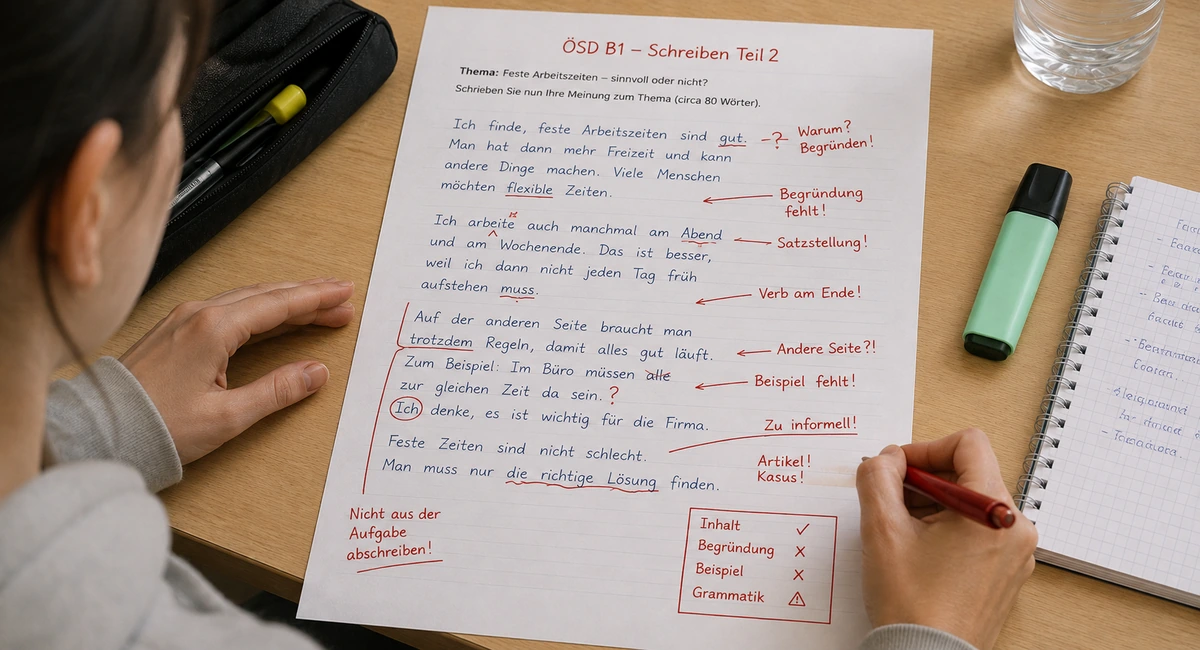
- Do not copy. Do not take whole words or parts of sentences from the given comment. Formulate in your own words.
- Vary the sentence beginnings. Do not begin every sentence with Ich.
- Name an example. An own experience makes your text stronger.
- Write enough. About 80 words or a bit more. A text that is too short is penalised.
- Use connectors. Words like weil, denn, deshalb, trotzdem connect your thoughts.
- Keep the structure. Introduction, opinion with reasoning, example, other side and ending.
- Leave time for correcting. Read your text through again at the end.




There are no comments for this article. Leave your comment