





telc B1 Reading Part 1:
the right strategy and all typical traps
How do you solve Reading Part 1 safely and quickly? Here you learn the right method step by step and recognise every typical trap before you train on our site. This way you get the maximum number of points.
The right method: in which order to read?
Many learners ask themselves: should I first read the headings, underline the important words and then search for exactly these words in the text? The idea is good, but it has a dangerous catch. Exactly this searching for identical words is the trap that Part 1 is built on. The right order therefore looks a little different.
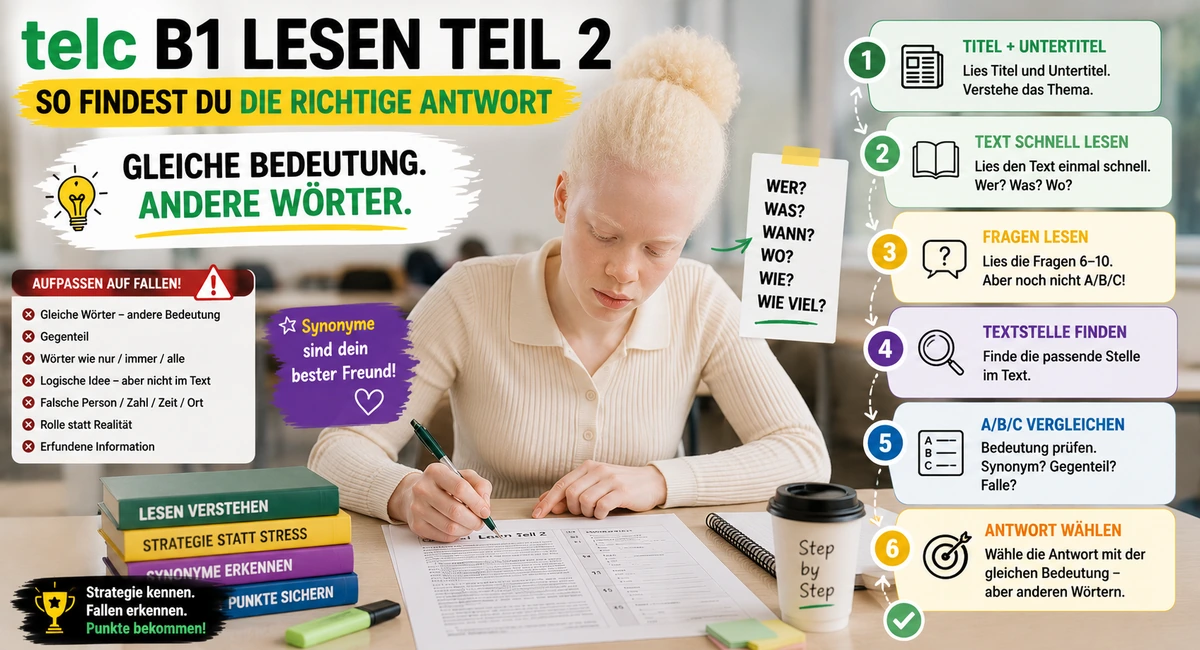
This is how you best proceed
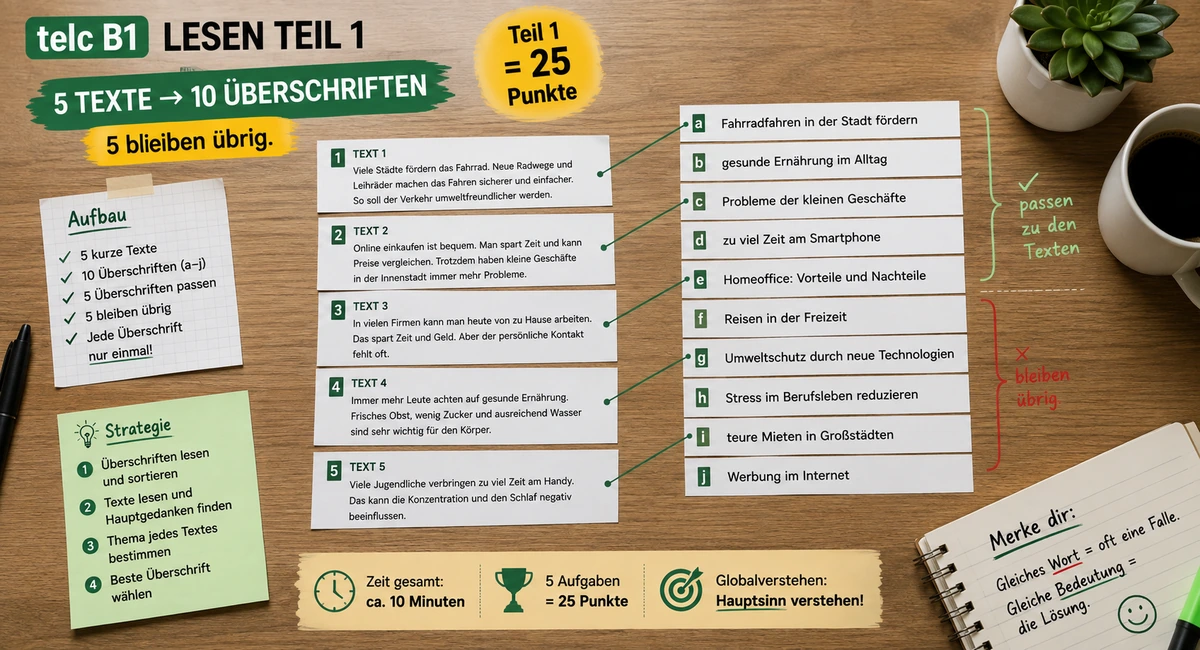
- Step 1 – headings first. Read all ten headings and underline the key word in each. Mentally assign the headings to two or three topics. This way you know roughly what it is about.
- Step 2 – read the text for the meaning. Read each text and underline the words that carry the main idea. Then say to yourself in your own sentence: what is this really about?
- Step 3 – assign by meaning, not by word. Look for the heading that hits this main idea. Pay attention to synonyms and paraphrases (confirmation) and to the opposite (for sorting out).
- Step 4 – sort out. Cross out used headings. Remember: five headings remain and fit no text.
- Step 5 – transfer. Enter your solutions on the answer sheet (Antwortbogen) in time.
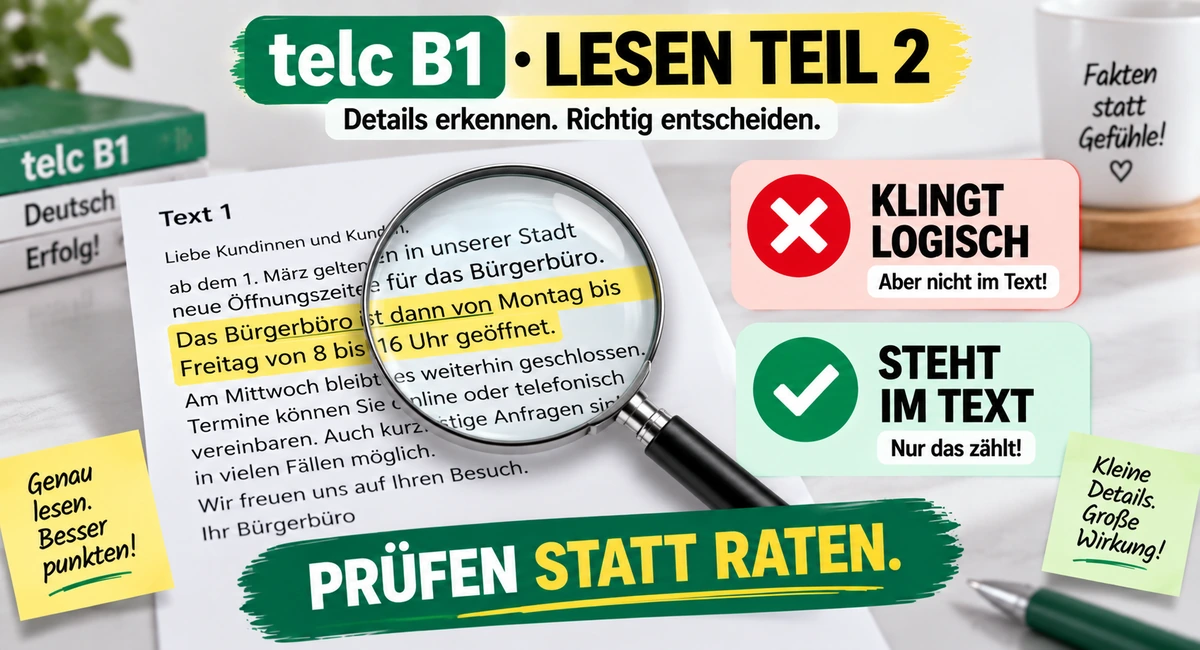
Yes, read the headings first and underline the key words. But afterwards do not search the text for the same word, but for the same meaning – and always also check whether a heading claims the opposite.
The most important principle: same meaning instead of same word
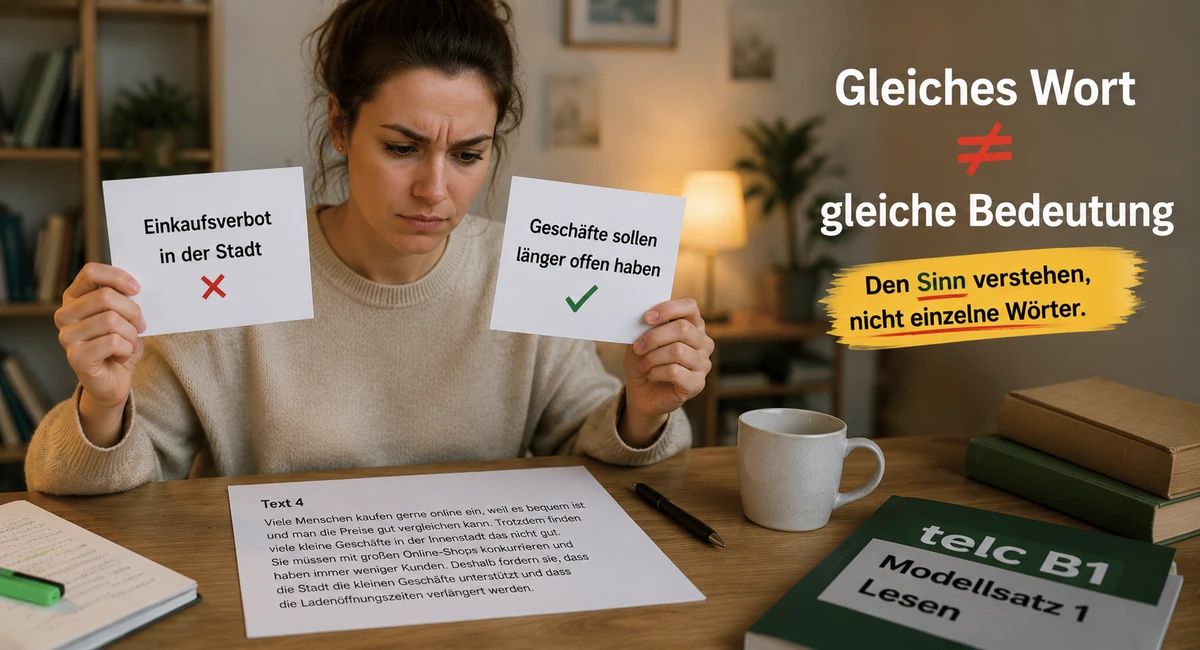
If you keep only one sentence from this article, then this one: an identical word is often a trap, the same meaning is the solution. The correct heading almost always uses other words than the text and still expresses exactly the same idea. A heading, on the other hand, that takes over a striking word from the text is often a distraction.
The fitting heading hits the meaning of the whole text in its own words. Whoever only searches for familiar words runs straight into the trap.
Two simple word traps to warm up
- Same word, different sense: a text is about sleep research in a laboratory. The heading Neue Schlafsofas im Angebot (new sofa beds on offer) uses the word Schlaf (sleep) but means something completely different.
- Similar-sounding word: a text is about the observation of whales in the sea. The heading Tipps für die richtige Wahl (tips for the right choice) sounds similar (Wahl / Wale) but has nothing to do with the text.
Traps that twist the meaning
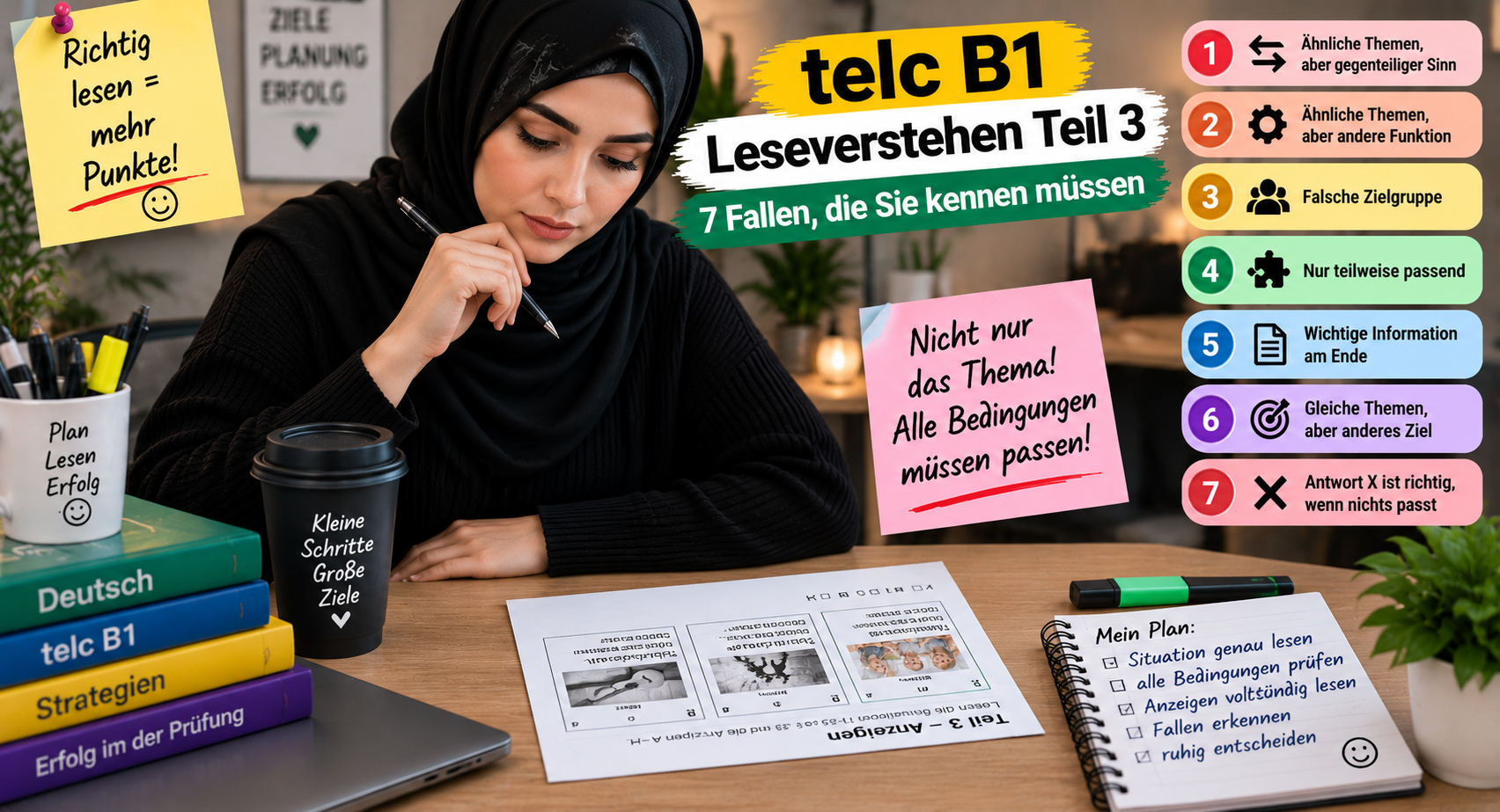
This group is the most common and most dangerous. The heading takes the right topic but twists the statement – through the opposite, through a small word, through a wrong comparison or through a claim that is not in the text at all.
| Trap | What it builds on | Mini example (invented) | This is how you expose it |
|---|---|---|---|
| The opposite | The statement is reversed. | Text: immer weniger Jugendliche rauchen (fewer and fewer young people smoke). Heading: Rauchen nimmt stark zu (smoking is increasing strongly). | Is the direction of the statement correct? |
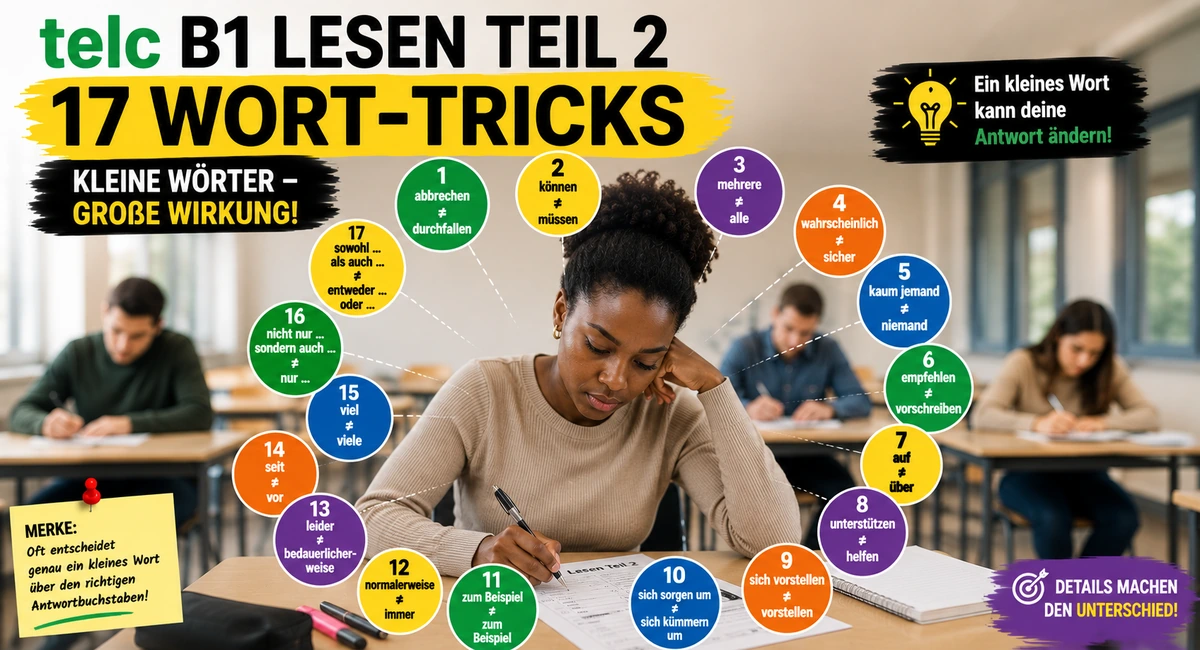
| Small words | A quantity word turns the sense (nur, kein, kaum, die Hälfte). | Text: die meisten Gäste sind zufrieden (most guests are satisfied). Heading: Kaum ein Gast ist zufrieden (hardly a guest is satisfied). | Underline and check words like nur, kein, kaum. |
| Planned instead of happened | A plan is presented as a fact. | Text: die Stadt plant ab nächstem Jahr neue Wege (the city plans new paths from next year). Heading: Stadt hat neue Wege gebaut (city has built new paths). | Has it already happened or is it only planned? |
| Absence instead of ban | A state becomes a measure. | Text: in der Region gibt es kein Kino mehr (there is no cinema left in the region). Heading: Kinos werden verboten (cinemas are being banned). | Is something missing, or is it really being banned? |
| Reversed comparison | The comparison points in the wrong direction. | Text: Gruppe A spart mehr als Gruppe B (group A saves more than group B). Heading: B spart mehr als A (B saves more than A). | According to the text, who is more, who less? |
| Invented comparison | A comparison is added that does not exist. | Text: speaks only about group A. Heading: A ist besser als B (A is better than B). | Does the second side appear in the text at all? |
| Equal instead of better | Equality becomes superiority. | Text: beide Gruppen sind gleich gut (both groups are equally good). Heading: A ist besser als B. | genauso gut wie (just as good as) is not besser als (better than). |
| Invented reason | A cause and effect is invented. | Text: viel Arbeit heißt nicht automatisch Stress (a lot of work does not automatically mean stress). Heading: Mehr Arbeit führt zu mehr Stress (more work leads to more stress). | Is this reason really in the text? |
| Added on | Something is claimed that is not in the text. | Text: about mothers in work. Heading: Finanzielle Hilfe für Mütter (financial help for mothers) (money is not mentioned). | Do I really find this statement in the text? |
| Invented trend | A development is claimed. | Text: describes an offer. Heading: Angebot immer beliebter (offer ever more popular). | Is there a comparison of before versus now? |
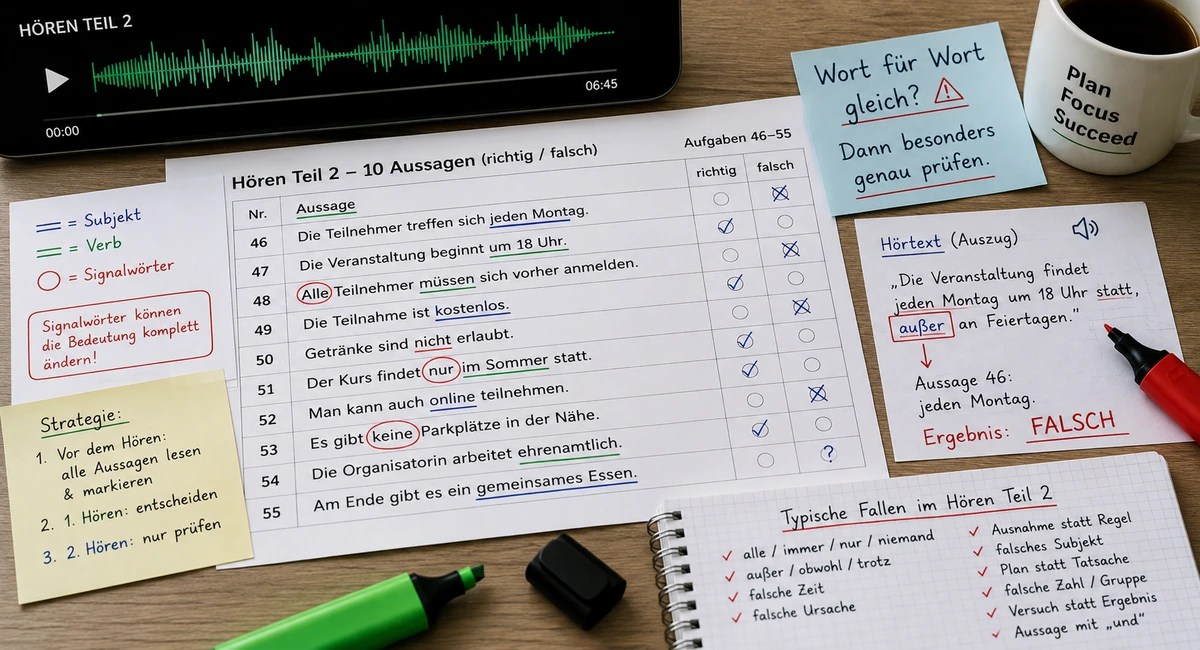
| Exaggeration | manchmal becomes immer (alle, keine, nur, gratis). | Text: an manchen Tagen ist der Eintritt frei (on some days admission is free). Heading: Eintritt immer gratis (admission always free). | Careful with alle, immer, nur, kein, gratis. |
Read every possible heading once with the question: does it really say the same as the text – or the opposite, a bit more or a bit less? This one thought alone prevents most mistakes.
Traps with wrong reference and wrong scope
In this group the words are correct, but they belong to someone else, to another place, to another time – or the heading does not fit the whole text but only a small part of it.
| Trap | What it builds on | Mini example (invented) | This is how you expose it |
|---|---|---|---|
| Who does what (role swap) | Acting and affected person are swapped. | Text: der Lehrer wird von den Schülern gelobt (the teacher is praised by the pupils). Heading: Lehrer lobt die Schüler (teacher praises the pupils). | Who is the acting person, who the affected one? |
| Shifted number | A number is referred to something wrong. | Text: der Park hat 200 Bäume (the park has 200 trees). Heading: 200 Besucher im Park (200 visitors in the park). | What exactly does this number belong to? |
| Wrong place | The where of the event is shifted. | Text: die Kinder lernen unterwegs im Bus (the children learn on the way in the bus). Heading: Unterricht im Klassenzimmer (lessons in the classroom). | Where does it really happen? |
| Wrong time | The when is shifted. | Text: die Geschäfte öffnen nur sonntags (the shops open only on Sundays). Heading: Geschäfte öffnen samstags (shops open on Saturdays). | When exactly does the statement apply? |
| Too narrow (only one detail) | The heading picks out a detail. | Text: about a whole region. Heading: names only a single village. | Does the heading fit the whole text? |
| Too broad | The heading is much wider than the text. | Text: only about ticket prices. Heading: Alles über den Nahverkehr (everything about local transport). | Does the text really cover so much? |
| Mixed from two texts | The heading combines words from two texts. | One word from text A, one word from text B – fits neither completely. | Does the heading really fit one single text? |
| Wrong action | Right topic, wrong verb. | Text: tips on saving electricity. Heading: So wechseln Sie den Stromanbieter (this is how you change your electricity provider). | Which action does the text describe exactly? |
| Wrong text type | The type of text is confused. | Text: an illustrated book to look at. Heading: Handbuch für Fortgeschrittene (manual for advanced learners). | What is it: book, course, survey, advertisement? |
| Wrong target group or number | Addressee, origin or number is wrong. | Text: about a single pupil. Heading: Schüler schreiben Geschichten (pupils write stories) (many instead of one). | For whom, from where, one or many? |
Every number in the text is a popular bait. With every number, briefly tell yourself what it belongs to. A heading that takes the right number but assigns it to a different thing is a classic trap.
When two headings seem to fit
Sometimes two headings both seem correct. That is intentional. One of them hits the main idea of the text, the other only a side point or a small deviation. Here even good learners lose points if they decide too quickly.
If two headings fit, choose the one that covers the main idea of the whole text – not the one that describes only a subordinate clause or a detail. Ask yourself: which heading would I give to someone who wants to understand the text in one sentence?
Then check the two candidates specifically against the traps from the sections above: does one of them reverse the direction? Does it exaggerate? Does it refer a number wrongly? Very often one single small word decides which of the two really fits.
The quick check before every answer
Before you finally choose a heading, go through this short list. It takes only a few seconds and catches almost every trap.
- ✅ Does the heading say the same as the text – or only the same word?
- ✅ Does it fit the whole text and not just one detail?
- ✅ Is the direction correct: who does what, more or less, planned or happened?
- ✅ Is something claimed that is not in the text at all?
- ✅ Is there an exaggeration word like alle, immer, nur, kein or gratis?
- ✅ Do number, place and time really belong to this statement?
Read the headings first, then understand the text in its meaning and assign by meaning. Do not search for the same word, but for the same thought – and distrust every heading that reverses, exaggerates or adds something to the statement.


There are no comments for this article. Leave your comment