





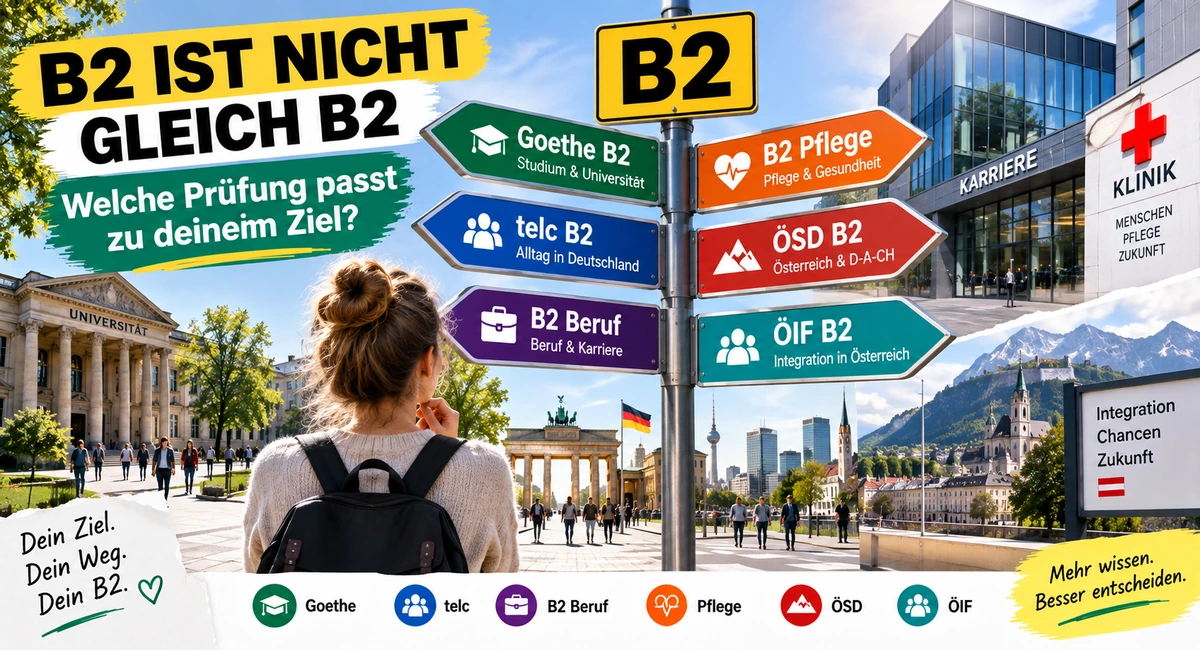
Preparation for the German B2 exam:
A comprehensive guide
Preparation for the German B2 exam: tips, learning strategies and exercises for all exam parts — your complete guide to passing successfully.
Preparing for the B2 exam is an important step on the path to reaching an advanced level. Successfully passing this exam opens up opportunities for study, work or immigration. A B2 certificate confirms sufficient German language skills for effective communication in a professional environment. This opens up excellent prospects for job-seeking in international companies and for career advancement. German at B2 level is also important because of the opportunities it provides for successful integration into academic life. Holding a corresponding certificate confirms that the candidate is able to process academic content and communicate with teachers and students at a sufficient level.
Candidates wishing to take the B2 exam should bear in mind that there is no universally applicable preparation method. The examination systems differ in their specific features, requirements, task formats and assessment criteria. This guide will help you understand the specific features and basic requirements of German language exams at B2 level, in order to create an effective preparation plan and pass the exam with confidence.
Goethe B2 exam
The Goethe-Zertifikat B2 is a German language exam that certifies advanced language skills. It corresponds to the fourth level of the six-level competence scale in accordance with the CEFR (Common European Framework of Reference for Languages).
The exam was developed by the Goethe-Institut. It is conducted worldwide in cooperation with partner organisations. The Goethe-Institut is a German cultural institution and at the same time a prestigious international organisation regarded as a leading provider of German language exams. It was founded in 1951. It actively promotes the development and spread of the German language worldwide. The Goethe-Institut offers not only language courses but also exams for obtaining certificates tailored to people with different language levels.
With the B2 Goethe certificate, the candidate confirms that they:
- understand the main content of texts on concrete and abstract topics as well as specialist discussions in their own field;
- can participate spontaneously and freely in conversations, enabling communication with native speakers without particular effort on either side;
- can express themselves clearly on a wide range of topics, take a position on current issues and present the advantages and disadvantages of various options.
On the official website of the Goethe-Institut you will find information about preparatory courses for the exam (online and offline formats). Information materials and exercises (model exams) for self-testing of all four language skills are provided there.
Structure of the Goethe B2 exam
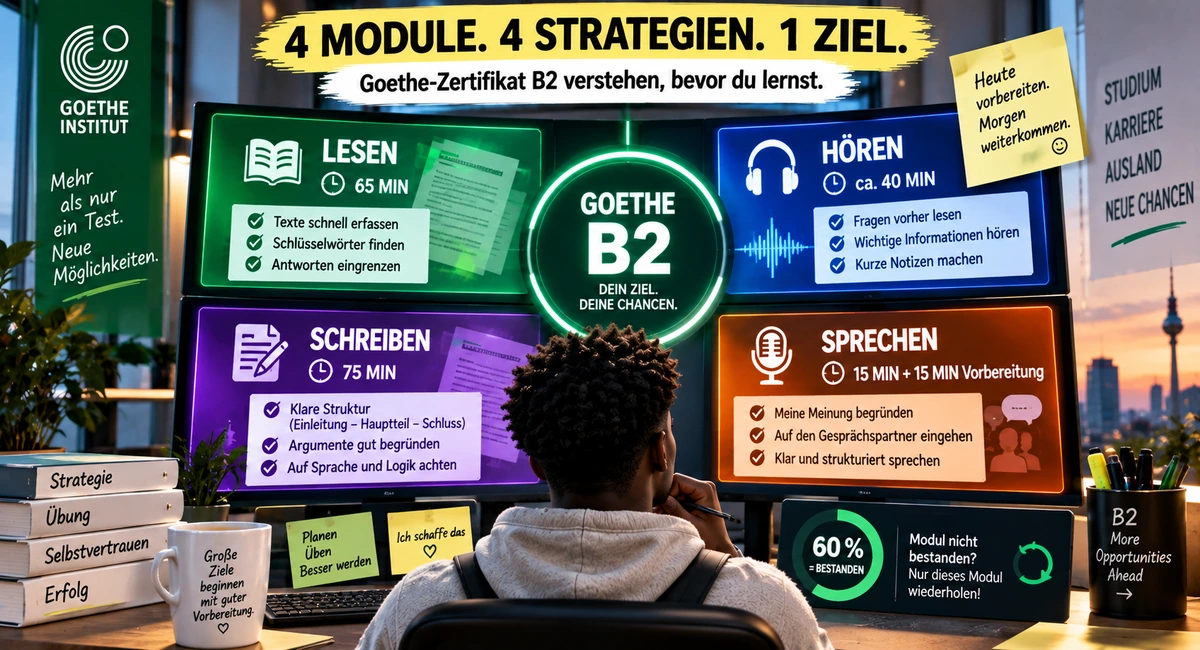
Preparing for the Goethe B2 exam involves familiarising yourself with the modules the candidate must complete, the task formats and the study of general information. The B2 German exam consists of four modules: reading, listening, writing and speaking. Candidates have the option of taking the exam in paper or digital format. The duration and assessment criteria are identical worldwide.
Reading
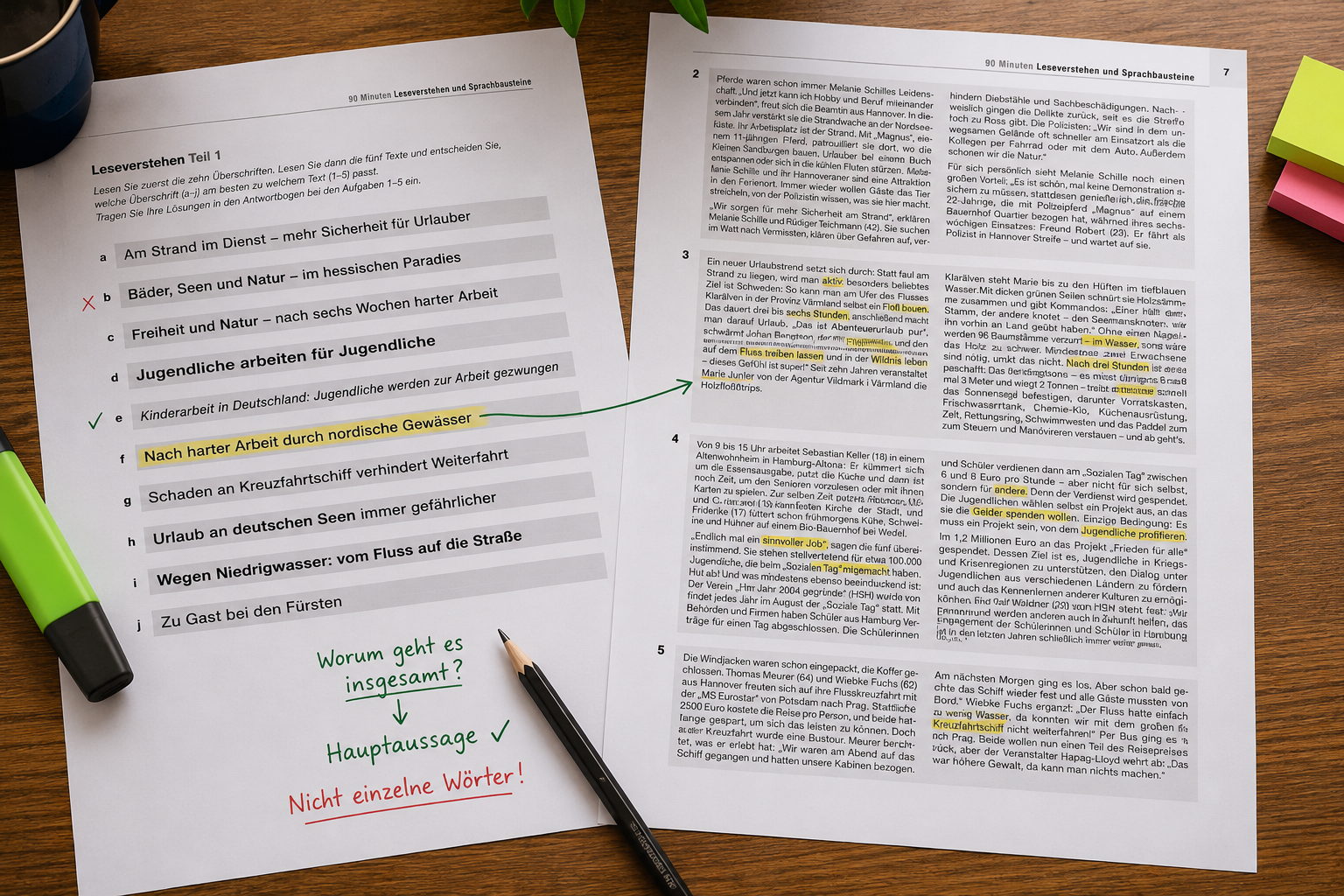
B2 reading involves working with various texts. Candidates may be presented with the following texts:
- forum posts;
- articles from newspapers and magazines;
- comments and instructions.
The task is to identify the most important information and details as well as viewpoints, opinions and rules. The processing time for this section is 65 minutes.
Writing
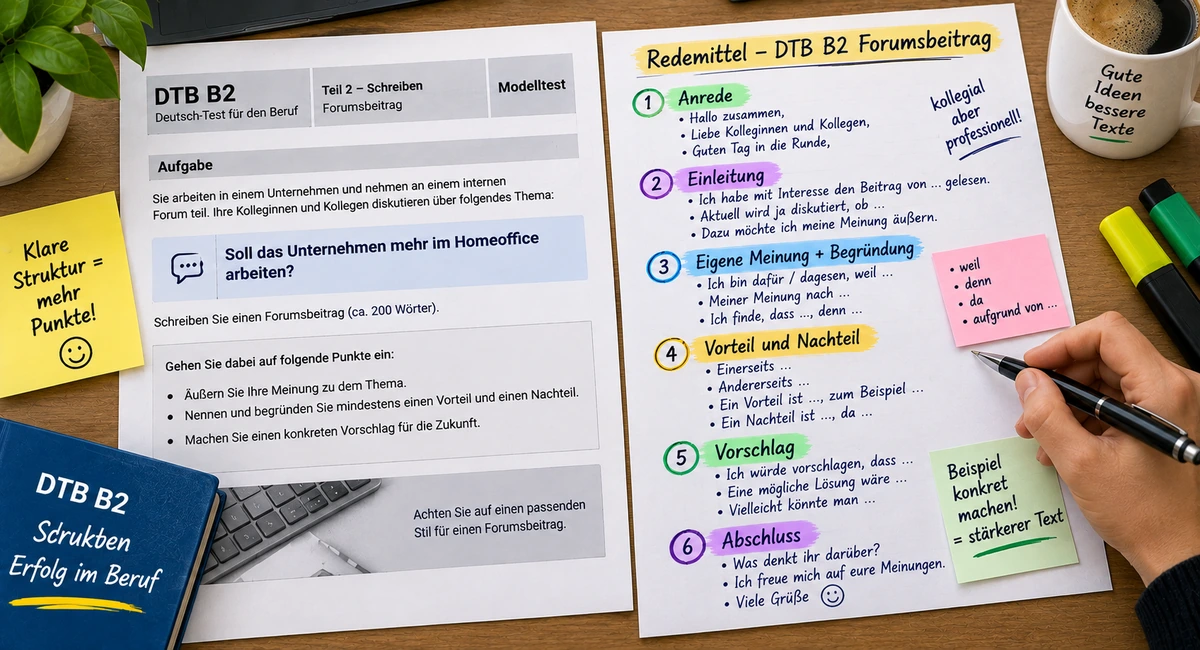
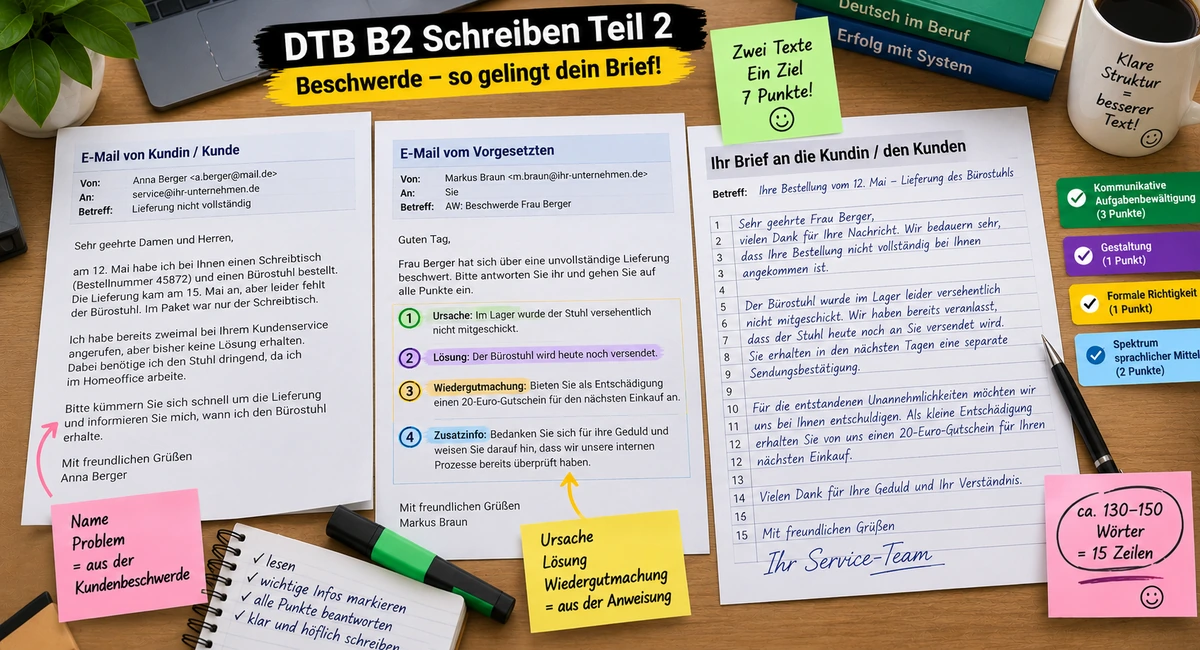
B2 writing consists of presenting an argued opinion on a socially relevant topic in a forum. In addition, the candidate must compose a formal written message connected to the professional field. The duration of this module is 75 minutes.
Listening
B2 listening comprehension requires the candidate to listen to interviews, conversations and everyday utterances as well as excerpts from radio broadcasts. The task is to understand the essence of what was heard and to identify important details. Typical tasks are used to test competences:
- selecting the correct answer from the given options;
- making matches (by comparing information);
- true/false assessment;
- filling in gaps (missing words or short parts of sentences).
The duration of the listening comprehension section is 40 minutes.
Speaking
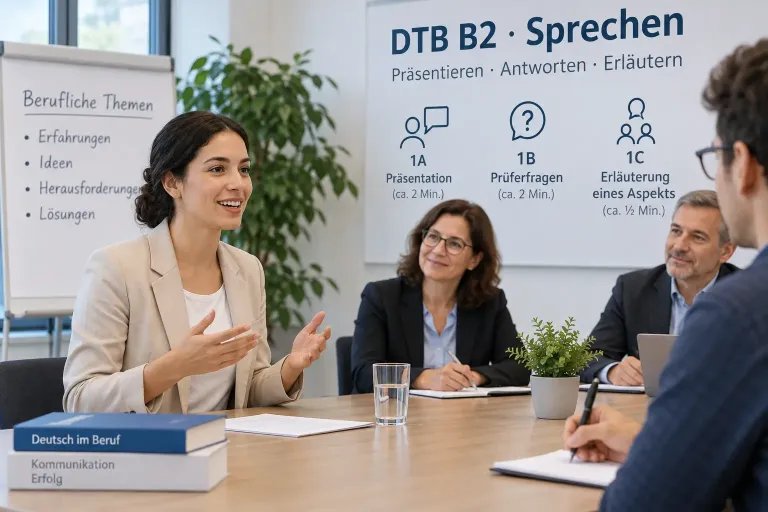
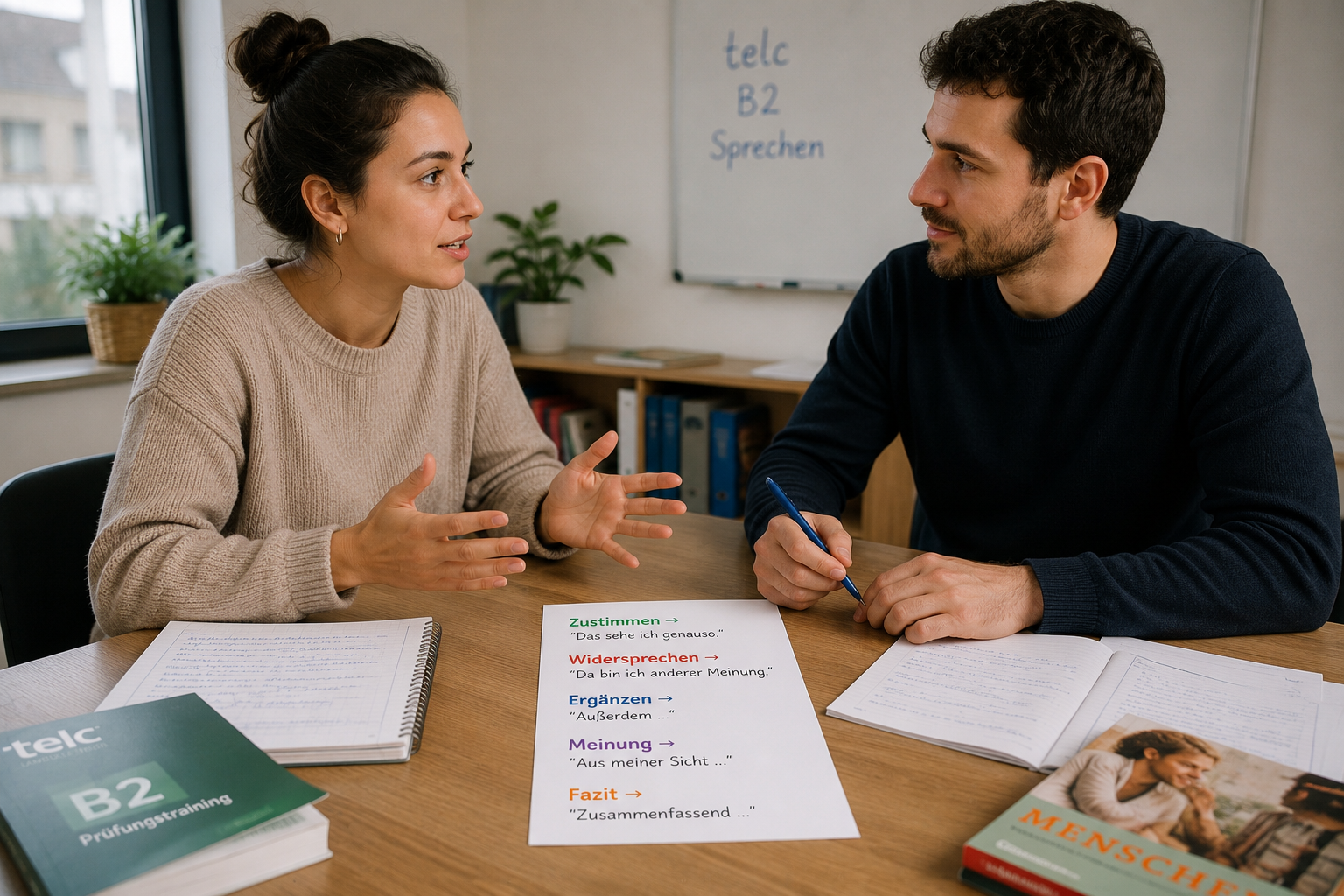
B2 speaking consists of the candidate giving a short presentation on a specific topic and discussing it with the conversation partner. During the discussion it is important to participate actively: to follow the logic of the conversation partner's statements, to ask clarifying questions, to respond to their statements, to exchange arguments and to evaluate them. The duration of this section is 15 minutes.
All tasks at the Goethe-Institut's B2 level reflect real communication situations. Their aim is to test whether the candidate can respond in German appropriately, correctly and coherently. The certificates of the Goethe-Institut are internationally recognised documents. They are accepted by many educational institutions and employers worldwide.
👉 Exercises for preparation for the Goethe B2 examtelc B2 exam
The telc B2 exam is a standardised test for participants with advanced German language skills. It tests whether candidates can use the language flexibly and precisely in everyday life, at work and in social life. Preparing for the telc B2 exam should focus on expanding vocabulary and learning topics that concentrate on everyday situations.
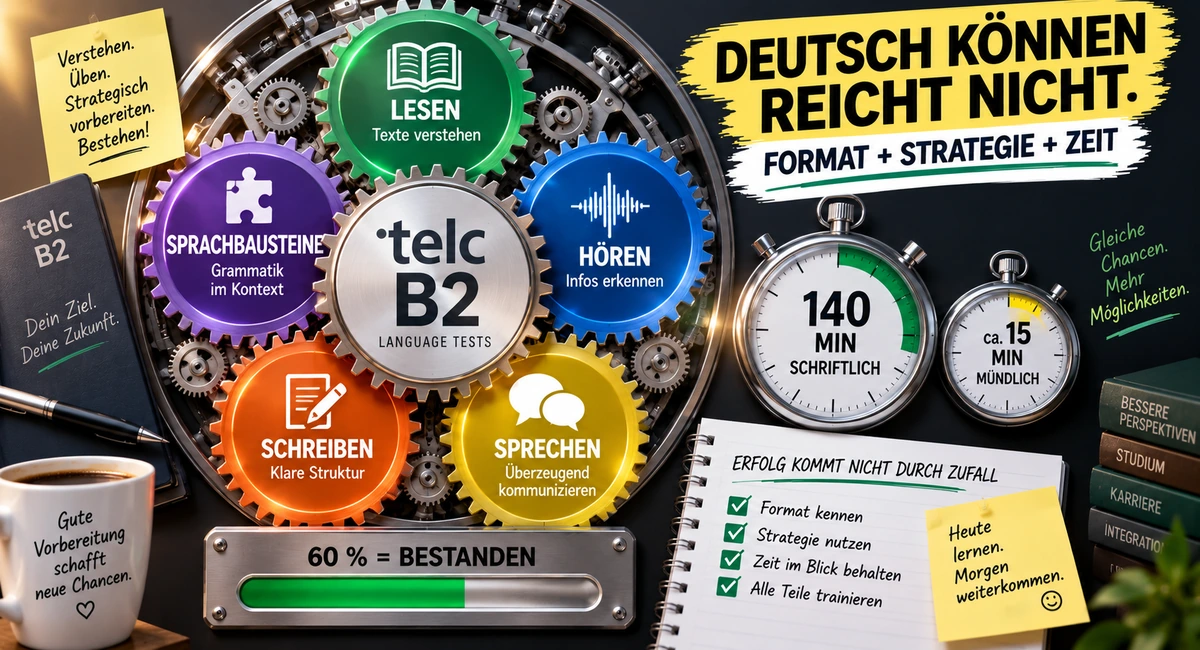
Candidates work on tasks using their receptive and productive language skills. Tasks for reading and listening comprehension as well as a section on language elements are provided to test receptive skills. Productive skills are assessed in written and oral tasks.
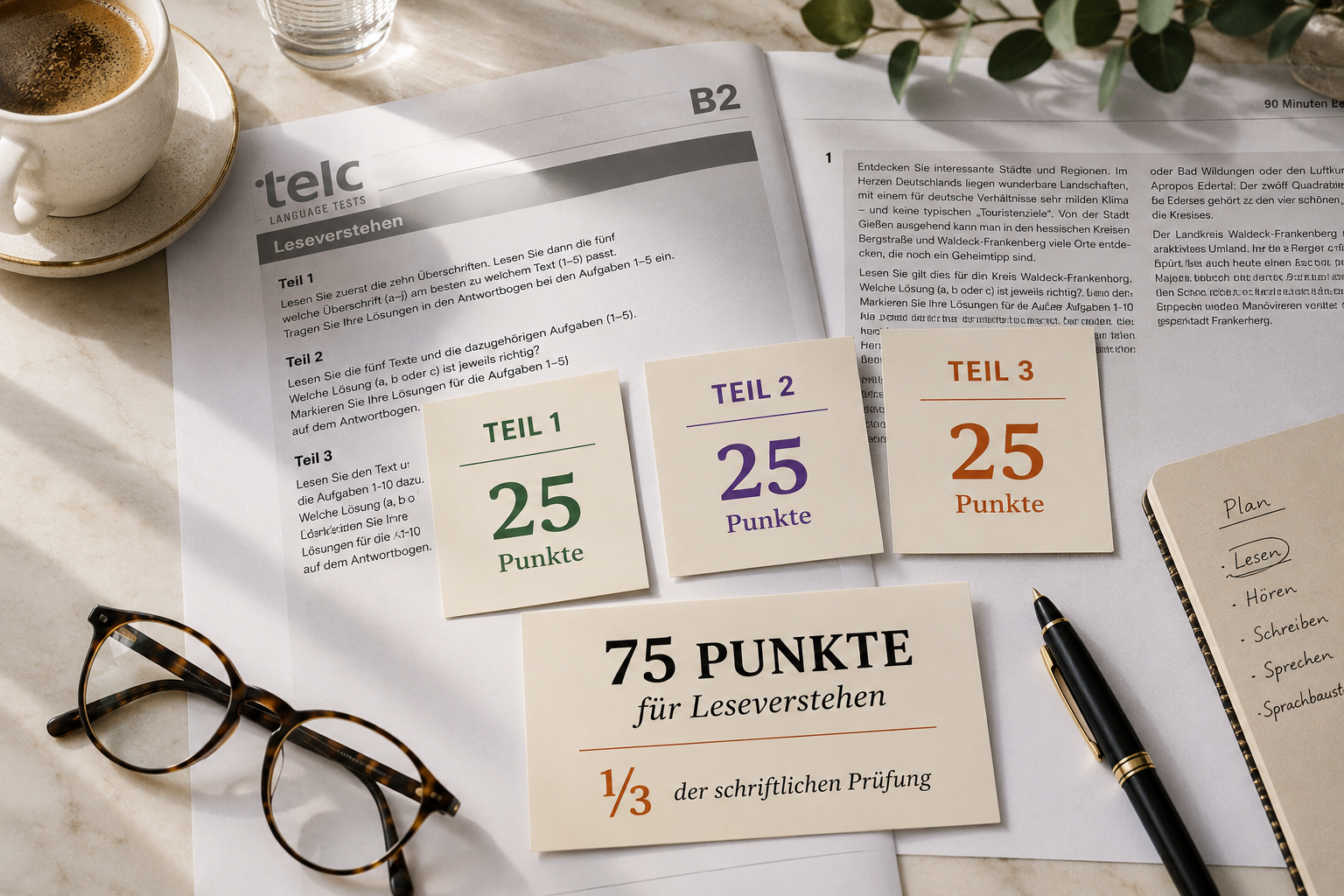
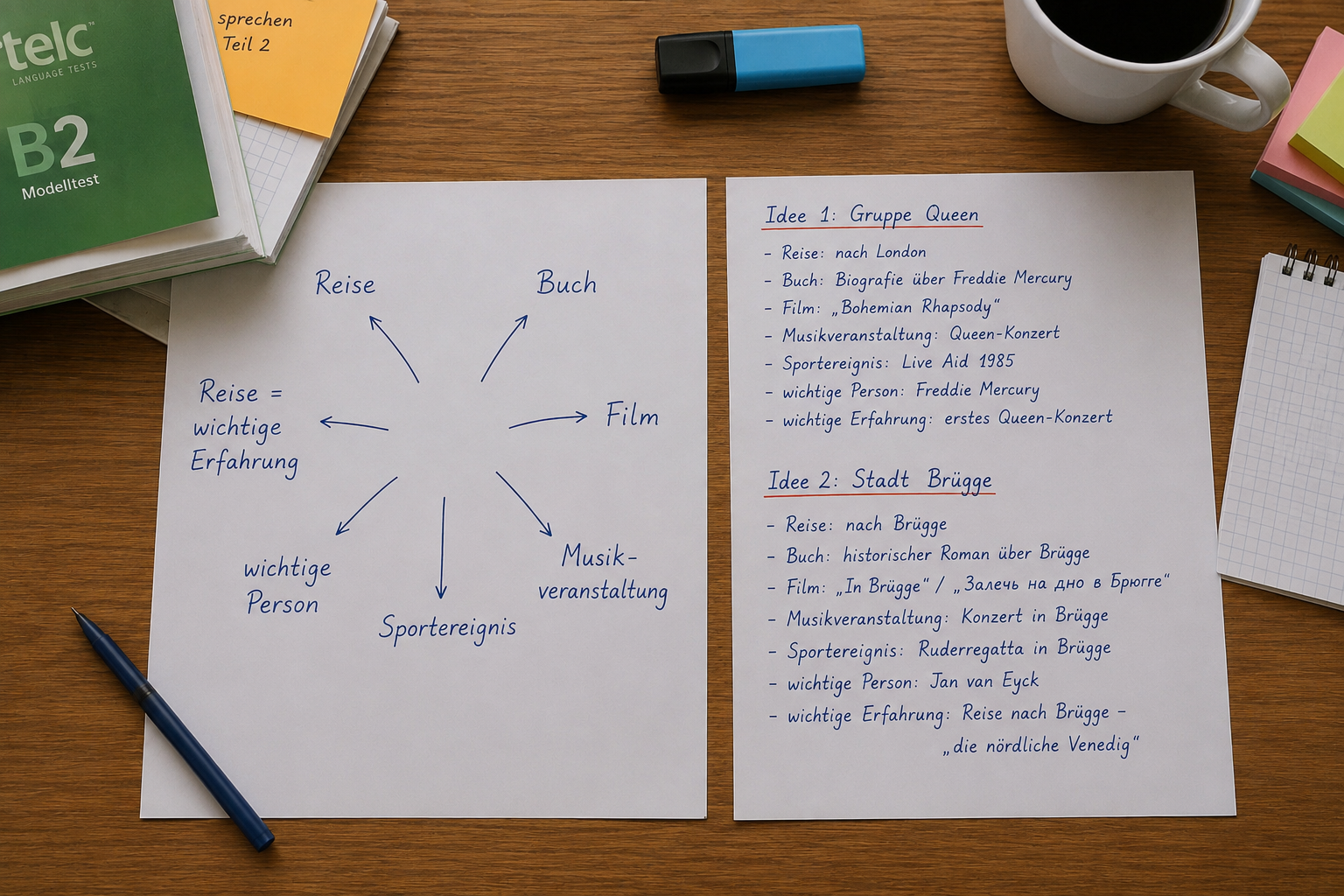
The telc B2 exam consists of a written and an oral part. The written part includes reading (90 minutes), listening (20 minutes) and writing (30 minutes). The oral part consists of speaking. The oral exam lasts 15 minutes (+20 minutes preparation time).
Difference between Goethe and telc: formats and approaches
The exams of the Goethe-Institut and telc gGmbH serve to confirm the language level in accordance with CEFR, but differ in task format and approach to testing language competences.
The Goethe-Institut's methodology is more structured. It is an academic approach in which the tasks test comprehension of texts and grammar as well as the ability to formulate logically structured answers. The exam format is more demanding in the areas of writing and reading.
Telc B2 tests the ability to use German in everyday situations. The exam tasks often simulate real life situations — for example, communication in a shop, at the workplace, when using public transport or travelling.
Both certificates are recognised both in Germany and in many other countries worldwide. They can be used for study and work as well as for integration abroad. However, candidates should choose the type of exam according to the purpose of demonstrating language competence and their personal preferences.
The Goethe-Zertifikat B2 is the optimal solution for study and academic activities. Telc B2 is suitable when the goals are of a practical nature (communication in everyday life situations) as well as for planned immigration and smooth integration into society.
Advantages of the telc certificate
Successfully passing the telc B2 exam guarantees receipt of a certificate that is recognised not only in Germany but in all EU countries. The document confirms a confident language level and the ability to communicate freely on various topics.
Holding an internationally recognised certificate offers the participant several important advantages:
- Wide recognition of the document by German universities, employers and authorities.
- Reliable proof of language competences. The authority of Telc gGmbH is internationally recognised.
- Diverse areas of use. The certificate can be used not only for educational and employment purposes, but also for applying for a residence permit or German citizenship.
- Improved competitiveness on the labour market. Holding an internationally recognised document significantly increases a candidate's chances of finding employment in the German-speaking world.
An important feature of the certificate is the absence of an official validity period. This means that the document can be used without restriction, although in practice some employers prefer to hire applicants with "recent" proof of the telc B2 level.
👉 Exercises for preparation for the telc B2 examB2 Beruf exam
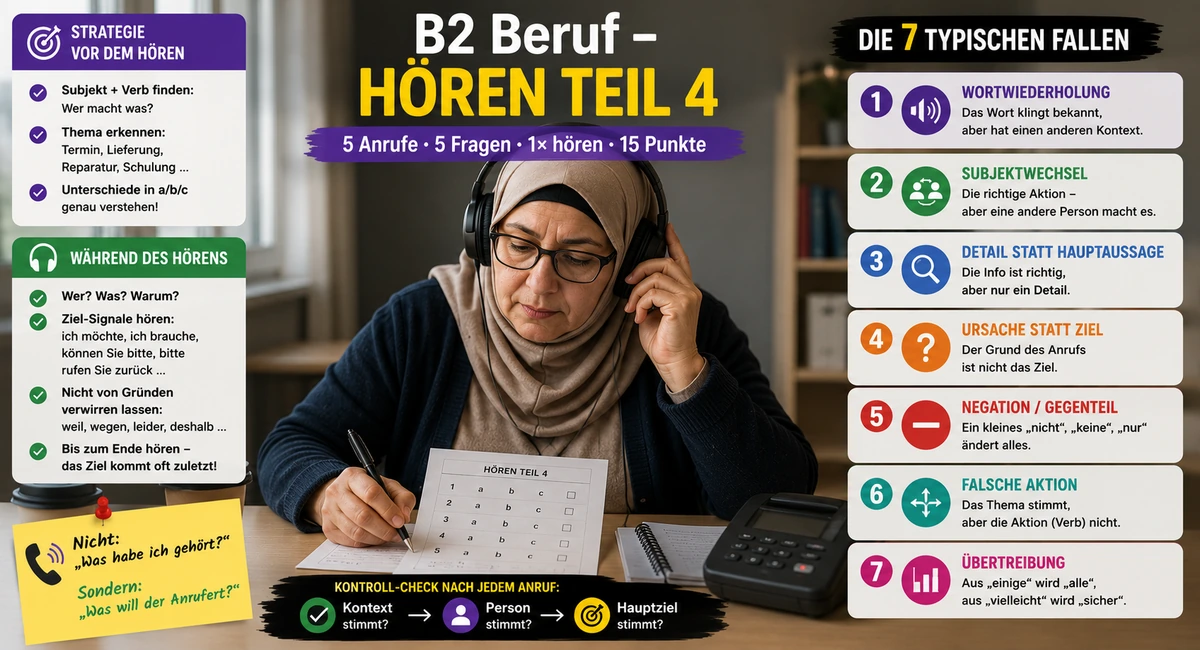
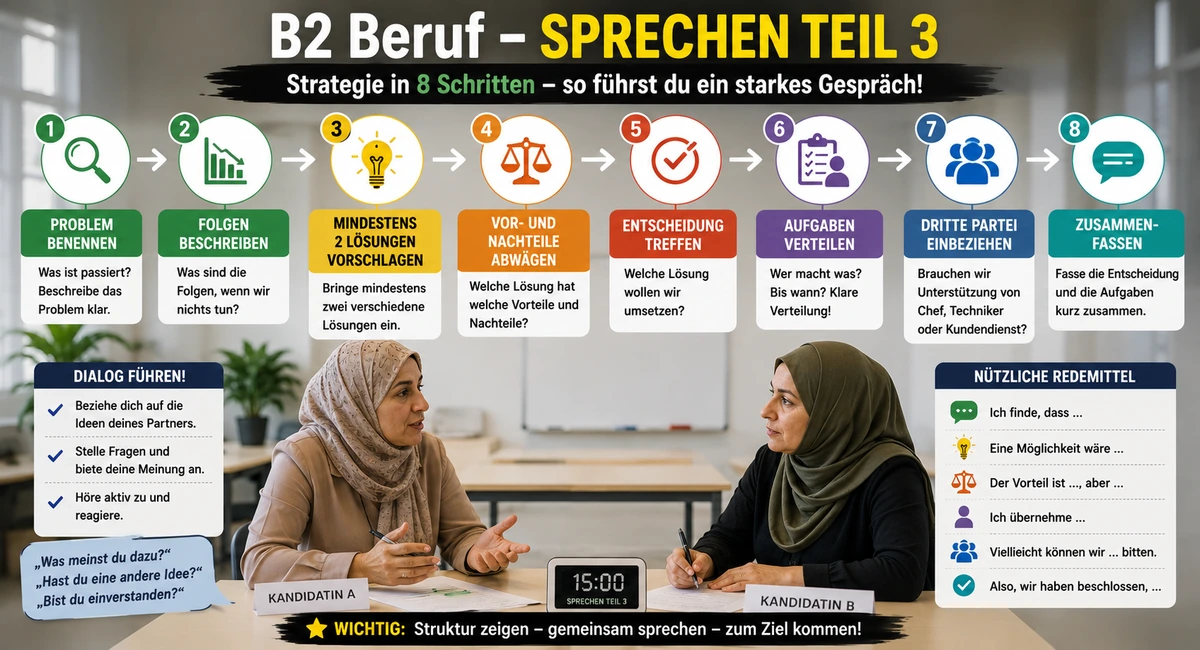
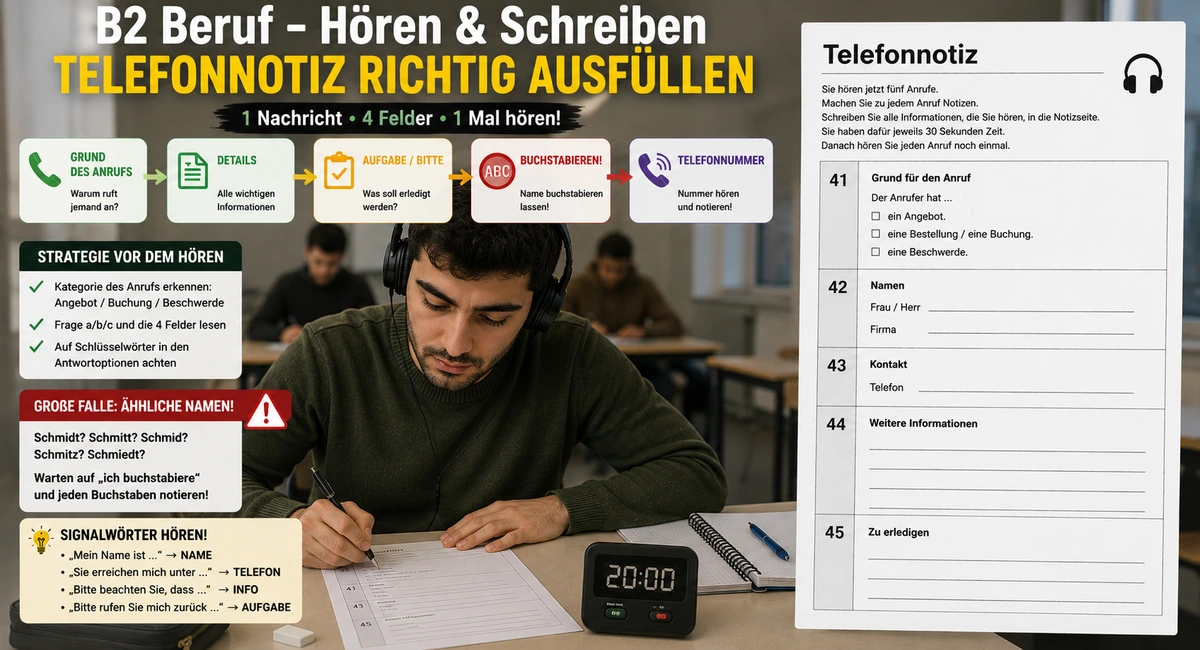
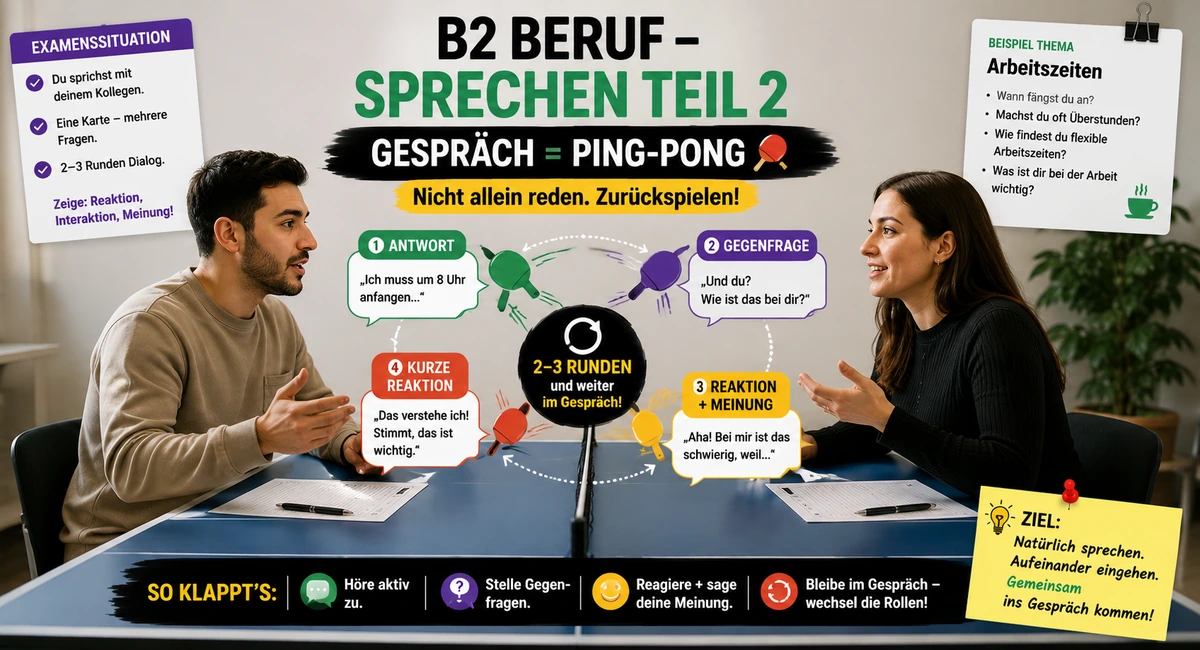
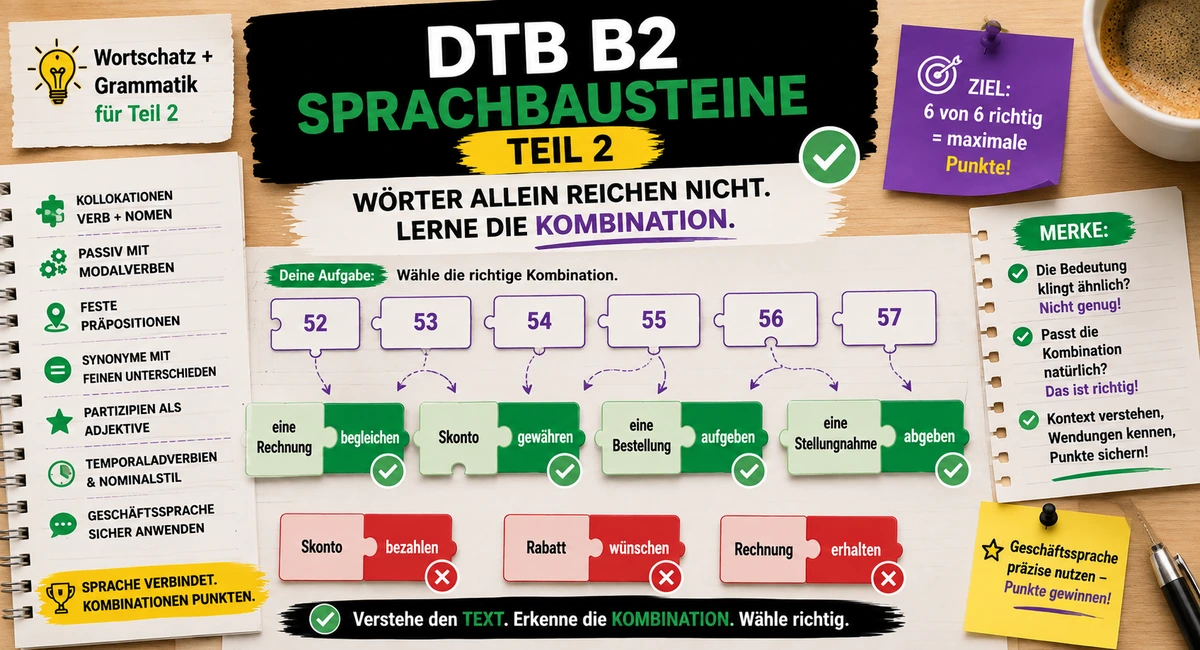
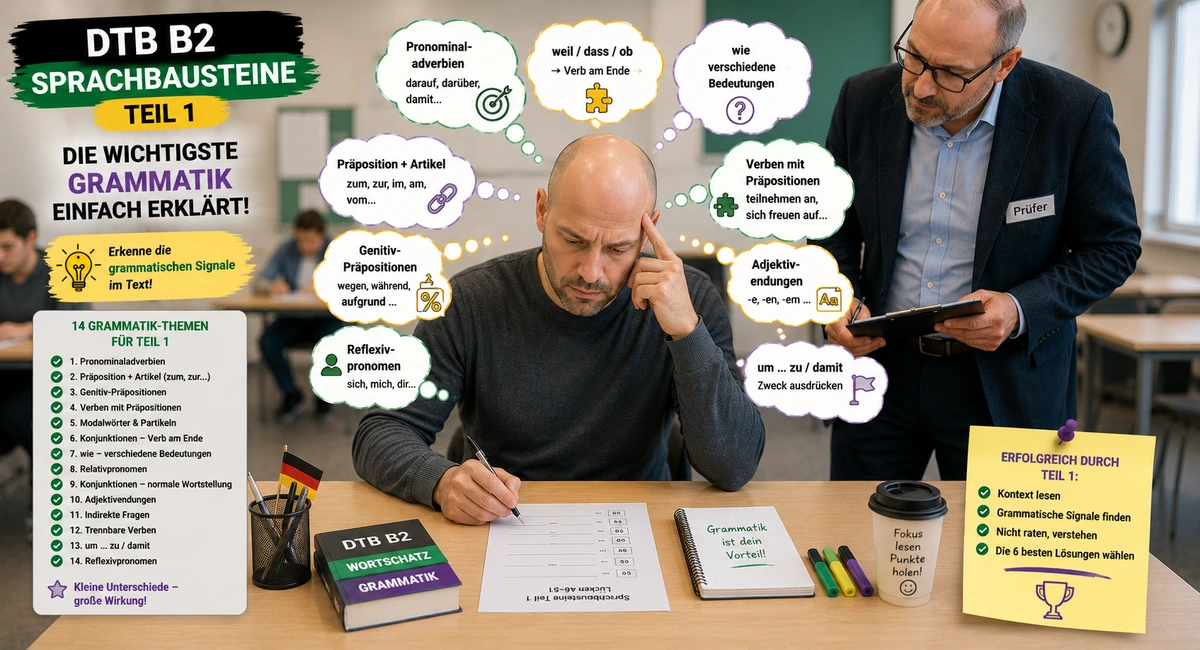
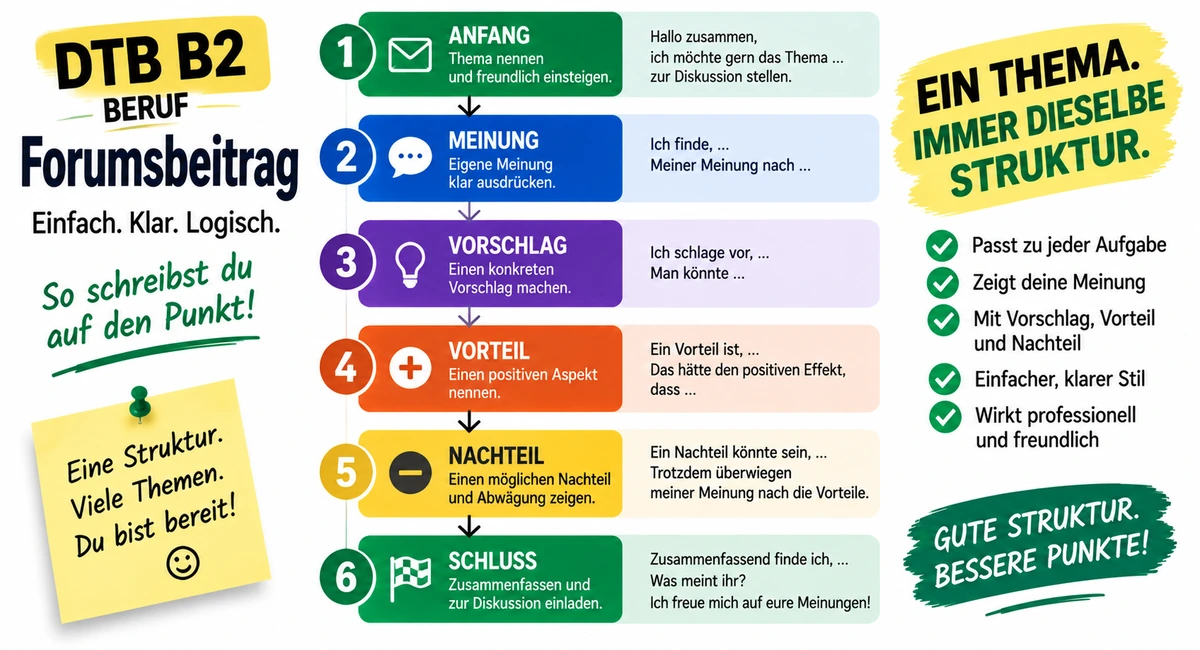
The "B2 Beruf" exam is a language test designed for the professional environment that does not test general everyday communication skills. It is conducted within the framework of state integration or job-related language courses in Germany, which are financed and coordinated by the Federal Office for Migration and Refugees (BAMF). This means that this exam is free for participants — the costs are covered by the state.
Correct and effective preparation for B2 Beruf involves above all expanding vocabulary in the area of specialist language, since the tasks cover situations typical of work:
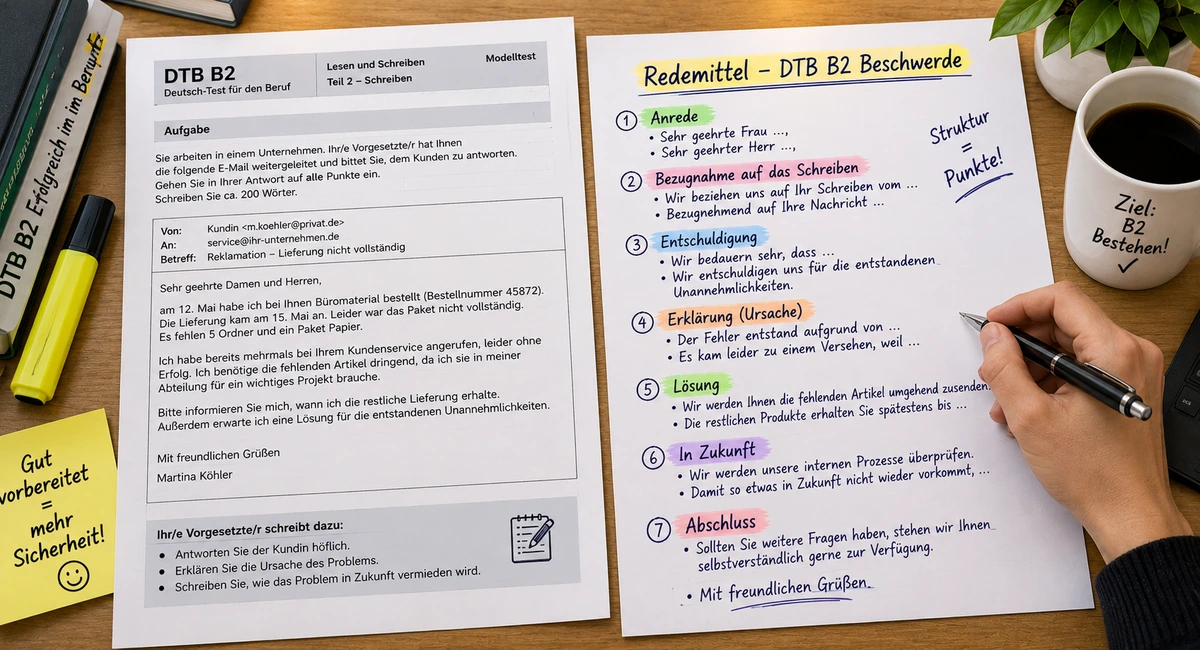
- business correspondence (email communication, enquiries, responses);
- conversations with colleagues/customers;
- discussion of work matters;
- understanding specialist texts and instructions;
- participating in meetings/presentations.
This means that the B2 Beruf exam differs fundamentally from the general B2. Its aim is to demonstrate sufficient communication competence specifically in various professional contexts.
Structure and specific features of the B2 Beruf exam
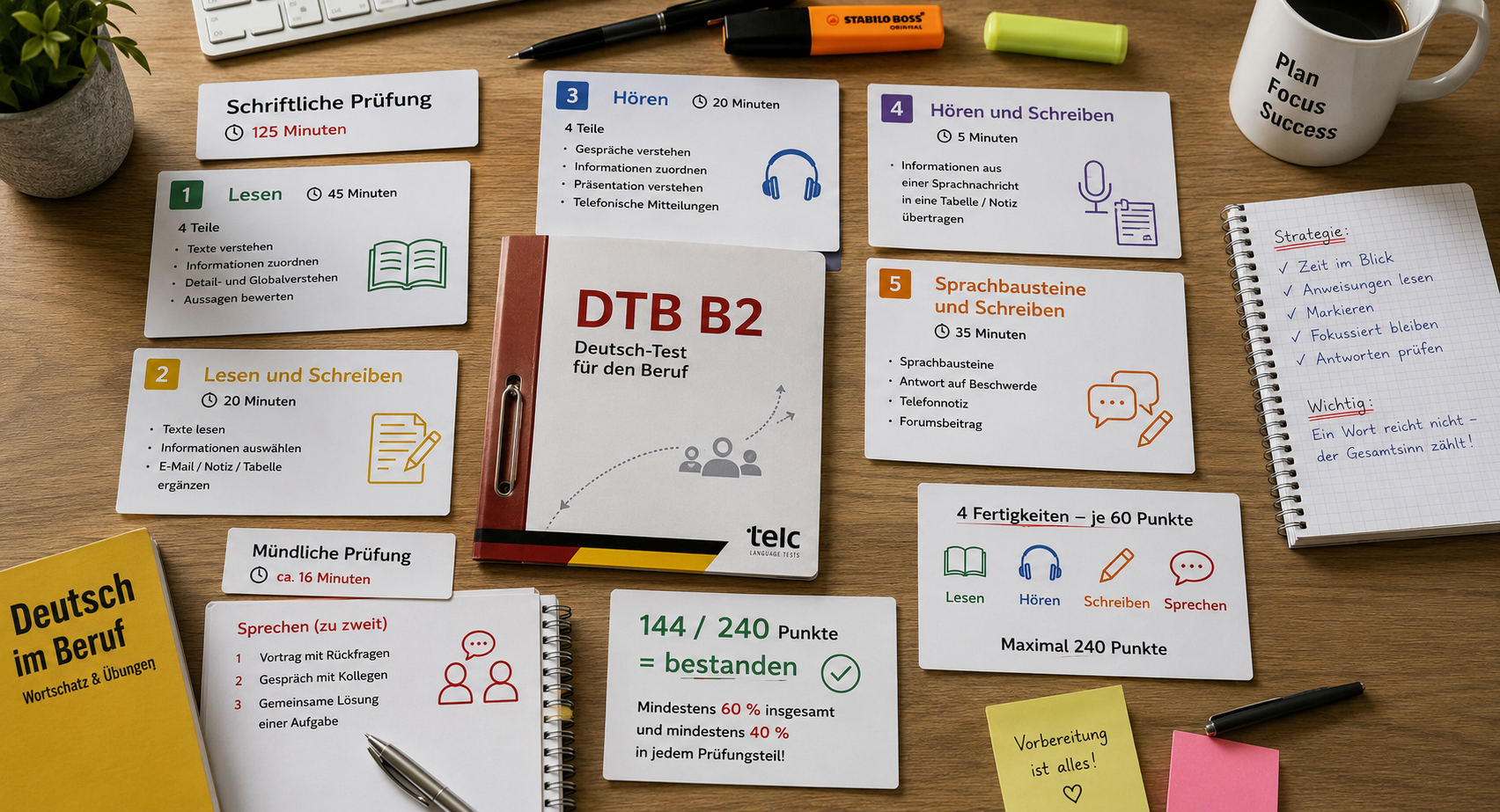
The exam consists of a written and an oral part. Candidates work on tasks covering all language skills.
The receptive part includes:
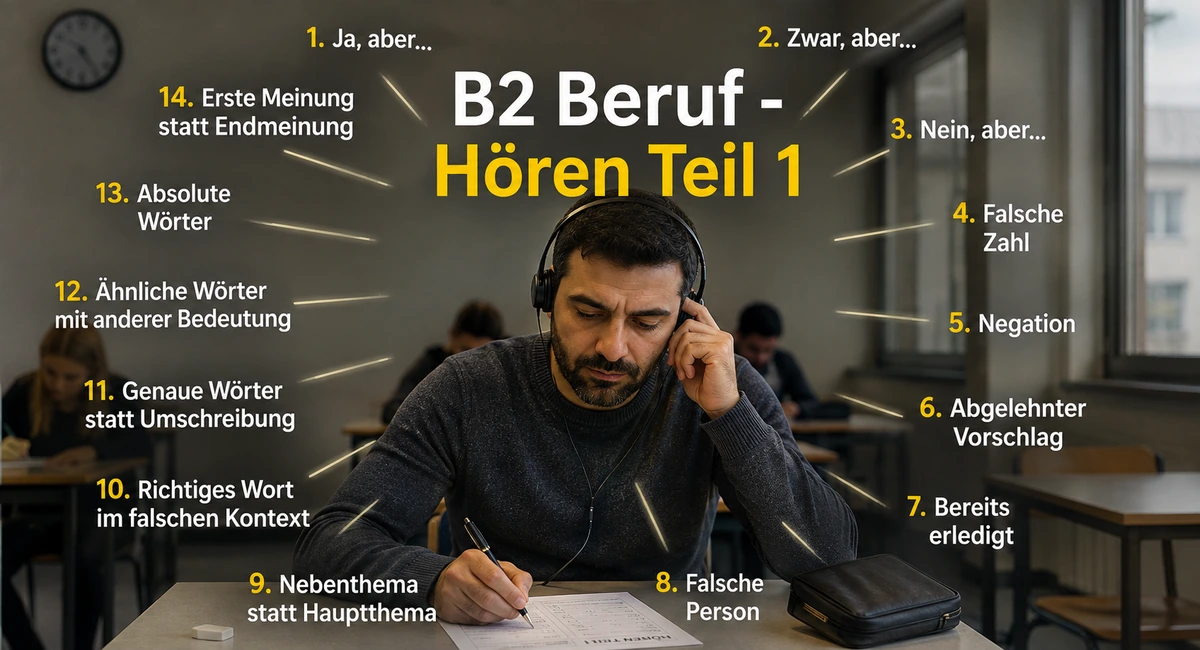
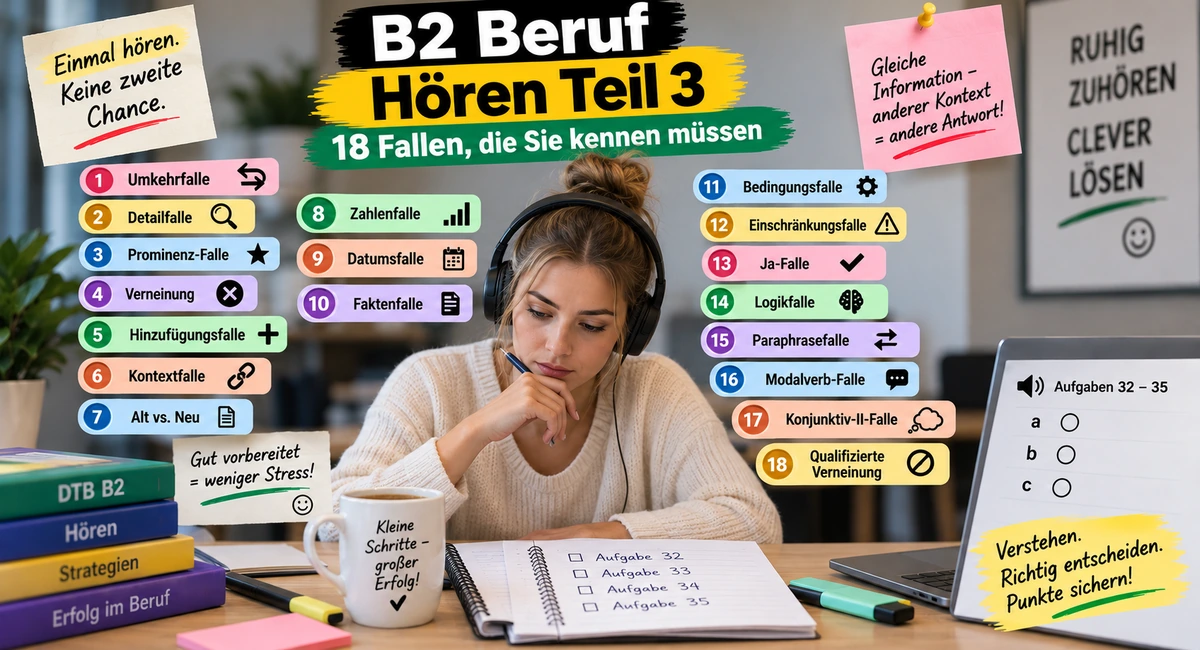
- Listening — 25 minutes;
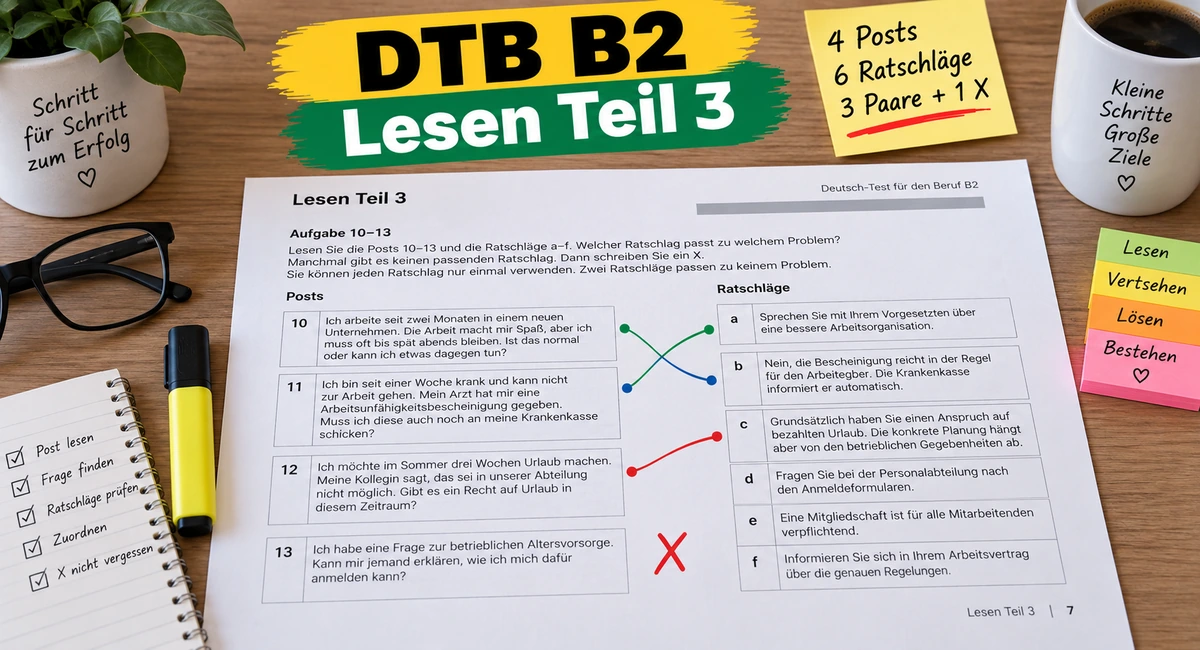
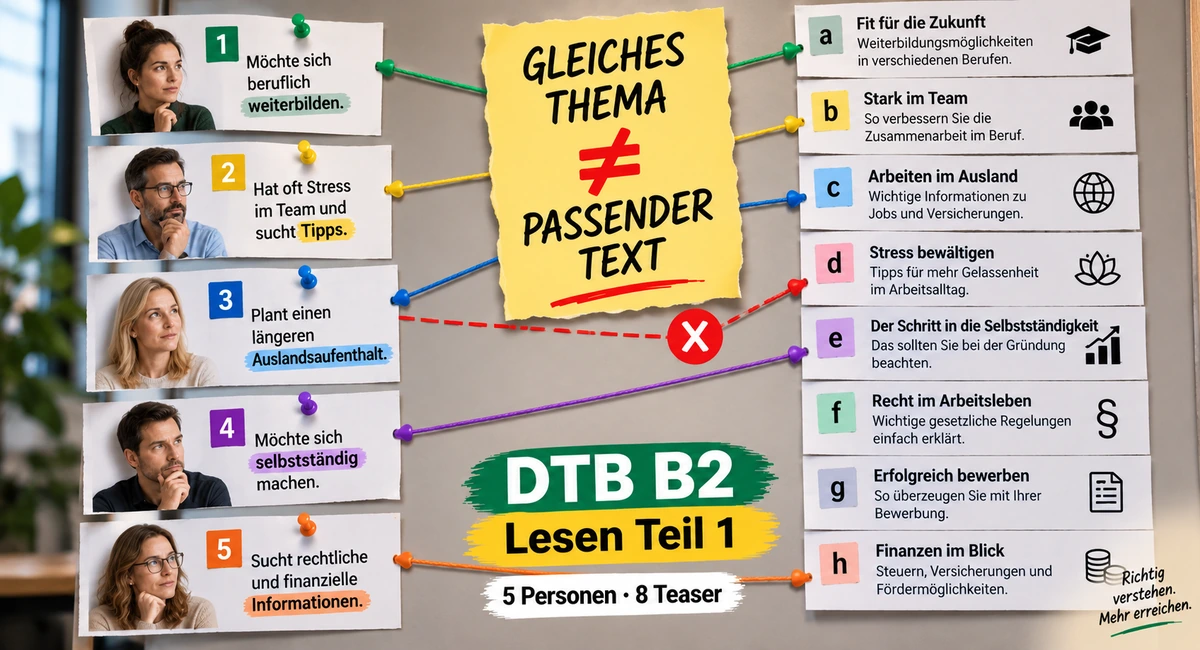
- Reading and speaking — 60 minutes in total.
Typical tasks in this section are multiple-choice questions or matching tasks.
The productive part includes:
- Writing — 45 minutes;
- Speaking — approx. 16 minutes + 20 minutes preparation.
In this block, exam participants respond to the information received. They express their opinion orally or in writing. All topics and tests of B2 Beruf relate to professions, everyday activities and tasks carried out at the workplace. The official exam is available in hybrid and paper formats. It is not possible to take individual or several modules of this exam type — it must be taken in full.
Requirements for candidates
A potential participant in the "B2 Beruf" exam is a person who:
- has B1 level in accordance with CEFR — this is the indispensable prerequisite for successful preparation for B2;
- has acquired basic communication skills in German in a professional or educational environment;
- wishes to use the language at the workplace or during an internship;
- intends to attend a vocational language course or prepare for the exam independently.
Advantages of the B2 Beruf certificate for a career
The B2 Beruf certificate is required for applicants from several categories:
- those who work or are seeking employment in German-speaking companies;
- students of vocational education with an international background;
- applicants who need to prove their language competences;
- professionals who wish to officially document their German language skills in order to expand their prospects.
The advantages of such a certificate include not only the improvement of competences that affect practical language use, but also increased chances of employment, participation in migration and state integration programmes, and enhanced competitiveness of the applicant in the eyes of employers.
👉 Exercises for preparation for the B2 Beruf examBeruf Pflege exam
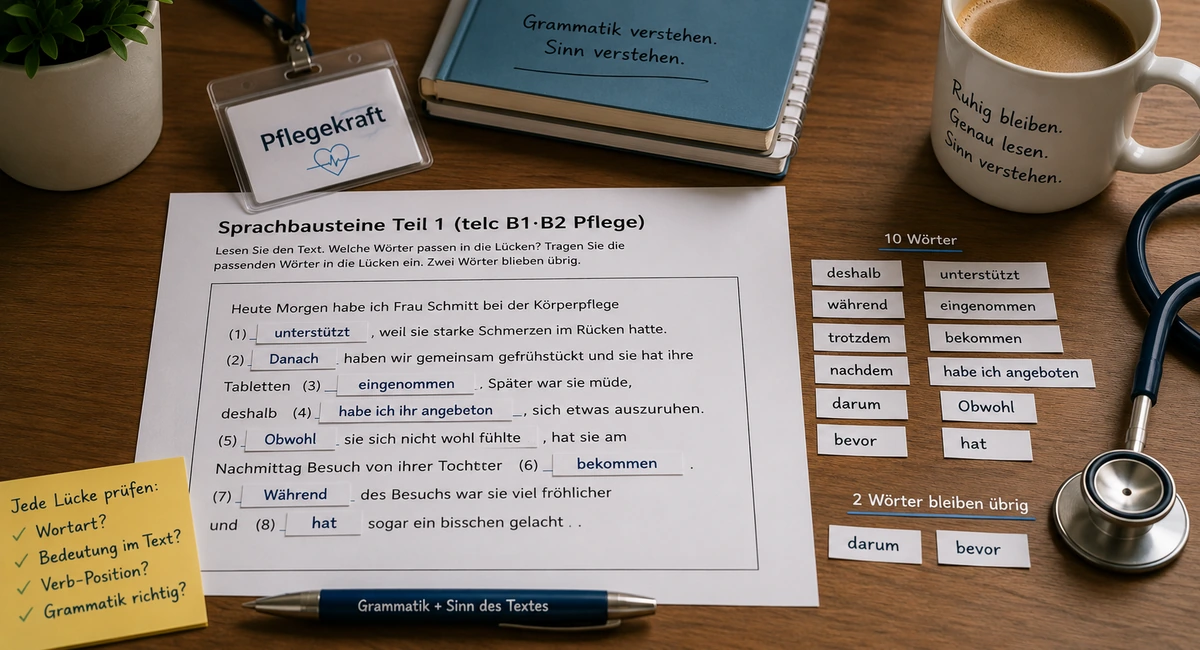
Beruf Pflege is a German language exam for medical staff. It tests the competences required for professional activity in the field of patient care. Important are the skills for effective communication at the workplace (with colleagues and patients) as well as the understanding of instructions and specialist texts with specific vocabulary.
Let us look more closely at the key competences:
- Receptive. Understanding specialist texts (care instructions, medical records, internal correspondence, timetables and duty rosters), the ability to find the required information and quickly grasp the content of a document. Free communication with colleagues and patients, understanding announcements and handling telephone calls are planned.
- Productive competences. Discussing procedures, advising patients, explaining measures, communicating in dialogue format and the ability to present specialist information. In addition, composing messages, notes and short patient reports, maintaining patient records and writing letters to colleagues or management are required.
- Specialist vocabulary. Sufficient vocabulary to describe the state of health, to report on procedures and to give clear care recommendations. There must be no confusion in the use of technical terms.
- Communicative competence. Includes the ability to adapt language to a specific work situation as well as the understanding and application of standards for polite and professional communication.
In the preparation phase it is important not only to expand vocabulary with a focus on specialist terminology, but also to pay attention to the correct context in its use.
Structure of Beruf Pflege
The exam consists of a written and an oral part. The first block comprises three modules:
- Reading and speaking — 60 minutes in total;
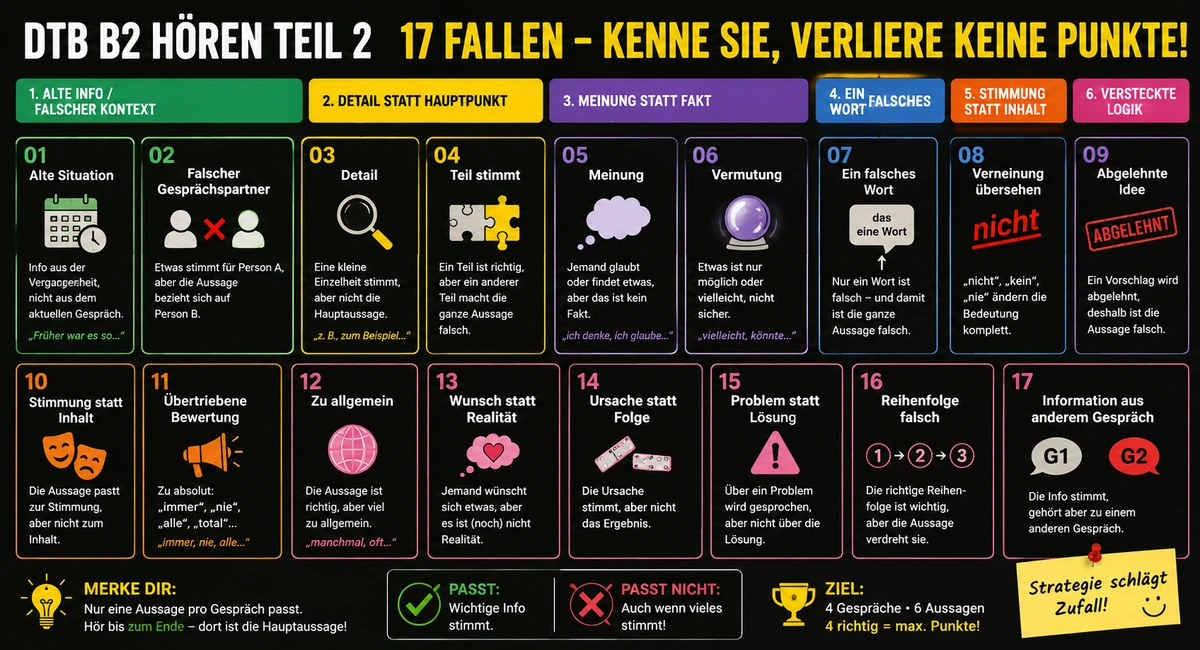
- Listening — 25 minutes;
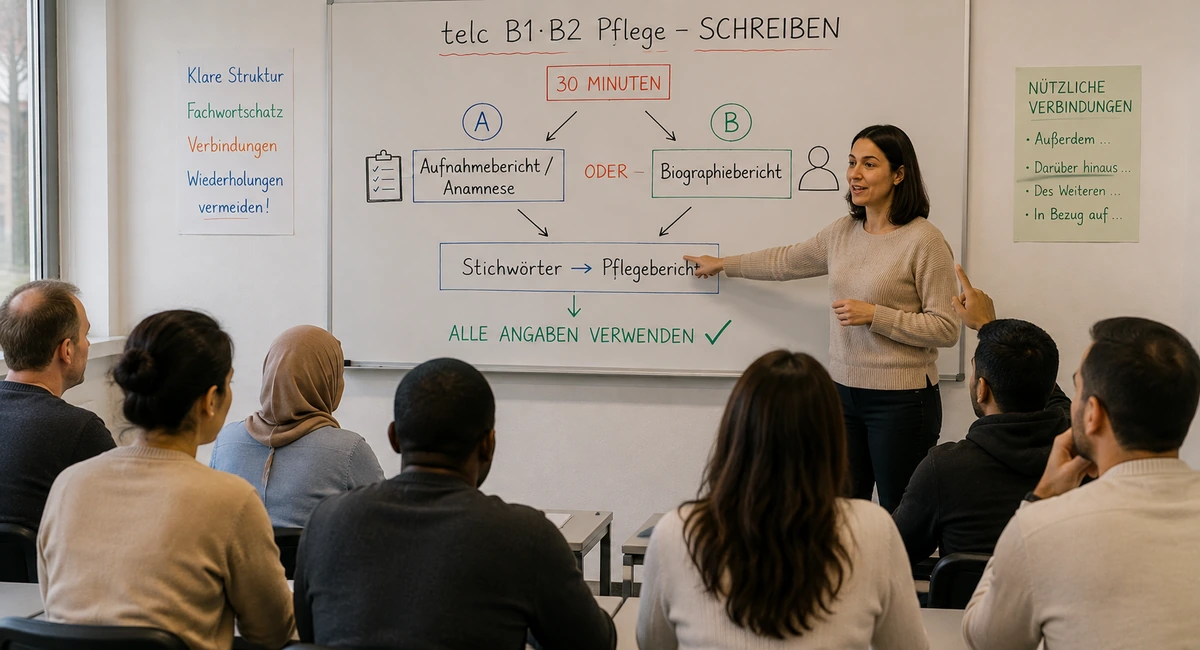
- Writing — 30 minutes.
The content and style of the texts and listening examples with which candidates work reflect the everyday working life of medical staff. Typical tasks in the written part of the exam include multiple-choice questions or matching tasks. In addition, an essay or biographical description must be written in free form.
The oral part of the exam, i.e. speaking, lasts approximately 16 minutes. The preparation time is 20 minutes. The format of this section involves a dialogue between the candidate and the examiner. The task is to discuss experiences and views on a given topic, to discuss controversial questions and to give a short presentation.
The official exam is available in three formats: digital, hybrid and paper. The "Beruf Pflege" exam must be taken in full — taking individual parts modularly is not provided for under the exam conditions.
Language requirements for working in the medical field in Germany
Medical German is a combination of the general language that supports everyday communication and the specialist terminology used in clinics. In Germany, the requirement to prove language skills is enshrined in law, justified by the need to ensure patient safety. For example, B1 level is prescribed for nurses/care workers, but in practice B2 is optimal. For doctors and pharmacists, at least B2 is required; however, C1 is needed for comfortable work and the effective fulfilment of professional duties.
Employers prefer applicants who are prepared to prove their competences through appropriate official certificates. This is important as it simplifies the process of recognising a foreign diploma (Anerkennung). The time required to reach a working level suitable for the medical field averages no more than 9–15 months.
Significance of the Beruf Pflege certificate for a career in healthcare
Holding an official language certificate is an investment in one's own career and opens up the possibility of freely choosing one's area of activity. Thanks to sufficient medical German language skills, participants who have successfully passed the exam gain access to the modern healthcare system and opportunities for professional development in Europe.
B2 ÖSD exam
The B2 ÖSD exam is an international German language exam that certifies language skills at B2 level in accordance with the Common European Framework of Reference CEFR. To pass this exam, participants must be able to present their thoughts on a wide range of topics clearly and in detail, and to communicate spontaneously and fluently with native speakers in everyday situations.
When preparing for the B2 exam, it should be borne in mind that the language must be oriented towards practical use, including intercultural communication in a German-speaking environment. The aim of the exam is to demonstrate the candidate's language competence in situations that go beyond private life — for example in the public sphere and to a certain extent also in the professional field.
Structure and specific features of the B2 ÖSD exam
The B2 ÖSD exam consists of two modules — a written and an oral one.
The written part comprises three sections:
- Reading. The candidate works on four tasks. These serve to assess the understanding of various authentic texts from Austria, Germany and Switzerland. The duration of this section is 90 minutes.
- Listening. Before working on the tasks, participants listen to authentic listening texts from Austria, Germany and Switzerland. The aim is to demonstrate a sufficient level of general, detailed and selective listening comprehension. The duration is approximately 30 minutes.
- Writing. Two tasks must be completed: a formal email and an essay/article expressing a personal opinion. Processing time: 90 minutes.
The oral part consists of a single block — speaking. Two test formats are provided: individual or in pairs. Typical tasks: information interview, image analysis and discussion. The duration of the block depends on the format. 15–20 minutes are provided for the individual exam, 20–25 minutes for the exam in pairs. The modules (oral and written) can be taken and certified both together and separately.
In order to quickly assess the specific features of the ÖSD exam, we have compiled the most important differences between this format and other B2 level certificates.
| Certificate | Who conducts the exam | Purpose of the exam | Specific features |
|---|---|---|---|
| ÖSD B2 | The Austrian examination system ÖSD | Proof of general German level B2, but with a focus on intercultural communication | The tasks use linguistic features from Germany, Austria and Switzerland. Focus on practical communication. |
| ÖIF B2 | Austrian Integration Fund | Linguistic integration and migration procedures | Used within integration programmes. Taking the exam is often part of integration requirements. |
| Beruf Pflege | telc GmbH | For activities in the care and medical field | All tasks simulate communication situations with patients and colleagues. Specialist vocabulary from the field of care is used. |
| B2 Beruf | BAMF | German for professional everyday life | Focus on business communication, work correspondence, conversations with colleagues. |
| telc B2 | telc GmbH | Proof of the corresponding level, universal test | Clearly structured format. Professional exam variants such as Pflege have been developed on this basis. |
| Goethe B2 | Goethe-Institut | Obtaining an international academic certificate for German | An academic task format is used. The certificate is regarded as one of the best known and most important in the international arena. |
Advantages of the ÖSD B2 certificate and specific features of its use in Austria
The certificate obtained is recognised in Germany, Switzerland and other European countries. It can be used for job-seeking, study or proof of language skills in the recognition of qualifications of foreign nationals. In Austria, the certificate enjoys a special status, as Austrian state educational institutions were directly involved in the development of the examination programme.
The document is recognised by state authorities, integration programmes and employers. For candidates wishing to work in Germany in the medical or care field, it often serves as proof of basic German language skills before taking the specialist exam.
B2 ÖIF exam
B2 ÖIF exams (an initiative of the Austrian Integration Fund) were developed to meet the needs of migrants in Austria. They serve to prove language competences, whereby holding a certificate is often a mandatory requirement for obtaining a residence permit, citizenship or successful professional integration.
A model test for the B2 ÖIF exam is available on the official website of the Fund. The exam to prove B2 level in German consists of four parts: listening comprehension, reading comprehension, speaking and writing. All tasks that the candidate must complete are based on real communication situations from everyday life, work and study.
Role of the ÖIF B2 certificate for immigrants in Austria and its significance for integration
A successfully passed exam and the certificate received are proof of the language level achieved for access to the labour market, admission to further training programmes or dealings with state authorities. The official document is particularly important for the successful integration and consolidation of the legal status of migrants in Austria. Its existence is clear evidence of the candidate's intention to become a full member of Austrian society through linguistic, social and economic adaptation. However, the exam format for obtaining the ÖIF B2 certificate does not include a knowledge block on the values or political system of Austria.
The B2 certificate in German is a powerful instrument that opens up new perspectives in all areas of life. On a personal level, it instils confidence in communication and helps with effective integration into German-speaking society. On a professional level, it makes the individual competitive on the labour market and opens up opportunities for working in international companies or studying at renowned universities.
Choose the right exam today, taking into account your personal plans, goals and ambitions. Use the practice tests from Deutsch Vorbereitung to achieve a positive result in the form of an official B2 German certificate and fundamentally improve your quality of life.





There are no comments for this article. Leave your comment