





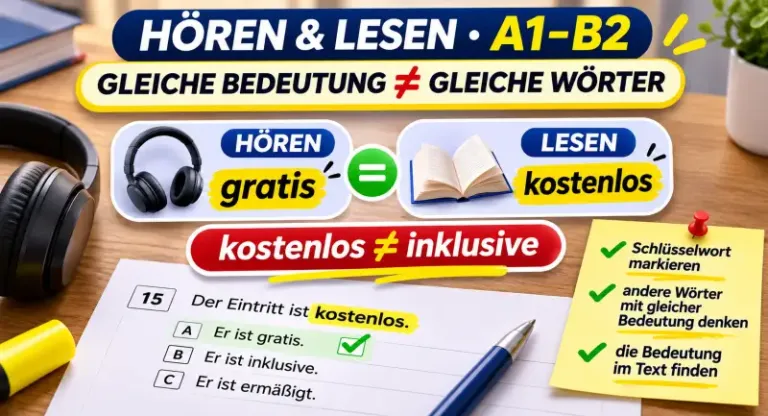
You understand the text, but your answer is still wrong? Or you simply cannot find the correct answer? Then you have not yet discovered the most important trick: the exam expresses almost everything in different words. The task says “kostenlos”, but the text says “gratis”. Here you will learn how to recognise this – for levels A1 to B2 in telc, Goethe, ÖSD, DTZ, ÖIF and DTB exams.
How Do I Solve Listening and Reading Tasks? The Short Answer
Do not look for the same word in the text as in the task. Look for the same meaning. This is the most important tip for listening and reading in every German language exam, from A1 to B2.
Here is an example: the task says “Das Museum ist am Montag geschlossen.” However, the text says “Montags haben wir Ruhetag.” The word “geschlossen” does not appear at all. Anyone who only looks for “geschlossen” will find nothing and select the wrong answer. You may already know the most familiar example: the task says “kostenlos”, but the text says “gratis”. You can find a list of 30 such word pairs from the DTZ listening section in the article Synonym Traps in Listening.
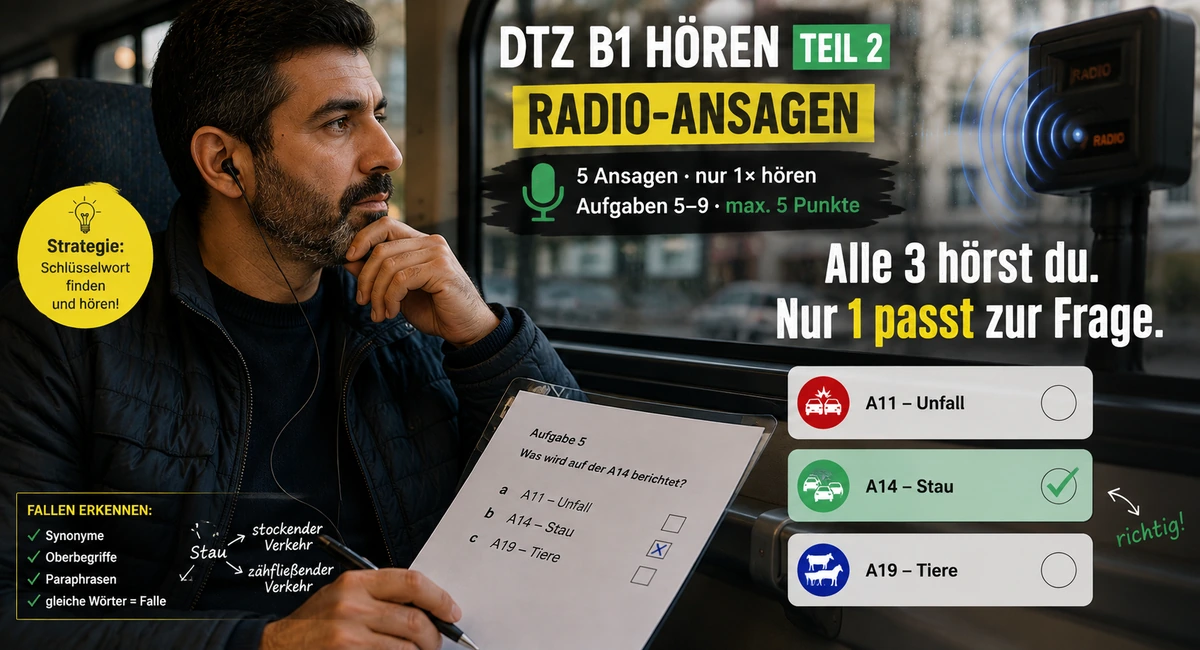
The opposite is also true: if the text contains exactly the same word as the task, it is often a trap. The information behind that word does not match.
Experts call this a “synonym” (a different word with the same meaning) or a “paraphrase” (the same information expressed in different words). You do not need to know these terms. You only need to remember one thing: the exam expresses almost everything in different words. In this article, you will learn how to recognise these alternative expressions quickly.
Listening and Reading in 4 Steps
These four steps will help you solve listening and reading tasks in telc, Goethe, ÖSD, DTZ, ÖIF and DTB exams.
- Read the task and highlight a keyword. Which word determines the correct answer? For example, “geschlossen”, “am Wochenende” or “verboten”.
- Think of alternative words and expressions. When you see “verboten”, immediately think of: nicht erlaubt, nicht gestattet, untersagt. For “am Wochenende”, think of: samstags und sonntags. This also works in the listening section because you have time to read the tasks before the audio begins.
- Look for the meaning in the text, not the word itself. Pay attention to the words and expressions you thought of in step 2.
- Found the same word? Double-check. If you find exactly the same word as in the task, read or listen to the entire sentence. Does the information really match?
Practise step 2 aloud as well: before reading or listening to the text, say two alternative words for each keyword. After a week, this will become almost automatic in the exam. For listening, you can also use the S–P–D–A method described in the article B1 Listening – The Most Important Tips.
How the Exam Hides the Correct Answer: 7 Tricks
The exam uses seven different ways to express the same information differently. If you know them, you can find the correct answer faster.
- Synonym. A different word with the same meaning: besichtigen → ansehen, Auskunft → Information.
- Paraphrasing. Several words instead of one: geschlossen → “Wir haben Ruhetag”, Urlaub → “Ich bin nicht im Büro”.
- A different part of speech. A noun becomes a verb: “Anmeldung erforderlich” → “Sie müssen sich vorher anmelden”.
- The opposite with “nicht”. “geöffnet” → “nicht geschlossen”, “günstig” → “nicht teuer”.
- A general term and an example. The task says “Möbel”, but the text says “Sofa”. The task says “Obst”, but the text says “Äpfel und Birnen”.
- Numbers, dates and times. “zwei Wochen” → “14 Tage” or “vom 3. bis 17. Mai”. “Viertel nach acht” → “8:15 Uhr”.
- Implicit conclusion. The text does not state the information directly. “Ich habe meinen Führerschein noch nicht” means that the person cannot drive a car independently.
The Vocabulary List: The Task Says A, the Text Says B
These word pairs appear repeatedly in listening and reading tasks, regardless of the exam provider. The left column shows what often appears in the task. The right column shows what you may hear or read in the text.
Money and Prices
| In the Task | In the Text |
|---|---|
| billig, günstig | preiswert, nicht teuer, zum halben Preis, im Angebot |
| teuer | kostet viel, nicht billig, hat seinen Preis |
| Kosten werden übernommen | die Firma zahlt, die Krankenkasse bezahlt das |
| bar bezahlen | mit Bargeld, nicht mit Karte |
Time
| In the Task | In the Text |
|---|---|
| täglich | jeden Tag, von Montag bis Sonntag |
| am Wochenende | samstags und sonntags |
| vormittags | zwischen 9 und 12 Uhr, am Morgen |
| im Sommer | von Juni bis August, in den Sommerferien |
| rund um die Uhr | 24 Stunden geöffnet, auch nachts |
| bald | in Kürze, in den nächsten Tagen |
| früher | in der Vergangenheit, damals |
| pünktlich | rechtzeitig, nicht zu spät |
Places and Directions
| In the Task | In the Text |
|---|---|
| weit weg | am Stadtrand, eine Stunde mit dem Bus, außerhalb |
| im Zentrum | in der Innenstadt, in der Stadtmitte |
| mit öffentlichen Verkehrsmitteln | mit Bus und Bahn, mit der U-Bahn |
| draußen | im Freien, an der frischen Luft |
Rules, Obligations and Possibilities
| In the Task | In the Text |
|---|---|
| verboten | nicht erlaubt, nicht gestattet, untersagt, bitte nicht |
| man muss | ist Pflicht, ist vorgeschrieben, ist erforderlich, ist notwendig |
| man darf, man kann | ist erlaubt, ist möglich, es besteht die Möglichkeit |
| sich anmelden | reservieren, buchen, einen Platz sichern |
| absagen | nicht kommen können, stornieren, den Termin streichen |
| verschieben | auf einen anderen Tag legen, später machen |
| Bescheid sagen | sich melden, informieren, kurz anrufen |
Learning, Work and Leisure
| In the Task | In the Text |
|---|---|
| nicht zu schwierig | leicht, vereinfacht, für Anfänger geeignet |
| regelmäßig | einmal im Monat, jede Woche, immer dienstags |
| am Computer | online, im Internet, am Bildschirm |
| Tourismus | Hotel und Restaurant, Gastronomie, Gäste aus dem Ausland |
| besser schreiben | Schreibkurs, schriftlicher Ausdruck |
| Arbeit suchen | eine Stelle suchen, sich bewerben, einen Job finden |
| Sport machen | sich bewegen, trainieren, fit bleiben |
People
| In the Task | In the Text |
|---|---|
| Kinder | die Kleinen, der Nachwuchs, Schülerinnen und Schüler |
| ältere Menschen | Seniorinnen und Senioren, Rentner, in Pension (Austria) |
| Eltern | Mutter und Vater, die Familie |
| Anfänger | ohne Vorkenntnisse, zum ersten Mal |
Opinions and Feelings (Important from B1 Onwards)
| In the Task | In the Text |
|---|---|
| ist dafür | findet die Idee gut, unterstützt das, befürwortet es |
| ist dagegen | hält nichts davon, lehnt das ab, ist skeptisch |
| ist zufrieden | es hat ihr gefallen, sie würde es wieder machen |
| ist enttäuscht | hatte mehr erwartet, das war nicht so toll |
Quantities and Numbers
| In the Task | In the Text |
|---|---|
| die Hälfte | 50 Prozent, jeder Zweite |
| die meisten | die Mehrheit, fast alle |
| doppelt so viel | zweimal so viel, verdoppelt |
Austria and Switzerland
In ÖSD and ÖIF exams, as well as Goethe exams, the texts sometimes contain words from Austria or Switzerland. These are also “different words” for the same thing. You can find a detailed list in the article German in the DACH Region: Similarities and Differences.
Almost the Same, but Not Quite: Be Careful with These Words
Not every similar word has the same meaning. In these cases, it is worth taking a second look.
| Word | Is NOT the Same as | Why |
|---|---|---|
| kostenlos | inklusive | “Frühstück inklusive” means that breakfast is included in the price. You are still paying for it. |
| kostenlos | ermäßigt | “Ermäßigt” means cheaper, not free of charge. |
| Abfahrt | Ankunft | The time may be correct but still refer to the wrong event. |
| verlängert | verschoben | “Verlängert” means extended, while “verschoben” means moved to another date or time. |
| Termin vereinbaren | Termin haben | Someone who wants to arrange an appointment does not have one yet. |
| geöffnet | erreichbar | An office may be closed but still reachable by phone. |
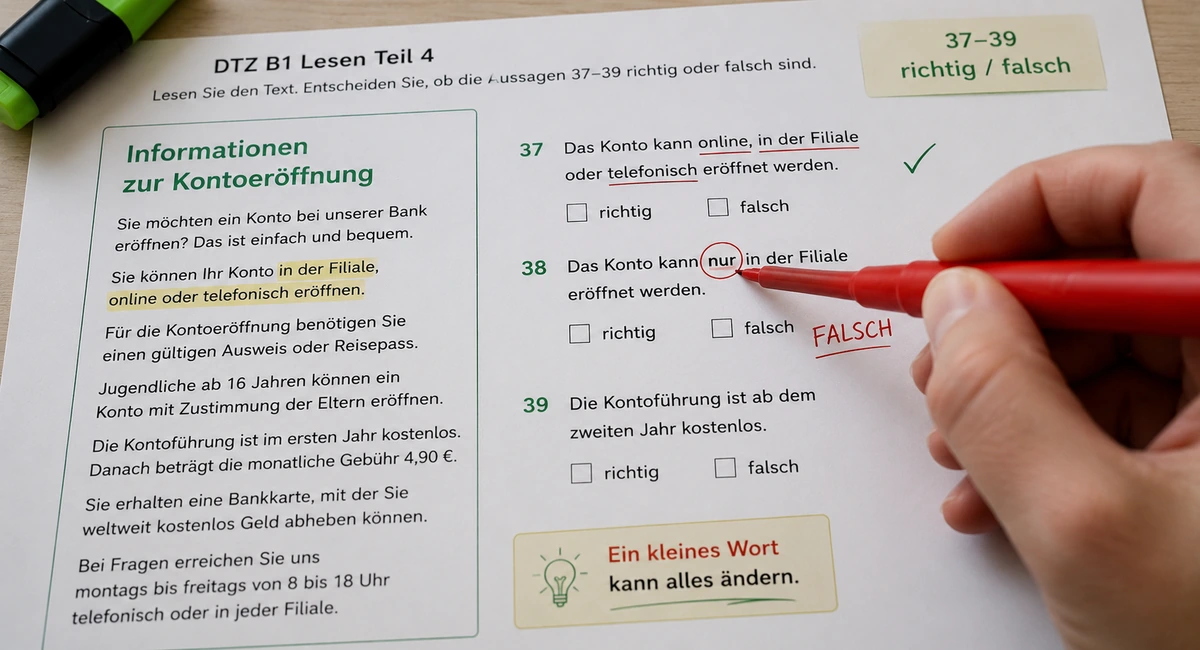
Small words such as “nur”, “erst”, “ab” or “kaum” can also completely change the meaning. You can learn more about this in the articles B1 Listening – The Most Important Tips and 17 Small Word Tricks: Lexical Traps. Traps involving numbers, tenses and words such as “mindestens” are explained in the article Listening Part 3: 18 Traps You Need to Know.
What Changes from A1 to B2?
The higher the level, the more freely the information is rephrased. At A1, recognising a familiar alternative word is often enough. At B2, you need to recognise how entire sentences have been rephrased.
| Level | How the Text Expresses It Differently | Example |
|---|---|---|
| A1 | Familiar alternative words, times, days of the week | Arzt → Doktor; 14:30 Uhr → halb drei |
| A2 | Everyday paraphrasing | geschlossen → “heute haben wir zu”; anrufen → “sich telefonisch melden” |
| B1 | Different parts of speech, opposites with “nicht”, implicit conclusions | “Anmeldung erforderlich” → “Sie müssen sich anmelden”; “nicht billig” → teuer |
| B2 | Nominal style, passive voice, general terms, opinions | “Die Kosten werden übernommen” → “Sie zahlen nichts”; “Ware” → “Artikel” |
Practise with tasks at your level:
Additional Tips for Listening and Reading
In the reading section, you can see the alternative words. In the listening section, you must recognise them as the audio plays. This is why there are a few differences, at B1 as well as at B2.
Typical Features of Listening Tasks
- The information is spread across several sentences. A statement from the task may be spread across two or three sentences in the audio. This is also described by telc for B2.
- Numbers sound different. You hear “8:15” as “Viertel nach acht” and “0,50 €” as “fünfzig Cent”.
- Spoken language. “Das geht leider nicht” instead of “Das ist nicht möglich”. “Klar, kein Problem” instead of “Ja, gern”.
- First one thing, then another. During conversations, people often change their minds: “Montag? Nein, Dienstag ist besser.” In this case, the final piece of information is what matters.
Typical Features of Reading Tasks
- Abbreviations. “Mo–Fr”, “inkl.”, “ca.”, “ab sofort”. In the task, the words are often written out in full.
- Nominal style. “Die Teilnahme ist kostenfrei” instead of “Sie müssen nichts bezahlen”.
- Long advertisements with many details. The relevant information is often found at the end.
- The main idea rather than individual words. When matching headings, the meaning of the entire text matters. You can find examples in the article Why Exam Candidates Make Mistakes in Reading.
Do the Exam Providers Really Say This?
Yes. The major exam providers themselves explain this in their official preparation tips.
| Exam Provider | What the Official Tips Say |
|---|---|
| telc Deutsch B2 | “Do not wait to hear the same words” – the statement is expressed in different words or spread across several sentences. Source |
| telc Deutsch B1·B2 Beruf | The audio usually contains different words. For example, the task says “Ware”, while the audio refers to “Artikeln”. Source |
| telc Deutsch B1·B2 Pflege | “soziale Situation” in the task may become “Familie und Freunde” in the audio. Source |
| telc Zertifikat Deutsch B1 | Headings and texts frequently use synonyms or paraphrases, even for ordinary everyday words. Source |
| Deutsch-Test für den Beruf B2 | The questions often use different words and expressions from those in the text. Source |
| Goethe-Zertifikat A2 (Goethe-Institut Italy) | Look for similar words in the text, for example “online” and “im Internet” or “im Moment” and “gerade”. Source |
| Goethe-Zertifikat B1 | For listening, the Goethe-Institut recommends thinking of synonyms for the keywords in advance. For reading, it recommends paying attention to synonyms of the keywords. Listening · Reading |
| ÖSD Zertifikat B1 | Do not choose an answer too quickly simply because the same words appear. Source |
For DTZ and ÖIF, we did not find any specific advice on this topic in the publicly available materials. However, these exams also use alternative words and expressions in their actual tasks. Information as of 18 November 2026.



There are no comments for this article. Leave your comment