





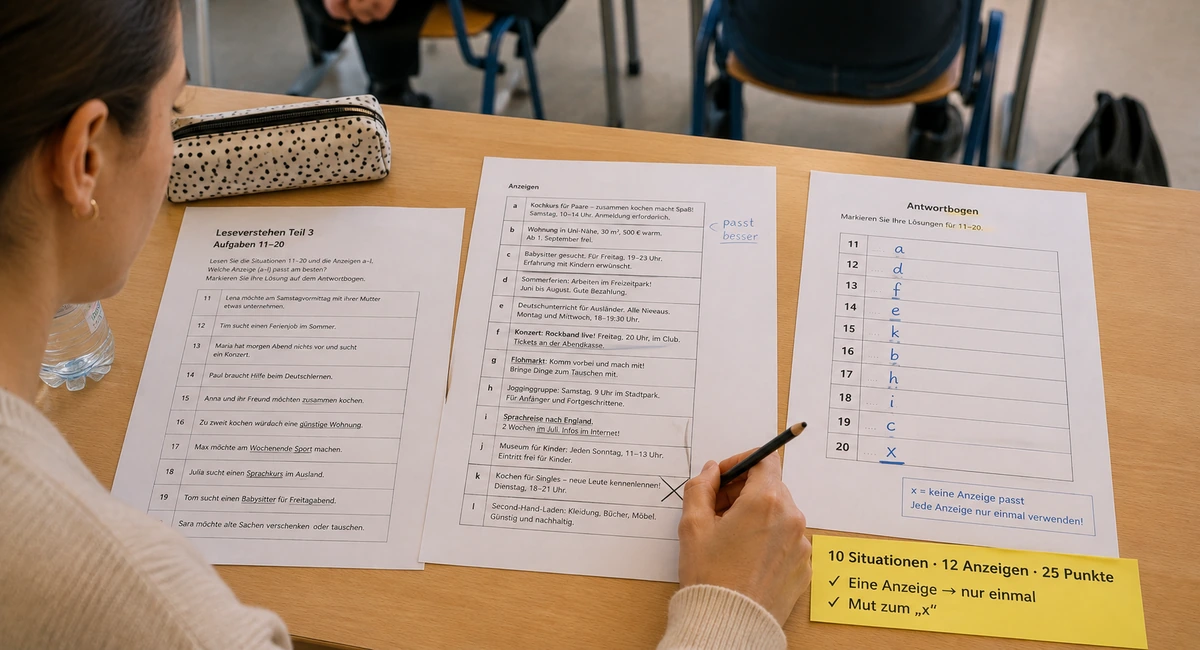
Reading Comprehension Part 3 (telc B1):
structure, points and all traps explained simply
Understand the structure of Reading Comprehension Part 3, the points and above all the typical traps. This way you know exactly what to watch out for, so you can solve this task with confidence.
What is Reading Comprehension, Part 3?
Reading Comprehension Part 3 (Leseverstehen, Teil 3) is a task in the written telc Deutsch B1 examination. It is the third and final part of the reading comprehension section. Many participants find exactly this part difficult. The reason is not the language, but the logic of the task.
In Part 3 you read small advertisements (Anzeigen), just like in a newspaper or on the internet. Then you have to find the matching advertisement for each situation. So it is not about understanding a long text. It is about finding the right information quickly.
The goal: selective understanding
Officially Part 3 tests selektives Verstehen (selective understanding). This means: you look only for very specific information and ignore the rest. You do not have to understand every word. You only have to recognise whether an advertisement matches your wish or not.
Imagine that in real life you are looking for a German course in the evening. You read through many advertisements quickly and pay attention to only two things: Deutsch and Abend. This is exactly the skill that Part 3 tests.
The structure: 10 situations, 12 advertisements and the x
The structure of the Lesen part (telc B1) is always the same. If you know it well, you do not lose any time in the exam.
- 10 situations (number 11 to 20). Each situation briefly describes a wish or a problem, for example: Sie suchen für Ihren Sohn einen Kurs.
- 12 advertisements (letters a to l). Each advertisement is a small offer: a course, a shop, an event, a trip and so on.
Your task is: Which advertisement matches which situation? There are three important rules for this.
The three basic rules
- You may use each advertisement only once.
- There are more advertisements than situations (12 against 10). So some advertisements are left over. These leftover advertisements are called Ablenker (distractors). They look suitable, but they are not.
- Sometimes not a single advertisement matches a situation. In this case you mark the letter x.
Because there are 12 advertisements and only 10 situations, at least two advertisements always remain. And because there are often one to three x answers, even more advertisements end up without a partner. This is normal and not a mistake.
Points, time and weighting
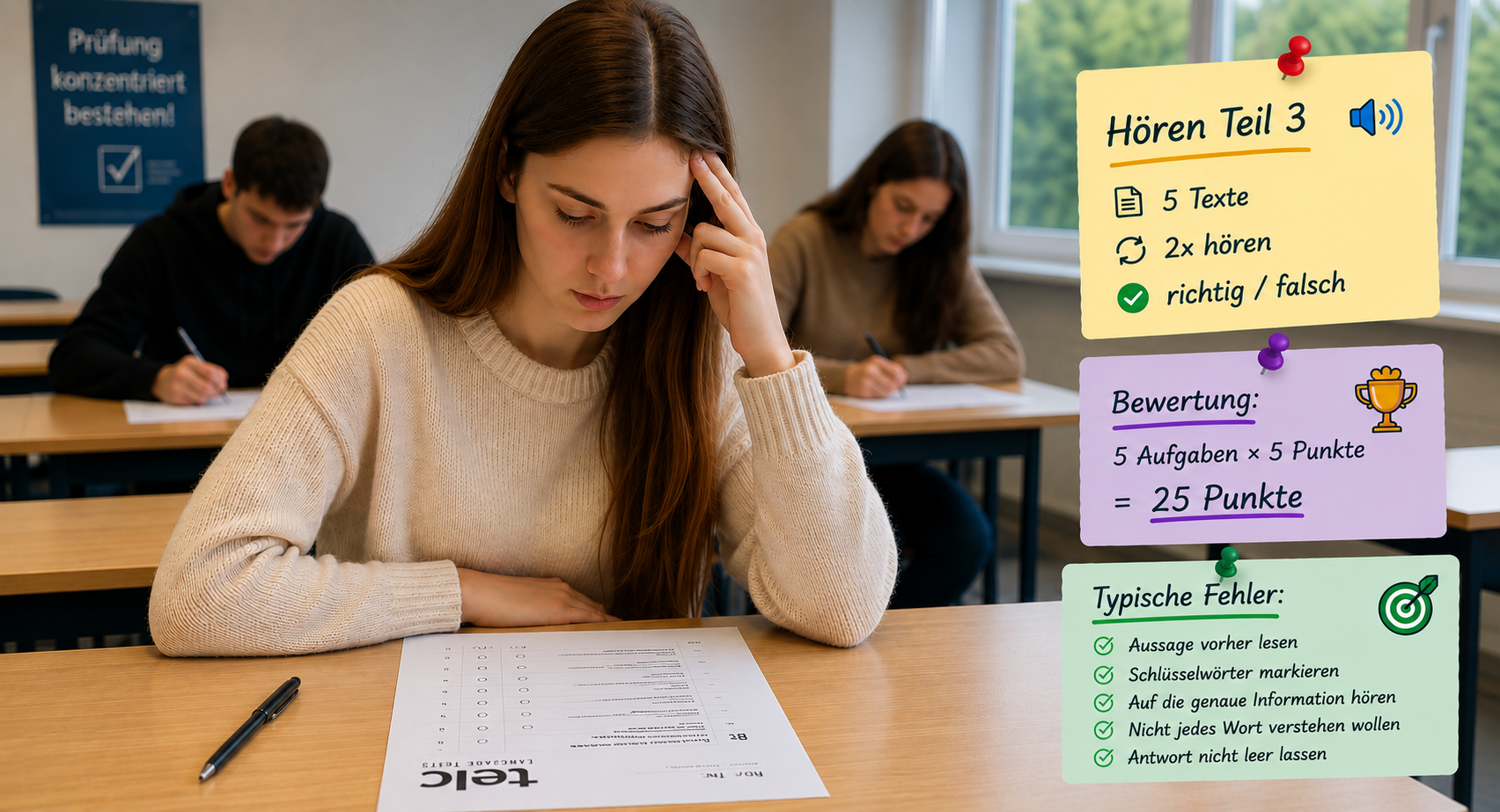
Part 3 has 10 tasks. Each correct answer gives 2.5 points. In total you can therefore get 25 points. This makes Part 3 one third of the entire reading comprehension section.
| Part | Goal | Tasks | Points |
|---|---|---|---|
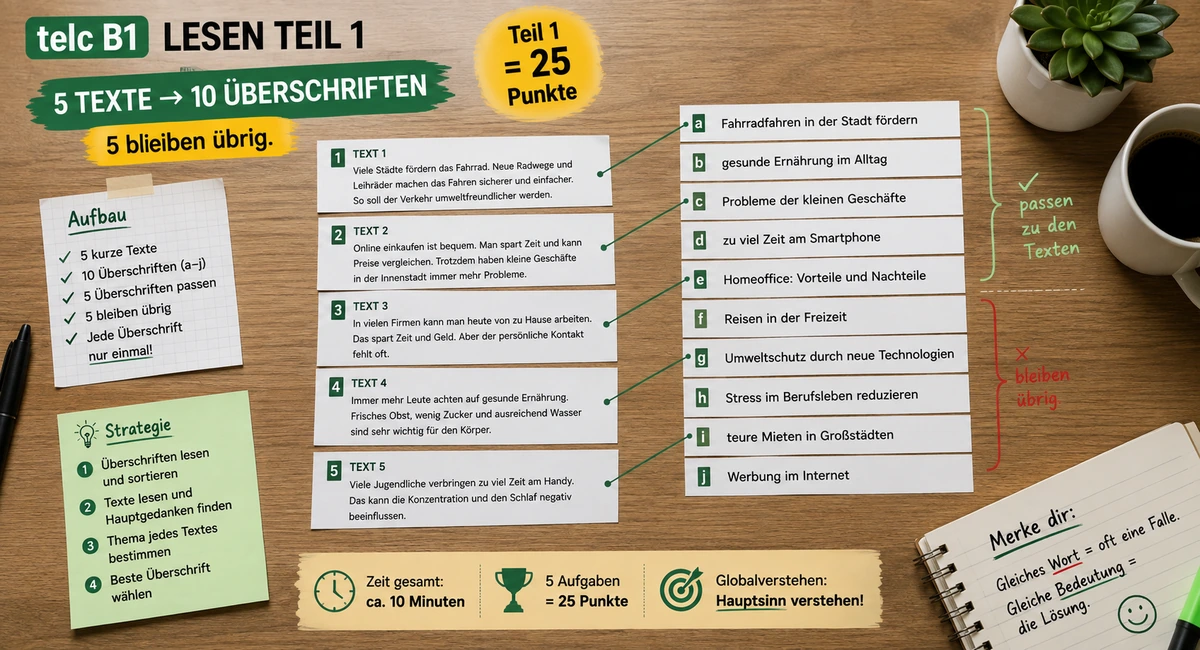
| Leseverstehen Teil 1 | Globalverstehen (matching headlines) | 5 | 25 |
| Leseverstehen Teil 2 | Detailverstehen (multiple choice) | 5 | 25 |
| Leseverstehen Teil 3 | Selektives Verstehen (matching advertisements) | 10 | 25 |
| Leseverstehen gesamt | — | 20 | 75 |
How much time do you have?
Reading comprehension (Leseverstehen) and Sprachbausteine together form one block of 90 minutes. There is no separate time only for Part 3. This means: you divide the time yourself. Many participants plan about 15 to 20 minutes for Part 3. You should not lose more time here, because you still need time for the Sprachbausteine.
The right pace is best learned with a complete test under real conditions. In our Modeltest section you can train easily and comfortably, get used to the pace and learn to divide the time correctly.
Whether you pass the entire exam depends on the score in all exam parts together, not only on Part 3. As a rule you have to reach around 60% of the points. The exact conditions can differ — please always check them directly with your examination centre.
Why is Part 3 so hard? The logic behind the traps
Many participants make mistakes in Part 3 even though they understand all the words. Why? Because the exam works with a simple trick: it tests whether you only compare words or whether you really understand the meaning.
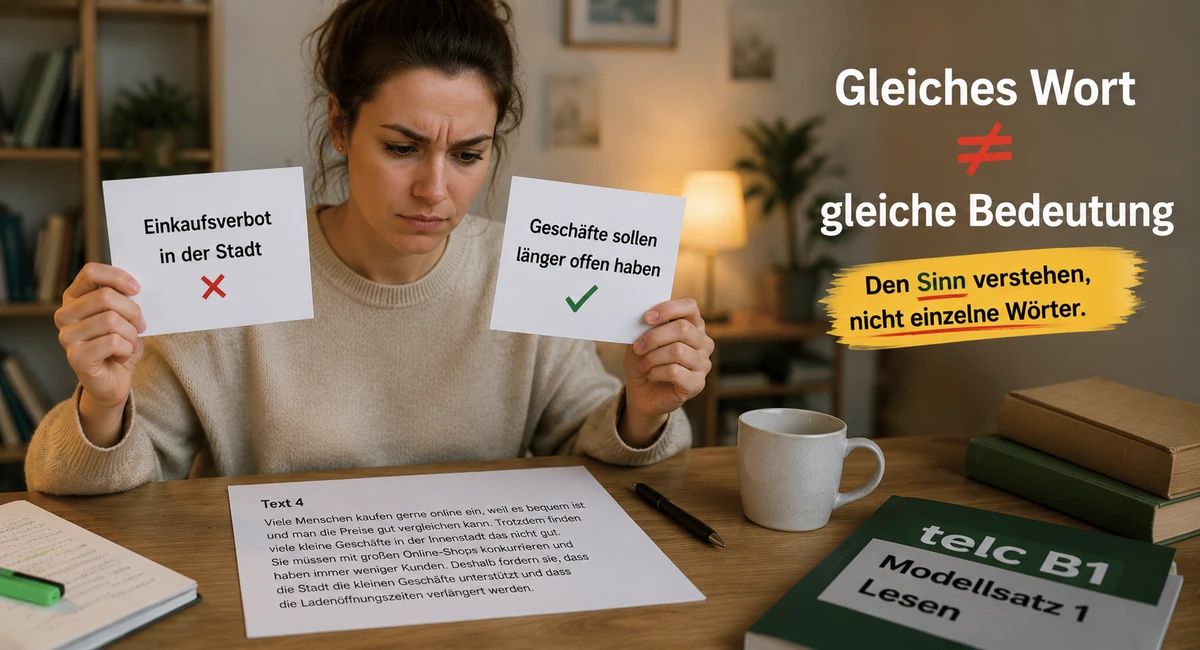
The most important rule is this: the situation and the correct advertisement almost never contain exactly the same word. The correct advertisement uses a different word with the same meaning (a synonym or a paraphrase).
At the same time there is often a wrong advertisement that contains exactly the same word as the situation. This advertisement looks perfect, but it is a trap. Anyone who only searches for identical words falls into it immediately.
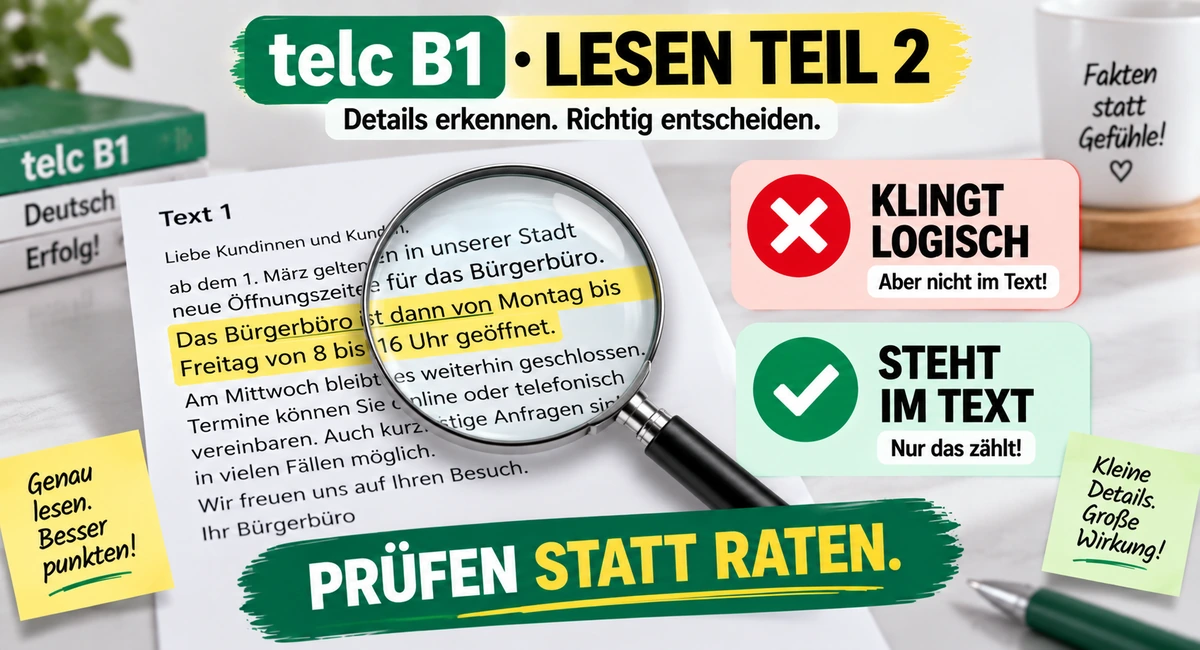
Same word in situation and advertisement → often wrong. Same meaning with different words → often right. So never compare words, always compare the meaning.
In the next section you will see the typical traps, each with a simple example. Once you know these traps, you read the advertisements with completely different eyes.
The most important traps explained step by step
There are not endlessly many traps. They are always the same types. Learn these types and you will recognise them again in every exam.
Trap 1: Same word, different meaning
This is the most common trap. A word in the advertisement looks like the word in the situation, but it means something different.
Example: The situation: Mein Kind hat Probleme beim Sprechen und braucht Hilfe. One advertisement promotes a Sprachschule. Both contain the word part Sprach — but a Sprachschule teaches foreign languages, it does not help with a speech disorder. The correct advertisement is a logopädische Praxis, even if the word Sprachproblem does not appear there at all.
Trap 2: The wrong direction (offering or looking for)
Pay close attention to who does what. Who is looking for something (suchen), and who is offering something (anbieten)?
Example: Your wish: Ich suche jemanden, der mir Klavierunterricht gibt. The correct advertisement is from a teacher who writes Ich biete Klavierunterricht an. An advertisement where another family writes Wir suchen einen Klavierlehrer does not match — even though the word Klavier appears in it. Both are looking, but nobody is offering anything.
The same trap exists with courses and jobs: Eine Schule sucht Lehrer is a job advertisement, not a course for you.
Trap 3: The wrong age or the wrong person
Often the topic matches, but the age or the person is not right.
Example: You are looking for a club for your daughter who is 14 Jahre old. An advertisement promotes a club — but only für Kinder von 4 bis 10 Jahren. The topic Club matches, the age does not. Always pay attention to numbers such as the age or signals like ab 16 Jahren.
Trap 4: The wrong day or the wrong time
An offer can be perfect in content and still not match, because the day or the time is not right.
Example: You want to invite your friends to the circus am Montagabend. The advertisement says: Letzte Vorstellung am Sonntag. The circus matches, but the day is wrong. Very often the correct answer is then x. Also pay attention to words like tagsüber, am Wochenende or nur werktags.
Trap 5: General term and concrete example
Sometimes the situation names a general term, and the advertisement only names a concrete example of it — or the other way around.
Example: Your wish: billige Winterkleidung für die ganze Familie. An advertisement offers 50% discount on Skianzüge nur für Damen. This is winter clothing, but only for women, not for the whole family. The correct advertisement is a shop with günstige Wintermode für die ganze Familie.
Trap 6: The same topic, but a different offer
The topic of an advertisement is right, but it is not at all what you need.
Example: You want to travel to Ägypten. An advertisement talks about Ägypten — but it is a Buch about Egypt or an Ausstellung about Egypt. A book or a museum is not a trip. The country is right, the offer is wrong.
Another example: You are looking for a Tierfilm for your child. An advertisement names a film with the word Spinne in the title — but it is a crime film for adults (ab 16 Jahren), not an animal film for children.
The two hardest traps: the double advertisement and the x
These two traps cost the most points. If you understand them, you are ahead of many other participants.
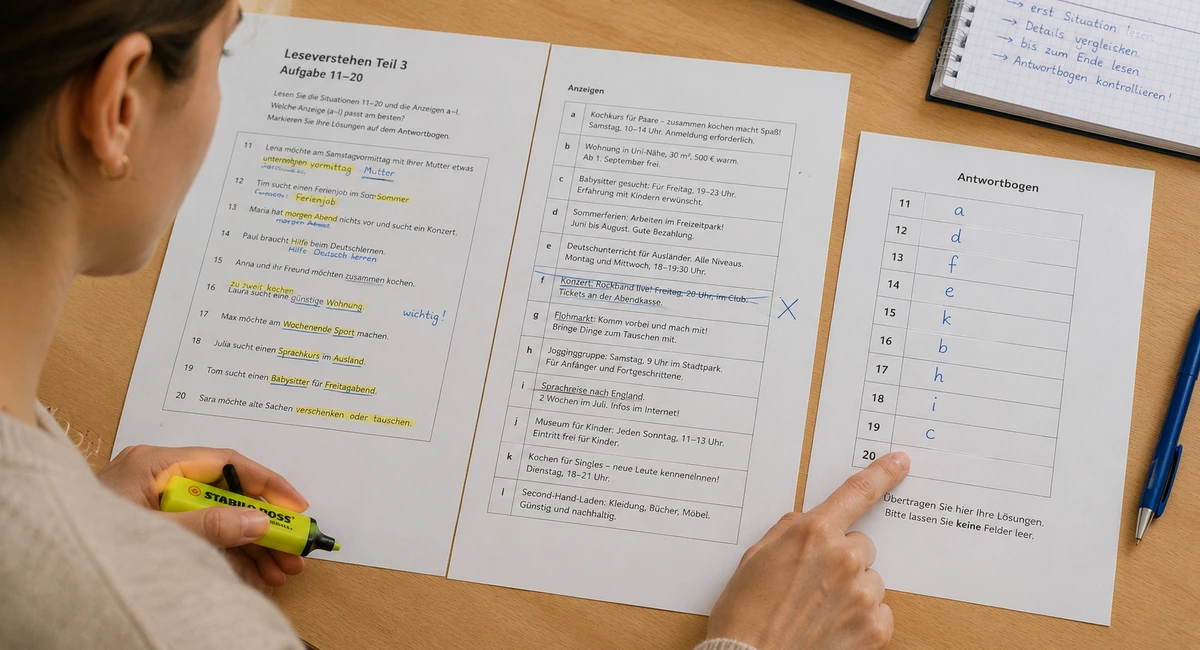
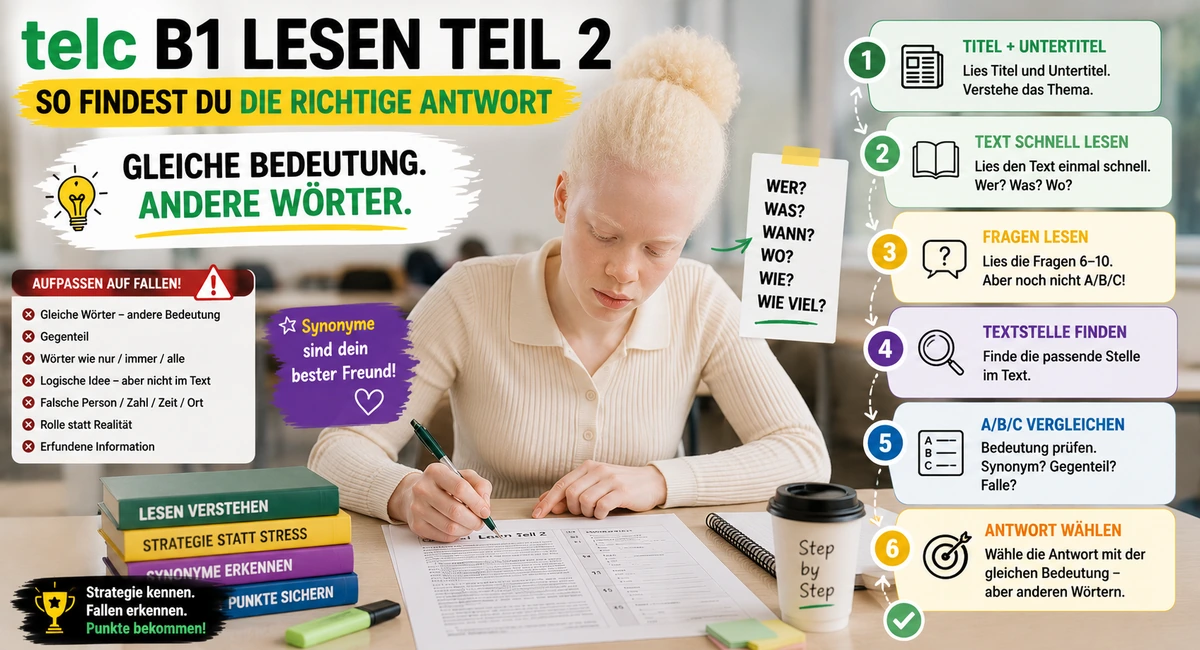
This is the best way to proceed: Always read the situation first and only then look for the matching advertisement — never the other way around. If two or three advertisements could match at first glance, mark them briefly, for example with a circle. Then concentrate on the keywords and the important expressions. Usually they are synonyms, that is, other words with the same meaning. In the end choose only the advertisement that fulfils your wish one hundred percent.
The double advertisement (one advertisement seems to match two situations)
A single advertisement can be written in such a way that it seems to match two or more situations. But you may use each advertisement only once. Only one situation really gets the advertisement. For the other situation the advertisement is only a trap.
Example: An advertisement for a Jugendtreff also offers free Hausaufgabenhilfe. So it seems to match two situations: Club für meine Tochter and Nachhilfe in Mathe. But a Jugendtreff with Hausaufgabenhilfe is not targeted maths teaching. The correct answer for Nachhilfe is a real Nachhilfe-Institut. The Jugendtreff belongs only to the first situation.
If an advertisement seems to match two situations, ask yourself: Zu welcher Situation passt sie am besten und ganz genau? That is where it belongs. The other situation needs a different advertisement or an x.
The x — the biggest fear of participants
Many participants do not dare to write x. They think: Eine Anzeige muss doch passen! This is a big mistake. The x is a correct answer, not an emergency solution.
The x is right when every advertisement has one small but important detail wrong: the age, the day, the direction (suchen instead of anbieten) or the offer (Buch instead of Reise). Then simply no advertisement matches.
Example: Ihre Mutter ist 72 Jahre alt und sucht eine Gruppe für Menschen in ihrem Alter. But there is only a Kinderclub and a Jugendtreff. For her age there is nothing. The correct answer is x.
Have the courage to write x. If all advertisements have a clear mistake in the detail, x is the correct solution. A forced advertisement gives 0 points, a correct x gives 2.5 points.





There are no comments for this article. Leave your comment