





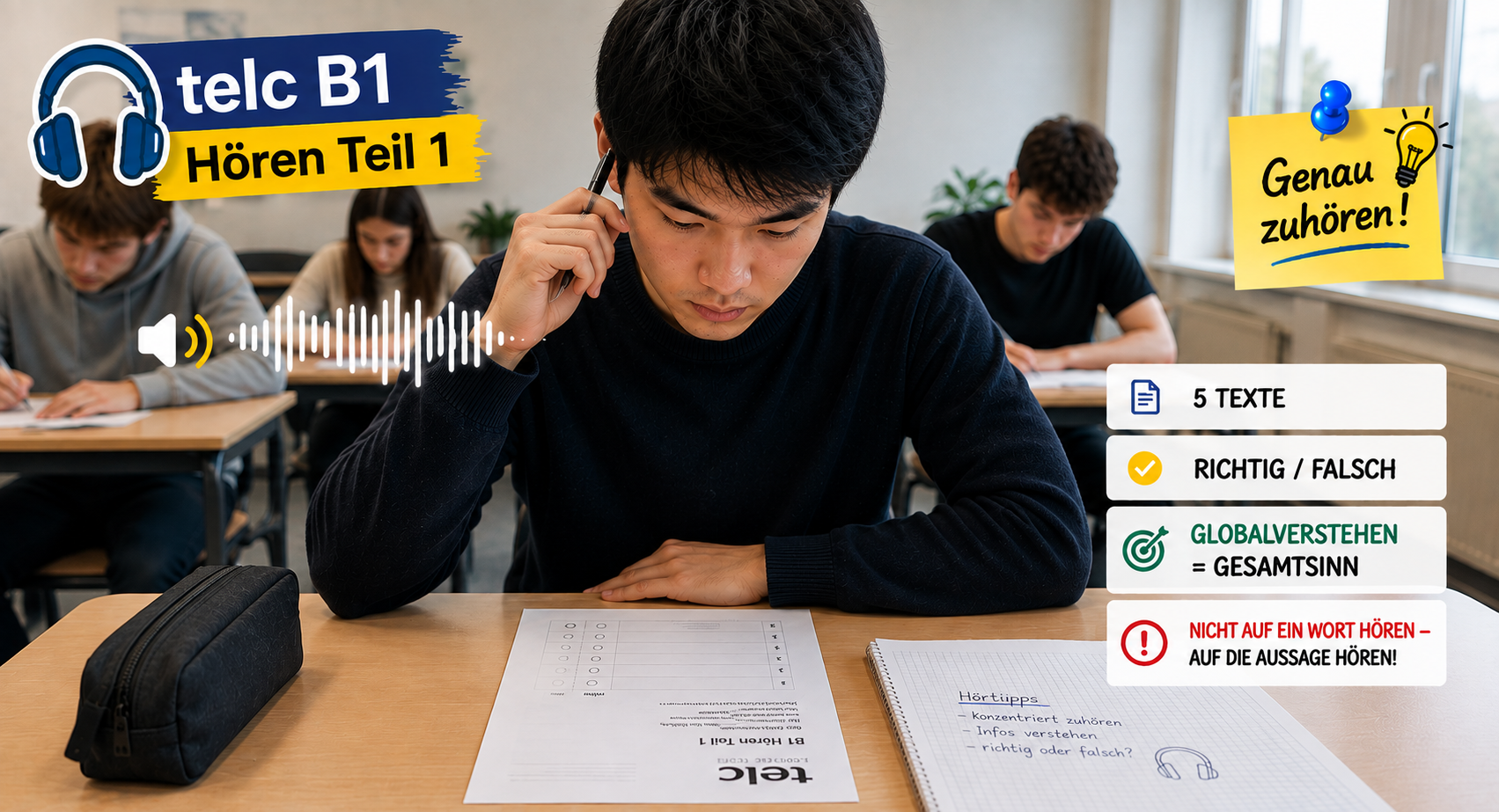
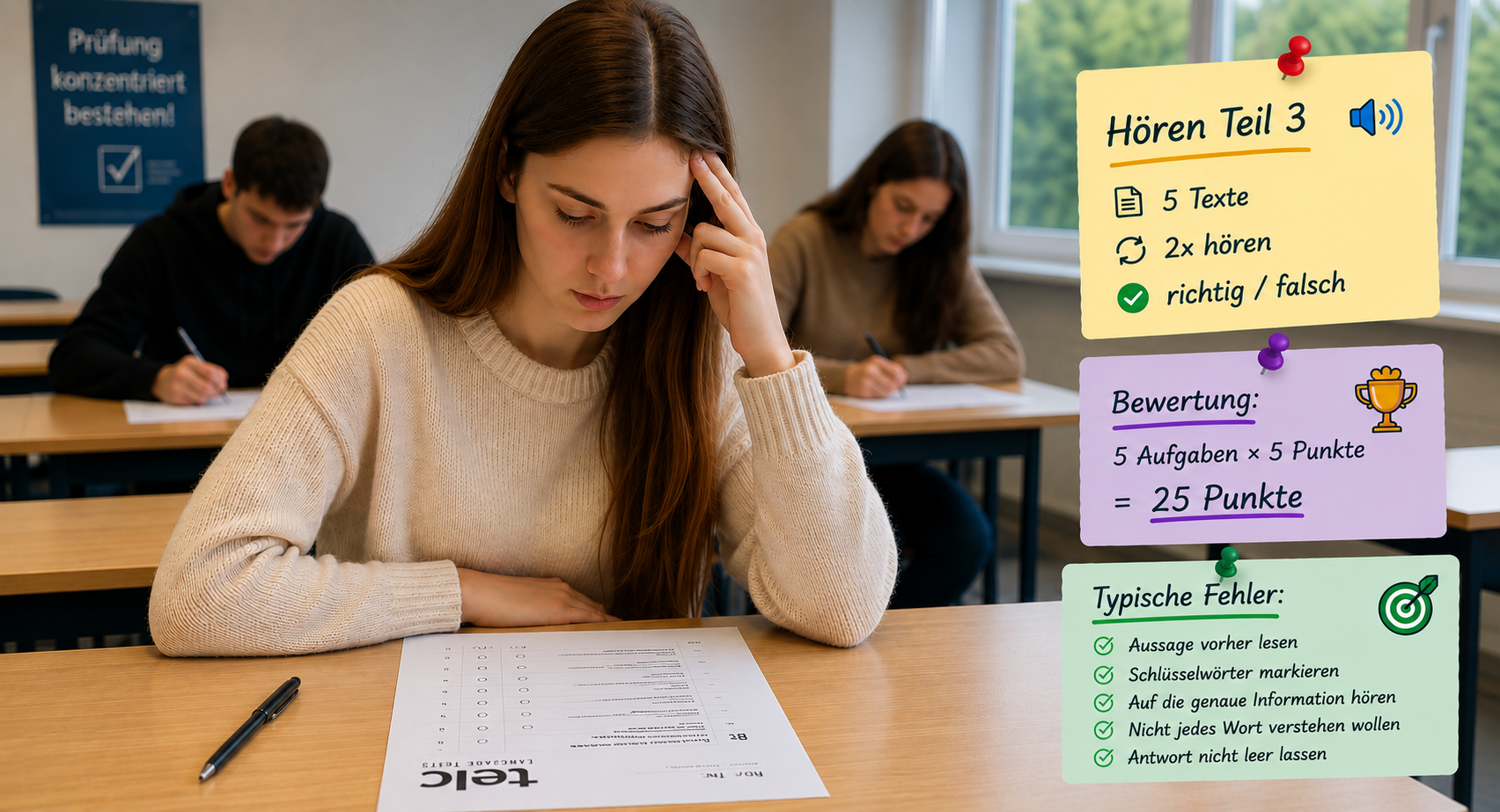
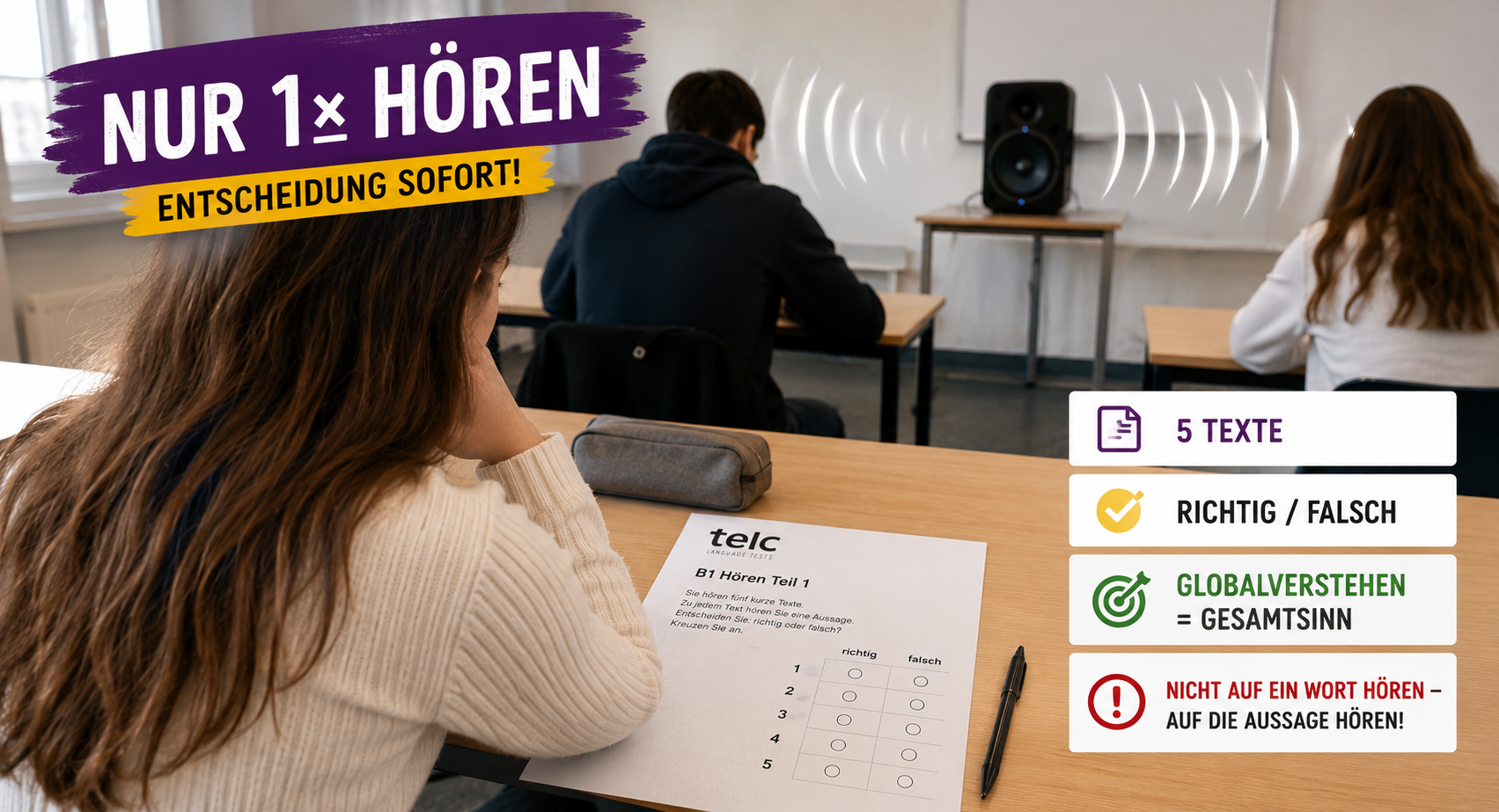
Listening Part 3:
the right strategy and all the typical traps
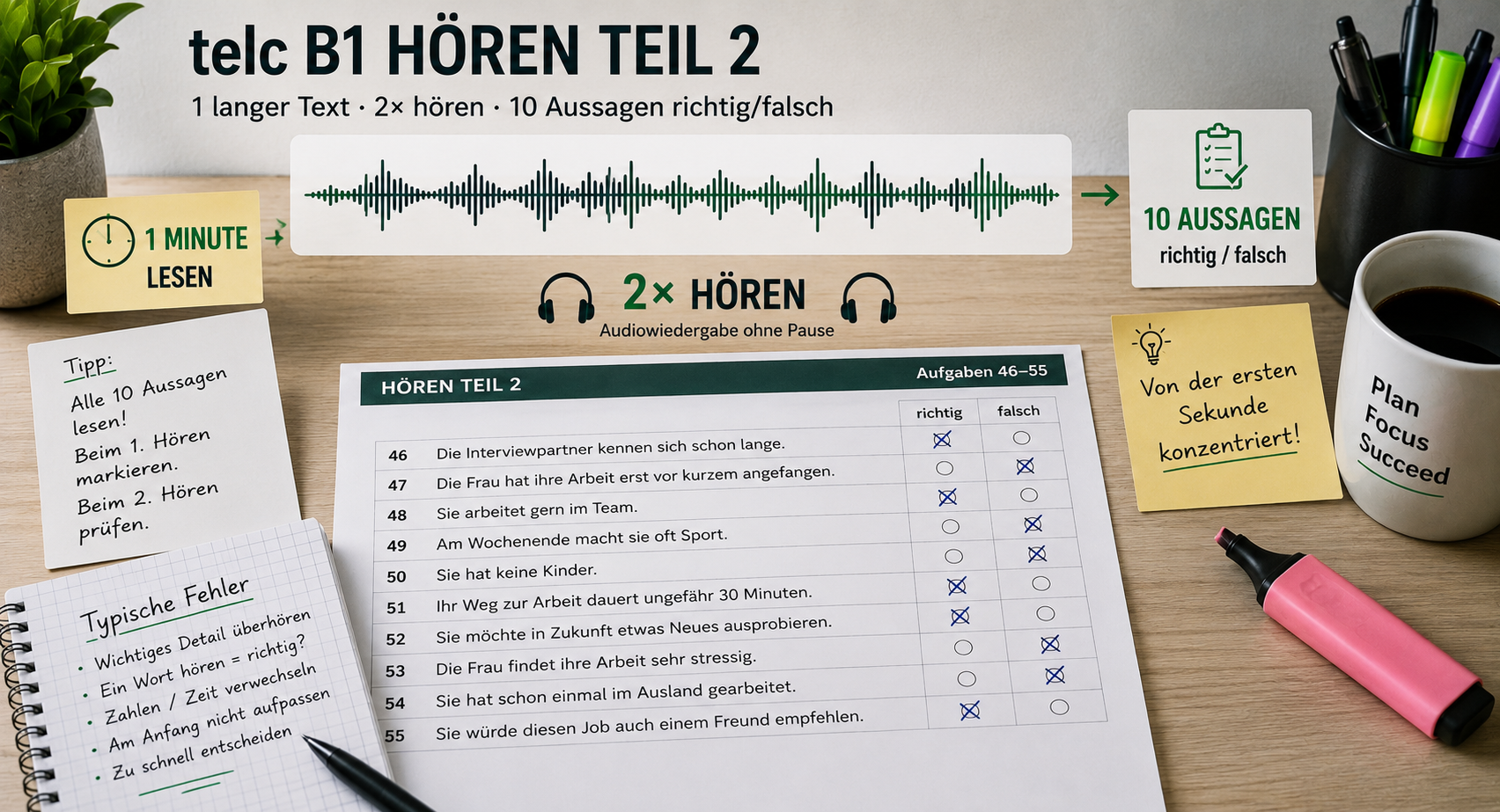
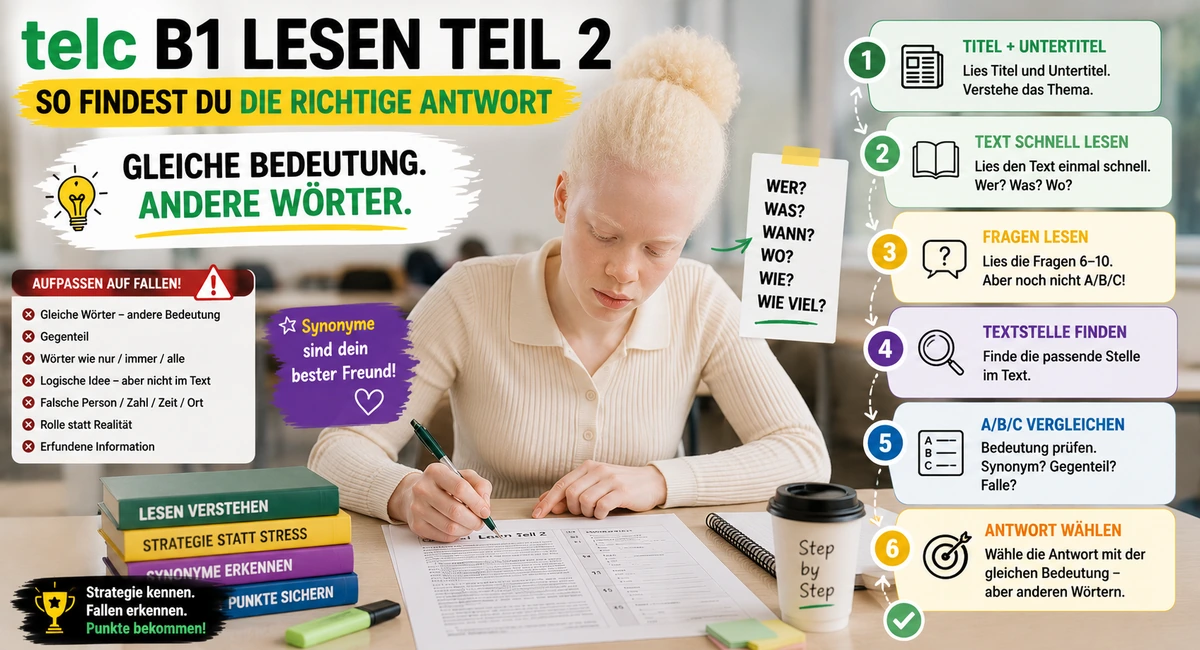
Do you already know the structure and the assessment of Listening Part 3? Then now learn the one central method with which you can analyse every listening text – plus all the signals you have to pay special attention to.
The correct strategy: step by step
For each of the five texts in Listening Part 3 the same method works.
Step 1: before listening – read the statement and underline important words
You only have a few seconds. Read the statement once in full and underline the words that could be important for the solution: names, numbers, places, time references, activities.
Step 2: first listening – pay attention to the introduction and the underlined words
First pay attention to the introductory sentence – it briefly presents the situation to you. After that you pay targeted attention to the words you underlined and already mark a first solution.
Step 3: check the solution during the second listening
Compare the content of the statement once more exactly with the listening text and check your solution.
Step 4: mark a solution in any case
Mark your final answer: true (+) or false (−). Mark a solution for every statement in any case, even when you are unsure.
The basic method: comparing subject and predicate
This method is the most important one in this article. It works with almost every statement in Listening Part 3, regardless of the topic.
The method in three steps
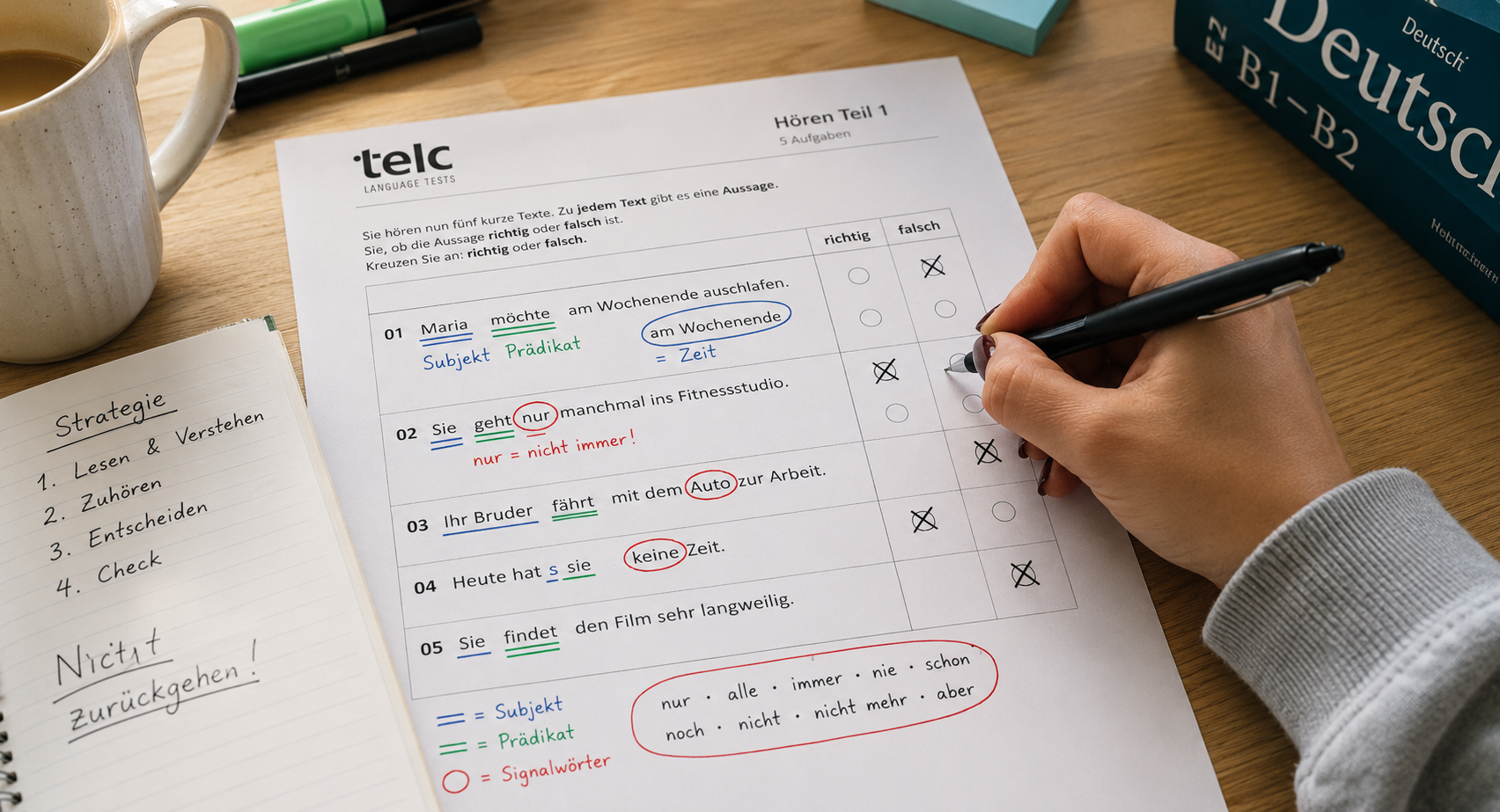
Step A: Analyse the statement. Identify the subject (who? what? – the person, the place, the object) and the predicate (what happens? what is being claimed?).
Step B: Look in the listening text for the place where this subject occurs – often not with the same word, but with a synonym or a paraphrase (more on that in the next section).
Step C: Compare the predicate from the statement with what the listening text really says about this subject. Three possible results:
- It matches directly or through a clear synonym → true.
- It matches only partly, only under a condition, or it is the opposite → false.
- The subject does not occur in the listening text at all → false.
Example 1
Statement: Markus holt seine Freundin ab. (Markus is picking up his girlfriend.)
Listening text: Hallo Sandra, hier ist Markus. Ich kann dich leider nicht abholen. Thomas übernimmt das. (Hello Sandra, this is Markus. Unfortunately I can’t pick you up. Thomas is taking care of it.)
Analysis: subject = Markus. Predicate in the statement = abholen (to pick up). In the listening text it says about Markus: kann nicht abholen (can’t pick up). That is the opposite.
Result: false. Markus is not picking her up – Thomas is taking care of it.
Example 2
Statement: Der Service bringt die Gäste nach Hause. (The service takes the guests home.)
Listening text: Sobald Ihre Gäste sich auf den Heimweg machen, ist bei Ihnen wieder alles aufgeräumt. (As soon as your guests set off for home, everything at your place is tidy again.)
Analysis: subject in the statement = the service. But in the listening text the subject of the action sich auf den Heimweg machen (to set off for home) is not the service, but the guests themselves.
Result: false. The subject is swapped: the guests go themselves, the service does not take them.
These two examples are the same method, only with different content. Apply it to every statement: who/what is the subject? What is claimed about it? What does the listening text really say about this subject?
Synonyms and paraphrases: almost never the same words
In a real listening text the statement almost never uses exactly the same words as the listening text. That is normal and no coincidence – it is part of the exam format. You have to learn to recognise meanings, not just words.
| In the statement | Often phrased like this in the listening text |
|---|---|
| kostenlos (free of charge) | gratis, umsonst, ohne Kosten (free, for nothing, at no cost) |
| sofort (immediately) | ab sofort, ohne Wartezeit, gleich (from now on, with no waiting, right away) |
| Verspätung haben (to be delayed) | später ankommen, sich verzögern (to arrive later, to be delayed) |
| verboten (forbidden) | untersagt, nicht gestattet (prohibited, not permitted) |
| nach Hause gehen (to go home) | sich auf den Heimweg machen (to set off for home) |
| genauso teuer (just as expensive) | nicht teurer als, derselbe Preis (not more expensive than, the same price) |
| Probleme haben (to have problems) | Schwierigkeiten haben, es fällt schwer (to have difficulties, it is hard) |
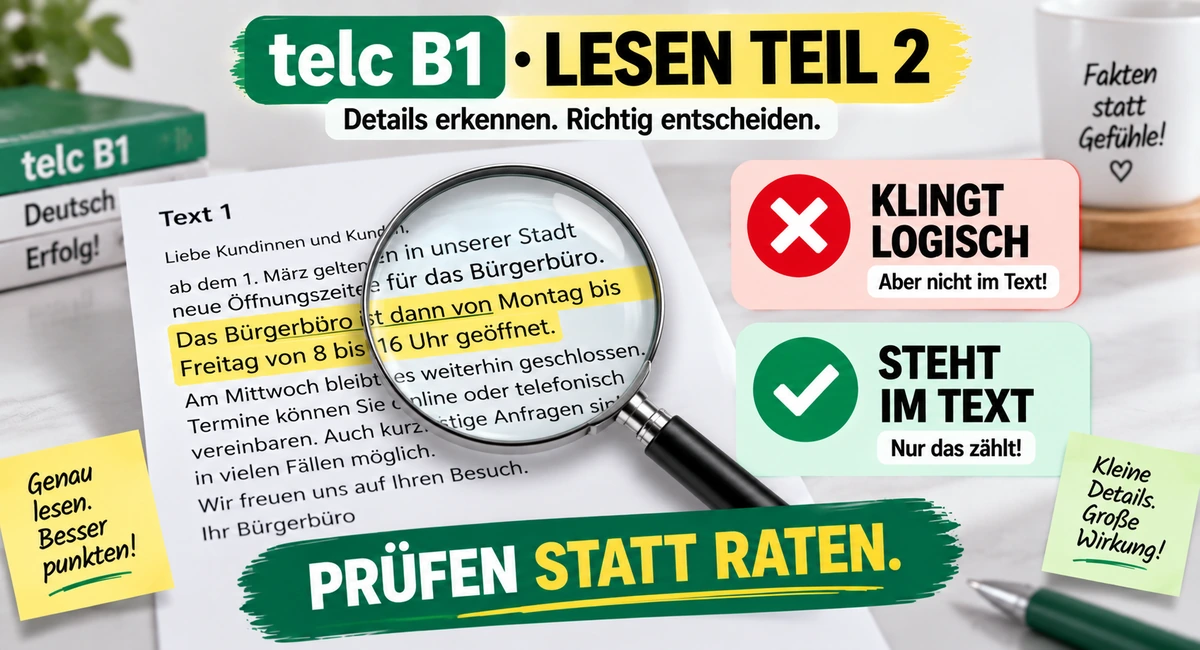
Ask yourself with every word in the statement: which other words could express the same meaning? Look in the listening text for the meaning, not for the exact word.
Partly true is completely false
Some statements consist of two parts. One part matches the listening text, the other part does not. In this case the whole statement is false – not partly true.
Statement: Gestern Nacht gab es einen Autounfall. Ein Mann starb dabei. (Last night there was a car accident. A man died in it.)
Listening text: Letzte Nacht wurde auf der Landstraße ein Mann von einem Auto erfasst und schwer verletzt. (Last night a man was hit by a car on the country road and seriously injured.)
Analysis: Part 1 (car accident last night) matches. Part 2 (a man died) does not match – he was only injured.
Result: false. A single false part makes the whole statement false.
Check each individual part of every statement separately. A comma or und (and) often links two claims that have to be checked separately. If even one part does not match, the whole statement is false.
Words that turn the whole meaning around
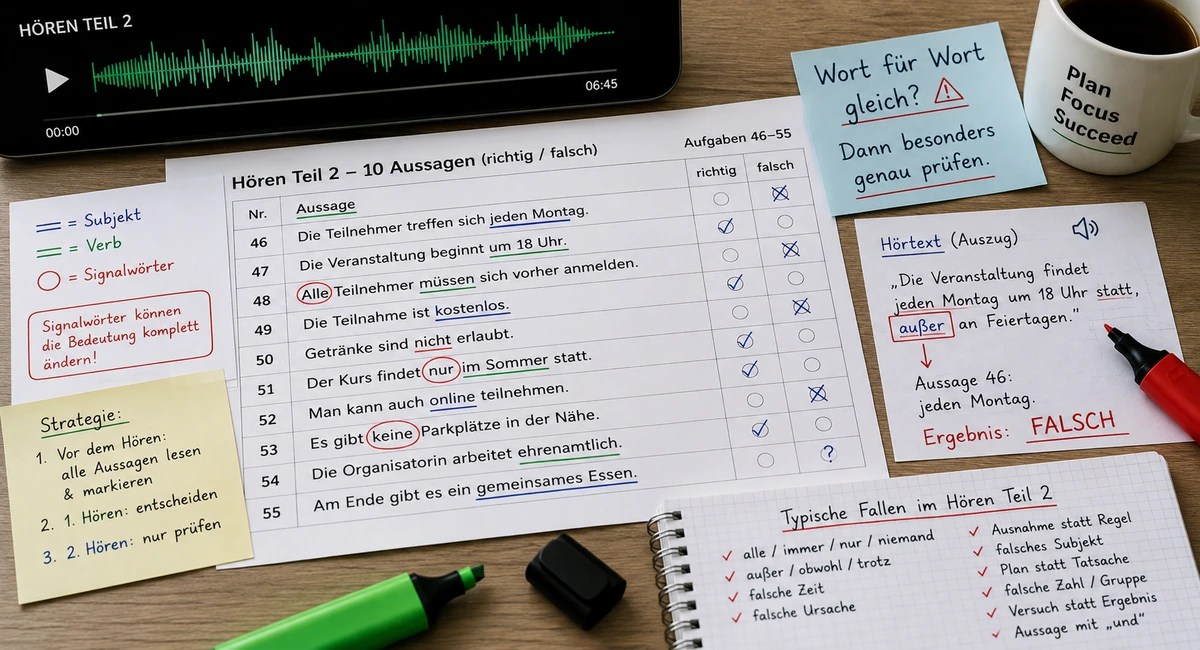
A single word can change the complete meaning of a sentence. These words almost never come at the beginning of the listening text – they are in the middle or towards the end, often after the text at first seems to confirm something else. So: always listen to the last word, even if the beginning already seems to confirm the statement.
| Signal word | Function |
|---|---|
| aber (but) | contradicts what was said before |
| jedoch (however) | contradicts what was said before (more formal) |
| allerdings (though) | restricts what was said before |
| dennoch / trotzdem (nevertheless / even so) | shows an unexpected contrast |
| außer (except) | names an exception to a rule |
| nur (only) | restricts a statement strongly |
| sonst (otherwise) | shows a condition, not a current fact |
| obwohl (although) | links two contrasting facts |
Statement: Für die Party ist alles fertig, nichts fehlt mehr. (For the party everything is ready, nothing is missing anymore.)
Listening text: Eigentlich ist alles fertig. Aber die Musik haben wir noch nicht organisiert. (Actually everything is ready. But we haven’t organised the music yet.)
Analysis: The first part of the listening text confirms the statement. Only after aber (but) comes the information that makes the statement false.
Result: false.
If one of these words occurs in the listening text, everything before it has to be treated with caution. The information directly after the signal word is usually the decisive one.
Numbers: the same number, a different meaning
A number on its own means nothing. Only the word right next to it gives it a concrete meaning. Check with every number in the statement: which word does this number really belong to in the listening text?
Statement: 30 Minuten Verspätung. (30 minutes delay.)
Listening text: Der Zug hat eine Verspätung von 50 Minuten. Der Aufenthalt hier dauert 30 Minuten. (The train has a delay of 50 minutes. The stop here lasts 30 minutes.)
Analysis: The number 30 belongs to the word Aufenthalt (stop), not to Verspätung (delay). The delay is 50 minutes.
Result: false.
Statement: 250 Gramm kosten 2,15 Euro. (250 grams cost 2.15 euros.)
Listening text: Ein viertel Kilo Kartoffeln kostet nur 2 Euro 15. (A quarter of a kilo of potatoes costs only 2 euros 15.)
Analysis: Ein viertel Kilo (a quarter of a kilo) means 250 grams (1000 grams ÷ 4 = 250 grams). The numbers are only expressed here in a different unit, the quantity is identical.
Result: true. Careful: here you have to work out for yourself whether the two units really mean the same quantity.
Statement: Die Gewinnzahl ist 24. (The winning number is 24.)
Listening text: Die Gewinnzahl lautet 42. (The winning number is 42.)
Analysis: 42 (zwei-und-vierzig, two-and-forty) and 24 (vier-und-zwanzig, four-and-twenty) have their parts swapped.
Result: false.
With every number, note the word right next to it immediately. With compound number words pay close attention to the order of the parts (zwei-und-vierzig vs. vier-und-zwanzig). Also check whether a number applies only to a subcategory, and work out for yourself whether two different units (grams, kilos, fractions like ein viertel, a quarter) really mean the same quantity.
Places and directions
With directions the subject from Section 2 is a place. The difficulty: the listening text often names two or three places one after another, but only one of them is really the destination in the end. That is why you need an additional rule before you can compare subject and predicate.
The method in three steps
Step A: Note in your head every place you hear in the listening text, in the order in which it is named.
Step B: After each place, check whether a correction word comes directly afterwards: aber (but), bleiben Sie (stay). If such a word comes, the place named last is withdrawn – the place before it applies again.
Step C: With every place name, check whether the word Richtung (towards) is in front of it. If so, that is not a destination, but only an indication of movement. The real place is usually in a separate detail, often with zwischen… und… (between… and…).
Only the final place determined in this way is compared with the subject of the statement.
Statement: Das Geschäft ist in der Lindenallee. (The shop is in Lindenallee.)
Listening text: Sie sind in der Gartenstraße. Gehen Sie bis zur Lindenallee, überqueren Sie sie, aber bleiben Sie in der Gartenstraße. Dort finden Sie uns. (You are in Gartenstrasse. Go to Lindenallee, cross it, but stay in Gartenstrasse. That is where you will find us.)
Analysis: order: Gartenstrasse → Lindenallee → aber (but) → Gartenstrasse applies again.
Result: false.
Statement: Das Ereignis passiert in Nordstadt. (The incident happens in Nordstadt.)
Listening text: Auf der A21 Richtung Nordstadt kommt Ihnen zwischen Ostheim und Westheim ein Fahrzeug entgegen. (On the A21 towards Nordstadt, a vehicle is coming towards you between Ostheim and Westheim.)
Analysis: In front of Nordstadt is Richtung (towards) – only an indication of movement. The real place is between Ostheim and Westheim.
Result: false.
Lists with several similar elements
Sometimes the listening text contains not just one subject, but a whole list of similar subjects one after another (several cinemas, several prices, several trains). The basic method from Section 2 stays the same – only the search for the right subject becomes harder, because several similar subjects stand right next to one another.
The method in two steps
Step A: Find in the list exactly the subject that is also in the statement (for example a particular name).
Step B: Take as the predicate only the information that stands immediately next to this one subject – not the information that belongs to the next element in the list.
One special feature: sometimes the listening text does not repeat a piece of information but refers with derselbe/dieselbe/dasselbe (the same) to something that has already been named. In this case you have to go back and find the earlier information.
Statement: Der Film Die Reise läuft im Kino Palast. (The film Die Reise is showing at the Palast cinema.)
Listening text: Kino Palast: der Film Der lange Sommer. Kino Stadtmitte: der Film Die Reise. (Palast cinema: the film Der lange Sommer. Stadtmitte cinema: the film Die Reise.)
Analysis: subject = Palast cinema. Right next to it is Der lange Sommer, not Die Reise.
Result: false.
Statement: Der Zug nach Südstadt fährt von Gleis 9. (The train to Südstadt leaves from platform 9.)
Listening text: Zug nach Nordstadt von Gleis 7, und Zug nach Südstadt vom selben Gleis. (Train to Nordstadt from platform 7, and train to Südstadt from the same platform.)
Analysis: vom selben Gleis (from the same platform) refers back to platform 7.
Result: false.
Contrast between two similar things
Here there is not just one subject, but two subjects of the same kind (two regions, two days, two countries) that the listening text deliberately contrasts. The danger: you remember a characteristic but forget which of the two subjects it actually belonged to.
The method in two steps
Step A: As soon as a new name (a new region, a new day, a new country) begins in the listening text, delete all the facts you memorised before from your head.
Step B: From now on assign to this new name only the facts that come immediately afterwards. Only at the end compare which of the two subjects is meant in the statement, and whether exactly these facts fit it.
Statement: Im Osten bleibt es sonnig. (In the east it stays sunny.)
Listening text: Im Westen bleibt es sonnig, im Osten wird es bewölkt. (In the west it stays sunny, in the east it becomes cloudy.)
Analysis: Next to Osten (east) is bewölkt (cloudy), not sonnig (sunny) – that characteristic belonged to the west.
Result: false.
Statement: Das Museum schließt jeden Tag um 18 Uhr. (The museum closes at 6 p.m. every day.)
Listening text: Wir schließen normalerweise um 18 Uhr. Ab sofort ist das Museum jeden Freitag bis 22 Uhr geöffnet. (We normally close at 6 p.m. From now on the museum is open every Friday until 10 p.m.)
Analysis: There are two subjects: the normal day and Friday as a special case. A different time applies for Friday.
Result: false.
Similar-sounding words
In Section 3 you learned: statement and listening text often use different words for the same meaning (synonyms). Here it is the opposite problem: statement and listening text use similar-sounding words or word parts – but with a different meaning. In German many words consist of several parts (for example Sport+tasche, sports bag), or there are several words with a similar sound (Nordsee/Ostsee, North Sea/Baltic Sea).
The method in two steps
Step A: If you recognise a word part or a similar-sounding word from the statement in the listening text, do not treat that as confirmation.
Step B: Determine the complete word in the listening text and compare it very exactly with the complete word from the statement. Only an exact match of the complete word counts.
Statement: Der Urlaub ist an der Ostsee. (The holiday is at the Baltic Sea.)
Listening text: Urlaub an der Nordsee. (Holiday at the North Sea.)
Analysis: Nord- and Ost- sound similar, but the whole word is different.
Result: false.
Statement: Jemand hat eine Sporttasche verloren. (Someone has lost a sports bag.)
Listening text: In der Sportabteilung wurde eine schwarze Damentasche gefunden. (In the sports department a black lady’s bag was found.)
Analysis: Sport- occurs in both words (Sportabteilung, sports department; Sporttasche, sports bag), but the whole words are different: what was found is a lady’s bag, not a sports bag.
Result: false.
Statement: Man kann dort Kinderbücher kaufen. (You can buy children’s books there.)
Listening text: Die Veranstaltung wird von der Kinderbuchautorin eröffnet. (The event is opened by the children’s book author.)
Analysis: Kinderbuch- is the common part, but Kinderbücher (children’s books, a product) and Kinderbuchautorin (children’s book author, a profession) are different, complete words.
Result: false.
alle (all), nichts (nothing), nur (only): listen to the end
These are special predicates: they claim something not just about one subject, but about every single element of a whole group. That is exactly what makes them dangerous – a single counterexample in the listening text is enough to make the whole statement false.
The method in two steps
Step A: If you read alle (all), nichts (nothing), nur (only) or nie (never) in the statement, that is a signal: listen to the listening text right to the last word, even if the beginning already seems to confirm the statement (as in Section 5).
Step B: While doing so, count how many different categories, exceptions or elements the listening text really names. Compare this number with what alle/nichts/nur (all/nothing/only) claims in the statement.
Statement: Alle Preise gehen nach Skandinavien. (All the prizes go to Scandinavia.)
Listening text: Die Preise gehen an einen Film aus Portugal und an eine Produktion aus Skandinavien. (The prizes go to a film from Portugal and to a production from Scandinavia.)
Analysis: two different categories are counted, not just one.
Result: false.
Statement: Es gibt nie ein Vormittags-Programm. (There is never a morning programme.)
Listening text: …das vierte Kino hat sonntags auch ein Vormittags-Programm. (…the fourth cinema also has a morning programme on Sundays.)
Analysis: at the end of the list comes an additional exception that disproves nie (never).
Result: false.
Counting as a way to the solution
Sometimes the answer is not stated directly in the listening text at all, but has to be inferred from an incomplete list. This only works if you know how many elements the full list should actually have (for example: a week has 7 days).
The method in two steps
Step A: Count in the listening text how many elements of a known, complete group are really named (weekdays, means of transport, opening status).
Step B: If an element is missing from the full number, or only a restricted version is named (for example nur Beratung, only advice, instead of a complete offer), that almost always has a concrete meaning – usually the opposite of what the statement says.
Statement: Das Geschäft ist auch montags geöffnet. (The shop is also open on Mondays.)
Listening text: Geöffnet Dienstag bis Sonntag. (Open Tuesday to Sunday.)
Analysis: 6 of 7 days are counted. The missing day (Monday) is closed.
Result: false.
Statement: Am Wochenende ist geschlossen. (It is closed at the weekend.)
Listening text: Am Wochenende nur Beratung, kein Verkauf. (At the weekend only advice, no sales.)
Analysis: a restricted version (only advice) is not a complete closure.
Result: false.
Symmetry that does not exist
This trap combines two principles you already know: the contrast between two similar subjects (Section 9) and counting as a way to the solution (Section 12). A programme runs on two days, and the statement assumes that both days are automatically structured identically.
The method in two steps
Step A: Build a separate list of its own for every day that occurs in the listening text – exactly as described in Section 9.
Step B: Count for each day separately how many times are really named, and only after that compare the two lists with each other. Never assume that the second list automatically looks just like the first.
Statement: Samstag und Sonntag gibt es je eine Nachmittags- und eine Abendvorstellung. (On Saturday and Sunday there is one afternoon and one evening performance each.)
Listening text: Samstag und Sonntag 15.30 Uhr, Samstag zusätzlich 20 Uhr, Sonntag zusätzlich 17.30 Uhr. (Saturday and Sunday 3.30 p.m., Saturday additionally 8 p.m., Sunday additionally 5.30 p.m.)
Analysis: list Saturday: 3.30 p.m. + 8 p.m. (that is an evening performance). List Sunday: 3.30 p.m. + 5.30 p.m. (no evening performance).
Result: false.
The best next step is practical training with new exercises – consciously apply the basic method and the signals from this article to texts you have never seen before. Train directly here: B1 telc – Listening.
And if you cannot find a solution?
Sometimes you find no clear solution for an item – that is normal, it happens to every candidate. Ask yourself briefly: what is the subject? What is the predicate? Is there a signal word I might have missed?
If you are still unsure after that: simply guess. With true/false there are only two options – your chance is 50 to 50. That is always better than an empty box, because an empty box is automatically wrong. So mark a solution in any case and move on to the next item straight away.
Overview: all the signal words
This table summarises all the important signal words from this article.
| Signal word/signal | What it means |
|---|---|
| aber, jedoch, allerdings (but, however, though) | contradiction of what was said before – rarely comes at the beginning |
| dennoch, trotzdem, obwohl (nevertheless, even so, although) | unexpected contrast |
| außer, nur (except, only) | exception or strong restriction |
| sonst (otherwise) | condition, not a current fact |
| derselbe/dieselbe/dasselbe (the same) | reference to information already named |
| alle, nichts, nie (all, nothing, never) | alarm signal: listen to the end, count exceptions |
| Richtung [Ort] (towards [place]) | not a place reference, only an indication of movement |
| number + neighbouring word | the number alone means nothing – the word next to it counts |





There are no comments for this article. Leave your comment