





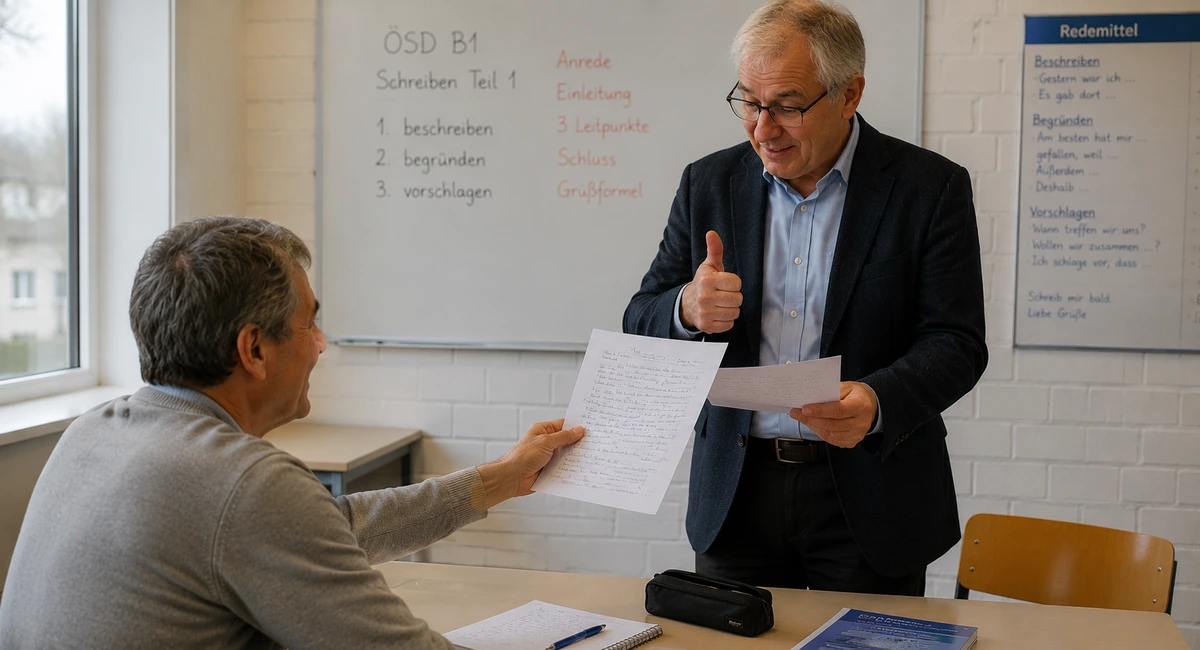
B1 ÖSD Writing Part 1:
structure, assessment and typical mistakes
What is Writing Part 1 in the ÖSD certificate B1? Learn, explained simply, how the informal email is structured, how it is assessed, how many points it brings and which mistakes count as serious.
What is Writing Part 1 in the certificate B1?
The Writing module in the ÖSD certificate B1 consists of three tasks. Writing Part 1 is the first of them. Here you write an informal email to a friend. So it is a personal message to a person you know well.
Good to know: the certificate B1 is a joint product of the ÖSD (Österreichisches Sprachdiplom Deutsch) and the Goethe-Institut. The structure, tasks and assessment of Writing Part 1 are identical at the ÖSD and at the Goethe-Institut. So this article applies equally to the ÖSD certificate B1 and the Goethe certificate B1.
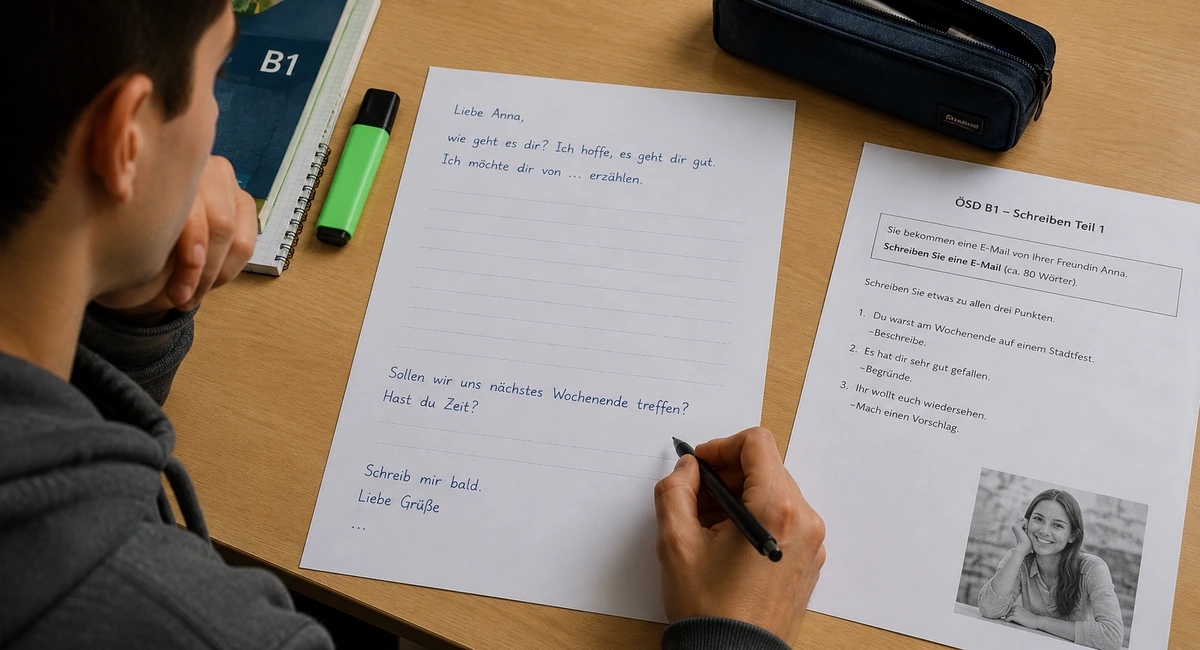
Because you are writing to a familiar person, you use the Du-Form (informal you) and a friendly salutation such as Liebe Anna or Lieber Tom. The goal is simple: you tell something, give information and at the end make a suggestion.
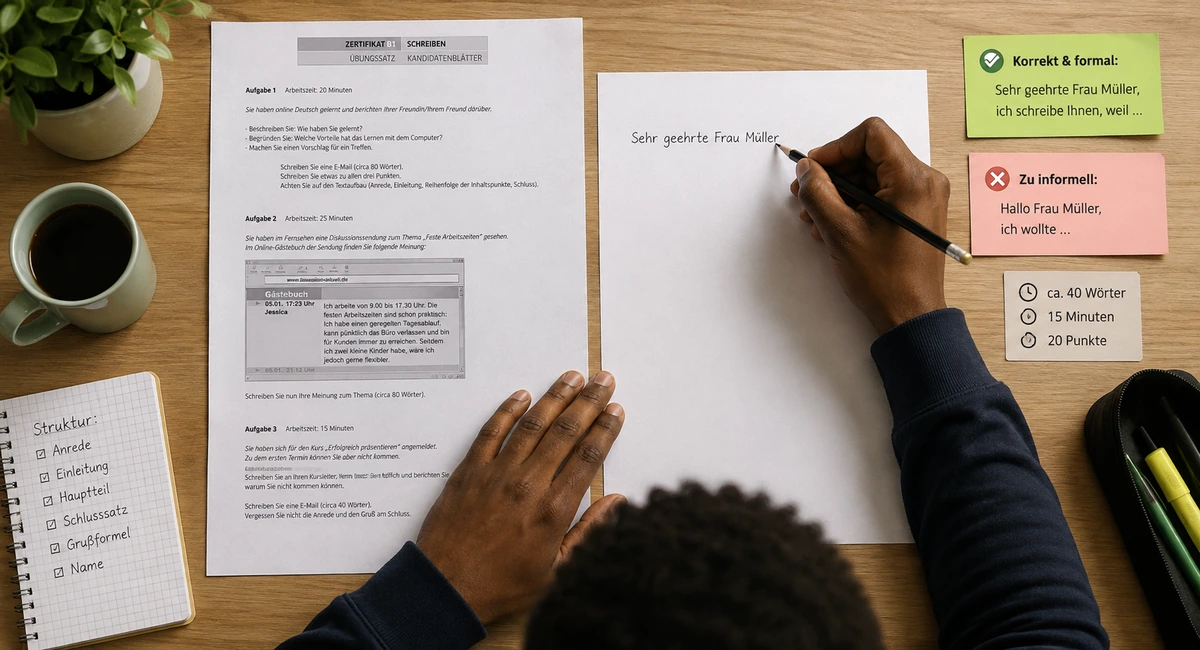
You have about 20 minutes for this task and write a text of about 80 words. The task always consists of a short situation and three guiding points.
The three guiding points
For each of the three points you write two to three sentences. Almost always these are these three speech acts:
- Beschreiben (describe) — you tell what happened (for example: Wie war die Feier?);
- Begründen (give reasons) — you explain something and say why (for example: Welches Geschenk war besonders schön und warum?);
- Einen Vorschlag machen (make a suggestion) — you suggest a meeting (for example: Wann sehen wir uns?).
The correct structure of the email
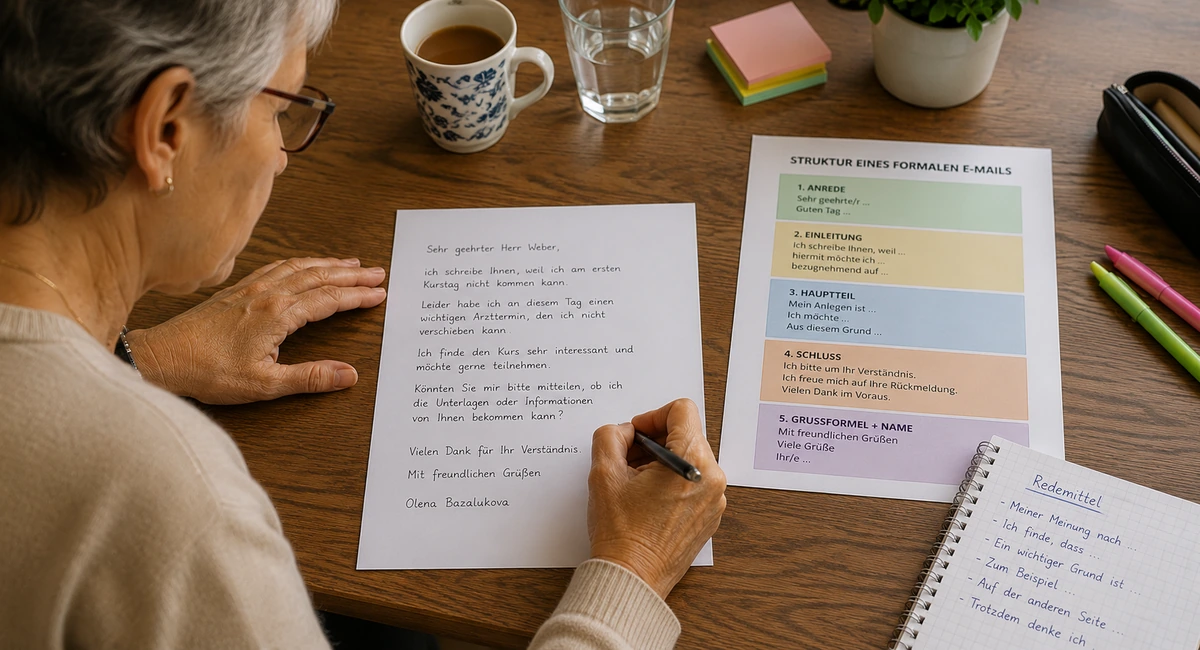
A good email has a clear structure. Pay attention to this order:
- Anrede (salutation) — for example Liebe Anna,;
- Einleitung (introduction) — a short beginning, for example wie geht es dir? Ich möchte dir etwas erzählen.;
- Hauptteil (main part) — the three guiding points in the correct order;
- Schluss (ending) — a last sentence, a closing formula and your name, for example Schreib mir bald. Liebe Grüße, deine Olena.
✅ The length is only assessed indirectly. A somewhat shorter or longer text is not penalised, as long as all three points are dealt with appropriately. What matters is the quality, not the exact counting of the words.
How is B1 ÖSD Writing Part 1 assessed? The four criteria
Each text is assessed by two examiners independently of each other. They pay attention to four criteria. Each criterion is equally important. Here we explain each criterion simply and with examples.
Criterion 1: Erfüllung (task fulfilment)
Here it is checked whether you have dealt with all three guiding points. In addition, the text should be recognisable as an email and have the right form (informal salutation, Du-Form, closing formula).
Example: If the task requires Beschreiben, Begründen and Vorschlag, but you forget the suggestion for a meeting, then the task is not completely fulfilled — and you lose points.
Criterion 2: Kohärenz (coherence)
Kohärenz means good structure and connection of the sentences. Your sentences should be logically connected and linked with small words (for example weil, und, deshalb, außerdem).
Example of weak coherence: Es war super. Wir hatten viel Spaß. Das Wetter war gut. — nothing but short, unconnected sentences.
Better: Es war super, weil wir viel Spaß hatten und das Wetter schön war. Also important: do not begin every sentence with Ich. Vary the sentence beginnings.
Criterion 3: Wortschatz (vocabulary)
Here it is about whether you use suitable words and whether you know enough words for level B1. Small mistakes are allowed, as long as the text is easy to understand.
Example: Die Party war wunderschön is suitable. Colloquial language like total geil or Mist, on the other hand, does not fit into an exam and can cost points.
Criterion 4: Strukturen (structures)
Strukturen means grammar and spelling: verb forms, word order, subordinate clauses and punctuation. Here too what counts is: does a mistake disturb the understanding or not?
Example: Ich habe ein Geschenk bekommen, weil ich Geburtstag hatte is correct. A text with many small mistakes that still stays understandable often gets more points than a text with few but serious mistakes.
| Criterion | What is checked? | Example |
|---|---|---|
| Erfüllung | All three points dealt with, correct text form and salutation | Beschreiben + Begründen + Vorschlag complete |
| Kohärenz | Structure and connection of the sentences | …, weil …, … und …, varied sentence beginnings |
| Wortschatz | Suitable words, range for B1 | wunderschön instead of colloquial language |
| Strukturen | Grammar, sentence structure, spelling | Correct verb forms and subordinate clauses |
How many points does Writing Part 1 bring?
Writing Part 1 in the ÖSD certificate B1 brings a maximum of 40 points. These points are distributed evenly across the four criteria. So each criterion can bring up to 10 points.
The assessment is done in levels. For each criterion there are five possible levels:
| Level | Meaning | Points per criterion |
|---|---|---|
| A | Upper end of B1 | 10 |
| B | Lower end of B1 | 7.5 |
| C | Close to B1 | 5 |
| D | Far below B1 | 2.5 |
| E | Cannot be assessed (too short or topic missed) | 0 |
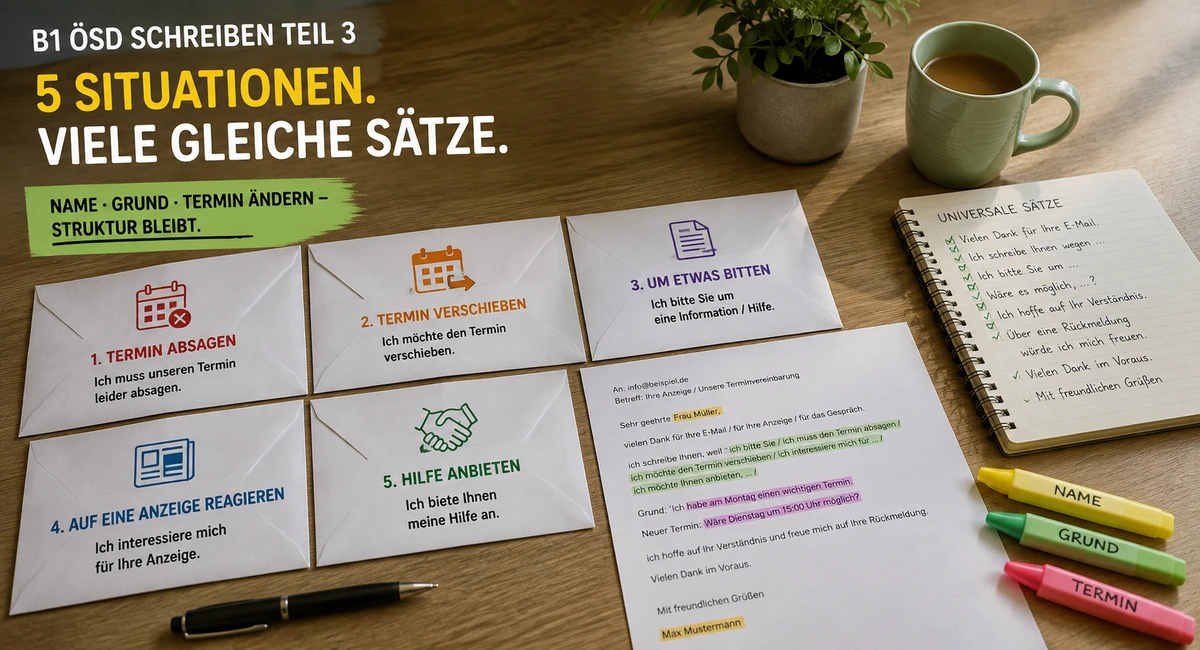
The whole Writing module (Part 1 + Part 2 + Part 3) brings 100 points together. Part 1 and Part 2 bring 40 points each, Part 3 brings 20 points. To pass the module you need a total of at least 60 out of 100 points.
⭐ For the maximum score in Kohärenz you should connect your sentences with words like weil, und, deshalb or außerdem and vary the sentence beginnings. Write simply, but not in nothing but short, separate sentences.
Which mistakes count as serious?
Some mistakes cost only a small part of the points. Other mistakes are serious and lead to a big loss of points. Here are the most important serious mistakes that you should absolutely avoid.
Forgetting a guiding point or leaving it unclear
If a point is missing or the reader does not understand it, the fulfilment drops sharply. The suggestion is especially dangerous: if the reader does not recognise your sentence as an invitation to a meeting, the point counts as not fulfilled.
Missing the topic or writing too short
If the text has fewer than half of the required words or goes past the topic, the fulfilment is assessed with 0 points. With that the whole task is not passed.
Wrong salutation or wrong register
Writing Part 1 is a personal email. A formal salutation like Sehr geehrte Damen und Herren or the Sie-Form does not fit here. Colloquial language (for example total idiot) also counts as an unsuitable register.
Mistakes that disturb the understanding
It is not the number of mistakes that is decisive, but their effect. A mistake that makes the sentence incomprehensible is serious. Many small mistakes in a text that is still understandable, on the other hand, are less bad.
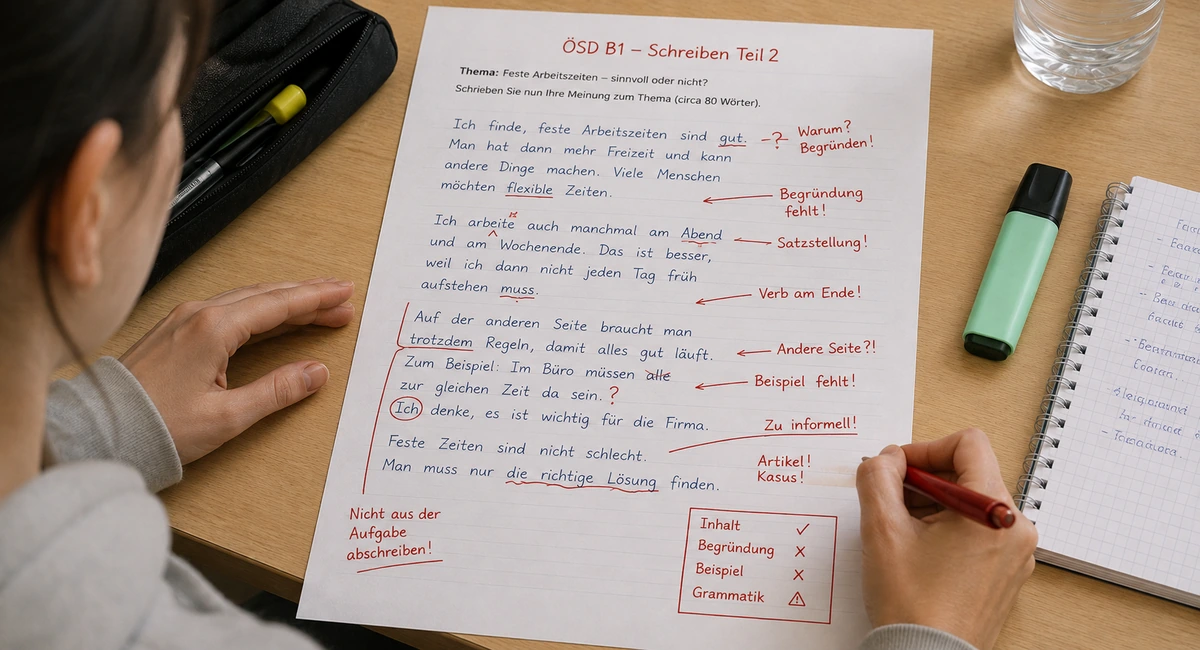
Copying whole sentences from the task
You may use individual words from the task. But if you copy whole sentences or phrases word for word, that leads to a deduction of points. Always formulate in your own words.
Two mistakes are assessed especially strictly because they can set the fulfilment to 0 points: missing the topic and writing a text that has fewer than 50% of the required words. In these cases the whole task is not passed.




There are no comments for this article. Leave your comment