





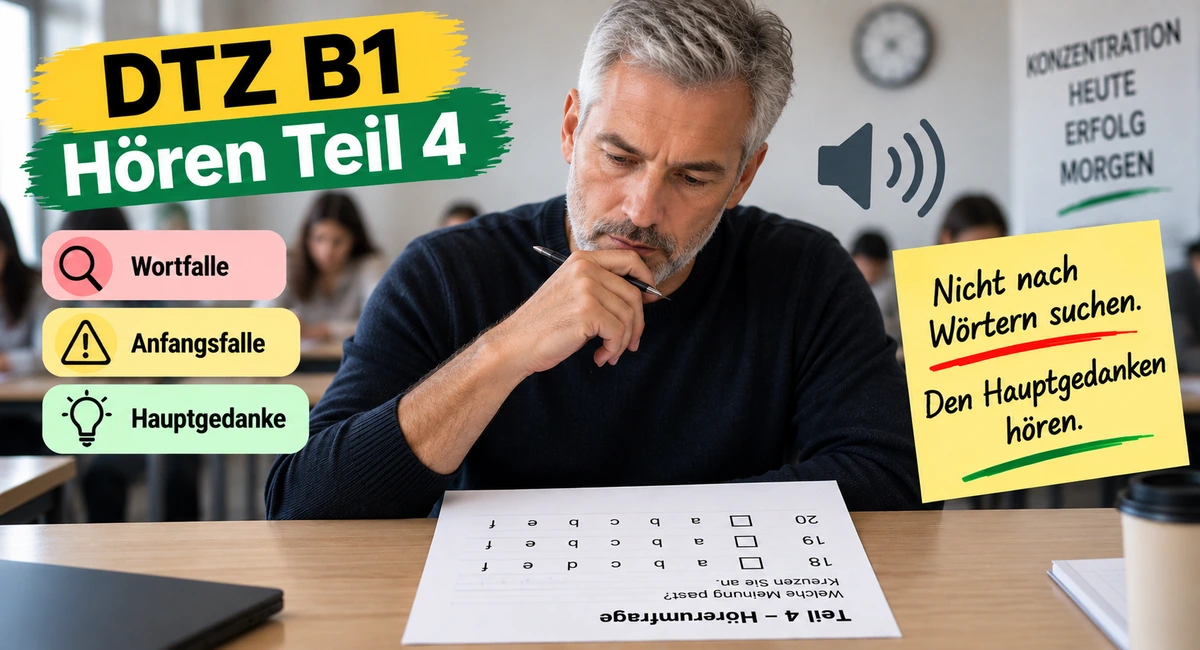
Why Is Teil 4 Special?
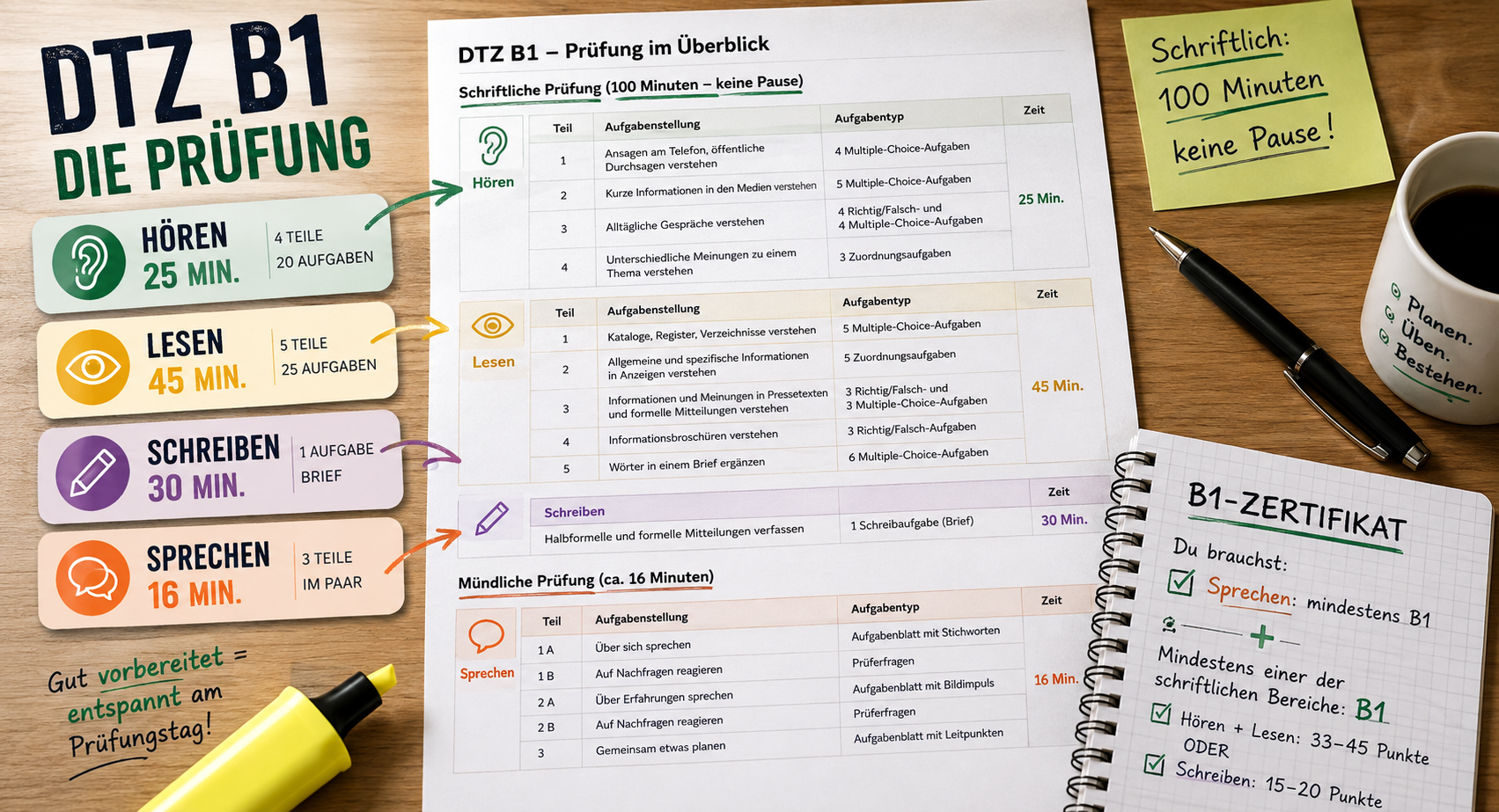
Anyone preparing for the B1 DTZ exam will quickly notice: the first three parts of the Listening section are challenging, but straightforward in structure. Teil 4 is different. It is the only part of the entire Listening section that is officially assigned to level B1 — sometimes even B1.2. This means: understanding individual words is not enough here. Here you need to think.
But don't be discouraged. Anyone who understands the logic of this task can solve it systematically. That is exactly what this article is about.
What Do You Actually Have to Do in Teil 4?
You hear a radio programme in the format of a listener survey. The host asks a question on an everyday topic — for example about neighbours, health, work or family. Then four short opinions from different people are played. One of them is an example that has already been solved. The three remaining ones — Aussage 18, 19 and 20 — have to be solved independently.
Your task: read six sentences (a to f) and match each opinion you heard to the appropriate sentence. Three sentences fit — three do not. Sounds simple? In reality there are specific tricks involved. And those are exactly what we are going to work through now.
The Golden Rule — The Most Important Thing
Before we talk about traps, remember one key rule:
The correct answers are not quotations. They are a brief summary of the main idea.
The speaker never says word for word what is written in options a–f. They tell a story, give an example, describe a situation — and you have to grasp the essence of what was said.
Example: A woman explains that she works as a waitress, is on her feet all day, carries heavy trays and suffers from back pain by the evening. An orthopaedist recommended special footwear — and things have been better ever since. The correct answer: Unsuitable footwear can cause back pain. Anyone who hears the word "carry" and thinks: "Oh, this is about lifting heavy things!" — falls straight into the trap.
Trap 1: The Same Word — A Different Meaning
This is the most dangerous trap of all. A word from the audio text appears almost word for word in one of the wrong answers — but the meaning is completely different, sometimes even the opposite.
Example: Someone describes in detail how they lift a heavy box of books — and at the same time explains the correct technique to avoid injuring their back. The wrong answer reads: Back pain occurs when you lift books from the floor. You hear the word "books" — you see the word "books" — and you reach for the wrong answer. But the speaker was describing protection, not the cause of the pain!
Remember: If a word from the text appears word for word in one of the options — that is a warning signal. Always check the meaning, not just the word.
Trap 2: The Meaning Is Turned Upside Down
The speaker says one thing — and the wrong answer flips the meaning to the exact opposite.
Example: A young woman says: "It was clear to me from the very beginning — I didn't want to live alone." Wrong answer: Most young people today prefer to live on their own. You hear the word "alone" — and reach for the wrong answer, even though the speaker means exactly the opposite.
Remember: Pay particular attention to small words — nicht, kein, aber, obwohl. They change everything.
Trap 3: The Profession Leads You Astray
Many speakers mention their profession right at the start. This immediately steers your thinking in a certain direction — and that direction is not always the right one.
Example: A PE teacher talks about back pain among her female students. You immediately think: She will say something about exercises or sport. But her actual main point is something completely different: More and more teenagers are suffering from back pain. The profession is just context. Not the answer.
Remember: The profession explains why someone is speaking about this topic. It says nothing yet about what their main point is.
Trap 4: The First Sentence Leads You Astray
Many speakers begin with a sentence that seems to directly match one of the wrong answers. Then the text changes direction — and the real opinion only comes at the end.
Example: A man begins with the words: "A few years ago I did sport almost every day." You think: "The answer is — you need to exercise every day!" But then he explains that because of work he now has almost no time for sport. The real main point: Not everyone has time for sport.
Remember: Never make a decision after the first sentence. Listen to the end.
Trap 5: The Main Idea Is Right at the End
This is the complete opposite of the previous trap. The speaker talks at length about details, background, situations — and only in the very last sentence says what the actual main idea is.
Example: A woman talks at length about a difficult period in her life, a break-up and sleep problems. And only right at the end does she say: "When everything in life is going well and there are no worries — good health comes by itself." That is the answer. Everything else was just the path leading to it.
Remember: Stay focused until the very last sentence. That is often where the real idea is hiding.
Trap 6: Details Distract from the Essence
Some speakers tell their story very vividly — with names, numbers, specific situations. These details sound important, but they are not.
Example: A man describes in detail how when lifting a box he bends his knees, keeps his back straight and lifts the load slowly. This description takes up almost half the text. But the correct answer has nothing to do with it — it reads: Targeted muscle training reduces the load on the spine.
Remember: Details are an illustration, not the main idea. Always ask yourself: what does this person want to say overall?
Trap 7: The Speaker's Situation and Their Opinion Are Two Different Things
Sometimes the speaker's personal situation is the direct opposite of their opinion.
Example: A woman says she works full-time. She then explains that in her opinion parents should work part-time in order to spend more time with their children. Her situation and her opinion are two different things.
Remember: Don't ask "What does this person do?" — ask "What does this person think?"
Trap 8: The Example Option
The example — the text that has already been solved and marked with a cross — often covers an idea that overlaps thematically with the other statements. Anyone who is not careful may mistakenly reach for this option again.
Remember: Before listening, read the example option carefully and consciously remove it from your mind. It is no longer in the game.
Strategy: Step by Step
One Minute Before Listening
Before the statements begin, you have one minute to read options a–f. Use it like this:
- Mark the example option with a cross and mentally forget about it.
- Read the remaining five options and note one key word for each: what is this option about? No need to memorise — just get a rough sense of the topic.
- If two options sound similar, mark them. One of them is almost certainly a trap.
While Listening
Don't look for individual words — look for the main idea. Ask yourself: what does this person want to say? What problem are they describing? What opinion are they expressing?
If you are unsure after listening — don't panic. Sometimes the answer only becomes clear once you have listened all the way to the end.
After Listening
If you are hesitating between two options — check for the word trap. Which of the two contains a word that was said word for word in the text? That is most likely the trap. The other option — the one that expresses the same idea in different words — is most likely the correct answer.
What Topics Appear in Teil 4?
According to the official BAMF requirements and the curriculum of integration courses, Teil 4 always deals with topics from everyday life in Germany. These are exactly the topics covered in the courses — and exactly the ones that appear in the Hörerforum radio format:
health and nutrition · sport and exercise · family and raising children · housing and neighbourhood · work and leisure · ecology and transport · technology and everyday life · school and education
The texts of B1 DTZ Hören are always close to real life and cover situations familiar to everyone. No specialist knowledge is required — but a broad vocabulary on these topics and the ability to express opinions in German are a great help during preparation.
Summary — The Most Important Points at a Glance
| Trap | How to Recognise It |
|---|---|
| Word trap | A word from the text appears in the answer — but the meaning is different |
| Reversed meaning | The speaker denies what is written in the answer |
| Profession trap | The profession creates a false expectation about the topic |
| Opening trap | The first sentence leads you in the wrong direction |
| Ending trap | The main idea is in the very last sentence |
| Detail trap | Specific details distract from the essence |
| Situation ≠ opinion | The speaker's personal situation contradicts their opinion |
| Example trap | The example option is thematically similar to the real answers |
One Last Thing
Teil 4 does not test grammar knowledge. It does not test spelling. It tests something far more important: the ability to truly listen to a person and understand what they mean. Not what they say. But what they mean.
That is a skill needed in real life every single day. And that is exactly why B1 DTZ Hören Teil 4 is not just an exam task. It is training for life.






There are no comments for this article. Leave your comment