





telc B1 Reading Part 1:
structure, assessment and typical mistakes
How is Reading Part 1 of the telc Deutsch B1 structured, how many points does it bring and which mistakes cost the most? Here you find the clear overview and a practical solving strategy.
Structure: what awaits you in Reading Part 1?
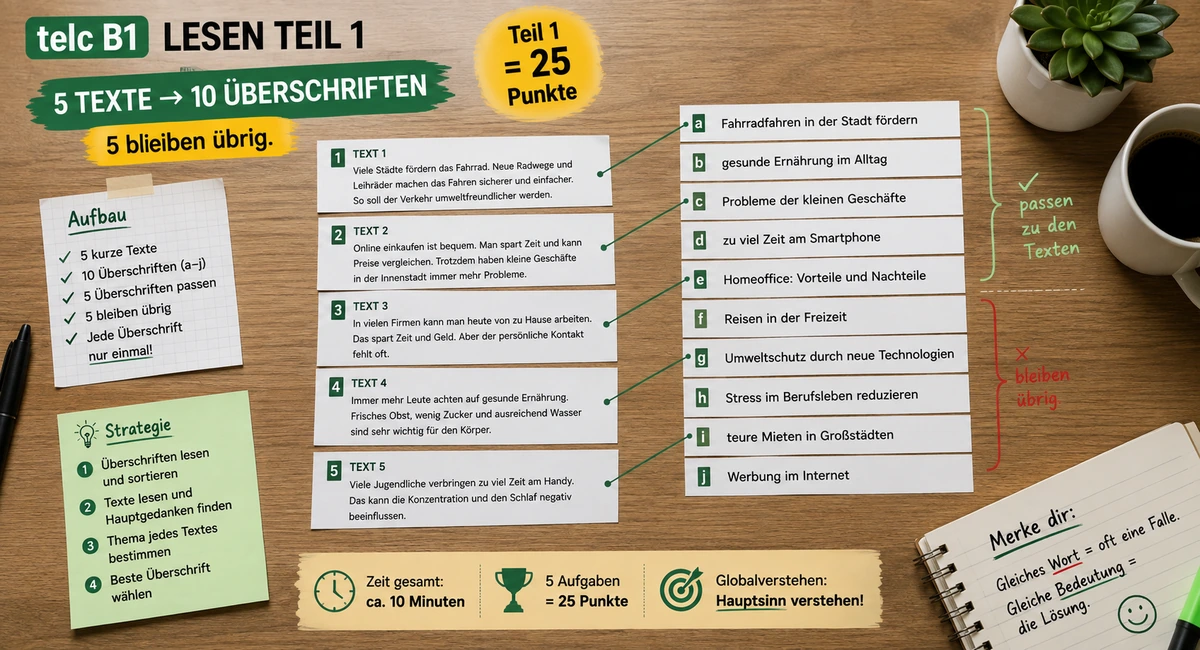
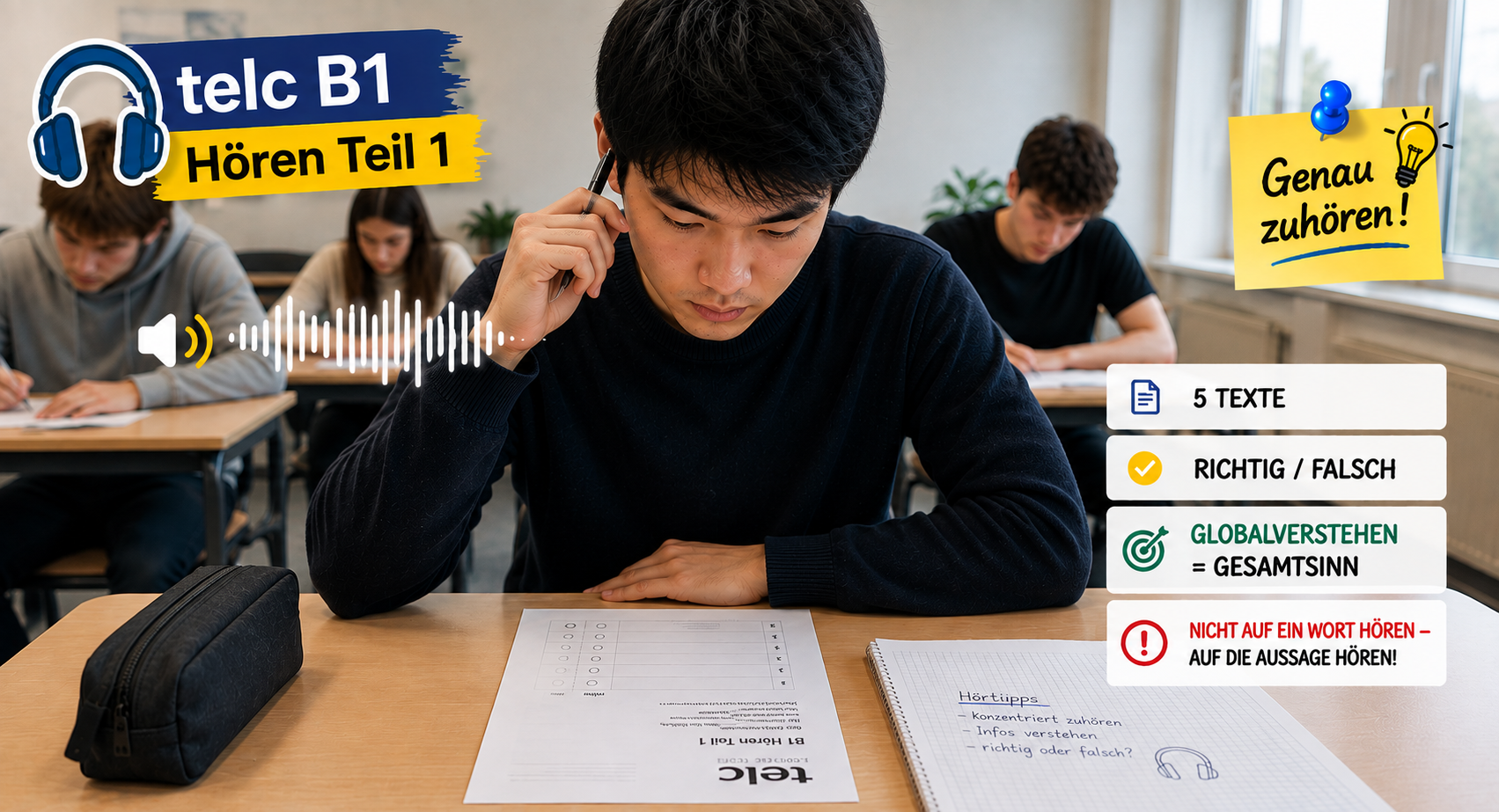
Reading Part 1 is the first task in the written exam section reading comprehension (Leseverstehen). The reading comprehension subtest consists of three parts, and Part 1 tests so-called global understanding (Globalverstehen) – that is, the ability to grasp quickly what a short text is essentially about. Here you do not have to understand every detail, but to recognise the main idea of each text.
The task is a matching task: you get five short texts and ten headings. For each text you should find the one matching heading. That sounds simple, but it is deliberately built so that merely searching for identical words is not enough.
The most important facts at a glance
- Tasks: 1 to 5 (five texts, five solutions).
- Headings: ten of them, marked with a to j.
- Rule: each heading may be used only once.
- Distractors (Distraktoren): five headings remain – they fit no text and serve only as distraction.
- Aim: global understanding, that is, recognising the main idea of each text.
There are twice as many headings as texts. Exactly these five additional headings make the task hard: they usually sound fitting, but do not describe the text precisely.
The texts and the headings
The five texts are short, everyday texts from newspapers and magazines: small notices, announcements, book tips, surveys or information on an offer. The topics are general and easy to understand, for example travel, health, work, family, leisure or education. The language is at level B1.
The ten headings are short and all seem credible. One characteristic that telc itself describes is important: the headings can be sorted into few topic areas – usually into at most three. This means: several headings often belong to one topic at the same time. So the fact that a heading has the same topic as a text proves nothing yet. The exact meaning is always decisive.
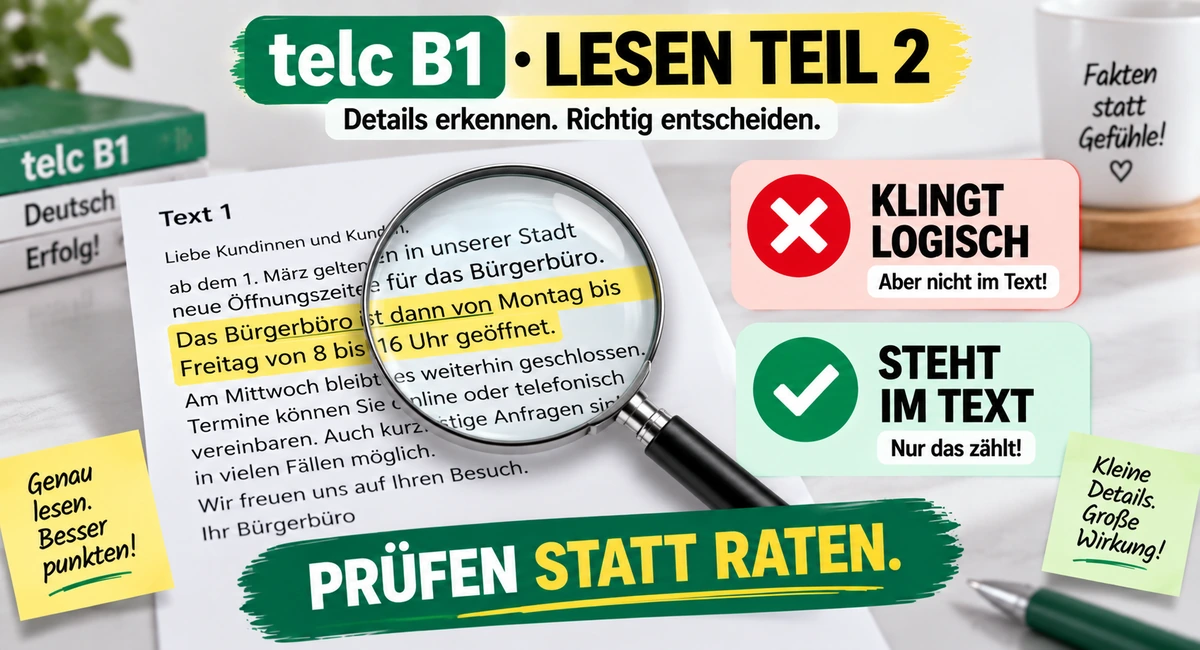
An identical word in text and heading is often a distraction. The correct heading hits the meaning of the whole text, not just a single word from it.
The correct heading must fit the whole text, not just one sentence or one number. A heading that describes only a small detail is almost always wrong – even if the detail really appears in the text.
Assessment and points
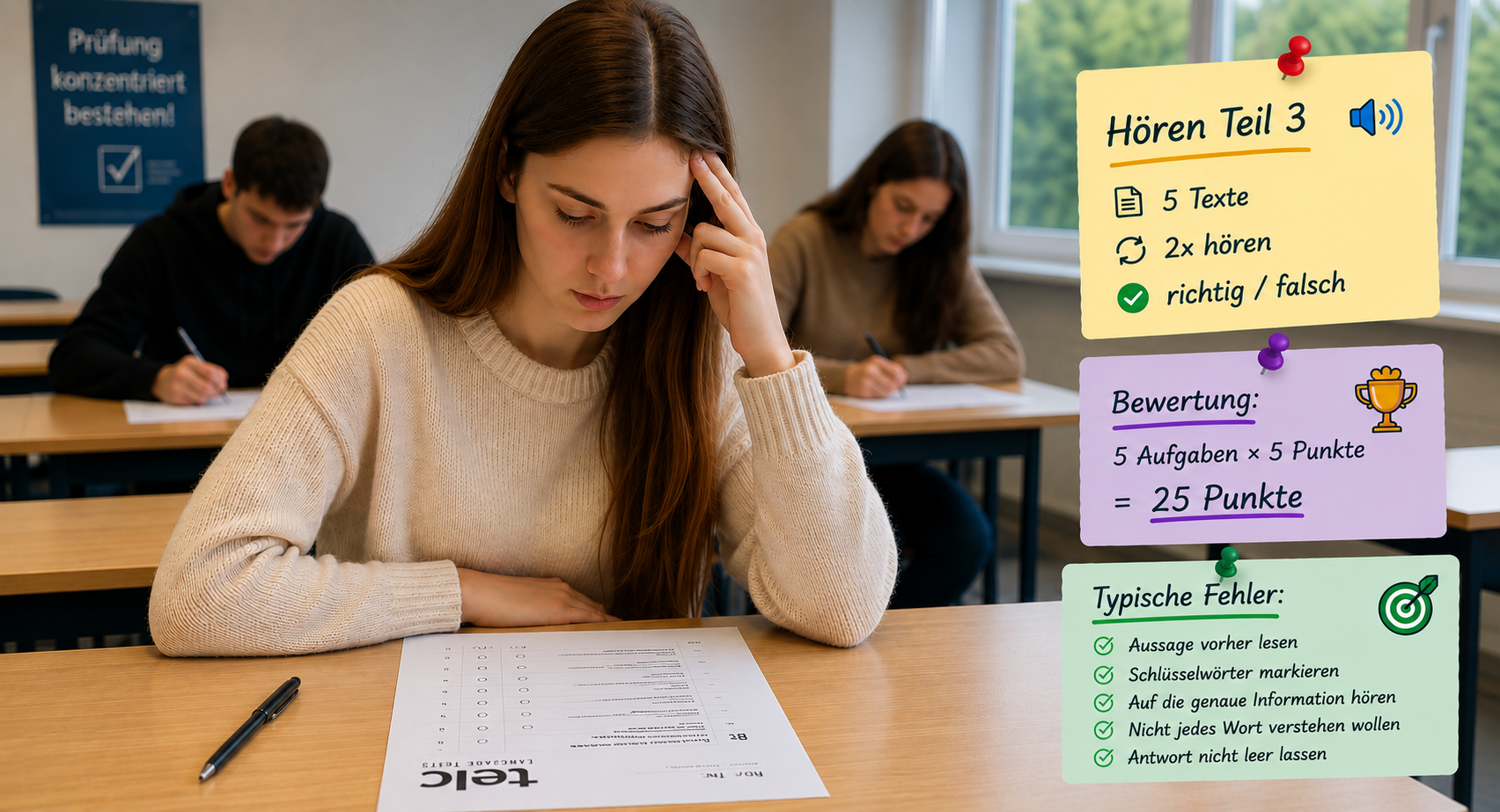
In Reading Part 1 every correct solution is worth a lot. For each of the five tasks there are five points. This makes Part 1 one of the most rewarding sections in the whole reading comprehension.
| Exam part | Tasks | Points per task | Points total |
|---|---|---|---|
| Reading Part 1 (global understanding) | 1 to 5 | 5 | 25 |
| Reading Part 2 (detailed understanding) | 6 to 10 | 5 | 25 |
| Reading Part 3 (selective understanding) | 11 to 20 | 2.5 | 25 |
| Reading comprehension total | 1 to 20 | – | 75 |
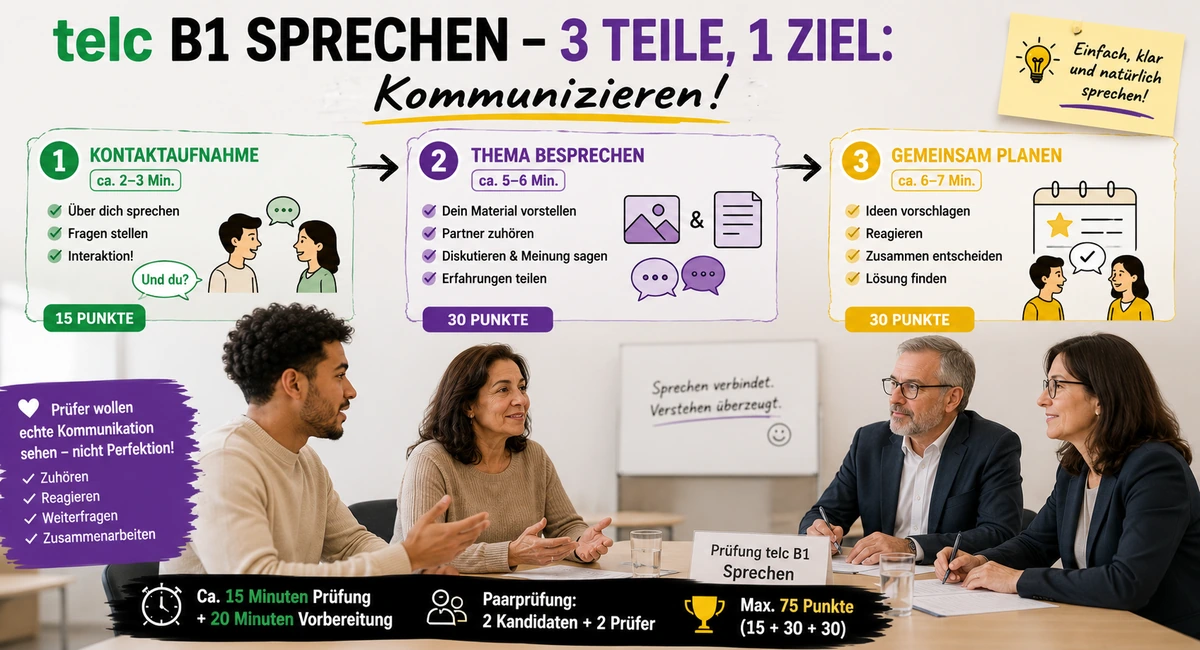
The whole reading comprehension brings 75 points and makes up 25 percent of the exam. The whole exam comprises 300 points. It is passed when you reach 60 percent of the possible points in both the written and the oral part, that is 135 points written and 45 points oral.
How much time do you have?
For reading comprehension and Sprachbausteine (language structures) together there are 90 minutes without a break. There is no separate time only for Part 1. Since the five texts are short, it is wise to work quickly here and to save more time for the longer tasks. A good guideline is about ten minutes for Part 1.
Structure, points and weighting follow the information from telc and the official practice test. You find the official information on the exam at telc: telc Deutsch B1 auf telc.net.
The official solving strategy in four steps
In the official telc training material a clear path is shown for how you solve Part 1 safely and quickly. Keep to these four steps, then you lose less time and fall for distractions less often.
| Step | What you do |
|---|---|
| 1 | First read all ten headings and mentally assign them to two or three topic areas. |
| 2 | Read the texts and underline the most important words in each text. |
| 3 | First assign each text to a topic area. This way only a few possible headings remain per text. |
| 4 | Within the topic area, choose the one heading that hits the content most precisely. |
The topic narrows down the circle of possible headings, but it does not yet give you the solution. You always make the final decision via the exact meaning of the whole text.
Typical mistakes and how you avoid them
Most points in Part 1 are lost not through lack of knowledge, but through haste and through a few recurring thinking errors. Here are the most common ones – and the simple solution for them.
| Mistake | Why it costs points | Better like this |
|---|---|---|
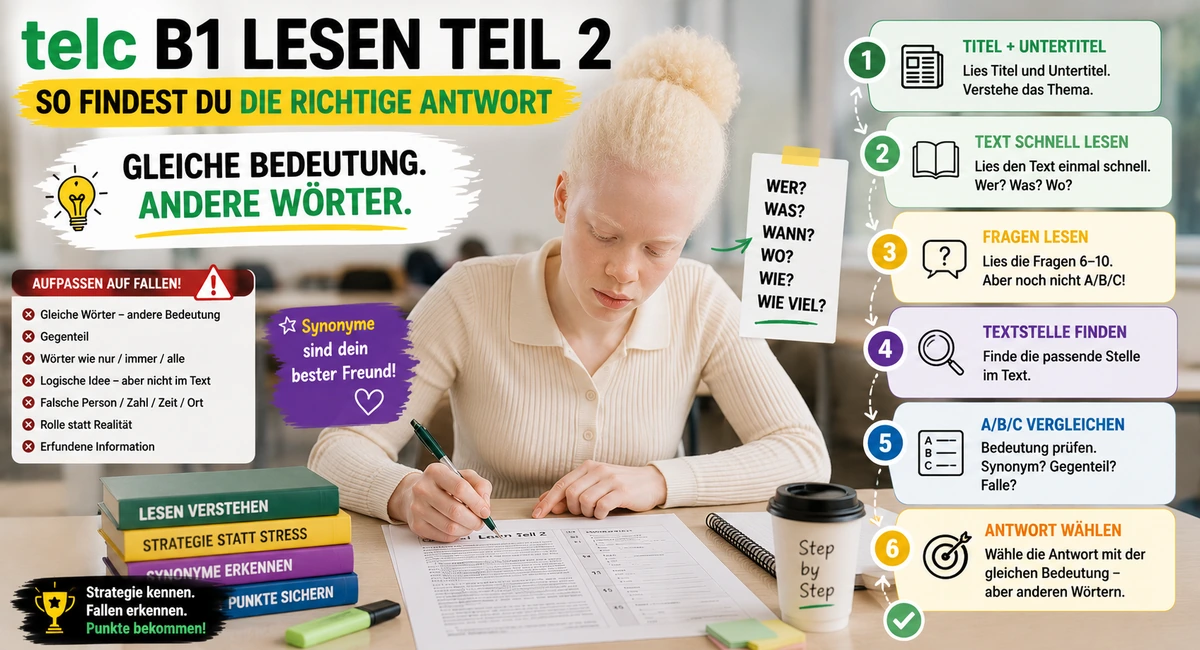
| Searching for identical words | Many headings contain a word from the text but mean something else. | Pay attention to the meaning, not to single words. |
| Reading the texts first, then the headings | Without headings in mind you read aimlessly and lose time. | Always read the ten headings first. |
| Choosing a heading that fits only one detail | A striking number or a subordinate clause is not the topic of the text. | Ask: does the heading fit the whole text? |
| Forgetting that five headings remain | You desperately look for a use for every heading. | Accept that five headings are only distraction. |
| Getting stuck too long on one text | Valuable time is then missing for the longer tasks. | Mark a difficult text, carry on, come back later. |
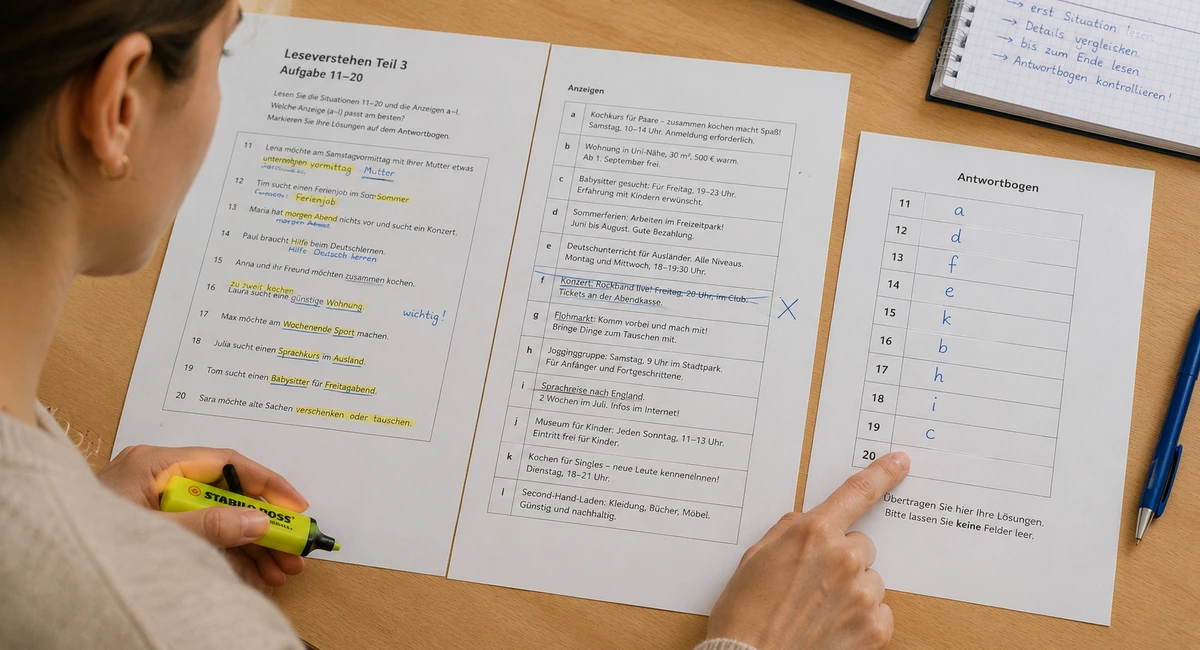
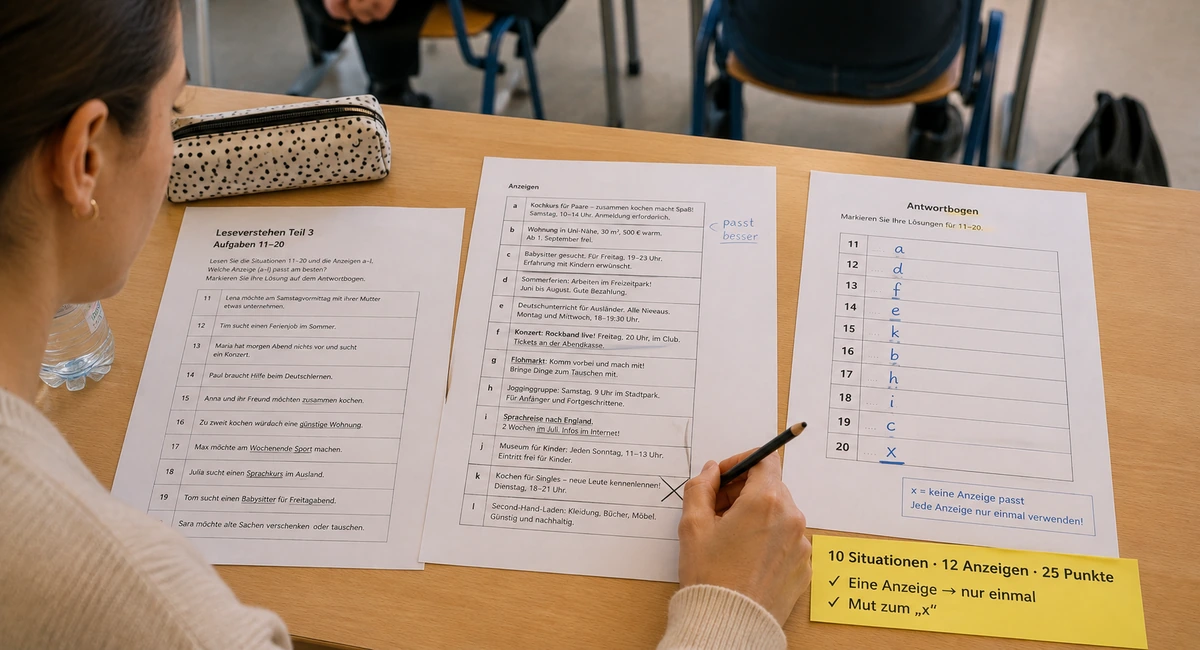
| Not transferring solutions cleanly | Only the mark on the answer sheet (Antwortbogen) counts. | Enter the answers in time and correctly. |
An identical word is often a trap – the same meaning is the solution. If two headings seem to fit, choose the one that hits the main idea of the text most precisely.
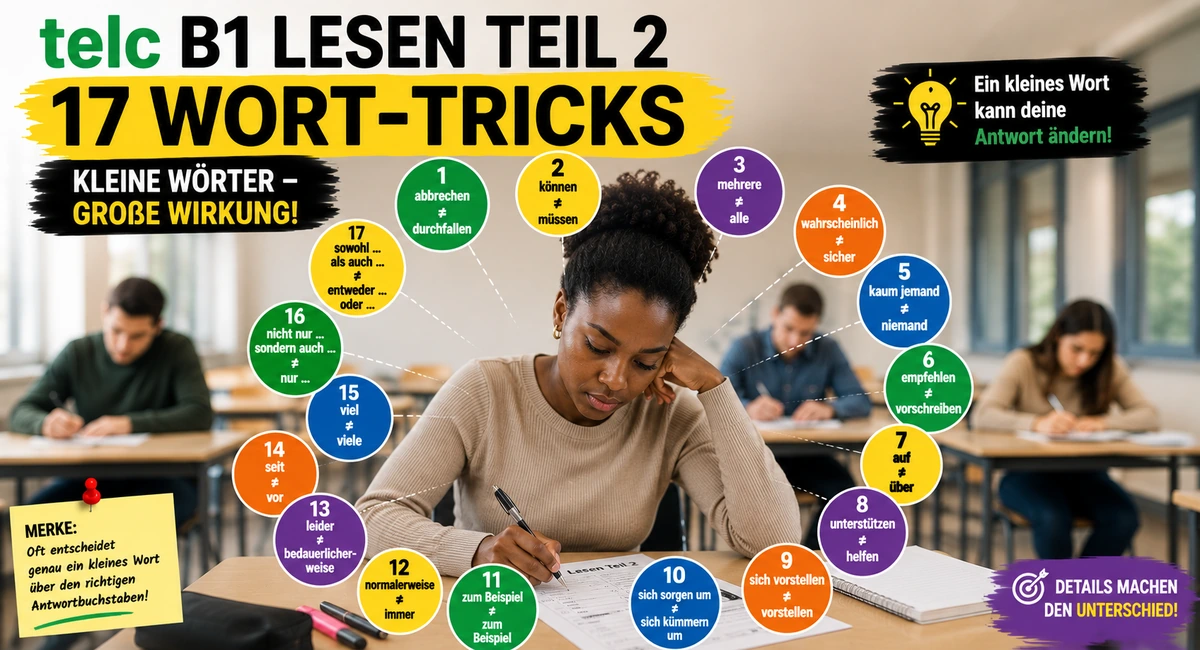
A final tip from practice: pay attention to small words like nur, kein, mehr, weniger (only, no, more, less) or to the tense. Often one single such word decides whether a heading really fits the text or whether it slightly twists the statement.
📚 All exercises on telc B1




There are no comments for this article. Leave your comment