





Goethe B1 Reading Part 2:
structure, assessment and typical mistakes
How Reading Part 2 is structured, how many points you really need and which mistakes cost you points unnecessarily. With official figures from the Goethe-Institut – clearly explained for your preparation.
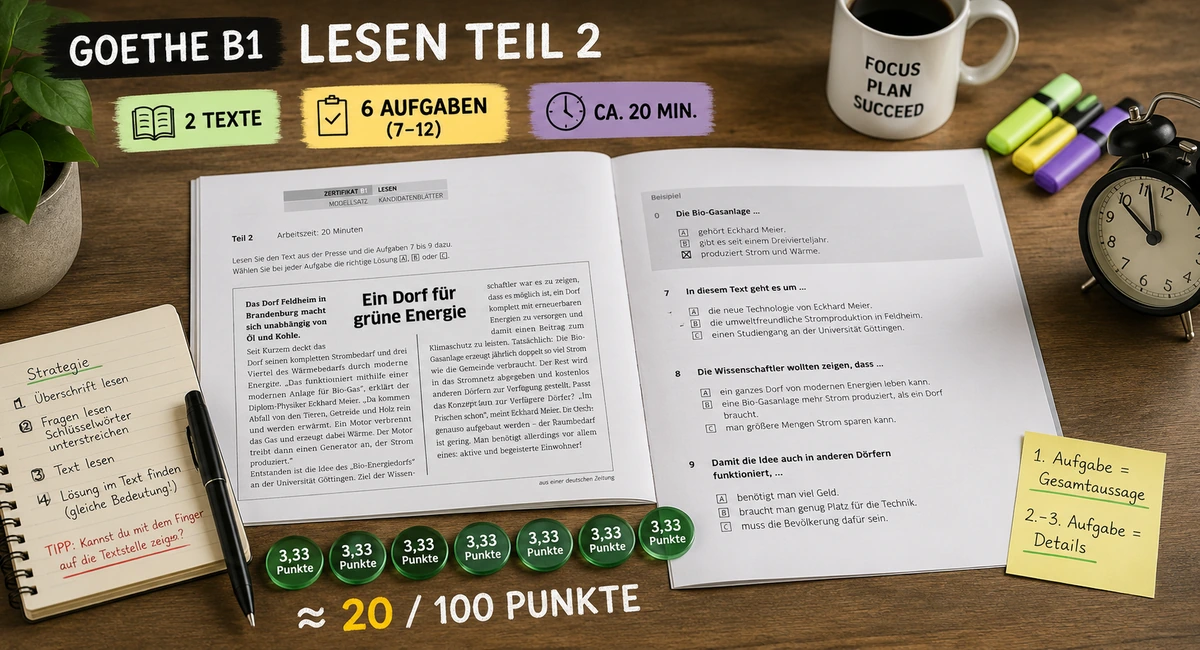
Structure: Part 2 in the Reading module
The Reading module in the Goethe-Zertifikat B1 consists of five parts and lasts 65 minutes in total. Each part tests a different reading skill. Part 2 is responsible for detailed reading: you should not only roughly understand what it is about, but also grasp individual pieces of information precisely.
| Part | What is mainly tested |
|---|---|
| Part 1 | understanding the main points of a personal text |
| Part 2 | understanding factual texts in detail |
| Part 3 | matching advertisements to a situation (selective reading) |
| Part 4 | recognising opinions (for or against) |
| Part 5 | understanding rules and instructions |
Because Part 2 tests precise understanding, quick skimming is not enough here. You have to find the right place and then read carefully. Exactly for this reason this part also has the most time of all five parts, with about 20 minutes.
You can work on the five parts in any order. If Part 2 suits you, you can do it first – or save it for later if you want to secure easier points first.
Which texts and which tasks await you
The texts
In Part 2 you read two factual texts. These are, for example, newspaper articles, texts from a magazine, from a brochure or an information leaflet. The topics are everyday and factual: society, leisure, environment, work, travel, technology and the like. Each text is about 300 words long.
Important to know: the texts come from the whole German-speaking area – that is, from Germany, Austria and Switzerland. Therefore individual regional words may appear. Do not let that unsettle you; the meaning almost always becomes clear from the context.
The tasks
Each text has three tasks (so six in total, number 7 to 12). For each one you choose between three options: a, b or c. Only one is correct. The structure is always the same:
- First task – overall statement: what is the whole text about?
- Second and third task – details: individual pieces of information from the text.
A practical advantage: the detail tasks usually follow the order of the text. So the answer to the second task is further up than the answer to the third. This way you find the matching places faster.
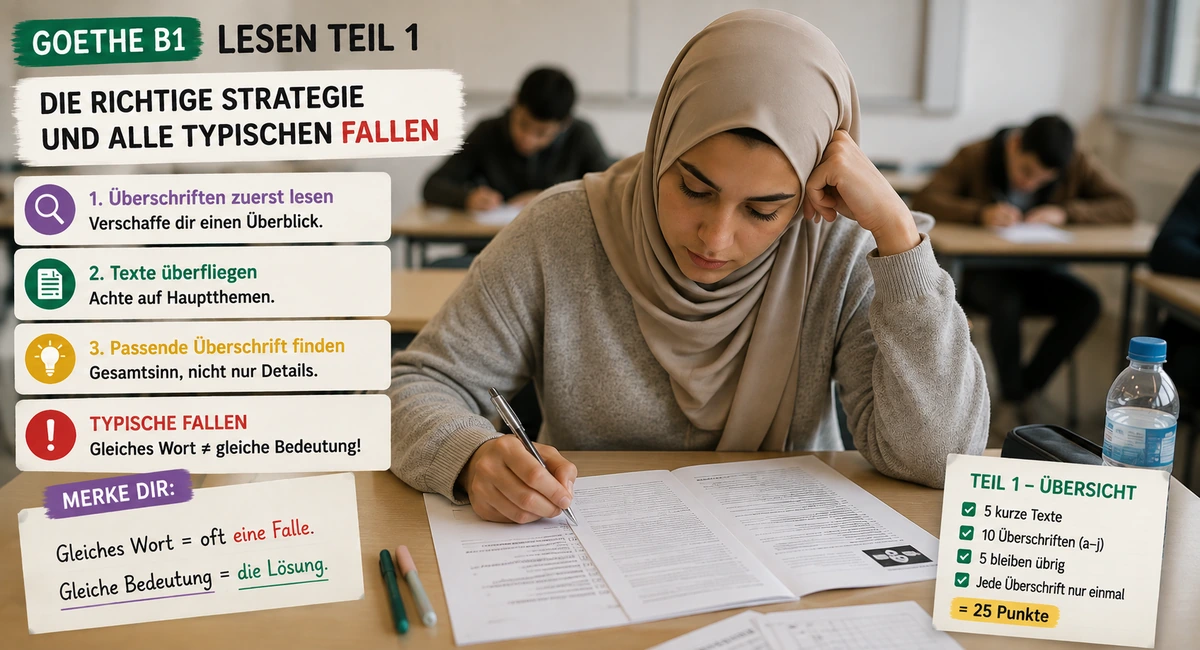
Which concrete traps the wrong answers contain (same words in the wrong context, the opposite, absolute words and so on) and how you solve them step by step, we explain in detail in the article the right strategy and all typical traps. Here it is about structure, assessment and the most common mistakes in approach.
Assessment: how Part 2 is counted
Many learners do not know exactly how their points come about. Yet the system is simple – and it helps you to divide your time correctly.
According to the official implementation regulations (Durchführungsbestimmungen) of the Goethe-Institut, there are 30 tasks (items) in the whole Reading module. Each task is a measurement point and brings either 1 point (correct) or 0 points (wrong). At the end the points reached are multiplied by the factor 3.33 and converted to 100 result points.
| Question | Answer |
|---|---|
| How many tasks does the Reading module have? | 30 tasks (items) |
| How many of them are in Part 2? | 6 tasks (no. 7–12) |
| How many points per correct answer? | 1 measurement point ≈ 3.33 result points |
| How many points does Part 2 bring at most? | 6 × 3.33 ≈ 20 of 100 points |
| When is the module passed? | from 60 of 100 points (60%) |
| Point deduction for wrong answers? | no |
Three consequences for your exam
- ⭐ Every task is worth the same. No part and no question counts more than another. A difficult detail question brings just as many points as an easy one.
- ⭐ Wrong answers cost nothing. There is no deduction. Therefore never leave a field empty.
- ⭐ You can take the Reading module separately and also repeat it separately. You do not have to redo the whole exam if only one module is missing.
A correct answer in Part 2 is worth about 3.33 points. Six correct answers therefore bring around 20 points – a fifth of the whole module. That is a lot: it is worth training Part 2 specifically.
How many points do you really need?
To pass the Reading module, you need 60 of 100 points. Converted to the 30 tasks, that means: you have to solve about 18 of 30 tasks correctly (18 × 3.33 ≈ 60). The remaining 12 may be wrong.
That is an important, reassuring piece of information: you do not have to be perfect. But every secure answer helps. If you have, for example, five of six tasks correct in Part 2, that is already around 17 points – a big step towards 60.
| Correct items (of 30) | Result (approx.) | Reading module |
|---|---|---|
| 30 | 100 points | passed |
| 24 | approx. 80 points | passed |
| 18 | approx. 60 points | passed (borderline) |
| 15 | approx. 50 points | not passed |
The exact point threshold is always set by the Goethe-Institut. This table serves only as orientation, so that you get a feeling for the numbers.
👉 Practise the Reading section under exam conditions B1 GoetheTypical mistakes – and how you avoid them
Most of the points lost in Part 2 do not arise from poor German, but from a wrong approach. Here are the most common mistakes at a glance.
| Mistake | The consequence | Better like this |
|---|---|---|
| Wanting to understand every word exactly | loss of time, no time for the second text | First read roughly, then search specifically for the right place |
| Getting stuck too long on a difficult task | easy points are left lying at the end | Put a question mark, carry on, come back later |
| Leaving a field empty | a safe guessing chance given away | Always tick (no point deduction) |
| Answering from your own knowledge instead of from the text | the answer sounds logical, but is wrong | Only what really stands in the text counts |
| Treating the first task like a detail question | a detail chosen instead of the main topic | First task = what is the whole text about? |
| Not using the order of the questions | long searching in the text | detail questions follow the text order |
| Transferring solutions not at all or too late | answers do not count | Plan time for transferring, use a ballpoint pen |
| Never practising with a time limit | too slow in the exam | Train regularly with a 20-minute limit |
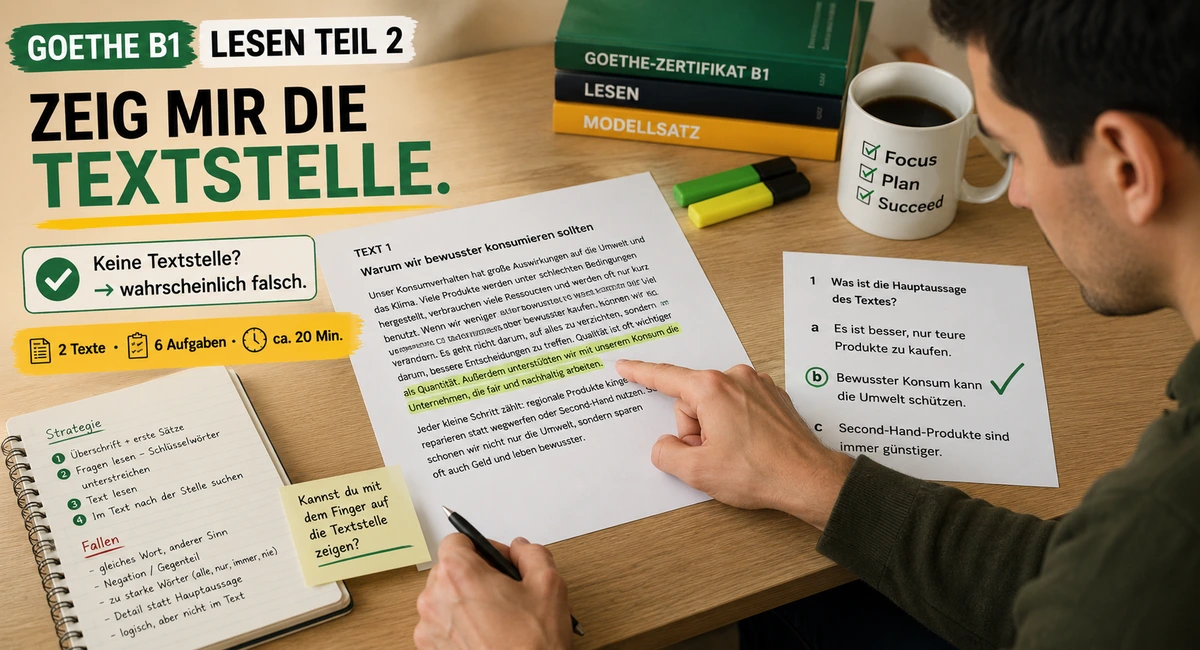
1. Answer only with the text in your hand – point at the place with your finger.
2. Divide the 20 minutes deliberately: about 9 minutes per text, then transfer.
3. Practise several complete tasks with a stopwatch beforehand, so that you know the pace.
Official sources and materials
All information on structure, number of tasks, time and assessment comes from the official documents of the Goethe-Institut. If you want to look at the original documents yourself, you find them here:
- 🔗 Official model test set B1 (Modellsatz – complete sample test with the Reading module): goethe.de – Modellsatz Erwachsene (PDF)
- 🔗 Implementation regulations B1 (Durchführungsbestimmungen – official rules on assessment and points): goethe.de – Durchführungsbestimmungen B1 (PDF)
Read the official rules through once in peace and then do many exercises in the same format. This way you connect the knowledge about the structure with real training – that is the fastest way to secure points.




There are no comments for this article. Leave your comment