





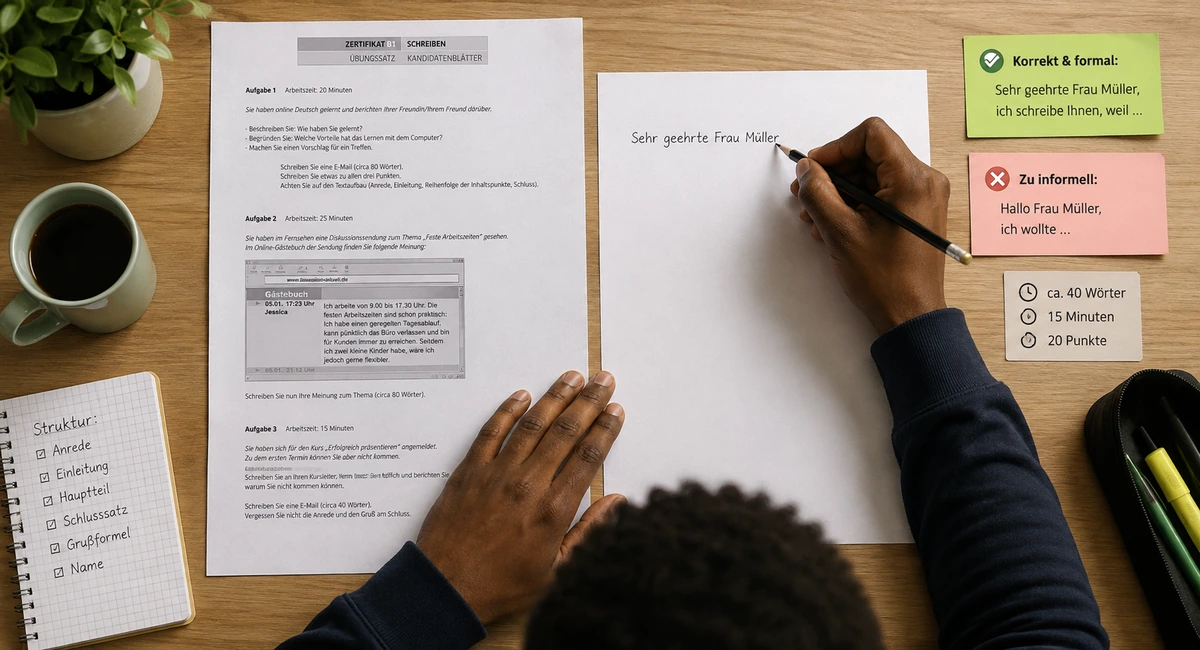
B1 ÖSD Writing Part 3:
structure, assessment and typical mistakes
Everything about Writing Part 3 in the ÖSD certificate B1: the structure of the formal email, the four assessment criteria and the typical mistakes that cost points.
Overview: structure, time and assessment of Writing Part 3
Writing Part 3 is the third and shortest task in the Writing module of the ÖSD certificate B1. Here you write a short, formal email. The topic is always practical: you have to, for example, cancel an appointment, ask for something or respond to an advertisement.
The task is short but important. Many participants lose points here because they do not read the situation carefully or use the wrong salutation. In this article we show you exactly how Part 3 works and how you avoid typical mistakes.
| Feature | Writing Part 3 |
|---|---|
| Text type | short, (semi-)formal email |
| Addressee | teacher, supervisor, company, service provider |
| Length | about 40 words |
| Time | about 15 minutes |
| Points | maximum 20 |
Part 3 is short, but you should still plan about two minutes at the end for checking. A small mistake in the salutation or the closing quickly costs points.
Who do you write to? The communication partners and the register
In Part 3 you do not write to a friend, but to a person from the (semi-)formal area. That is the biggest difference from Part 1. You always address the addressee with Sie.
Typical communication partners are:
- your teacher or course leader;
- your supervisor or a colleague;
- a potential employer or a company;
- a service provider, for example a workshop, a practice or a landlord.
Because the register is formal, you use a formal salutation and a formal closing. Colloquial language does not fit here. Words like super, okay or Quatsch are wrong in this email.
In Part 3 the following always applies: salutation with Sie and with the surname, for example Sehr geehrte Frau Müller. If you do not know the name, you write Sehr geehrte Damen und Herren.
Which language actions appear?
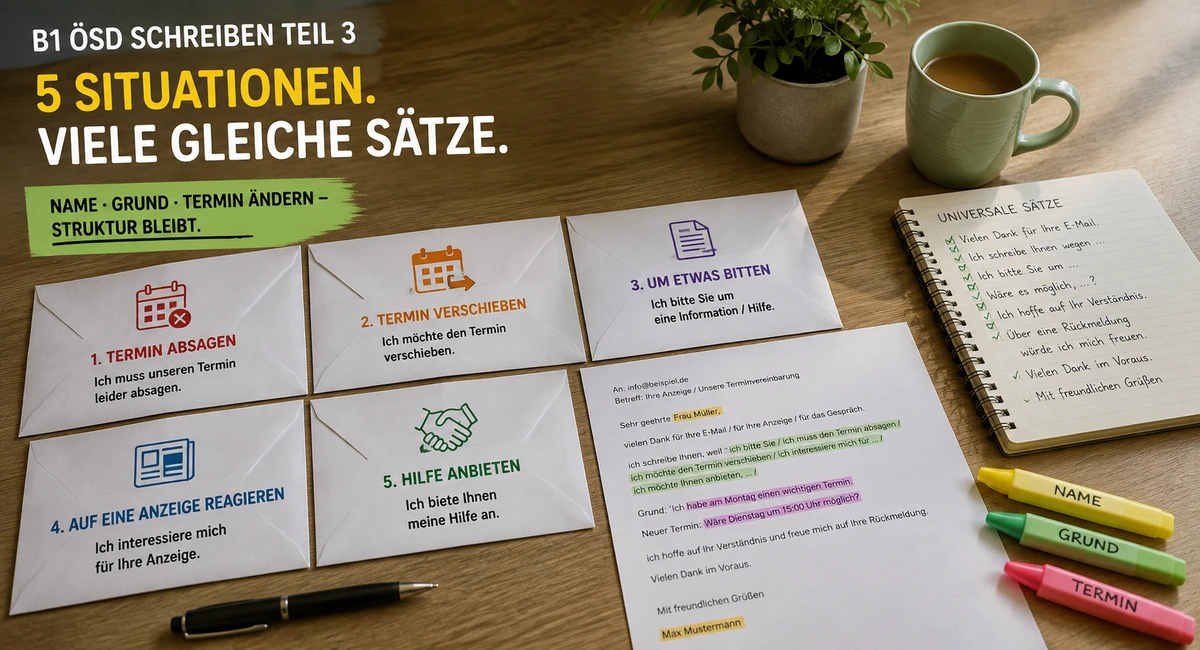
The task contains a situation, an addressee and a desired language action. The language action tells you what you have to do. These actions appear most often:
- sich entschuldigen / einen Termin absagen (apologise / cancel an appointment) — you cannot come to an appointment;
- einen Termin verschieben (postpone an appointment) — you would like a new appointment;
- um etwas bitten (ask for something) — for example for information or a certificate;
- auf eine Anzeige oder einen Aushang reagieren (respond to an advertisement or a notice) — for example for a flat or a job;
- Hilfe oder Mitarbeit anbieten (offer help or participation) — for example at a celebration;
- eine Information mitteilen (give a piece of information) — for example a new address.
Always read the task carefully. Often there are two small tasks in one sentence, for example: apologise and suggest a new appointment. You have to write both parts.
👉 Exercises for ÖSD B1 WritingThe structure of a formal email
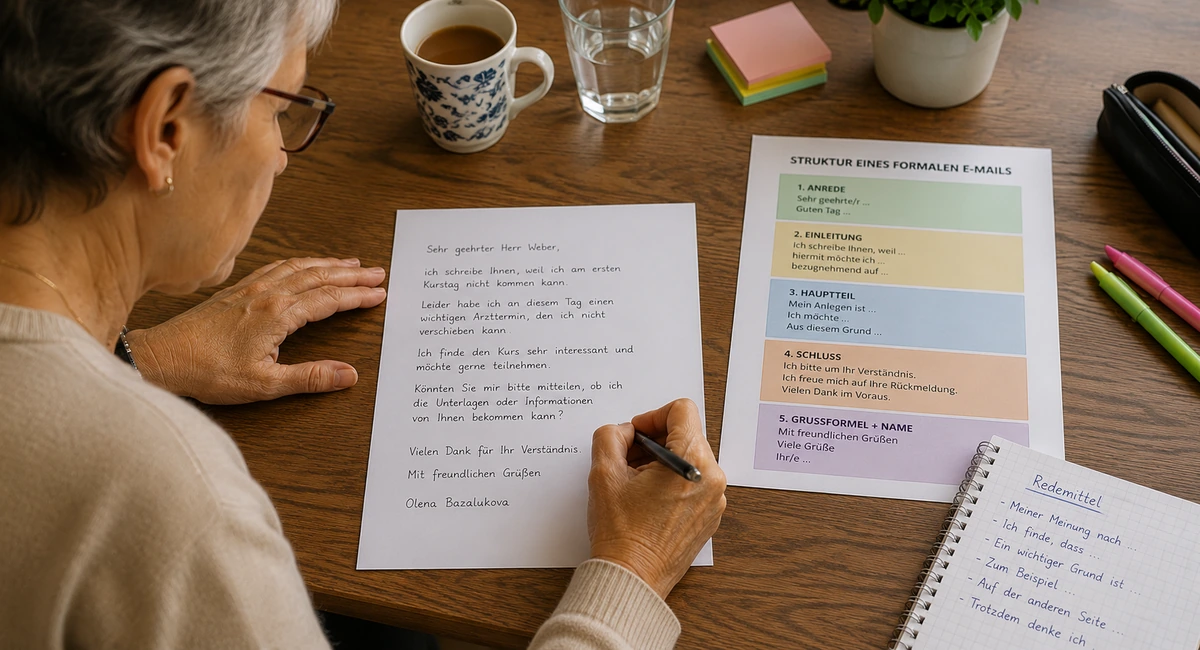
A good email in Part 3 always has a clear structure. This is what the structure looks like:
- Anrede (salutation): Sehr geehrte Frau … / Sehr geehrter Herr …
- Einleitung (introduction): a short sentence about the reason, for example vielen Dank für Ihre Einladung.
- Hauptteil (main part): here you carry out the language action, for example apologise and give a reason.
- Schlusssatz (closing sentence): a short, fitting sentence, for example Über einen neuen Termin würde ich mich freuen.
- Grußformel (closing): Mit freundlichen Grüßen
- Name (name): your first and family name.
Never forget the salutation and the closing. Without them the text type email is not complete, and you lose points for the coherence.
Write one to three short sentences for each point of the task. This way you reach the about 40 words without making the text too long.
The assessment: the four criteria and 20 points
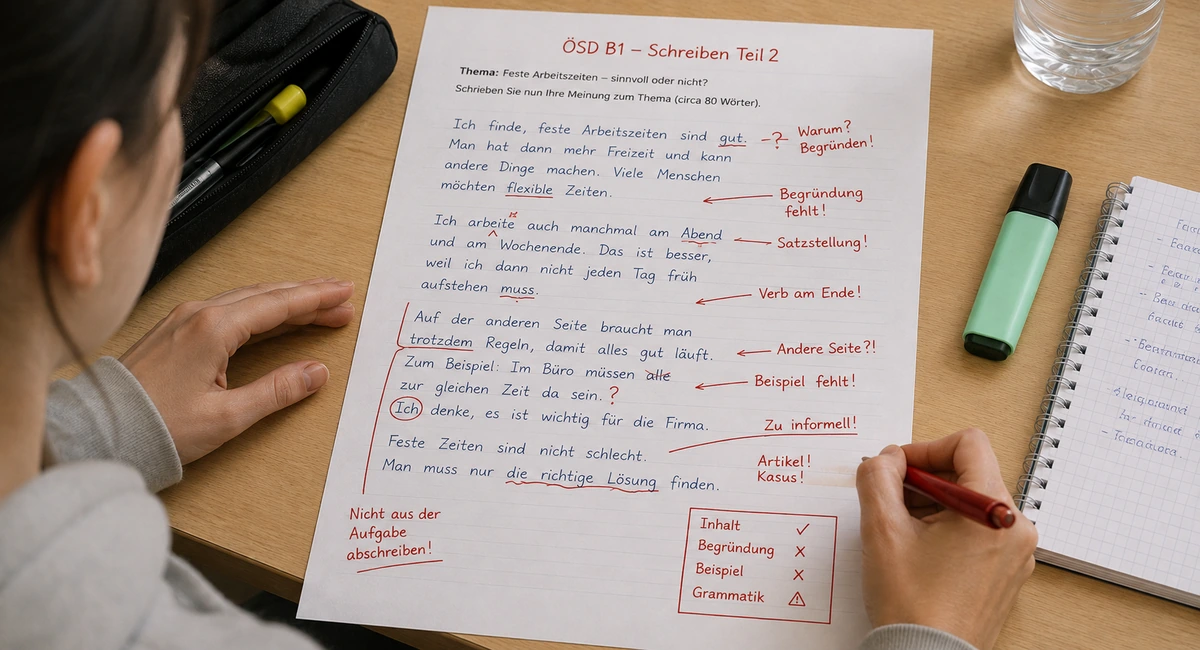
For Part 3 you can get a maximum of 20 points. The examiners assess your text according to four criteria:
| Criterion | Points | What is checked? |
|---|---|---|
| Erfüllung der Aufgabenstellung (task fulfilment) | 4 | Have you dealt with all points of the task? Does the text type email fit? |
| Kohärenz (coherence) | 4 | Is the text clearly structured? Are there a salutation, introduction and closing? Are the sentences well connected? |
| Wortschatz (vocabulary) | 6 | Do you use suitable words? Is the vocabulary correct and not copied from the task? |
| Strukturen (structures) | 6 | Is the grammar correct? Are the sentence structure, verb forms and spelling right? |
Important: mistakes in the vocabulary and in the structures count especially negatively when the reader can no longer understand the text because of them. Therefore better use simple sentences that you master confidently.
Typical mistakes and how to avoid them
These mistakes appear especially often in Part 3. If you know them, you lose no points.
Mistake 1: misunderstanding the situation
This is the most dangerous mistake. Some participants read the task too quickly and write about something wrong. If the task says that you should cancel an appointment, then you have to do exactly that. Therefore read the situation twice.
Mistake 2: wrong salutation or closing
A salutation like Hallo Frau Müller or just Frau Müller is too informal. Correct is Sehr geehrte Frau Müller. The closing must also be formal: Mit freundlichen Grüßen, not Viele liebe Grüße.
Mistake 3: too short or too long
A text with only 30 words is too short. Then important information is often missing. Write about 40 words. A bit more is no problem, but too short costs points for the fulfilment.
Mistake 4: copying words from the task
Do not write the same sentences as in the task. Use your own words. If you only copy, you get fewer points for the vocabulary.
Mistake 5: colloquial language
Words from spoken language like super, echt or Quatsch do not fit in a formal email. Stay polite and neutral.
The two most important points in Part 3 are: understanding the situation exactly and using the right register. Whoever pays attention to these two things is already halfway there.
Step by step: how to write Part 3
With these five steps you write Part 3 confidently and quickly:
- Read the situation. Who do you write to and why? Read the task twice.
- Find the language action. What should you do? Cancel, ask, offer?
- Note keywords. Write short notes for each point.
- Write the email. Salutation, introduction, main part, ending, closing and name.
- Check. Check the salutation, closing, grammar and word count.
Model letter with explanation
Here is an example. The task is: your course leader, Frau Müller, has invited you to a meeting about your grades. But you cannot come. Apologise politely and explain why.
Sehr geehrte Frau Müller,
vielen Dank für die Einladung zu unserem Gespräch über meine Noten. Leider muss ich mich entschuldigen, da ich an diesem Tag arbeiten muss und keinen freien Termin bekomme. Über einen neuen Termin würde ich mich sehr freuen.
Mit freundlichen Grüßen
Maria Sanchez
Why is this letter good?
- The salutation is formal and correct: Sehr geehrte Frau Müller.
- The introduction thanks politely for the invitation.
- The main part apologises and gives a clear reason.
- The closing sentence fits the situation and politely asks for a new appointment.
- The closing is formal, and the text has about 40 words.




There are no comments for this article. Leave your comment