





A straightforward guide for anyone who wants to understand the logic of the task and score the maximum number of points
Introduction: What is this exam – and what is it for?
If you are reading this article, you are preparing for the German language exam at the B2 level. This exam is called:
Deutsch-Test für den Beruf B2
Abbreviation: DTB B2
This exam is not just a language test. It is a state-recognised exam that concludes a special language course for adults – the "Berufssprachkurs" (occupational language course). These courses are offered throughout Germany for people who want to work or already work but want to improve their German for professional purposes.
Who is responsible for this exam? The German Federal Office for Migration and Refugees – BAMF (Bundesamt für Migration und Flüchtlinge). BAMF sets the rules: what you need to know, how points are counted, and what "passed" or "failed" means.
The official rules document is called the Prüfungshandbuch. It is published on the BAMF website and available free of charge:
Website: bamf.de → Infothek → Prüfungshandbuch Deutsch-Tests für den Beruf
Direct link: https://www.bamf.de/...
How is the overall exam structured?
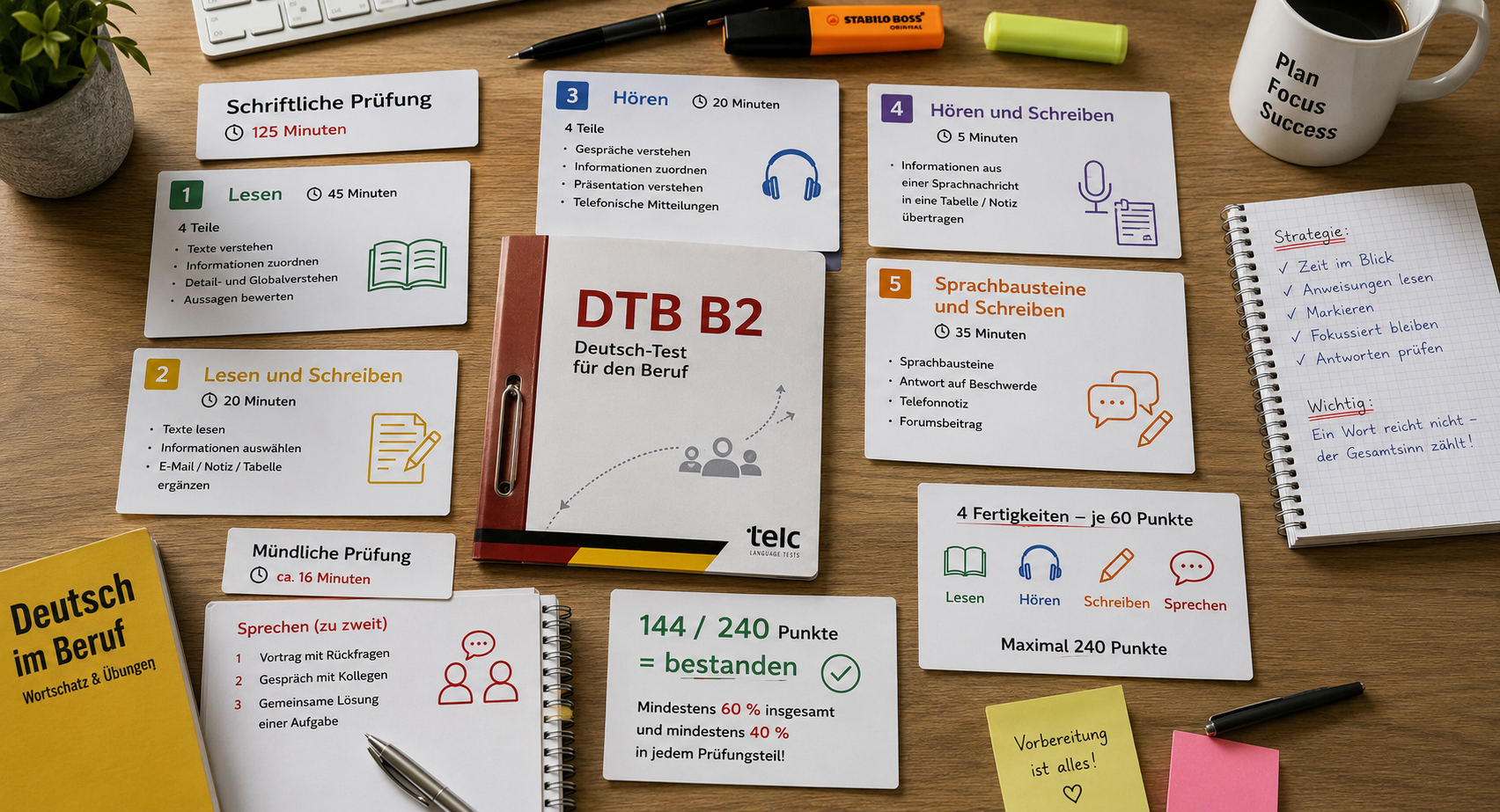
The exam tests four skills. Each skill is worth a maximum of 60 points:
| Skill | Maximum points |
|---|---|
| Lesen – Reading | 60 points |
| Hören – Listening | 60 points |
| Schreiben – Writing | 60 points |
| Sprechen – Speaking | 60 points |
| Total | 240 points |
| Minimum to pass | 144 points = 60% |
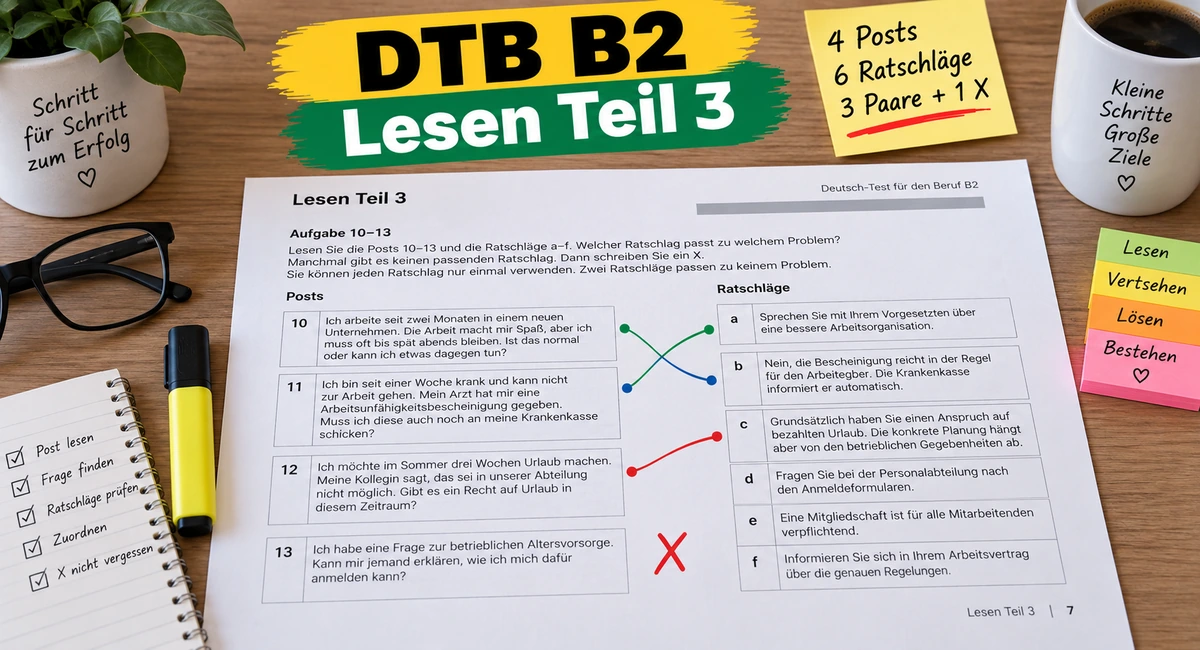
Lesen Teil 3 is one of four parts of the Reading section of the B2 Beruf exam. You can earn up to 12 points for it (4 questions × 3 points each). Every point counts!
Chapter 1: What to expect in the exam
Imagine: you open the task sheet. In front of you is a page showing an internet forum. People are asking questions about their work, and other people are answering them.
Your task is to match each question with the correct answer. That is Lesen Teil 3.
What does the task look like?
On the left (or above): 4 people have written about a problem at work. We will call these "posts". They are numbered: 10, 11, 12, 13.
On the right (or below): 6 people have written responses. We will call these "tips". They are labelled with letters: a, b, c, d, e, f.
Example: what the posts look like
Post 10: "My boss is asking for a doctor's note from the very first day of sick leave. I thought it was only required after three days. Is that right?"
Post 11: "I forgot to call work when I was ill. Now my boss says he can fire me. Is that possible?"
Post 12: "...(another problem)"
Post 13: "...(another problem)"
What do you need to do?
For each post (10, 11, 12, 13), you need to find the matching tip (a, b, c, d, e or f).
IMPORTANT! Two of the six tips are extra. They do not match anyone. Simply leave them unused.
EVEN MORE IMPORTANT! For one post, there is no correct tip at all. In that case, you write the letter X.
How many points are there?
| Correct match | 3 points |
| Correct X | 3 points |
| Wrong answer | 0 points |
| Total questions in Teil 3 | 4 questions |
| Maximum for Teil 3 | 12 points |
Chapter 2: The one key rule – remember it forever
THE KEY RULE
The correct tip answers the post's question EXACTLY.
Not "talks about a similar topic" – but actually answers what the person is asking.
Let's explain this with a simple everyday example.
You ask your neighbour: "Where is the nearest pharmacy?"
Neighbour No. 1 says: "The pharmacy is around the corner, it's open until 8 pm." ← That is the correct answer.
Neighbour No. 2 says: "I always go to the clinic, the doctors there are great." ← That is not an answer to your question. Even though it's about health – it misses the point.
The exam works exactly the same way. The question is about a doctor's note – the correct answer talks about the doctor's note. Not about doctors in general, not about illness in general – specifically about the doctor's note.
Look at the LAST sentence of the post
In every post, the person first tells their story and then asks the main question at the end. That question is in the last sentence.
Example from the exercise "Krankmeldung"
"Ich war nur einen Tag krank und heute war ich wieder im Büro. Mein Chef wollte sofort ein Attest sehen. Ich dachte immer, so etwas braucht man erst nach mehreren Tagen."
Main question (last sentence): Is a doctor's note required from the very first day?
What we look for in the tip: an answer about the doctor's note – specifically when it is required.
Tip: As you read each post, write one keyword next to the number – what is the person asking about? For example: "Attest", "Kündigung", "Pause", "Urlaub". This is your reference point.
Chapter 3: How to find the correct tip
Step 1: Read the post. Note the topic.
Read the post and find the question at the end. Write one keyword next to the number. For example:
- Post 10 → "Attest" (about the doctor's note)
- Post 11 → "Kündigung" (about dismissal)
- Post 12 → "Überstunden" (about overtime)
- Post 13 → "Urlaub" (about holiday)
Step 2: Read the tips. Note the topic of each one.
Read the first 1–2 sentences of each tip. Write one keyword next to the letter:
- Tip a → "about doctor's note"
- Tip b → "about dismissal"
- Tip c → "personal doctor experience"
- Tip d → "about holiday"
- Tip e → "about breaks"
- Tip f → "about contract"
Step 3: Match – starting with the most obvious.
Start with what is very clear. Post 10 asks about the doctor's note → Tip a talks about the doctor's note. It matches! Cross both out.
Then move on to the next obvious pair. And so on.
Step 4: The remaining post is X.
Once three pairs have been found, look at the remaining post. Check: is there at least one tip left that clearly answers this post's question? If not – write X.
Final check: You should have: 3 pairs (post + tip) + 1 X. And 2 tips left unused. If that's not the case – something went wrong, check again.
Chapter 4: The letter X – what is it and how do you find it?
X is the hardest part of the task. Many students are afraid of X. But it's actually simple once you understand the logic.
What does X mean?
X means: none of the six tips matches this post. The person asked a question, but there is not a single tip in the list that directly answers their question.
Example – why X?
Imagine: you are asking about insurance because you fell on the way to work – but you had stopped at the nursery to drop off your child first.
One tip talks about insurance AT work (in the building). Another is about insurance in the event of a car accident.
Neither one answers your specific question: are you covered if you did not take the direct route?
So – X.
How do you recognise that it is X?
Ask yourself one question about each remaining tip:
"Does this tip directly answer the post's question – or does it only talk about a similar topic?"
If it only covers a "similar topic" but does not give a precise answer – it does not fit. If that applies to all remaining tips – it is X.
When does X tend to appear?
Watch out for these signs – if the post contains any of the following, it may be X:
- Very unusual situation: for example, someone fell not on the direct route to work but on a detour – such details are rarely covered by standard tips
- Question about money or personal circumstances: "Can I afford this?" – there is no legal answer to that
- Question about trainees or special contracts: these are non-standard situations
- Combination of two different problems: for example, overtime + part-time contract at the same time
X example from a real exercise
From the exercise "Arbeitszeitregelungen": Sandra works 20 hours a week (part-time). Her boss suddenly says: "Work 8 hours a day for two weeks." Sandra asks: does she have to?
No tip addresses the part-time contract and the right to refuse a doubling of hours. One tip covers the payment of overtime. Another covers rules in specific industries. But neither answers Sandra's specific question.
Answer: X.
Chapter 5: Three traps – and how to avoid them
Trap No. 1: "About the same thing" – but doesn't answer the question
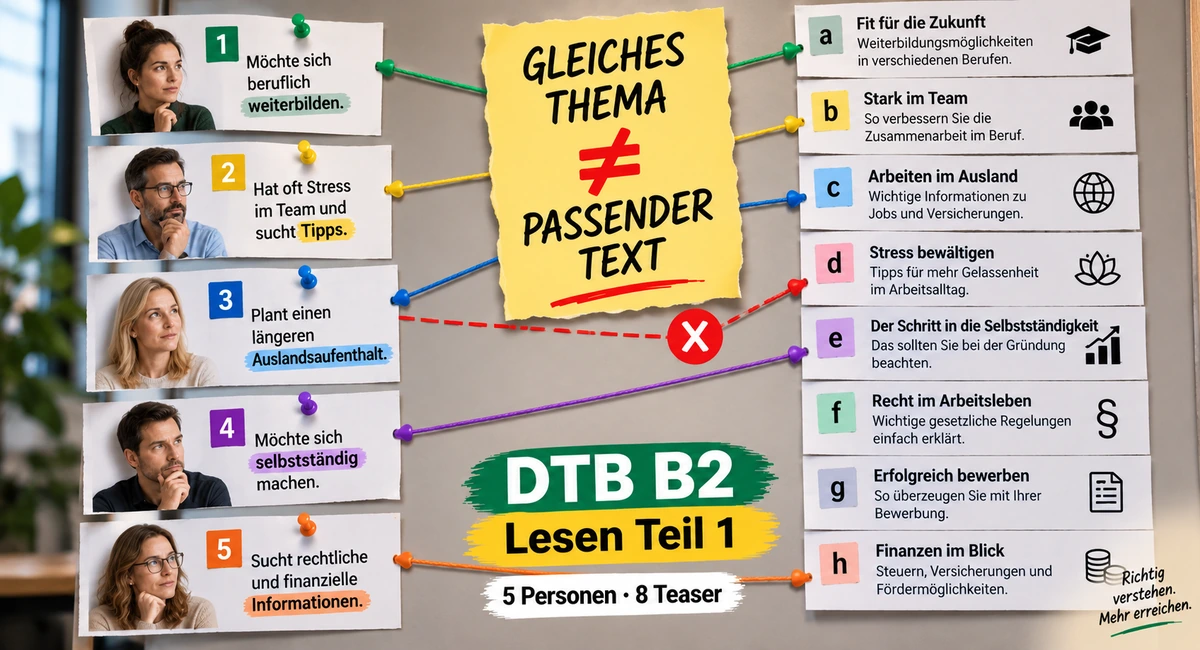
This is the most common mistake. The student sees similar words in a tip and thinks they have found the answer. But the tip is talking about a different aspect of the same topic.
TRAP: same words, different meaning
Post: Moritz fell on the way to work. But he had dropped his child off at nursery first – a detour. Is he insured?
Trap: Tip e says – "Yes, you are insured at your workplace." Both texts contain the word "versichert" (insured). It seems to fit!
Why it doesn't: Moritz is asking about insurance ON THE WAY to work. Tip e is about insurance AT WORK (in the building). These are different things. → X.
Rule: Similar words do not mean a correct answer. Always check the meaning, not just the words.
Trap No. 2: Personal experience instead of an answer
In every task there are 1–2 tips that do not answer anyone's question. These are the "extra" tips. They are easy to recognise: they describe the author's personal experience.
How to spot them? Look at the beginning of the tip:
| Beginning of the tip | What this means |
|---|---|
| "Ich gehe immer sofort zum Arzt..." | Personal habit → probably extra |
| "Bei uns im Büro ist das möglich..." | Personal experience → probably extra |
| "Das kenne ich auch! Bei mir war..." | Personal story → probably extra |
| "Ich finde das nicht in Ordnung..." | Personal opinion → probably extra |
| "Laut Gesetz..." / "Im Vertrag steht..." | Legal information → probably correct |
| "Du hast das Recht auf..." | Specific right → probably correct |
Example of an extra tip
From the exercise "Krankmeldung": Tip f (Miguel) says: "Ich gehe grundsätzlich sofort zum Arzt, sobald ich krank werde. Dann weiß ich schnell, was los ist..."
Miguel is describing his own behaviour. This is not an answer to any question. It is an extra tip.
Trap No. 3: Right topic – but different question
This is a sneaky trap for the X answer. Among the tips there is one that discusses the same topic as the post. But on closer inspection, it answers a slightly different question.
TRAP: similar topic, different question
Daniel's post (exercise "Krankmeldung"): "My child was ill and I didn't come to work. My boss is threatening to fire me if I miss another day. Is that legal?"
Trap – Tip e (Sophie): "Every parent knows this. In our office you can sometimes bring your child to work..."
Tip e also involves children and work. Looks similar!
But Daniel's question: "Is the threat of dismissal legal?"
Tip e says: "You can bring your child to the office."
These are different things. → X.
Chapter 6: What topics appear in the tasks?
Good news: the topics are always the same. Every exam is about working life in Germany. Here is what comes up most often:
| Topic | What people ask about |
|---|---|
| Illness and sick notes | When is a doctor's note required? Can you be dismissed? |
| Holiday | Can the boss cancel holiday? How many days are you entitled to? |
| Overtime and breaks | Do I have to work overtime? Do I have the right to a break? |
| Commute to work | Am I insured in an accident? Do I have to take a taxi during a strike? |
| Courses and training | Do I have to attend courses in my free time? Who pays? |
| Part-time work | Can the boss increase my hours? What are my rights? |
Tip: If you know these topics, you will understand the context at first glance. Even if you don't know every word – the topic is clear. This helps you guess the meaning of unfamiliar words.
The most important words – learn them!
Kündigung – dismissal / termination
Attest / Krankschreibung – doctor's note / sick note
Überstunden – overtime hours
Urlaub – holiday / annual leave
Pause – break
Versicherung – insurance
Arbeitsvertrag – employment contract
Abmahnung – formal warning (the first step before dismissal)
Chapter 7: How do you know a tip is correct?
A correct tip is almost always structured the same way. It follows this pattern:
Structure of a correct tip
1. Answers the question: "yes" / "no" / "it depends on the situation"
2. Explains why: refers to a law or contract
3. Gives advice: "talk to your boss" / "check your contract" / "you can do the following"
Example of a correct tip (from the exercise "Krankmeldung")
"Eine Kündigung passiert normalerweise nicht sofort [answer]. In vielen Fällen erhält man zunächst eine offizielle Verwarnung [explanation]. Vielleicht solltest du das Gespräch mit deinem Chef suchen [advice]."
Three check questions for a tip
When you think you have found the correct tip – check it with three questions:
- Does this tip answer the post's question EXACTLY – or does it just talk "about the same thing"?
- Does the tip contain at least one specific piece of information – a law, contract, or right?
- If you remove this tip – is there another one that fits even better?
If the answer to question 1 is "yes", to question 2 is "yes", and to question 3 is "no" → this is the correct tip.
Chapter 8: Working through a complete task together – step by step
Let's take the exercise "Urlaubsregelungen und Arbeitsrecht" from the website deutsch-vorbereitung.com. Only 7% of people answered it correctly on the first attempt. Let's see why – and how to do it right.
Posts (people's questions):
Sabine: "My boss says he may not approve my summer holiday because there's an important project this week. Can he refuse this late?"
Mark: "I have been at the company for one year. I want to take a long holiday in winter. Am I entitled to five weeks of holiday in my second year?"
Laura: "Last year I built up a lot of overtime. I wanted to take it as extra holiday days. Is there a law about this?"
Alex: "My boss said I must be reachable by phone during my holiday in case of an emergency. Is that legally permitted?"
Tips (what others write):
a (Erik): The boss can only refuse holiday in exceptional cases (urgent project). But he must find a solution that works for both parties. Holiday is a legal right.
b (Lara): By law in Germany – a minimum of 24 working days of holiday per year (based on a 6-day week). If you want more – you need to negotiate or it must be in your contract.
c (Tom): Overtime can often be taken as time off in lieu if this is set out in the contract or an agreement. There is no law that obliges the employer to do this. You need to check with your boss.
d (Nina): In principle, you are not obliged to be reachable during your holiday. But there can be exceptions if this is specified in the contract. Talk to your boss about setting clear boundaries.
e (Sofia): In the first six months of employment there is usually no entitlement to full holiday. From the second year onwards – full statutory holiday. Check your contract.
f (Michael): If overtime has built up, you can try talking to your boss about taking it as free days. But this depends on company policy – there is no law about it.
Applying our algorithm:
Sabine asks: "Can the boss refuse holiday this late?" → We look for a tip about the boss's right to refuse holiday. → Tip a (Erik): the boss may only refuse in the case of a very urgent project, but must look for a solution. It matches! Pair: Sabine → a.
Mark asks: "Am I entitled to 5 weeks of holiday in my second year?" → We look for a tip about the number of holiday days and the first years of employment. → Tip e (Sofia): no full entitlement in the first 6 months, from the second year – full holiday. It matches! Pair: Mark → e.
Alex asks: "Do I have to be reachable during my holiday?" → We look for a tip about being reachable during holiday. → Tip d (Nina): in principle no, but there may be exceptions under the contract. It matches! Pair: Alex → d.
Laura asks: "Is there a law about taking overtime as holiday?" → Tips b, c, f remain. Tip b is about the general number of holiday days (not about overtime). Tips c and f both address overtime as time off, but are too vague and say different things. No tip answers the legal question directly and unambiguously. → Laura → X.
Result: Sabine → a, Mark → e, Alex → d, Laura → X. Unused: b and f.
Chapter 9: Your action plan for the exam
Here is your step-by-step plan when you see Lesen Teil 3:
YOUR PLAN FOR THE EXAM
Step 1 – 20 seconds: Skim all posts and tips. What is the topic? Illness? Holiday? Commute?
Step 2 – read each post: Find the last sentence – that is the main question. Write one keyword next to the number.
Step 3 – read each tip: First 1–2 sentences. Note briefly what it is about. Personal experience? Law? Contract?
Step 4 – match the pairs: Start with the most obvious. Cross out tips you have already used.
Step 5 – look for X: For the remaining post: is there a tip that directly answers the question? If not – X.
Check: 3 pairs + 1 X. 2 tips left over. Done!
Chapter 10: The four most common mistakes
Mistake 1: Searching by a single word
You see the word "krank" (sick) in the post and look for a tip that also contains "krank". But the meaning matters, not just the word. Two texts can use the same word and be talking about completely different things.
Always ask yourself: "Does this tip answer the post's question – or does it just talk about a similar topic?"
Mistake 2: Taking the first similar tip
The student finds one tip that seems to fit and immediately marks it as the answer – without checking the others. But there might be another tip that is an even better match.
Find all the pairs first – then mark your answers.
Mistake 3: Being afraid of X
Many students never write X because they are afraid of getting it wrong. They choose "some" answer instead. But X is just as valid an answer as a, b or f. 3 points for a correct X – the same as for a correct pair.
If no tip answers the post's question exactly – write X without hesitation.
Mistake 4: Reading everything too slowly from beginning to end
Some students read every text from start to finish, word by word. This takes a lot of time. For Lesen Teil 3, you do not need to understand every single word.
For the post: it is enough to understand the topic + the last sentence (the main question).
For the tip: it is enough to understand the first 1–2 sentences + the last sentence.
The key points – in five sentences
1. The task is a forum. 4 questions, 6 tips. Your goal: 3 pairs + 1 X.
2. One rule: the tip must directly answer the post's question – not just "talk about something similar", but actually answer it.
3. X is normal. If no tip fits – write X. 3 points, same as any correct answer.
4. Extra tips are recognisable by personal experience: "I always do it like this...", "At our workplace...", "I think..."
5. Practise Lesen B2 Beruf exercises on the website deutsch-vorbereitung.com. There are many exercises with an explanation for every answer. After 5–7 tasks, the logic becomes second nature.




There are no comments for this article. Leave your comment