





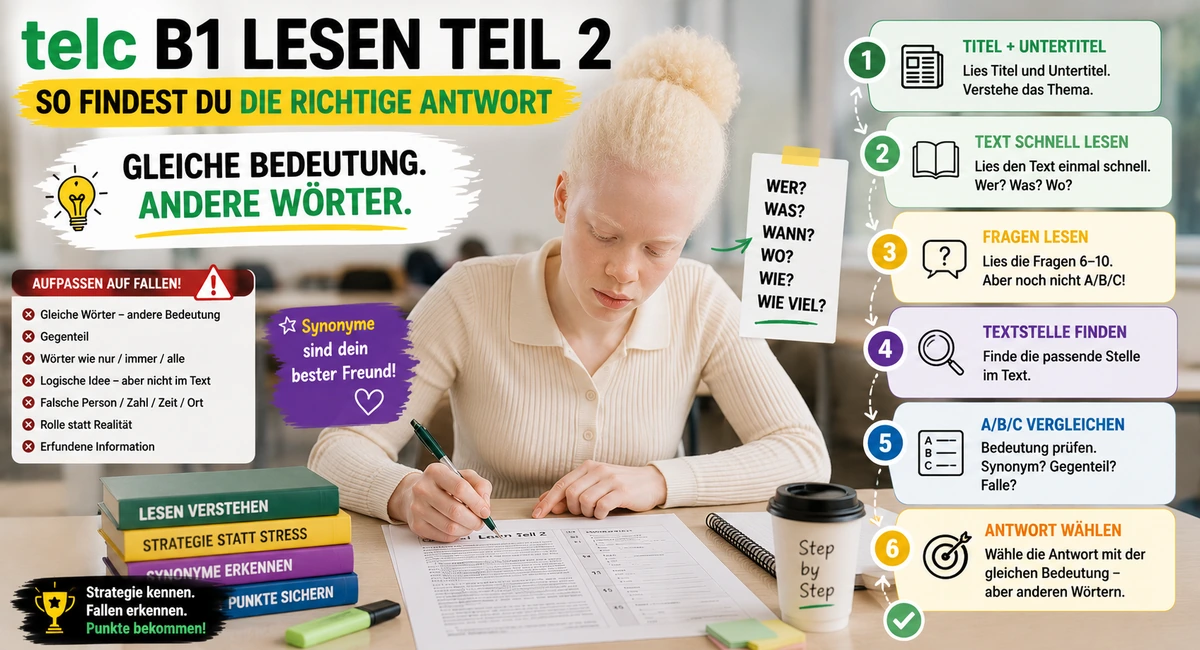
telc B1 Reading Part 2:
How to find the correct answer
The most important traps, tricks and tips for telc B1 Reading Part 2. Learn how to recognize the correct answers and get good points in the exam.
What is Reading Part 2 and why is it difficult?
In Part 2 of telc B1 Reading, you read a text from a newspaper. The text is not very long. It has about 300 to 400 words. After the text, there are 5 tasks (numbers 6 to 10). For each task, you see three answers: A, B and C. Only one answer is correct.
You have 90 minutes for Reading and Sprachbausteine together. For Part 2, you need about 15 to 20 minutes. You get 5 points for each correct answer. In total, you can get 25 points.
Why is Part 2 so difficult?
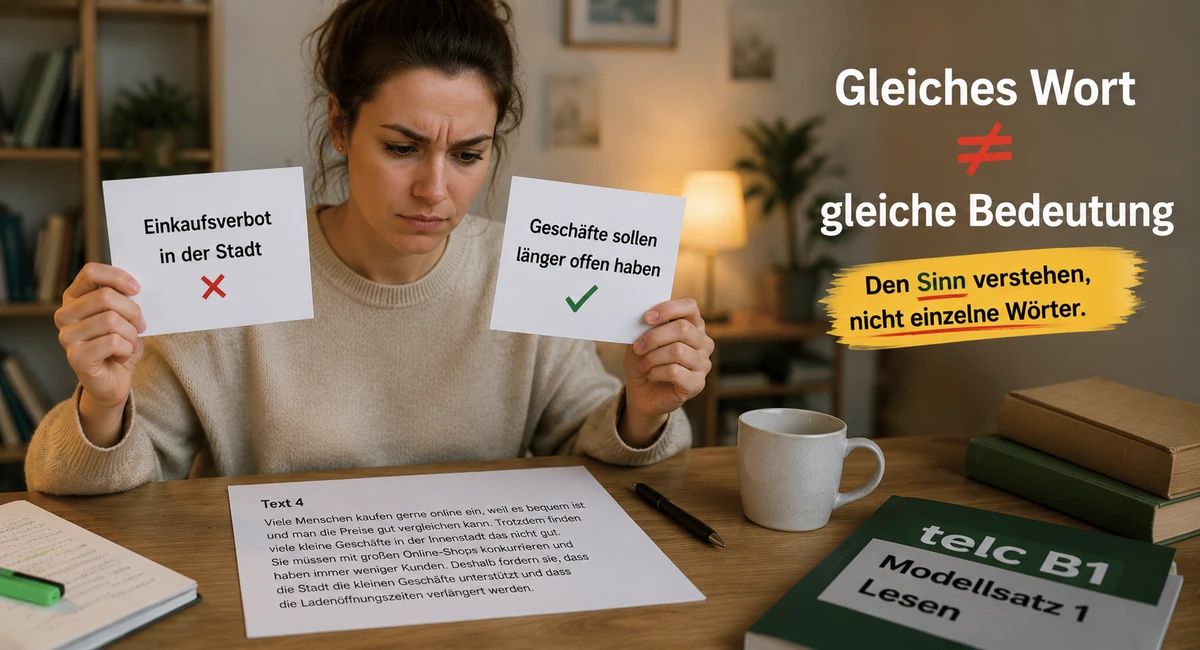
Many people think: I read the text and find the answer. That is easy. But in reality, Part 2 is very difficult. The answers often have the same words as the text. But the meaning is different! This is called a trap.
A trap is like a test: If you only search for words, you fall into the trap. You must also understand the meaning. In this article, you will learn how to recognize the traps. Then you will get good points in the exam.
Exam format – what you must know
| Criterion | telc B1 Reading Part 2 |
|---|---|
| Type of text | Newspaper article |
| Length of the text | about 300–400 words |
| Number of tasks | 5 tasks (numbers 6 to 10) |
| Type of tasks | Multiple choice (A, B or C) |
| Points per task | 5 points |
| Total points | 25 points |
| Recommended time | 15–20 minutes |
The most important rule: Different words, same meaning
This is the golden rule of Part 2. Write it on a piece of paper and remember it!
If the answer has exactly the same words as the text, then it is usually WRONG. The correct answer says the same as the text, but it uses different words. This is called synonyms.
A simple example
In the text it says: Sie hat viele Bücher gelesen.
- Answer A: Sie hat viele Bücher gelesen. (same words as in the text)
- Answer B: Sie liest gerne und oft. (different words, but same meaning)
Answer A looks correct. But this is the trap! The correct answer is B. Why? Because the exam tests whether you understand the meaning, not only the words.
Why is this rule so important?
In every task in Part 2, there is one correct answer and two wrong answers. The two wrong answers often have the same words as the text. They look correct. But they are wrong.
The correct answer almost always has different words. It uses synonyms or different sentences. If you understand this, you will make far fewer mistakes in the exam.
👉 Exercises to prepare for telc B1 ReadingThe 5 most important traps in Part 2
There are many traps in Part 2. But 5 traps appear in every exam. If you know these 5 traps, you can answer most tasks correctly.
Trap 1: The same words, but a different meaning
There is a word in the text. The same word appears in a wrong answer. But the meaning is different.
Example:
Text: In der Schule hat sie viel gelernt.
Wrong answer: Sie war oft in der Schule krank.
The word Schule is in both sentences. But the meaning is completely different. The text is about learning. The answer is about illness.
If you see a familiar word in the answer, be careful! Read slowly and understand the whole meaning.
Trap 2: Saying the opposite
The text says something positive. A wrong answer says something negative. Or the other way around.
Example:
Text: Die Kinder sind fröhlich und gesund.
Wrong answer: Die Kinder sind oft krank.
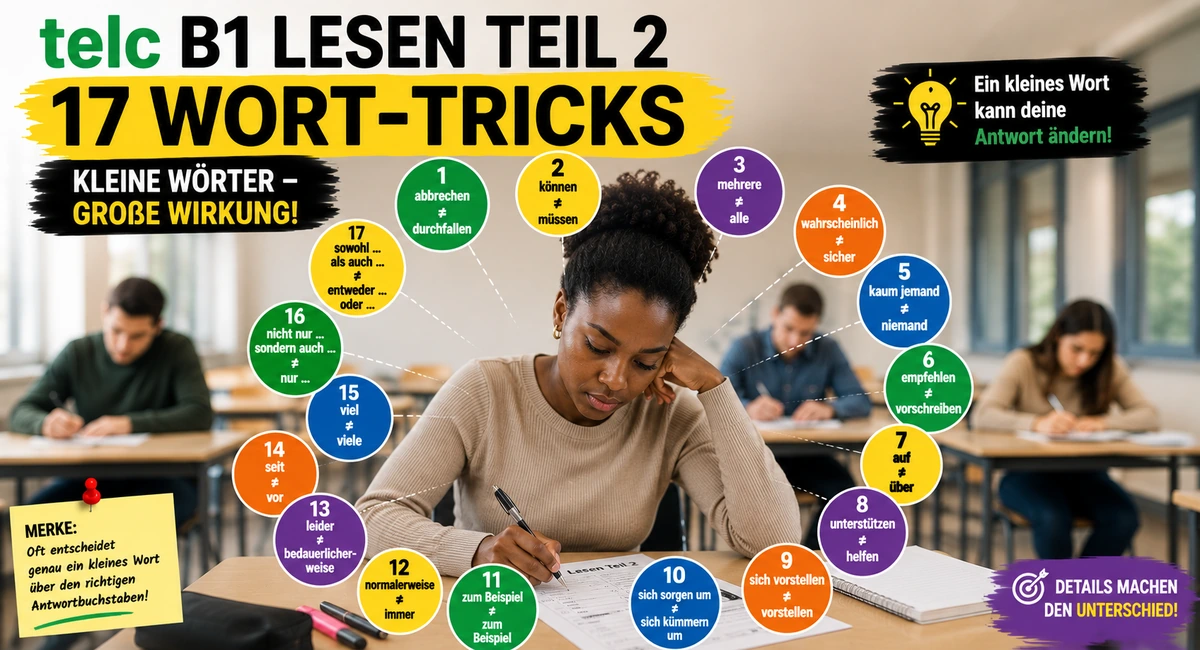
Sometimes the wrong answer uses only a small word like nicht or kein. Sometimes it uses another word with the opposite meaning (for example gesund versus krank).
Look for the word nicht or kein in the answer. Also look for words like immer / nie or viel / wenig. These words often show the opposite of the text.
Trap 3: Dangerous signal words
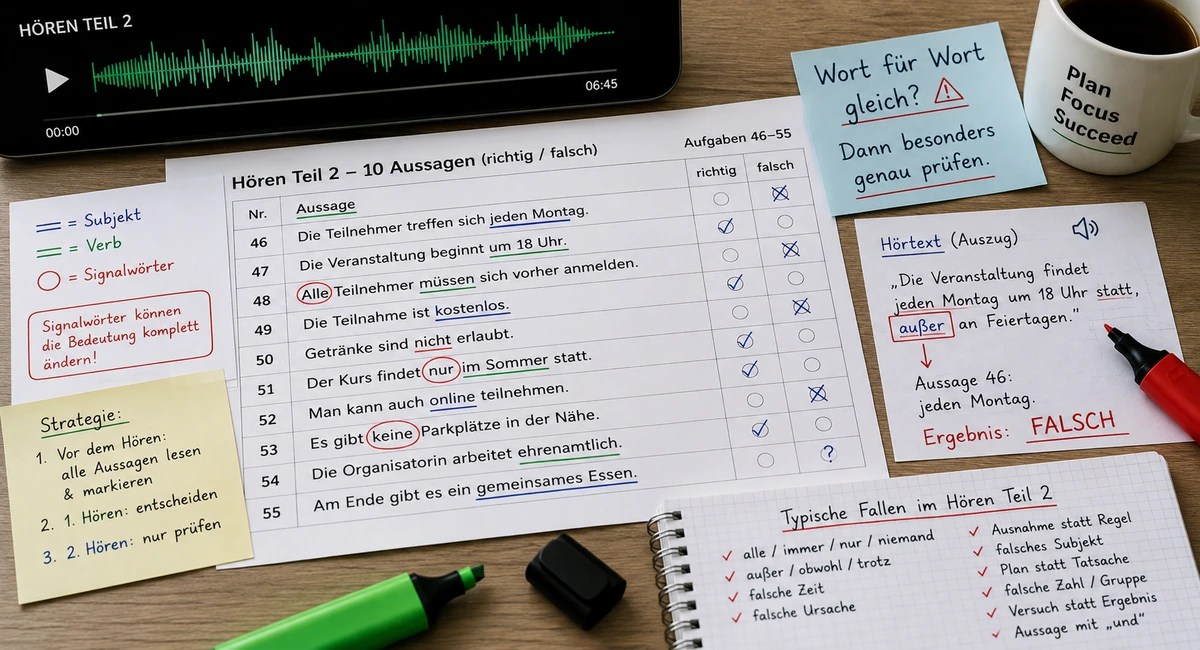
Some words are like a red stop sign. If you see them in an answer, be very careful. Here are the most dangerous words:
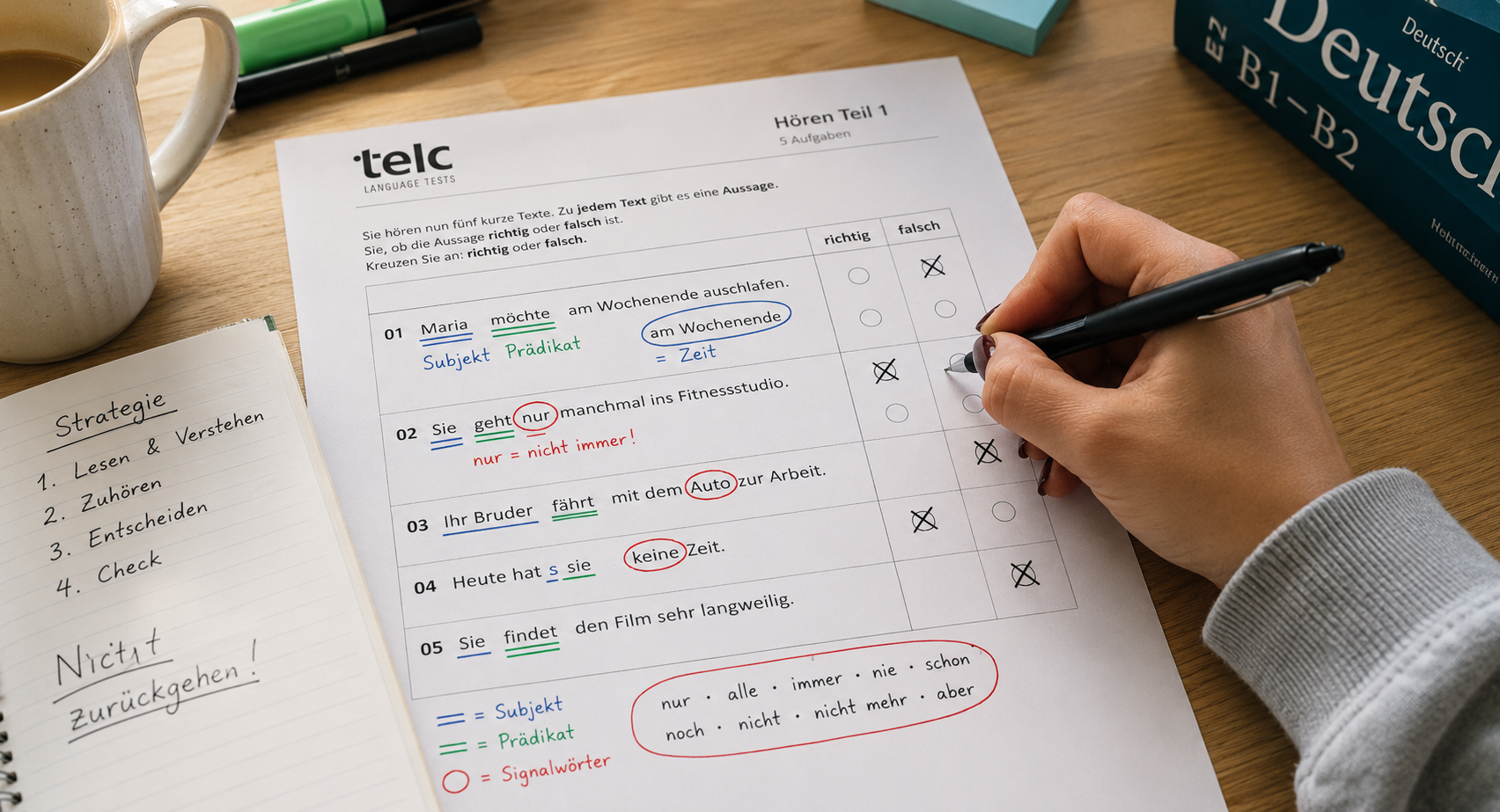
- nur – for example: Nur Kinder können kommen
- immer – Sie kommt immer zu spät
- alle – Alle Schüler haben ein Buch
- jeder – Jeder muss bezahlen
- vor allem – Vor allem alte Menschen kommen
- die meisten – Die meisten Menschen sind glücklich
- niemand or keiner
These words are very strong. They say 100 percent. But the text usually does not say 100 percent. For example, the text says: Viele Schüler haben ein Buch. That does not mean alle!
If you see one of these words in the answer, go back to the text. Check whether the word is really correct. If the text does not have the word, the answer is wrong.
Trap 4: A logical idea, but not in the text
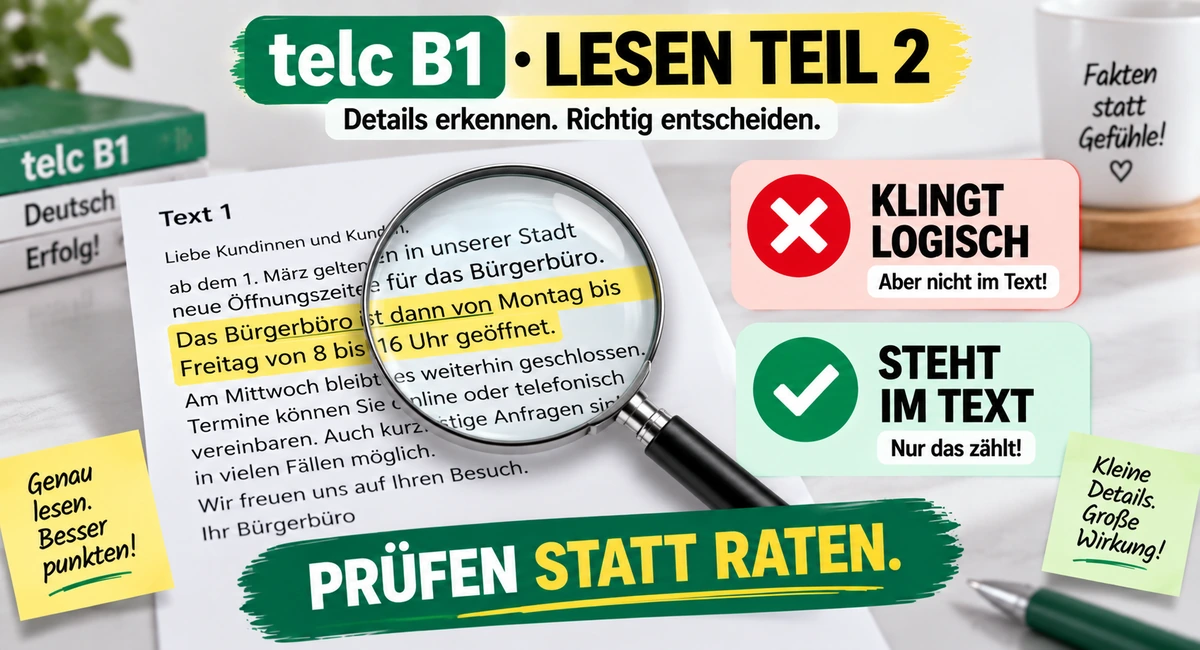
Sometimes you read an answer and think: Yes, that is logical! That is surely correct. But be careful! Logical is not the same as in the text.
Example:
Text: Die Schule für Kinder mit Talent ist besonders. Die Kinder lernen viel.
Wrong answer: Die Kinder werden später erfolgreiche Menschen.
That sounds logical, right? Someone who learns a lot will be successful later. But that is not in the text! The text only says that the children learn a lot. The text says nothing about the future.
Always ask yourself: Is this really in the text? Or do I only think that it is logical? Only what is in the text is correct.
Trap 5: Synonyms as the correct answer
This is not a trap, but a hint for you! The correct answer says the same as the text. But it uses different words.
Example:
Text: Die Kinder helfen sich gegenseitig.
Correct answer: Ein Kind hilft dem anderen Kind.
The words are not the same. But the meaning is the same.
Look for answers that say the same as the text, but with different words. This is usually the correct answer.
| Trap | What happens? | What should you do? |
|---|---|---|
| Same words | Answer has the same words as the text, but a different meaning | Read the whole meaning |
| Opposite | Answer says the opposite of the text | Look for words like nicht, kein, nie |
| Signal words | Answer has words like alle, immer, nur | Check whether the word is really in the text |
| Logical idea | Answer sounds logical, but it is not in the text | Ask: Is this really in the text? |
| Synonyms | Correct answer has different words, but the same meaning | Look for different words with the same meaning |
More traps you should know
The 5 traps above are the most important. But there are more traps. Here are the most important additional traps that appear in the exam.
Wrong person
There are many people in the text. A wrong answer says: Person A macht das. But in the text, Person B does it.
Example:
Text: Frau Müller ist Lehrerin. Ihr Sohn Max ist Schüler.
Wrong answer: Max ist Lehrer.
Read exactly who does what. Write it down if necessary.
Wrong number
There are numbers in the text. For example: 14 Jahre, 30 Prozent, 1995. A wrong answer has the correct number, but it is connected incorrectly.
Example:
Text: Sie ist 41 Jahre alt und arbeitet seit 21 Jahren in der Firma.
Wrong answer: Sie arbeitet seit 41 Jahren in der Firma.
The number 41 is in the text. But it is the age, not the working time! If you see a number in the answer, go back to the text. Ask: What exactly does this number mean?
Past or future
The text says something in the past. A wrong answer turns it into the present.
Example:
Text: Früher war sie Krankenschwester. Heute arbeitet sie in einem Kindergarten.
Wrong answer: Sie arbeitet heute als Krankenschwester.
In the text, she was a nurse in the past. Today she is no longer a nurse. The wrong answer confuses the past and today. Pay attention to time words: früher, heute, jetzt, vor 10 Jahren, seit 1995.
A role in the project becomes the correct truth
Sometimes someone plays a role in the text. For example: Maria spricht wie eine Polizistin im Hörspiel. The wrong answer then says: Maria möchte später Polizistin werden.
But that is wrong! Maria is only playing a role. She is not a real police officer. She also does not want to become a police officer. Ask yourself: Is this real or only a role in a project?
An invention – not in the text
Sometimes a wrong answer has a completely new idea that is not in the text at all.
Example:
Text: Im Kindergarten gibt es Spielzeuge und Bücher.
Wrong answer: Die Kinder im Kindergarten sind oft krank.
There is nothing about sick children in the text! This is an invention. Always ask yourself: Is this really in the text? Or is it a new idea?
How do you solve the tasks? – 6 steps
Here is a plan in 6 steps. Do this in the exam, then you have the best chance of getting good points.
Step 1: Read the title and the subtitle
The title tells you the topic. The subtitle gives you more information. This is your first help to understand what it is about.
Step 2: Read the whole text once quickly
You do not have to understand everything. You only need to know what it is about. Who are the people? What happens? Where does it happen?
Step 3: Read the questions
Now read the 5 questions. But do not read the answers A, B, C yet! First the questions, so you know what you have to search for.
Step 4: Search for the answer in the text
Find the place in the text where the answer is. Read this place carefully.
The questions do not always come in the same order as the text! The answer to question 7 can, for example, be at the end of the text.
Step 5: Then read A, B, C
Compare each answer with the text. Ask yourself:
- Does this answer say the same as the text?
- Does it have different words (synonyms)?
- Or does it have a trap?
Step 6: Choose the answer
Choose the answer that says the same as the text, but with different words. This is usually the correct answer.
6 questions you must ask yourself for every answer
Before you choose an answer, ask yourself these 6 questions:
- Who does it? Is it the same person as in the text?
- What does he or she do? Is it the same action?
- When? Is it the same time (past, today, in the future)?
- Where? Is it the same place?
- How? Is the meaning the same (positive or negative)?
- How much? Is it the same amount (much, little, all, some)?
If even one question means no, then the answer is wrong!
| Step | What should you do? | How long? |
|---|---|---|
| 1 | Read title and subtitle | 1 minute |
| 2 | Read the whole text once quickly | 3–4 minutes |
| 3 | Read 5 questions | 1–2 minutes |
| 4 | Search for the answer in the text | 5–7 minutes |
| 5 | Compare A, B, C | 3–4 minutes |
| 6 | Choose the answer | 1 minute |
Practical tips for the exam
These tips help you get more points in the exam. Read them carefully and remember them!
Tip 1: Do not be fast
Many people make mistakes because they read too fast. Read slowly and carefully. Better to have fewer correct answers than many wrong answers.
Tip 2: Mark in the text
If you have a pencil or marker, mark important words in the text. For example names, numbers, time words. This way you will find the right place faster later.
Tip 3: Do not trust your gut feeling
In Part 2, the answer that feels correct is often wrong! Trust the text, not your feeling. What is in the text is the truth. What you think is not important.
Tip 4: If two answers look good
If you have to choose between two answers, ask: Which answer has exactly the same words as the text? This answer is usually WRONG! Choose the other one.
Tip 5: Quotes are very important
There are often quotes from people in the text. For example: Frau Müller sagt: Ich finde die Arbeit schön. The correct answer often comes from a quote. Read quotes very carefully!
Tip 6: If you do not know it – guess
You do not lose points in the telc B1 exam if you guess wrong. But you gain points if you guess correctly. Do not leave any field empty!
In Part 2 of telc B1 Reading, the answer that looks easy is almost always wrong. The correct answer almost always has different words than the text. Trust the rule, not your feeling.
What you should do on the day of the exam
- Sleep well the night before the exam.
- Eat a good breakfast.
- Bring a pencil and eraser.
- Come early to the exam – at least 30 minutes before it starts.
- Drink water, but not too much.
- Stay calm – stress causes mistakes.


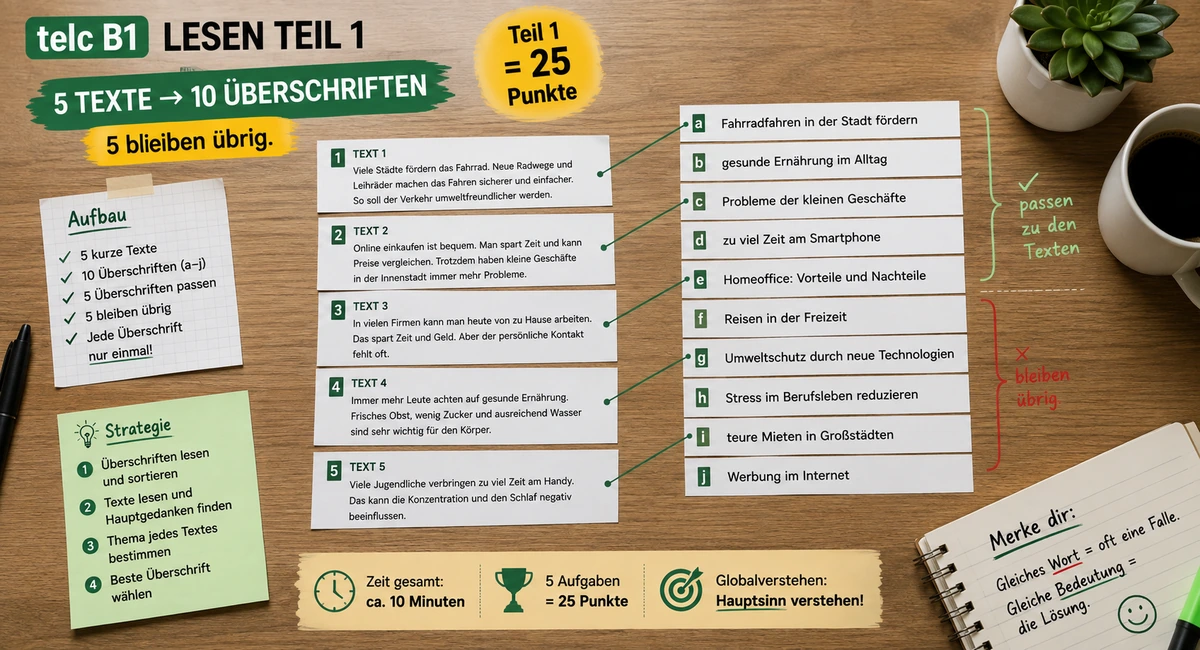
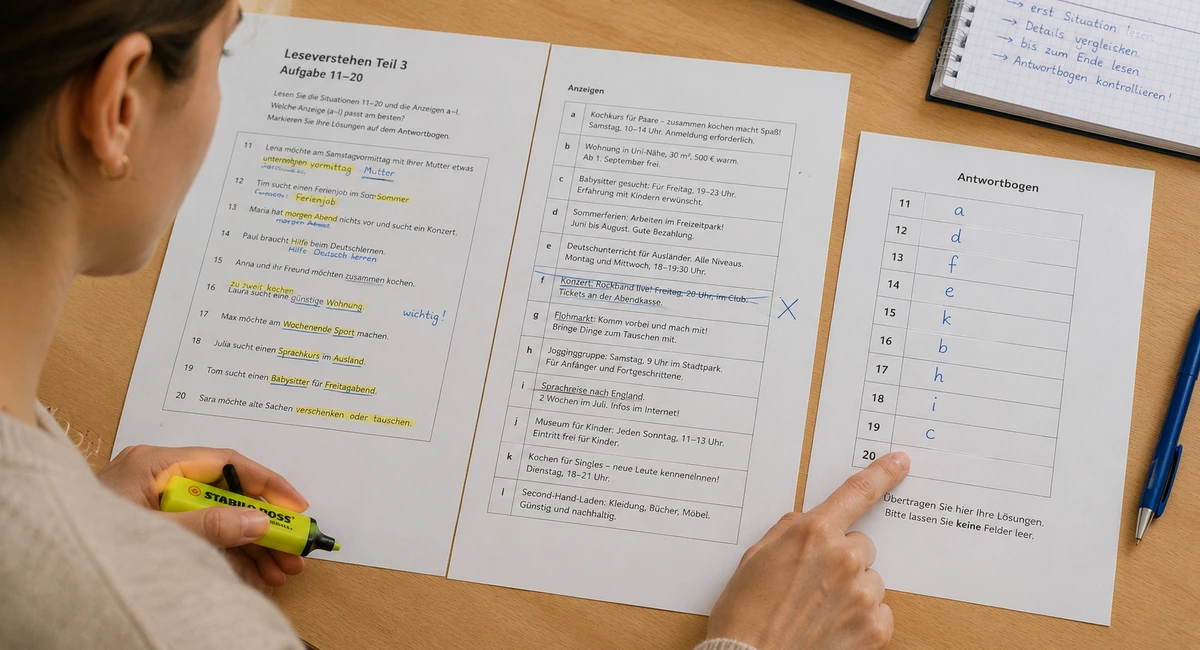
There are no comments for this article. Leave your comment