





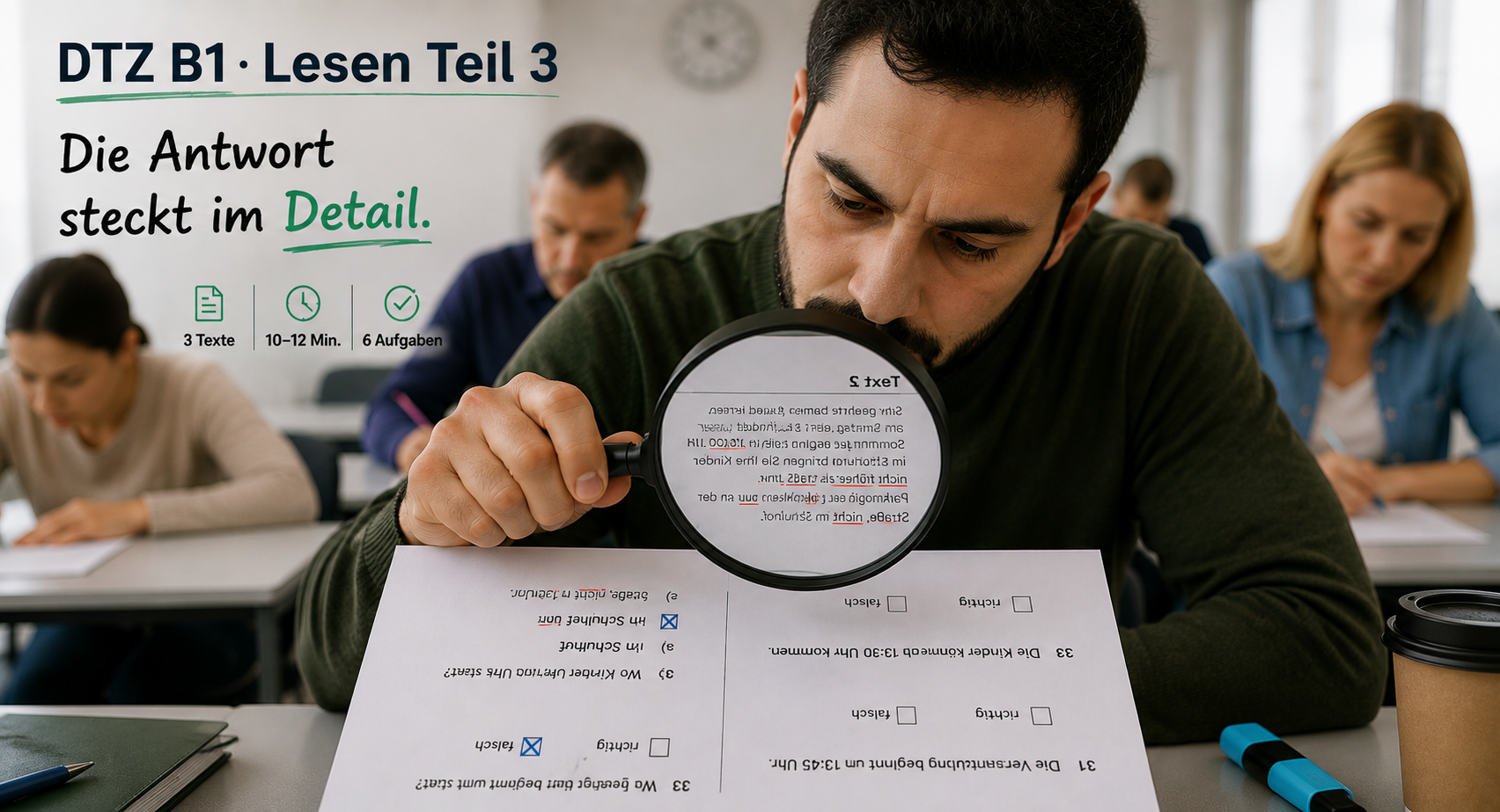
Lesen Teil 3:
Understanding texts and recognising traps
Here you do not read an advertisement but a complete letter, a notice or a short message. You must understand what is really written there. It sounds simple – but every question has hidden traps. We show you how to get all the points.
What is Lesen Teil 3 about?
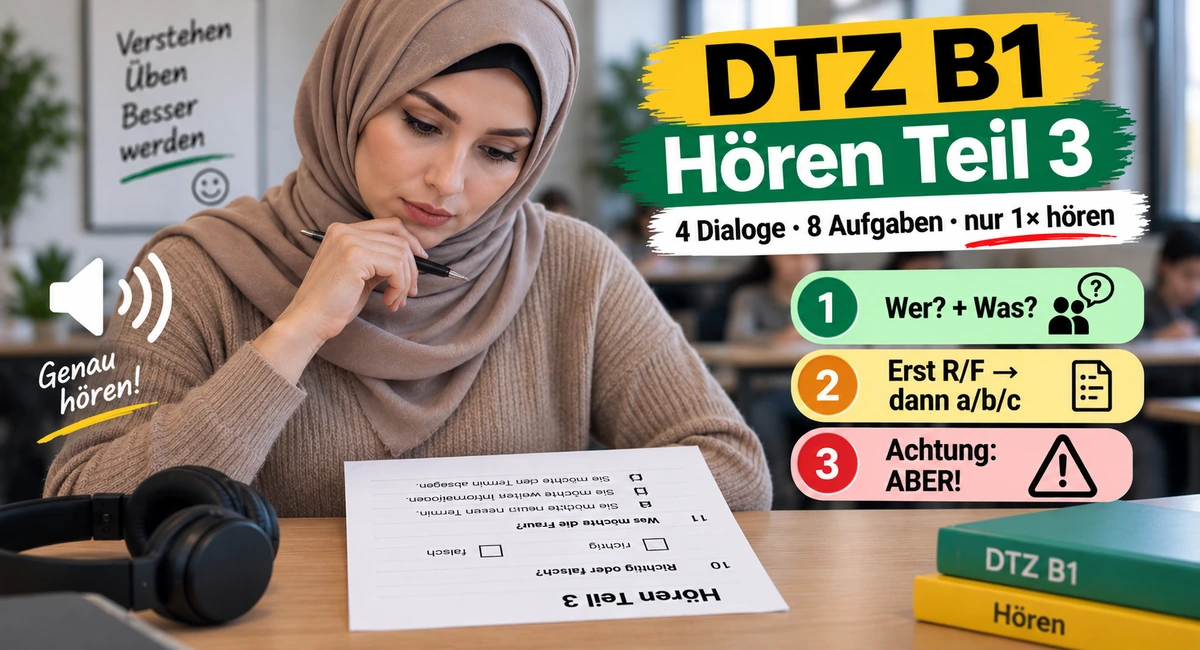
In Lesen Teil 3 you see three short texts. These can be letters, emails, notices or messages. For each text there are two tasks. In total that is 6 tasks (numbers 31 to 36) and 6 points.
The texts are slightly longer than in Teil 2 – but not very long either. Usually it is half a letter. You must understand what the person is really saying. Not every word – but the most important information.
✓ 3 texts with 2 tasks each = 6 tasks
✓ For each correct answer: 1 point
✓ Maximum possible: 6 points
✓ Time for Teil 3: approx. 10 to 12 minutes
Lesen Teil 3 is like a little detective work. Every text has its secrets. Sometimes the text says the opposite of what the question claims. Sometimes the answer is there in completely different words. Sometimes there are two or three numbers – but only one is the correct one. Those who know the traps are sure to win their points.
👉 Here you will find exercises for B1 DTZ Lesen Teil 3The two task types explained
Each text comes with two different tasks. It is important to understand this because you need a different method for both types.
Type 1: True or false?
The first task is always a sentence. You must decide: does this sentence agree with the text or not? There are only two answers: richtig or falsch.
The text says: Das Bürgerbüro wird in zwei Wochen wieder eröffnet.
Question: Das Bürgerbüro wird in zwei Wochen geschlossen. Richtig / Falsch?
Answer: Falsch! It is being reopened, not closed. That is an important difference.
Type 2: Three answers (a, b, c)
The second task gives you three answer options. You must choose the correct one. Be careful here: often two answers are plausible, but only one really agrees with the text.
The text says: Das Parkhaus ist im Zentrum und man kann kostenlos parken.
Question: Das Parkhaus...
a) hat keine Treppen
b) ist nur für ältere Menschen
c) kann man umsonst benutzen ✓
Explanation: „umsonst“ is another word for „kostenlos“. Answers a and b are not wrong in the world – but they are not written like that in the text.
The correct answer almost never appears with the same words as in the text. You must recognise synonyms – these are called Parafrasen. This is the most important skill for Lesen Teil 3.
What do you read first?
In Teil 3 there is a small trick that saves a lot of time. Do not read the whole text first. Read the two questions below it first. Only then do you read the text – and you already know what to pay attention to.
1. Read the two questions first (31 + 32, or 33 + 34, or 35 + 36)
2. Underline important words
3. Then read the text
4. Search in the text: where is something written about these questions?
This is how you work like a detective: you already know what you are looking for before you enter the scene of the crime. This way you immediately see what is important – and what is only a distraction.
Underline the key words
Take a pen. Underline in the questions:
- Nouns (Wohnung, Geld, Termin, Schule)
- Verbs (kaufen, mieten, anrufen, kommen)
- Numbers (date, price, age, percentage)
- Negations (nicht, kein, niemals)
These underlined words tell you what you must find in the text. That saves time and energy.
The correct method step by step
A good plan is half the battle. If you always proceed in the same way, you make fewer mistakes and save time.
Step 1: Read the two questions
Read question 1 (richtig/falsch) and question 2 (a, b, c). Understand what is being asked. Underline the most important words.
Step 2: Skim the text once
Read the text quickly. You do not need to understand every word. Just look: what is it about? Who is writing? To whom?
Step 3: Find the right passage
Now read the text more slowly. Look for the words from the question. Sometimes the same words appear – sometimes only similar synonyms. Mark this passage.
Step 4: Compare carefully
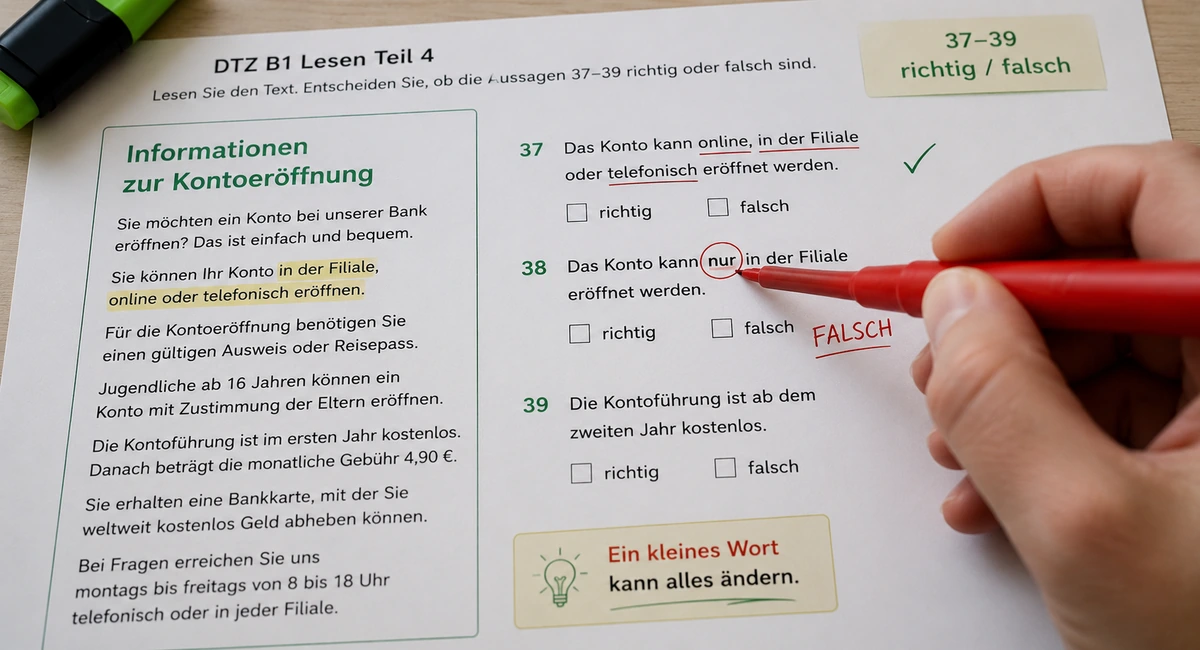
Read the sentence in the question and the sentence in the text word for word. Does the text really say the same thing? Or is something different written there? Pay attention to small words such as „nicht“, „kein“, „nur“, „ohne“.
Step 5: Decide and mark
If you are certain, mark your answer. If you are uncertain: look at the other answers. Sometimes one answer is definitely wrong – and that helps you.
The answer must completely match the text. If only one detail is wrong, the whole answer is wrong.
The 12 most important traps at a glance
When preparing for the DTZ exam, similar types of traps can be observed again and again. We have systematically compiled them for you. Now let us look at all 12 of them, with examples and explanations.
| No. | Trap | What is the problem? |
|---|---|---|
| 1 | Parafrase | Different words, same meaning |
| 2 | Inversion | The opposite is meant (mehr/weniger, neu/alt) |
| 3 | Verneinung | „nicht“ or „kein“ reverses the meaning |
| 4 | Absolutes Wort | „alle“, „immer“, „nur“ make the difference |
| 5 | Zahlenfalle | Several numbers in the text, one is correct |
| 6 | Zeit-Falle | Already done or still needs to be done? |
| 7 | Falsche Handlung | kaufen, mieten, reparieren – not the same thing |
| 8 | Falscher Ort | A place has a different meaning than expected |
| 9 | Falsche Information | The text describes – but does not explain |
| 10 | Ähnliche Namen | Buslinie 19 is not Buslinie 91 |
| 11 | Was nicht im Text steht | Sounds plausible, but is not written there |
| 12 | Falsche Rolle | Who is writing? To whom? Why? |
Trap 1: Die Parafrase
This is the most important trap in Lesen Teil 3. If you understand this trap, you will already solve half of all tasks correctly. A Parafrase means: saying the same thing but with different words.
The correct answer almost never contains the same words as the text. You must recognise synonyms. Anyone who only looks for the same word will not find the answer.
The text says: Bei einem Tarif bekommen Sie Geld zurück, wenn Sie Sport machen.
Question 32 c: Die Krankenversicherung zahlt manchmal Geld an die Versicherten zurück.
Paraphrase: „Geld zurückbekommen“ = „Geld zurückzahlen“. Same meaning, different words.
Common paraphrases
| In the text | In the answer |
|---|---|
| kostenlos | umsonst, ohne Kosten, gratis |
| telefonisch anmelden | anrufen |
| per Post zugesandt | im Extrabrief zugeschickt |
| Verspätungsgebühren | Strafe |
| im Viertelstundentakt | alle 15 Minuten |
| 500.000 Euro | halbe Million |
| gegenüber dem Busbahnhof | in der Nähe des Busbahnhofs |
| Familienpause | lange nicht gearbeitet |
If a word in the question is EXACTLY the same as in the text – be careful. This is often a trap. The correct answer usually uses synonyms.
Trap 2: Die Inversion
In this trap the question claims the opposite of what the text says. The topic is correct, but the direction is reversed. Anyone who reads quickly often does not notice this.
The text says: Das Bürgerbüro wird in zwei Wochen wieder eröffnet.
Question: Das Bürgerbüro wird in zwei Wochen geschlossen. Falsch!
The opposite is meant here. Anyone who only sees „in zwei Wochen“ might think: it matches!
The text says: Die Familie hat ein Guthaben von 150 Euro – sie hat zu viel Nebenkosten bezahlt.
Question: Ab Februar muss die Familie mehr Miete zahlen. Falsch!
She pays less, not more. The „Guthaben“ means: she has overpaid, she gets money back.
Typical inversion pairs
- eröffnet ↔ geschlossen
- mehr ↔ weniger
- neu ↔ alt / wieder
- billiger ↔ teurer
- zu viele ↔ zu wenige
- im Zentrum ↔ am Stadtrand
- spart ↔ verbraucht
Does the text really say what the question claims? Or does the text say the opposite?
Trap 3: Die Verneinung
A small word such as nicht, kein or weder can completely reverse the meaning of a sentence. These words are short and inconspicuous – but very important.
The text says: Die Fahrpläne für Straßenbahnen und U-Bahnen ändern sich aber nicht.
Question: Neue Fahrpläne gibt es nur für Busse. Richtig!
The small word „nicht“ means: only buses have new timetables. Trams and underground trains do not.
The text says: Man muss weder einen Fitness-Club noch eine Sporthalle aufsuchen.
Question: Die KKB bezahlt einen Kurs im Fitness-Club. Falsch!
„weder ... noch“ means: neither of the two. No fitness club, no sports hall. All exercises are on the internet.
Negation words you must pay attention to
- nicht – makes the opposite
- kein / keine – none of it
- weder ... noch – neither of the two
- leider – often connected with negation
- ohne – something is missing
If you find an answer almost correct, read the sentence in the text once more slowly. Look for negations. They are often short and easy to overlook.
Trap 4: Das absolute Wort
Some words are absolute: alle, immer, nur, jeder. If such a word appears in the question, you must check: does the text really say „alle“? Or perhaps only „manche“?
The text says: Den ersten Antragstellern zahlt die Familienkasse den Betrag schon im April. In Einzelfällen kann es bis Ende Mai dauern.
Question: Alle Eltern bekommen bis Ende April 100 Euro überwiesen. Falsch!
Not all – only the first ones. Some have to wait until May. The word „alle“ makes the sentence wrong.
The text says: Die Firma nimmt die Sauce mit der Nummer 7R128 und dem Datum 08.05.2017 zurück. Andere Saucen sind nicht betroffen.
Question: Die Firma nimmt alle Nudelsaucen zurück. Falsch!
Not all – only one specific variety.
Pay attention to these words
- alle – everyone without exception
- immer – every time, without exception
- nur – nothing else
- jeder – without exception
- ausschließlich – only that
- komplett – completely, without exception
Absolute words are often a signal for a trap. Check carefully: does the text really say „alle“? Or are some exceptions allowed?
Trap 5: Die Zahlenfalle
In many texts there are several numbers. One of them is the correct answer. The others are there to confuse you. You must read carefully which number belongs to which piece of information.
The text says: Die Zahl der Schüler ist in 10 Jahren um 14% zurückgegangen. In den alten Bundesländern sind es 17%. In diesem Schuljahr kamen 2,3% weniger Kinder.
Question 32: In diesem Schuljahr gab es in Deutschland... a) 14% weniger / b) 2,3% weniger / c) 17% weniger.
Here you must read carefully: 14% is over 10 years, 17% is in the old federal states, and 2.3% is in this school year.
The text says: Die Arbeiter fordern 8% Gehaltserhöhung. Der Arbeitgeber bietet nur 5%.
Question: Die Mitarbeiter wollen... a) 8 Prozent mehr verdienen / b) 5%...
The correct number is 8% – that is what the workers demand. 5% is the offer from the employer.
If there are several numbers in the text, ask yourself: what belongs to which number? Read the whole sentence with the number, not just the number itself.
Trap 6: Die Zeit-Falle
In this trap everything revolves around the point in time. Has something already happened? Or does it still need to happen? Is something the case now – or was it the case in the past?
The text says: Vor fünf Wochen hat unsere Firma in Ihrer Wohnung einen neuen Telefonanschluss eingerichtet.
Question: Die Firma Telefix soll bei Herrn Thomas einen neuen Telefonanschluss einrichten. Falsch!
That has already happened – five weeks ago. It is not something that still needs to happen.
The text says: Eigenbeteiligung für Krankenhausaufenthalt vom 24.05. bis 26.05.
Question: Herr Slacanin muss ins Krankenhaus gehen. Falsch!
He was already in hospital. Now he only needs to pay.
Time signals you must pay attention to
- haben + Partizip – already happened (haben gemacht, ist gekommen)
- werden – will happen in the future
- bald – will happen
- vor fünf Wochen – already happened
- schon – already happened or done
- noch nicht – still needs to be done
Trap 7: Die falsche Handlung
In this trap the topic is correct, but the action – the verb – is wrong. A carpet can be repaired or bought – that is not the same thing. Clothing can be sold or donated – that is also not the same thing.
The text says: Sie haben letzte Woche einen Teppich zur Reparatur und Reinigung in unser Geschäft gebracht.
Question: Frau Korte hat bei Herrn Özdemir einen Teppich gekauft. Falsch!
She did not buy a carpet. She brought her old carpet in for repair. A completely different action.
The text says: Wir sammeln Schuhe, Bekleidung, Wäsche, Wolldecken...
Question: Sie können hier Ihre alten Sachen verkaufen. Falsch!
You can hand the things in – not sell them. The organisation collects them. You do not receive any money.
Typical verb traps
| Verb in the text | Wrong action in the question |
|---|---|
| reparieren | kaufen |
| sammeln (kostenlos) | verkaufen |
| kündigen | abschließen |
| anmelden | bestellen |
| informieren | einen Kurs machen |
The verb is often more important than the noun. Always read carefully WHAT the person does – not just WHAT the text is about.
Trap 8: Der falsche Ort
Sometimes a place name appears in the text and in the question – but it has a different meaning. This is a particularly nasty trap.
The text says: Die Zahl der Schulanfänger ist um 14% zurückgegangen. Das teilte das Statistische Bundesamt in Wiesbaden mit.
Question: Nur in Wiesbaden gibt es immer weniger Schulanfänger. Falsch!
Wiesbaden is the city where the Federal Office is located – not the city where there are fewer pupils. The Federal Office is announcing that across the whole of Germany there are fewer pupils.
If a place name appears in the text, ask yourself: why is this place mentioned here? Is it the place where the event occurs? Or just the location of a source, a person, a company?
Trap 9: Die falsche Information
This trap is about what the text really does. Does the text describe something? Or does it explain something? These two things are different.
The text says: 1,5 Millionen Menschen zwischen 25 und 35 haben keinen Berufsabschluss. Deshalb gibt es ein neues Projekt „Spätstarter“ mit Ausbildung in 24 Monaten.
Question: Der Text erklärt warum viele junge Leute keinen Berufsabschluss haben. Falsch!
The text only says THAT they have no qualification. But it does not say WHY. The text describes the project, not the reasons.
Does the text really explain WHY? Or does it only say THAT? That is a big difference.
Trap 10: Ähnliche Namen und Nummern
Sometimes there are two similar names or numbers in the text. Buslinie 19 is not Buslinie 91. Familie Meyer is not Familie Mayer. Examiners often use similar names to see whether you read carefully.
The text says: Die Buslinie 19 fährt nicht mehr zur Messe, sondern zum Leopoldplatz. Die Buslinie 91 fährt zweimal pro Stunde vom Bahnhof zur Messe.
Question: Vom Bahnhof zur Messe fährt ab Dezember die...
a) Buslinie 19 viermal pro Stunde (Falsch! Line 19 no longer goes to the Messe)
b) Buslinie 91 einmal pro Stunde (Falsch! It goes twice per hour)
c) Buslinie 91 zweimal pro Stunde ✓
Read names and numbers carefully. Do not confuse 19 with 91. Read the whole sentence with the number – not just the number itself.
Trap 11: Was im Text gar nicht steht
Sometimes an answer sounds plausible and logical – but it is simply not written in the text at all. You must ask yourself: Is this really in the text? Or do I only think that it could be so?
The text says: Beim Elternsprechtag können Sie mit jeder Lehrkraft persönlich sprechen. Eine Lehrerin steht zu einem Gespräch zum Thema „Berufliche Orientierung“ zur Verfügung.
Question: Es gibt...
a) eine Möglichkeit zur Berufsberatung ✓
b) kostenlose Getränke
c) Wartelisten für die Lehrer
Problem: Answers b and c may perhaps sound plausible. But only the career guidance is actually written in the text.
An answer is only correct if it is in the text. No matter how logical it sounds – if the text does not say it, the answer is wrong.
Trap 12: Die falsche Rolle
Who is writing this letter? To whom? Why? These questions are often very important. Sometimes you must understand exactly who the person in the text is.
The text says: Hiermit bestätige ich, dass ich Ihre Kündigung bekommen habe. Ich schlage vor, dass wir die Wohnung gemeinsam besichtigen... Die Kaution von 1800 Euro erhalten Sie zurück...
Question: Der Schreiber des Briefs ist der Vermieter. Richtig!
Why? Because he received the notice to quit, inspects the flat and returns the deposit – that is what the landlord does.
In this trap you must conclude from the text which role the person has. Pay attention to:
- Who can do what? (kündigen, vermieten, kaufen, verkaufen)
- Who pays whom? (Mieter zahlt Vermieter, Kunde zahlt Firma)
- Who writes to whom? (Firma an Kunde, Schule an Eltern)
The 7 most important rules
Now we summarise everything. These 7 rules will help you in every B1 DTZ exam. Learn them by heart.
Rule 1: Questions first, then the text
Always read the two questions first. Underline the most important words. Only then do you read the text. That way you already know what you are looking for.
Rule 2: Synonyms instead of the same words
The correct answer almost never contains the same words as the text. Look for synonyms. If a word is exactly the same, this is often a warning signal.
Rule 3: Pay attention to small words
Words such as „nicht“, „kein“, „nur“, „alle“, „immer“ are small – but very important. They can change the whole meaning.
Rule 4: Read the whole sentence
Never read only a single word or a number. Always read the whole sentence. Only then do you understand what the word really means.
Rule 5: Check all three answers
For the question with a, b, c: read all three answers. First eliminate those that are definitely wrong. That leaves the correct one at the end.
Rule 6: Only what is in the text
An answer is only correct if it is in the text. No matter how logical it sounds – if the text does not say it, the answer is wrong.
Rule 7: Note the verb and the time
Pay attention to the action (the verb) and the time (already happened / still needs to happen). These two things often decide between right and wrong.
Questions first. Look for synonyms. Note small words. Read whole sentences. Compare answers. Only what is in the text. Check verb and time.
How much time do you have?
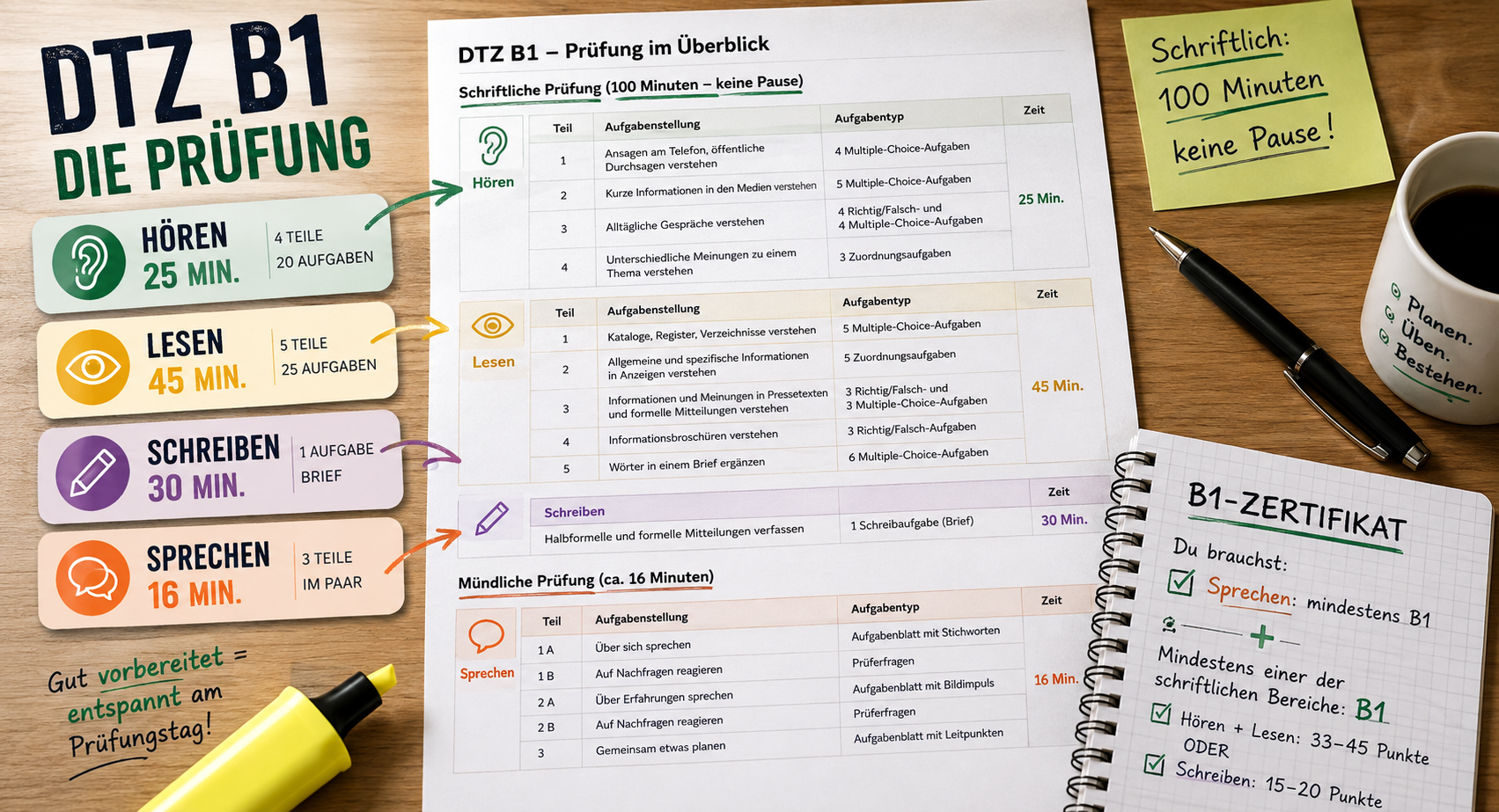
For the entire exam section Lesen you have 45 minutes. For Lesen Teil 3 you need approximately 10 to 12 minutes. That is approx. 3 to 4 minutes per text.
| Step | Time per text |
|---|---|
| Read the two questions | 30 seconds |
| Skim the text once | 1 minute |
| Find and check answers | 1.5 minutes |
| Check | 30 seconds |
Mark your answers on the answer sheet immediately. At the end of the exam section Lesen there is a STOP sign. You are then no longer allowed to write.
Important paraphrases to learn
These paraphrases appear again and again when preparing for the DTZ exam. Those who know them by heart solve the tasks much faster.
| In the text | In the answer (paraphrase) |
|---|---|
| kostenlos | umsonst, gratis, ohne Kosten |
| telefonisch anmelden | anrufen |
| per Post zusenden | im Brief zuschicken |
| Verspätungsgebühren | Strafe |
| im Viertelstundentakt | alle 15 Minuten |
| halbe Million | 500.000 |
| gegenüber | in der Nähe |
| Familienpause | lange nicht gearbeitet |
| Geld zurückbekommen | Geld zurückzahlen |
| nicht zu Hause sein können | an dem Tag nicht zu Hause sein |
| Beiträge nicht bezahlt | muss Geld zahlen |
| Termin verschieben | anderen Termin |
| Guthaben von 150 Euro | zu viel bezahlt |
| Wohnung besichtigen | Wohnung ansehen |
| Apfelbaum | Obstbaum |
| Online Banking nutzen | mit dem Computer machen |
| auf Hunde achten | auf Hunde aufpassen |
| weniger Schüler | Zahl ist zurückgegangen |
| Gehaltserhöhung fordern | mehr verdienen wollen |
| Wohnanlage | Wohngebäude |




There are no comments for this article. Leave your comment