





Deutsch B2 Beruf:
Exam Format, Tasks and Assessment
German B2 Beruf at a glance: exam format, tasks and assessment explained clearly — with tips for successful preparation.
What is the B2 Beruf exam?
"B2 Beruf" usually refers to two different exams: telc Deutsch B2+ Beruf and the Deutsch-Test für den Beruf B2 (DTB B2). Both test job-related German language skills at B2 level, but differ in exam format, tasks and assessment.
Beruf means "profession" in German. In the context of the exam name, this addition emphasises business communication. B2 level means being able to understand the main content of complex texts, communicate spontaneously and fluently, and express oneself clearly and in detail on many topics.
Target group and scope of application
The term 'B2 Beruf' can refer to different job-related exams. The Deutsch-Test für den Beruf B2 (DTB B2) is the final exam of the basic vocational language course B2 within the framework of job-related German language support. telc Deutsch B2+ Beruf is an independent vocationally oriented language exam for people who wish to demonstrate their German language skills in a work context.
Use the practice tests from Deutsch Vorbereitung to prepare effectively and pass the B2 Beruf exam on the first attempt. The tasks are available online around the clock. This allows you to train systematically at any time you choose. Thanks to the tests that replicate the typical tasks of the official exam, you can bring your language skills in all competence areas up to the required level.
The difference between DTB B2 and Telc B2 Beruf
DTB B2 and telc Deutsch B2+ Beruf are not identical. The DTB B2 is the final exam of the vocational language courses and may only be administered by DTB examination centres authorised by BAMF. telc Deutsch B2+ Beruf is an independent telc exam with a vocational focus. Let us look at each format in more detail.
telc Deutsch B2+ Beruf and the Deutsch-Test für den Beruf B2 are two different exam formats. telc Deutsch B2+ Beruf tests job-related communicative skills at B2 level in the areas of reading, listening, writing, language elements and speaking. The Deutsch-Test für den Beruf B2 tests workplace-related German in the skills of reading, listening, writing and speaking; the tasks also contain elements of mediation.
Recognition for work, residence and integration
Which exam makes more sense depends on the individual goal. The Deutsch-Test für den Beruf B2 is the final exam of the vocational language courses. telc Deutsch B2+ Beruf is an independent vocationally oriented language exam.
For better clarity, the information about the exams is summarised in a comparison table.
| Exam | Target group | Organisation | Particularity |
|---|---|---|---|
| Telc Deutsch B2 Beruf | Skilled workers who wish to work in Germany, candidates for recognition | Telc gGmbH | Vocational focus (business correspondence, work conversations). Widely recognised by employers and educational institutions |
| DTB B2 (Deutsch-Test für den Beruf) | Participants of the basic vocational language course B2 within the framework of job-related German language support | Developed by telc gGmbH on behalf of the Federal Ministry of Labour and Social Affairs with specialist support from BAMF; administered within the BAMF DTB system. | State format (completed after vocational language courses). Oriented towards the labour market |
Overview of the B2 Beruf exam format
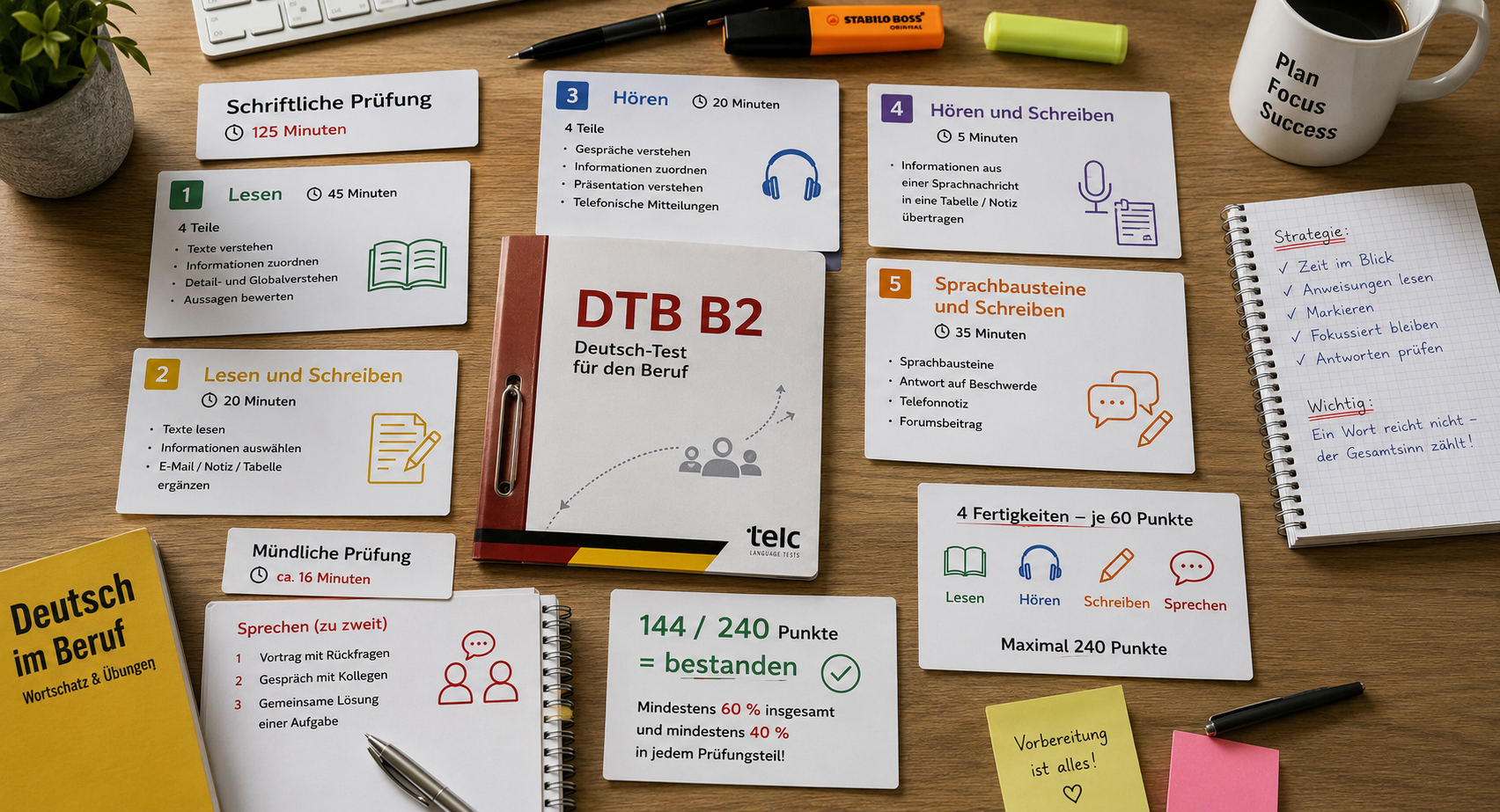
The structure depends on the exam format. telc Deutsch B2+ Beruf includes reading, writing, listening, language elements and speaking. DTB B2 has written subtests for reading, reading and writing, listening, listening and writing, as well as language elements and writing; in addition there is an oral exam.
For the vocational version, specific vocabulary, a formal communication style and the ability to navigate various work situations are important.
Written exam
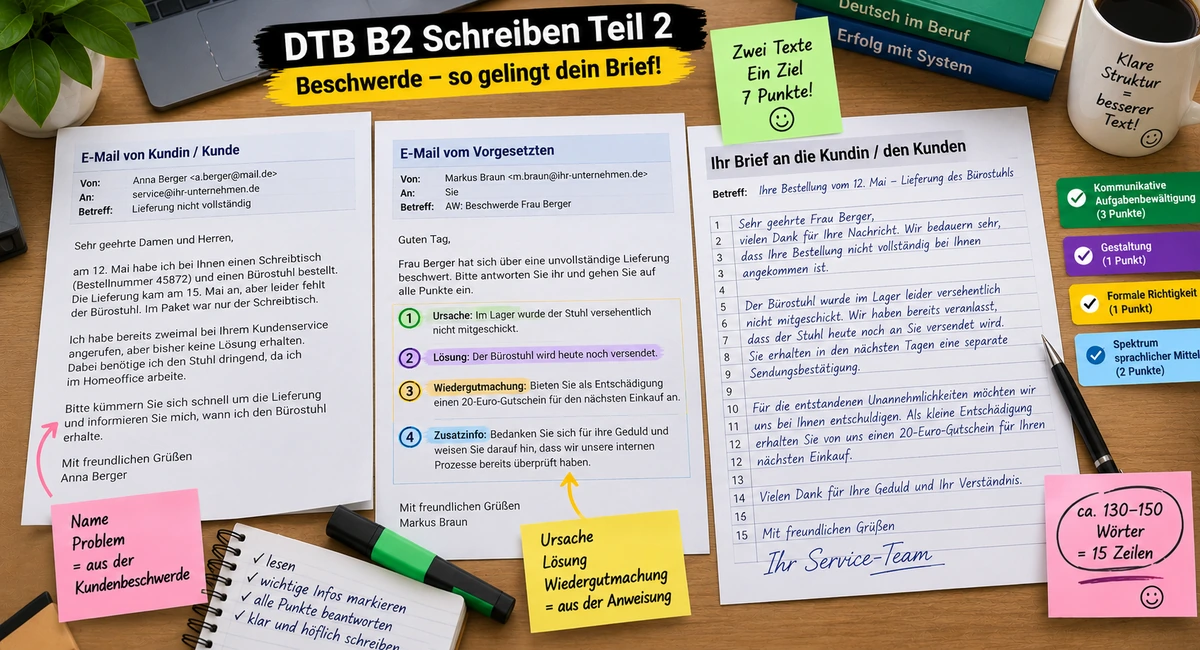
In the written part of B2, not only grammar is tested, but also the ability to communicate professionally and in a structured manner in a professional context. For example, writing emails, complaints, responses to customers or internal memos. A well-prepared written part demonstrates readiness to work in a German-speaking environment.
Reading
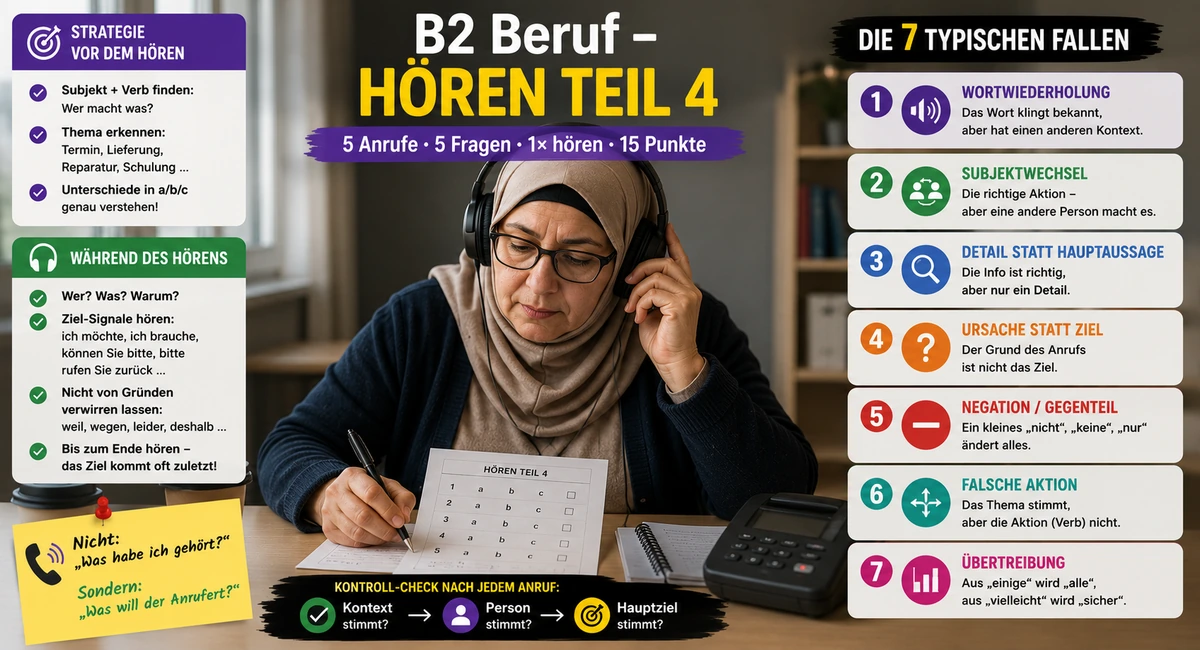
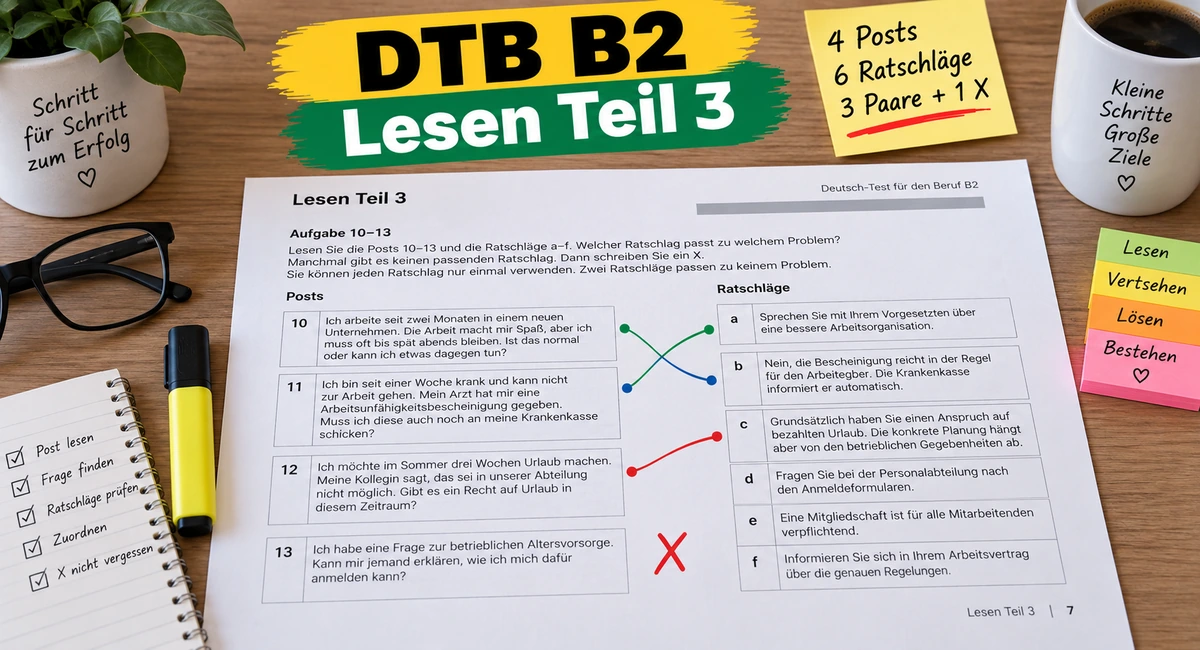
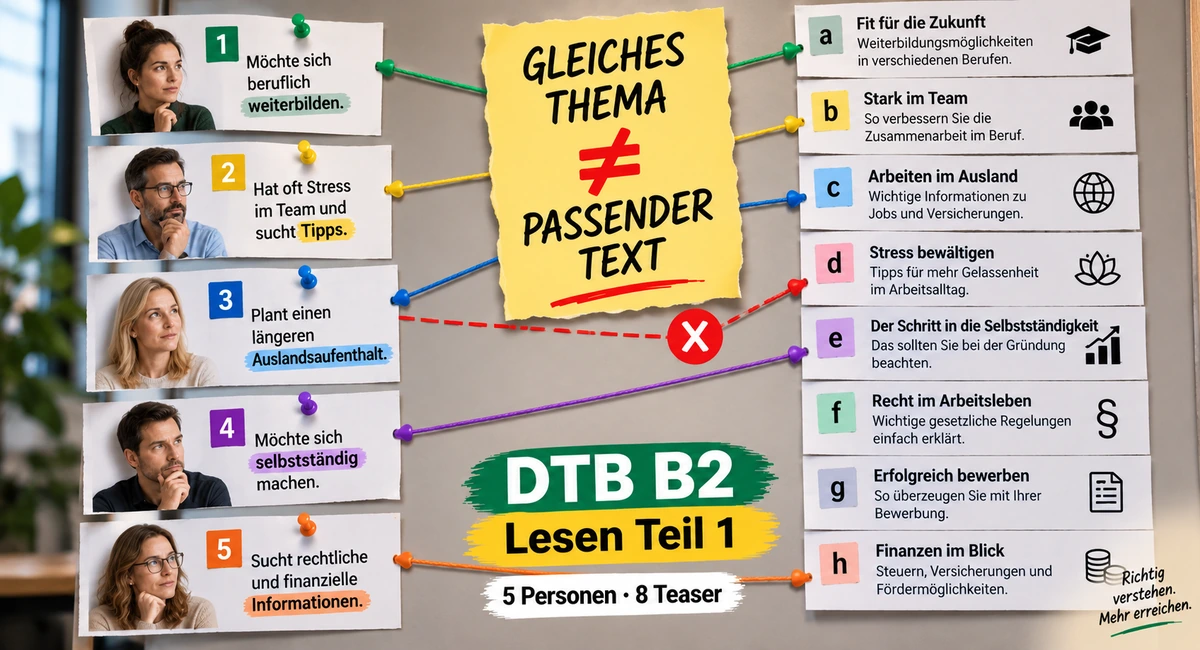
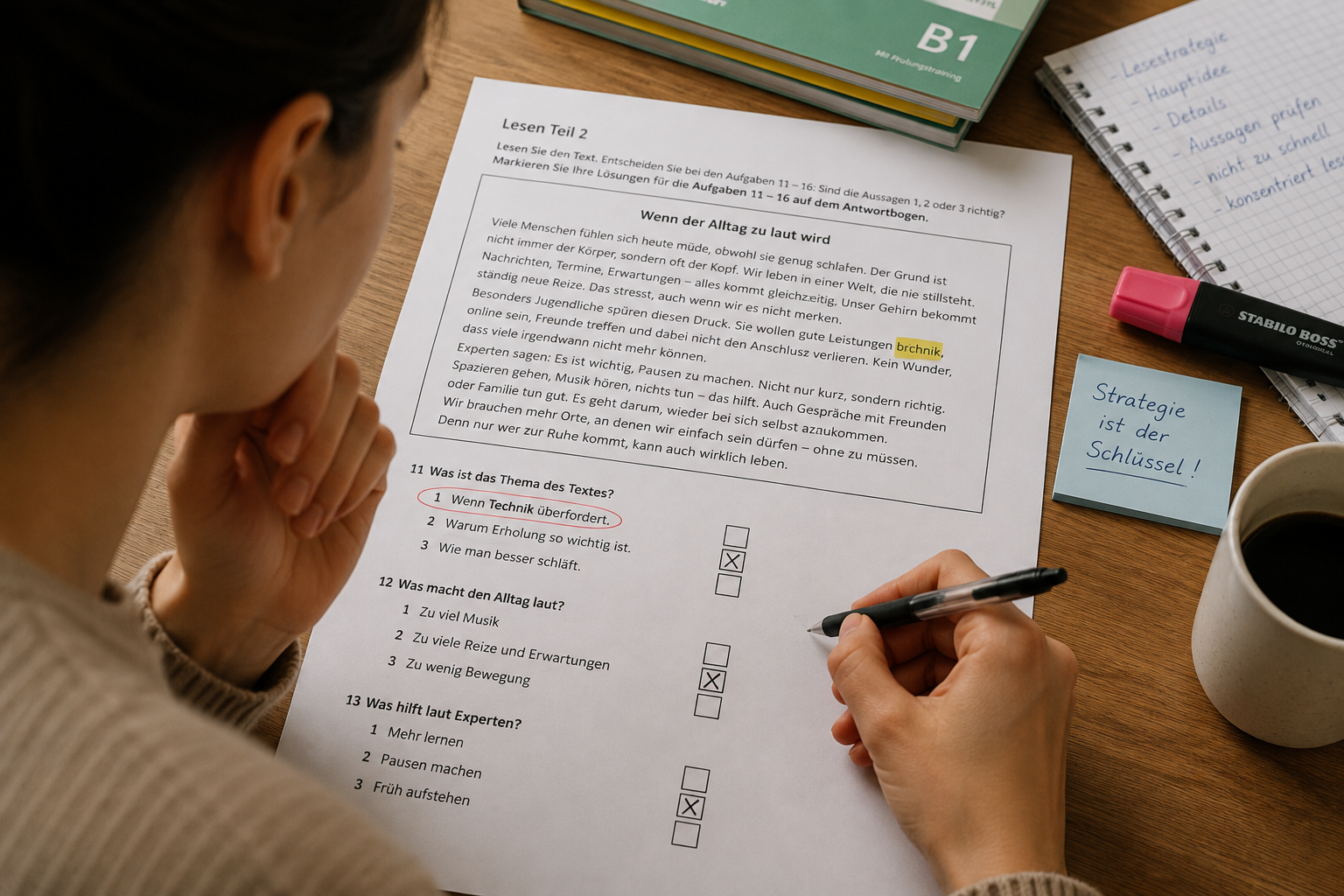
This part tests comprehension of specialist texts. The candidate must work with business letters/emails, announcements, instructions, articles on specialist topics and internal memos. Typical task formats: true/false, multiple choice or matching.
Listening
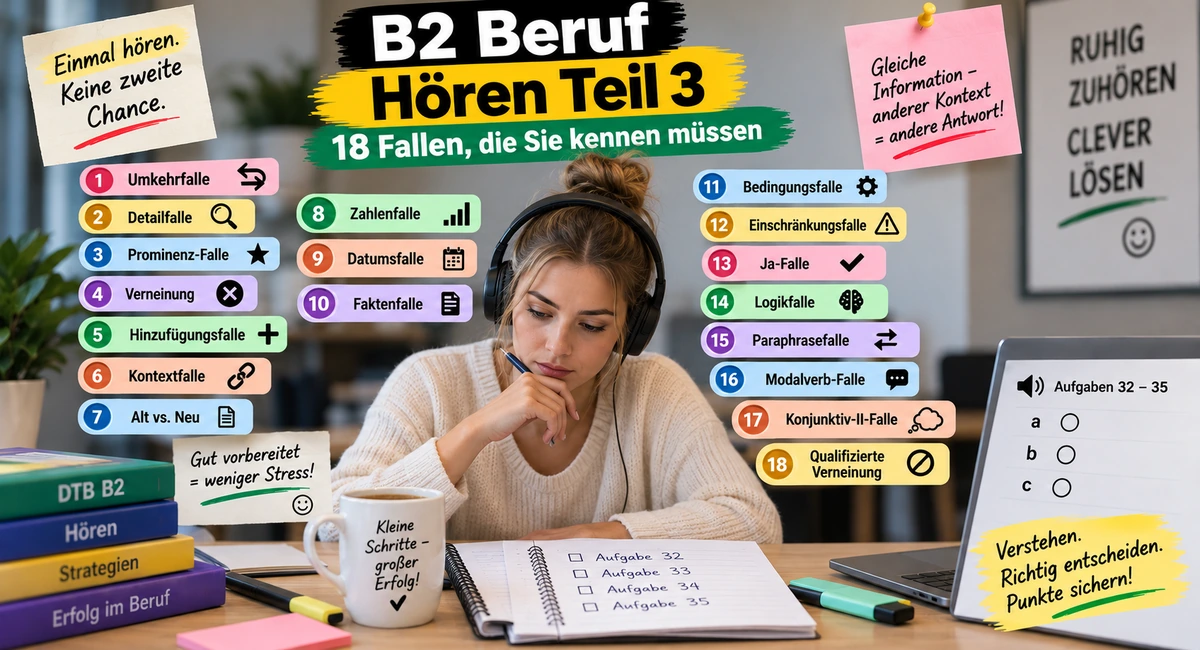
This part of the exam tests the competence to understand German audio texts. Candidates work with telephone calls, recordings of meetings, presentations and conferences. The task formats differ depending on the exam. In telc Deutsch B2+ Beruf, the listening comprehension includes true/false and multiple-choice tasks. In the Deutsch-Test für den Beruf B2, the listening section also includes matching tasks and a listening and writing section.
Writing
In telc Deutsch B2+ Beruf, the writing subtest comprises two tasks: in Part 1 a text such as a letter, a note or a short report of 180–200 words is written; in Part 2 an email or short message of 60–80 words. In the Deutsch-Test für den Beruf B2, the writing section consists of several cross-task parts, including reading and writing, listening and writing, language elements and writing, as well as an independent writing task.
Language elements
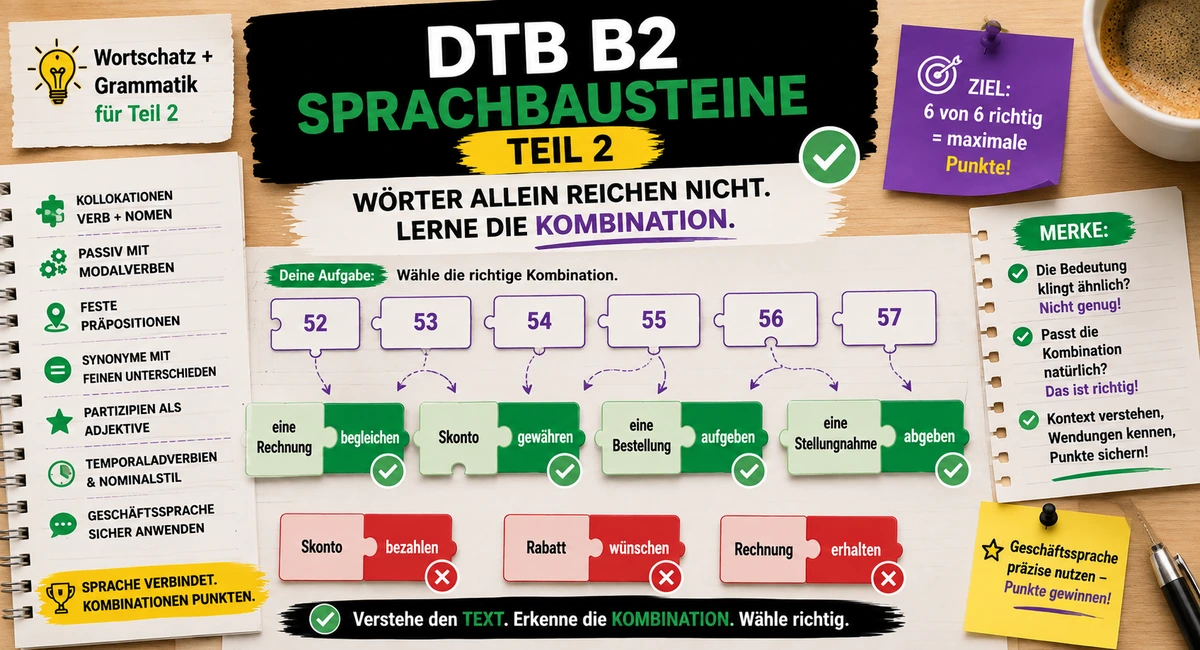
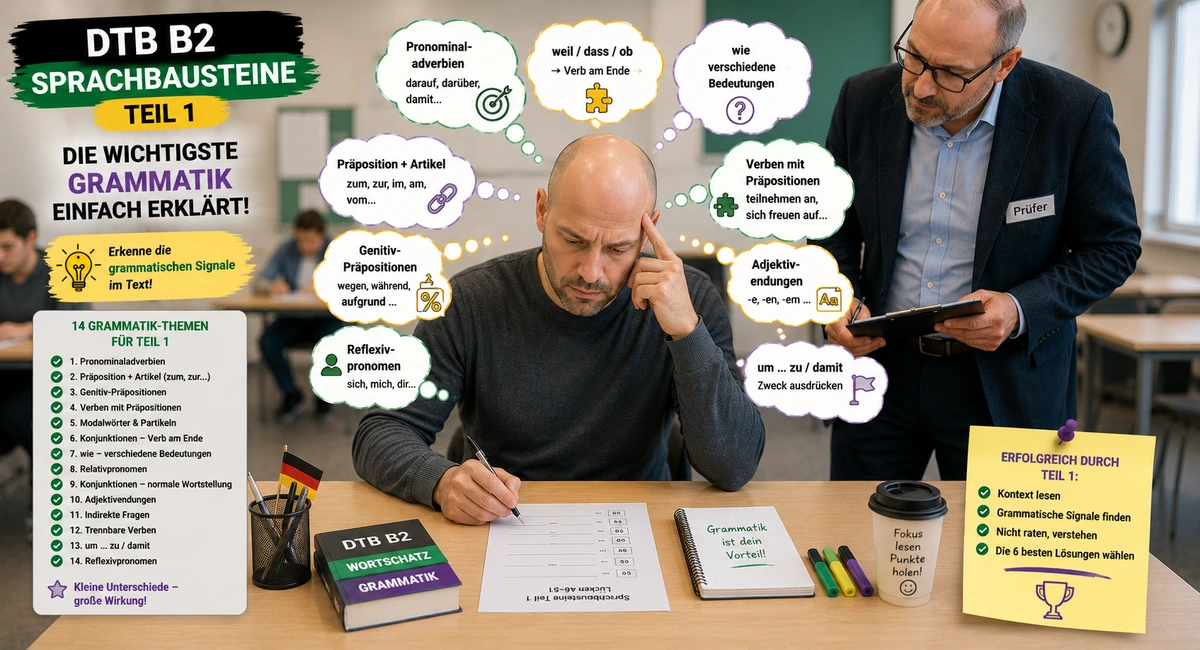
Language elements are not exclusive to telc Deutsch B2+ Beruf. The DTB B2 also includes a "language elements and writing" section. In telc Deutsch B2+ Beruf, the language elements section tests morpho-syntactic structures and vocabulary range. In the Deutsch-Test für den Beruf B2, the language elements section is integrated into the 'language elements and writing' part and does not consist of a simple gap-fill task, but of several task-specific formats. These are used to test the use of verbs, prepositions, conjugation skills, the application of a formal style and typical business formulations. Important are not only correct grammar, but also context and the appropriateness of certain language constructions in work situations.
Oral exam
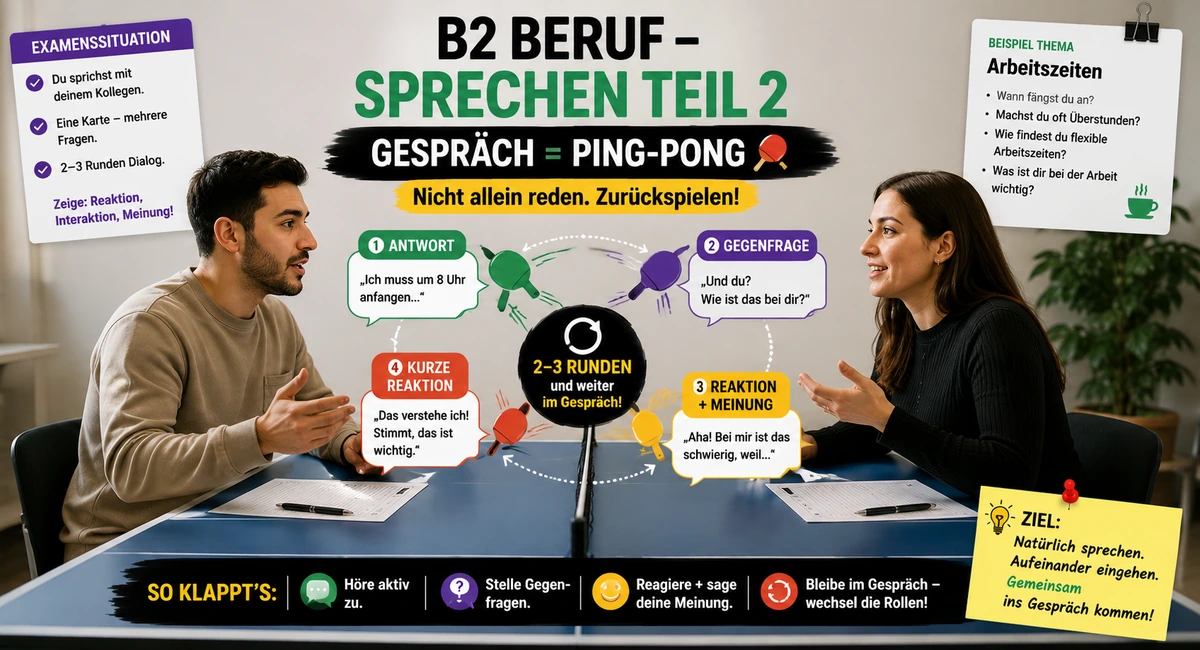
The oral B2 Beruf exam is used to assess the ability to communicate confidently and in a structured manner in professional situations. For example, presenting ideas, justifying a position and participating in discussions. This is important for normal interaction in a German-speaking environment — for conducting meetings, negotiations and teamwork.
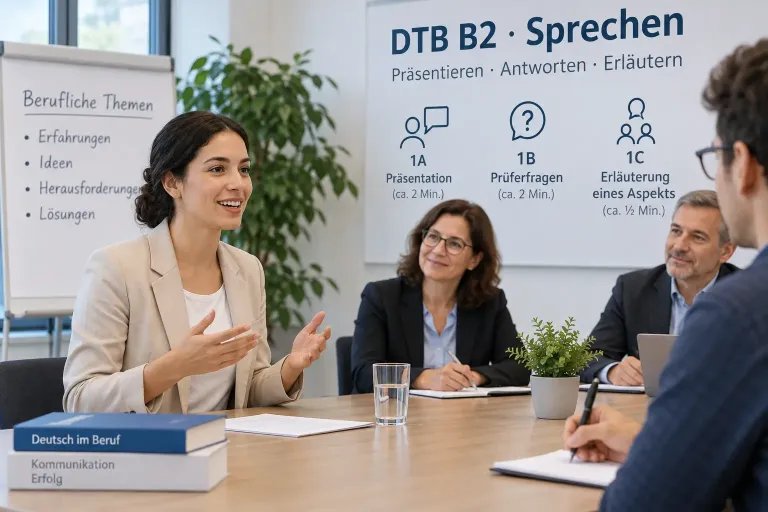
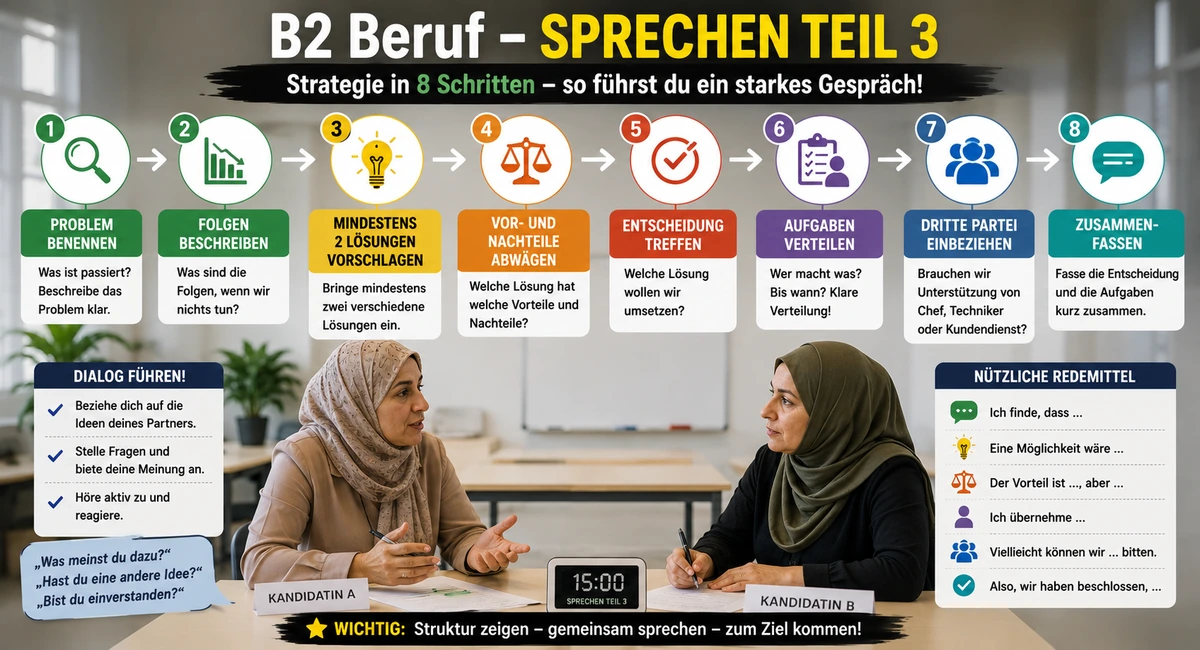
In telc Deutsch B2+ Beruf, the oral exam comprises introduction, presenting, discussing and negotiating. In the DTB B2, the speaking tasks consist of "talking about a topic", "talking with colleagues" and "discussing solutions".
The duration depends on the exam format. In telc Deutsch B2+ Beruf, the written exam includes reading comprehension, writing, listening comprehension and language elements; a break is also scheduled. The oral exam lasts 20 minutes, with an additional 20 minutes of preparation time. In the Deutsch-Test für den Beruf B2, the written exam lasts 105 minutes and the oral exam approximately 16 minutes; no preparation time is provided.
Deutsch-Test für den Beruf B2 (DTB B2)
| Skill | Points | Share |
|---|---|---|
| Reading | 60 | 25% |
| Listening | 60 | 25% |
| Writing | 60 | 25% |
| Speaking | 60 | 25% |
| Total | 240 | 100% |
The written exam lasts a total of 125 minutes. The oral exam lasts approximately 16–17 minutes. The times are not officially broken down separately by the four skills, as the written part also includes combined subtests such as "reading and writing" and "listening and writing".
telc Deutsch B2+ Beruf
| Subtest | Parts | Duration | Points |
|---|---|---|---|
| Reading comprehension | 1 | 60 min. | 20 |
| Writing | 2 | 60 min. | 25 |
| Listening comprehension | 3 | approx. 30 min. | 20 |
| Language elements | 2 | 30 min. | 10 |
| Oral exam | 3 | 20 min. | 25 |
| Total | — | — | 100 |
After the writing subtest, a 20-minute break is scheduled. An additional 20 minutes of preparation time is provided for the oral exam.
Task formats in the Deutschtest für Berufe B2
To prepare effectively for the exam in German with a vocational focus, you need to work with typical texts that are presented to candidates. Let us look at each format in detail.
Reading: analysis of job-related texts
Reading in the Telc B2 Beruf aims to develop competence in understanding professional texts, instructions, letters and announcements. To become familiar with the specific vocabulary as quickly as possible, you need to read various types of texts. Important here is not only the quick capture of information, but also the accurate understanding of content, structure and communicative intent.
Emails
When reading, you should identify the goal, important data and actions. It is important to learn the difference between a formal and a semi-formal style. Standard structure of an email:
- Greeting or salutation — Dear Sir/Madam… or Dear….
- Introduction — purpose of the letter (enquiry, confirmation, complaint, proposal).
- Main body — details, arguments, explanations.
- Closing — request for action or expression of thanks.
- Signature — name, position, contact information.
Work instructions
Documents with short and specific instructions. Imperative forms are used for actions (Press the button, Fill in the form). It is important to learn to quickly identify key steps and details (e.g. execution date, order number, sequence of actions).
Information sheets
Texts in this format are characterised by an informative and concise style of expression. They contain a lot of specialist vocabulary and frequently abbreviations (e.g. safety regulations, work steps). The "question-answer" or "list of rules" structure is considered practical. When reading, it is not necessary to translate every word. What matters is understanding the content of the text and the actions and their sequence. You need to learn to filter out the most important facts, terms and requirements.
Listening comprehension: conversations in a professional context
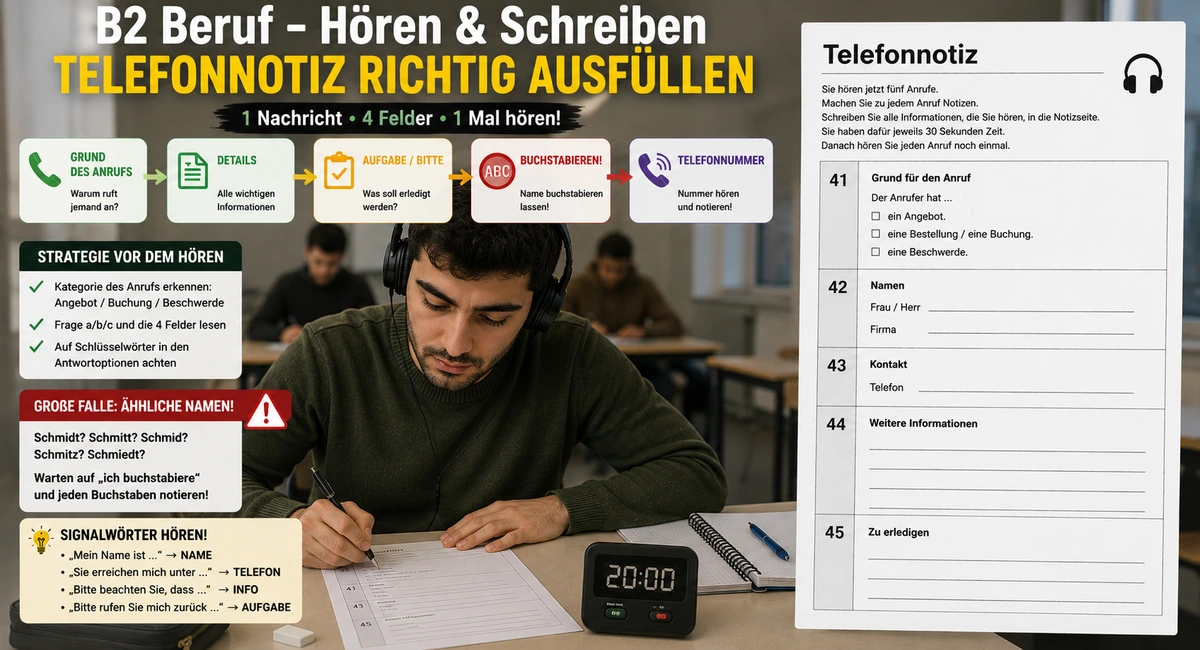
Listening comprehension B2 Beruf aims to develop the ability to correctly interpret professional situations. Candidates must demonstrate that they understand spoken utterances and can filter out important information from what they hear.
Telephone calls
When working with telephone calls, you need to immediately identify the topic and the roles of the participants. It is important to note important dates, names and figures. You need to pay attention to politeness formulas and instructions for further action. Typical phrases and objectives that are useful to memorise for dealing with exam tasks more quickly:
- Könnten Sie mir bitte…? — Request for information.
- Also, wir treffen uns am… — Confirmation of details.
- Ich verbinde Sie mit… — Transferring a call.
Meetings
A correctly conducted meeting follows the standard structure:
- Opening — greeting and introduction of participants.
- Setting objectives/agenda — topics for discussion are raised.
- Direct discussion — exchange of opinions, suggestions, clarifications.
- Decision-making/summary — setting deadlines, distribution of responsibilities among participants.
- Closing — formal farewell.
To understand the recordings, you need to identify the main tasks and actions, track the role and suggestions of each participant, and note deadlines and agreed steps.
Customer conversations
When listening to recordings, you need to learn to filter out the customer's needs and the proposed solutions, and to note important figures, deadlines and conditions. It is important to distinguish intonation and emphasis. This helps you understand the customer's priorities. You do not need to try to translate every word. What matters is the meaning and context of what is happening, as well as professional cues.
Writing: formal communication
To pass the B2 Beruf written exam, competences in composing texts with a vocational focus in compliance with structure and style are required. Accuracy in presenting information is also important.
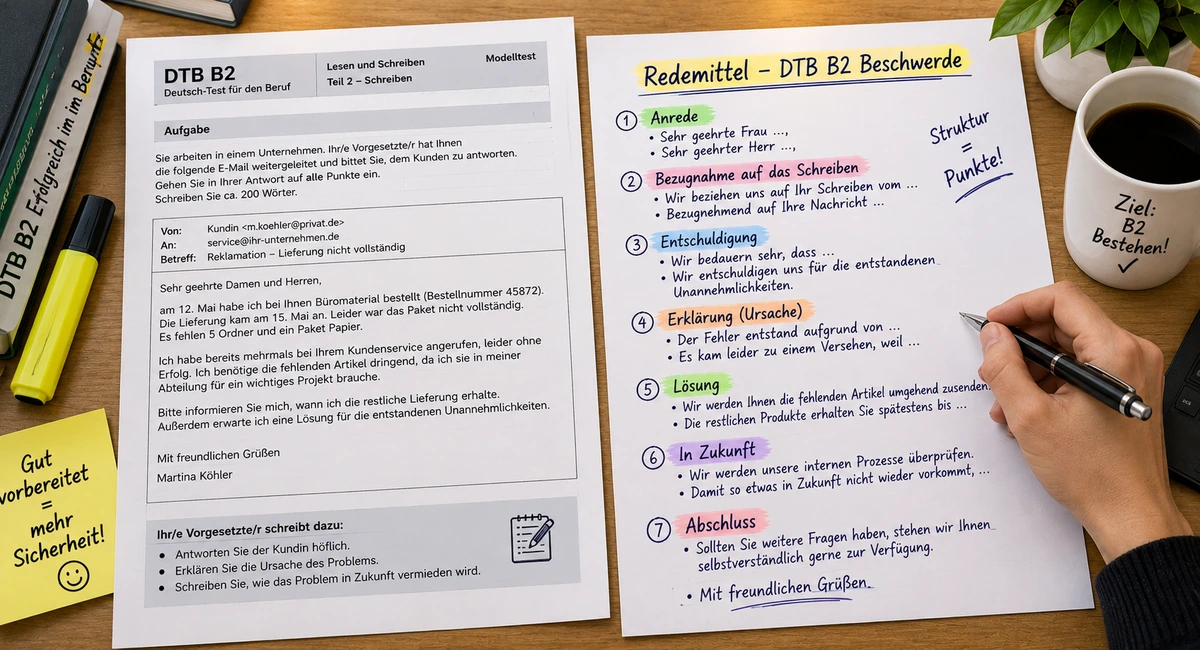
Complaint
When reading complaints, you need to immediately identify what happened, when it happened and who was involved in the incident. Typical formulations for letters of this format:
- Leider musste ich feststellen, dass… (Unfortunately I had to find that…)
- Ich bitte um eine schnelle Lösung des Problems. (I request a prompt resolution of the problem.)
- Bitte bestätigen Sie mir den Erhalt dieses Schreibens. (Please confirm receipt of this letter.)
The tone of a complaint is always formal and polite, but clear. The proposals are concise and precise. The requests or queries in the complaint are formulated so as to exclude misunderstandings.
Statement
The purpose of a written document is to inform about an acceptance, a request or an initiative. Arguments, facts and evidence of qualifications or experience must be included. Typical formulations for a statement:
- Hiermit beantrage ich… (I hereby apply for…)
- Ich bitte um Prüfung meines Antrags. (I request that my application be reviewed.)
- Für Rückfragen stehe ich Ihnen gerne zur Verfügung. (I am happy to answer any questions.)
The statement must be written in a formal style, with the emphasis on logic and persuasiveness. It is characterised by the use of formal vocabulary and phrases.
Internal memo
This text is less formal than a complaint or an application, but a business style is obligatory. Such messages frequently contain lists of actions or appointment reminders. The structure of the letter is standard (introduction, main body, closing), but sentences are short and concise so that the core message is not diluted and colleagues can understand it quickly.
Speaking: communication in everyday professional life
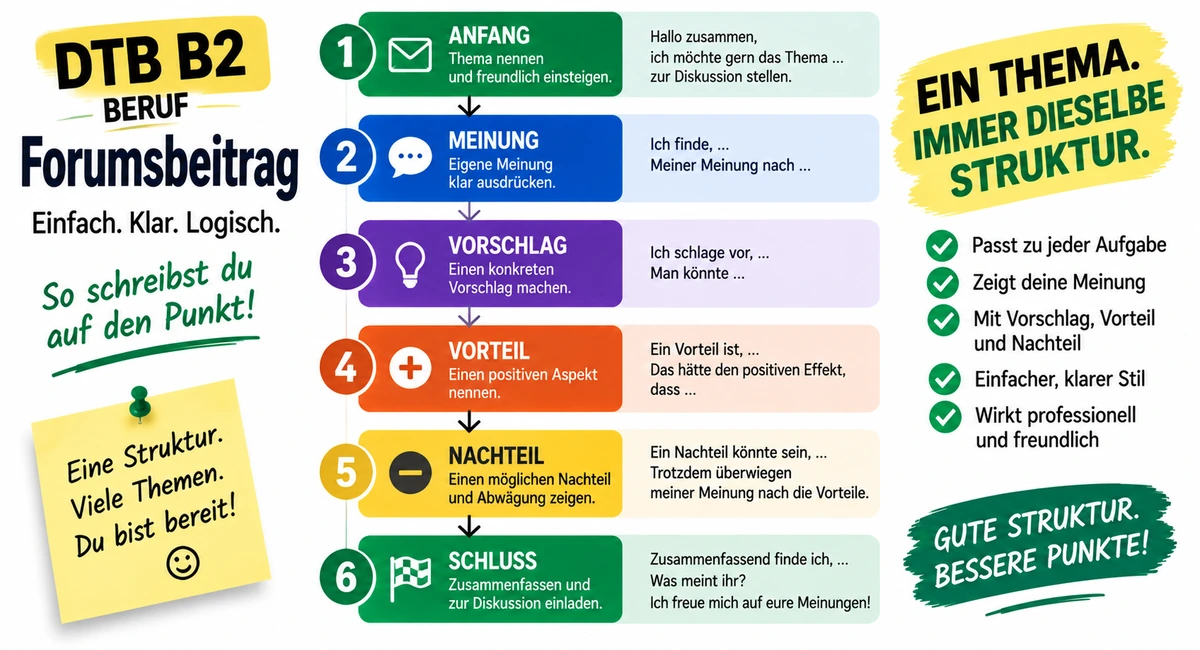
Preparation for the speaking section involves developing skills to communicate confidently in professional situations, express opinions, argue, solve problems effectively and work in a team.
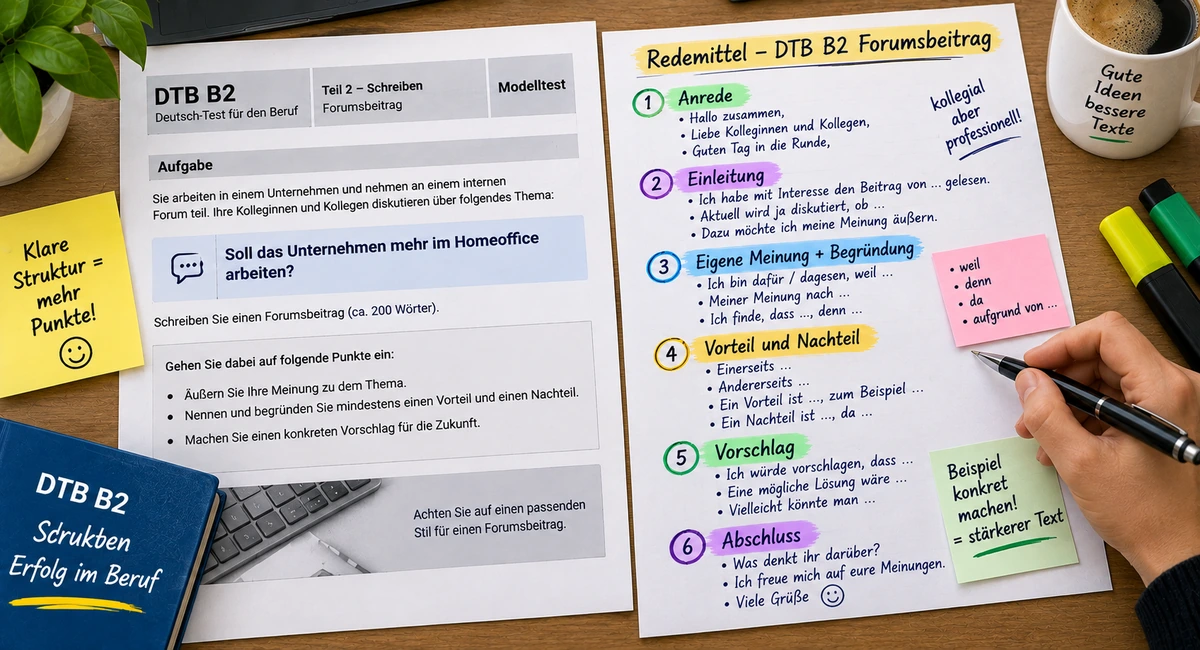
Argumentation
This involves providing information according to a standard structure as well as readiness to listen to and rebut possible objections. Important are the logical sequence of utterances and the use of specialist vocabulary and phrases for argumentation. The following are typical:
- Meiner Meinung nach… (In my opinion…)
- Ein wichtiger Punkt ist… (An important point is…)
- Man könnte einwenden, dass… aber… (One might object that… but…)
- Daher schlage ich vor… (I therefore propose…)
It is necessary to demonstrate a respectful tone, especially when disagreeing with the interlocutor. You should focus on what is essential and avoid superfluous information.
Problem-solving
The "problem-solving" format involves working with a clear structure:
- identifying the problem;
- analysing the causes;
- proposing solution options;
- selecting the optimal option, agreeing on actions.
Solving the problem always demonstrates a practical approach, with the emphasis on actions and results. Important is the use of specialist vocabulary to describe processes, deadlines or tasks. The optimal approach always shows flexibility. This means 2–3 solution options to achieve the best result.
Team discussion
This enables the development of skills for listening and interacting with colleagues, and the ability to agree or disagree politely. It is important to structure speeches and put forward clear arguments, and to participate actively in the discussion without interrupting colleagues. The use of linking words and introductory constructions makes speech fluent and logical. In texts in the format of a team discussion, it is important to place the emphasis on joint decisions and the distribution of responsibility.
Scoring system and minimum score
In telc Deutsch B2+ Beruf, a total of 100 points are awarded. In the Deutsch-Test für den Beruf B2, a total of 240 points can be achieved, distributed equally at 25 percent each across reading, listening, writing and speaking. In the Goethe-Zertifikat B2, the modules are listed separately; a maximum of 100 points can be achieved in each module.
Detailed point distribution
The distribution of points for B2 Beruf is carried out taking into account all the modules completed by the candidate. The maximum score for written tasks is 75 points, for oral tasks 25 points. To pass the exam, at least 60% of the possible points must be achieved.
Minimum requirements and passing rules
For job-related B2 exams, different passing rules apply depending on the exam format. In telc Deutsch B2+ Beruf, a total of 100 points are awarded. The exam is passed if at least 45 points in the written exam and 15 points in the oral exam are achieved. A separate minimum score only for the reading subtest is not officially required.
In the Deutsch-Test für den Beruf B2 (DTB B2), a total of 240 points can be achieved. To pass, 144 points must be obtained. In addition, at least three of the four skills — reading, listening, writing and speaking — must each exceed 60 percent, i.e. exceed 36 points. In one skill, a weaker performance can be compensated if the partial result is between 40 and 60 percent.
Overall result and certificate
To achieve a positive result for B2 Beruf, both parts (written and oral) must be passed. The first part is easier, as it comprises 3 modules, each of which can compensate for the weaker ones. It is important not to miss the oral part in particular. The options for retaking should be checked directly with the responsible examination centre or in the official implementation regulations.
The issued document states the total score, the exam result and the B2 level in accordance with the CEFR. The Beruf-type certificate confirms the candidate's ability to communicate and interact effectively in German in a professional environment. The certificate serves as official proof of language skills. Whether an institution only accepts recently issued certificates depends on its own requirements. telc has also officially confirmed that the digital certificate has the same validity as the paper version.
The table summarises the most important assessment criteria and requirements for the B2 Beruf modules.
| Module | Maximum score | Minimum score | Assessment criteria |
|---|---|---|---|
| Reading | 25 | No separate minimum score | Understanding the main idea, searching for specific information, analysing details, acquiring specialist vocabulary |
| Listening | 20–25 | No separate minimum | Understanding work dialogues, filtering out key information (dates, figures), interpreting intentions |
| Writing | 25 | No separate minimum | Complete fulfilment of the task, structure and logic of the text, specialist vocabulary, grammatical correctness |
| Speaking | 25 | 15 | Qualitative fulfilment of the communication task, vocabulary, grammar, pronunciation |
Effective preparation for the B2 Beruf exam
For successful preparation for the B2 Beruf exam, a competent strategy that covers all the key points is important. For example, you need to familiarise yourself with the structure of the official exam and select suitable tools for regular training. You also need to know and master the requirements for professional German, and practise in accordance with the schedule. Clear guidance helps you focus on the most important factors and allocate your efforts so as to achieve a positive result quickly.
Correct use of sample tests
It is a big mistake to simply work through tests without analysis. You need to apply diagnostic methods. For example, complete a test without preparation, but with time management in mind. Analyse which module produced the weakest result and what reduced the score (grammar, vocabulary, logic, etc.). After reviewing the performance and working on the mistakes, repeat the test.
Real-time simulation
Even excellent language skills cannot save a candidate who has not learned to work under time pressure and maintain composure in stressful situations. Approximately once a week, you should complete the tasks under full simulation conditions: following the schedule, in a quiet environment, without breaks and without looking things up in a dictionary. The results must be assessed according to the official criteria. Be sure to carry out an analysis of the test, work on your weak points and repeat the simulation after a few days.
Targeted learning of specialist vocabulary
To speak professionally, it is necessary to:
- define your field;
- work with thematic blocks;
- learn not individual words, but word combinations;
- actively practise writing.
Regularity is better than hour-long sessions once a week; analysing mistakes is more important than the number of texts worked through; active vocabulary yields more than passive vocabulary.
Textbooks and preparation materials
The following textbooks may be helpful for exam preparation, among others:
- Mit Erfolg zum telc Deutsch B2+ Beruf (Klett) — practice tests and targeted exercises for the exam sections.
- Prüfungstraining telc Deutsch B2+ Beruf (Cornelsen) — structured preparation with a focus on task formats.
- Menschen im Beruf — Medizin/Pflege/B2 (Hueber) — helpful for job-related vocabulary in the medical field.
- Handbuch zu B2 Beruf (Yevgeniya Shumova / German Backstage) — Ukrainian-language edition with explanations of tasks, grammar and vocabulary.
Model tests for preparation for the B2 Beruf exam (Telc or DTB) are available on the official website telc.net. You can also use the practical and effective online trainer on the Deutsch Vorbereitung platform.
Common mistakes in the B2 Beruf exam
Mistakes are a natural part of every learning process, but knowing the typical mistakes allows you to avoid them in the official exam. Let us look at the most important ones in order to increase the chances of successfully passing the exam.
Unclear structure of the written work
The absence of some elements of the standard structure (introduction, main body, conclusion) makes the text difficult to understand, unclear and inconsistent. With such a mistake, even correct word choice and grammar will not help achieve a high score. This mistake can be avoided through good planning before writing. It is important to get out of the habit of not taking 2–3 minutes for planning.
Lack of professional relevance
One must always bear in mind that the B2 Beruf exam tests the ability to use language in a professional context. It is wrong to deviate from the topic of the task or to give abstract examples, however well-crafted they may be.
Time management problems
Time management problems occur with almost all candidates who prepare for the official exam while ignoring timing. The result is incomplete tasks or superficial, only intuitively justified answers that do not get to the heart of the matter. Only daily practice with a timer helps develop a feel for time.
Uncertain argumentation in the oral part
General or superficial answers without convincing examples are a frequent problem in the oral part of the exam. Such an approach significantly weakens the candidate's position and arises from insecurity or fear of making mistakes. To prepare successfully for the exam, one must work in a structured manner during training and select examples with the vocational focus in mind.



There are no comments for this article. Leave your comment