





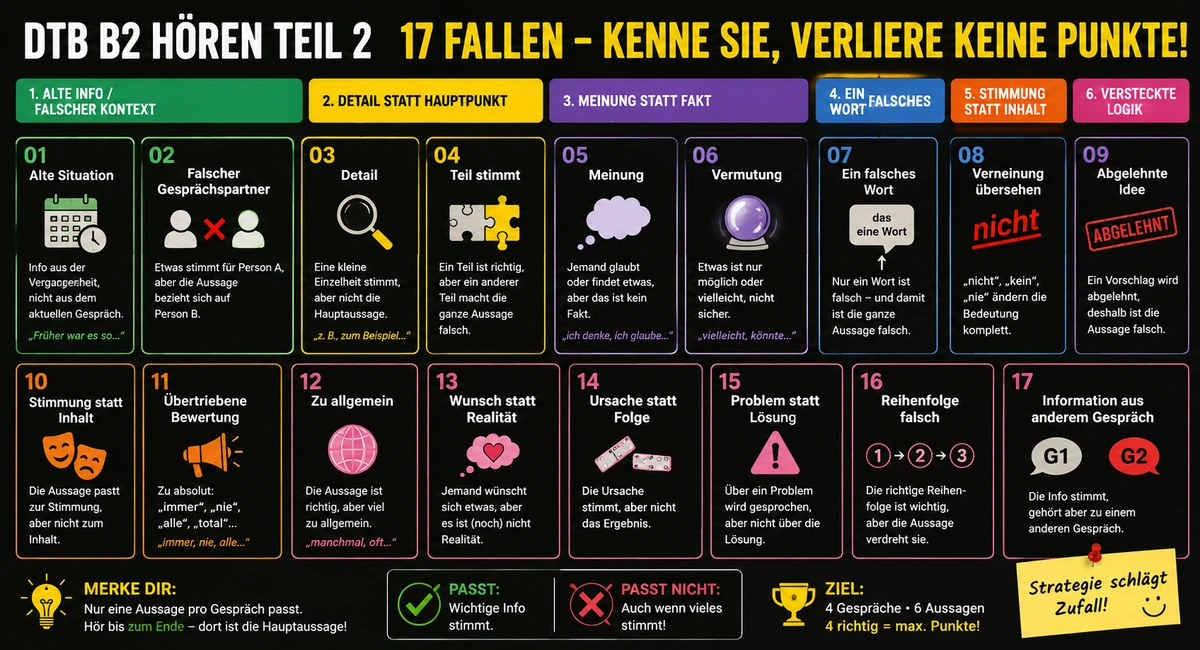
DTB B2 Hören Teil 2:
The 17 trap types – and how to avoid them
Hören Teil 2 is one of the most difficult parts of the DTB B2 exam. The wrong answers sound almost correct. This article explains all 17 trap types step by step – with examples, explanations and a clear strategy for the exam.
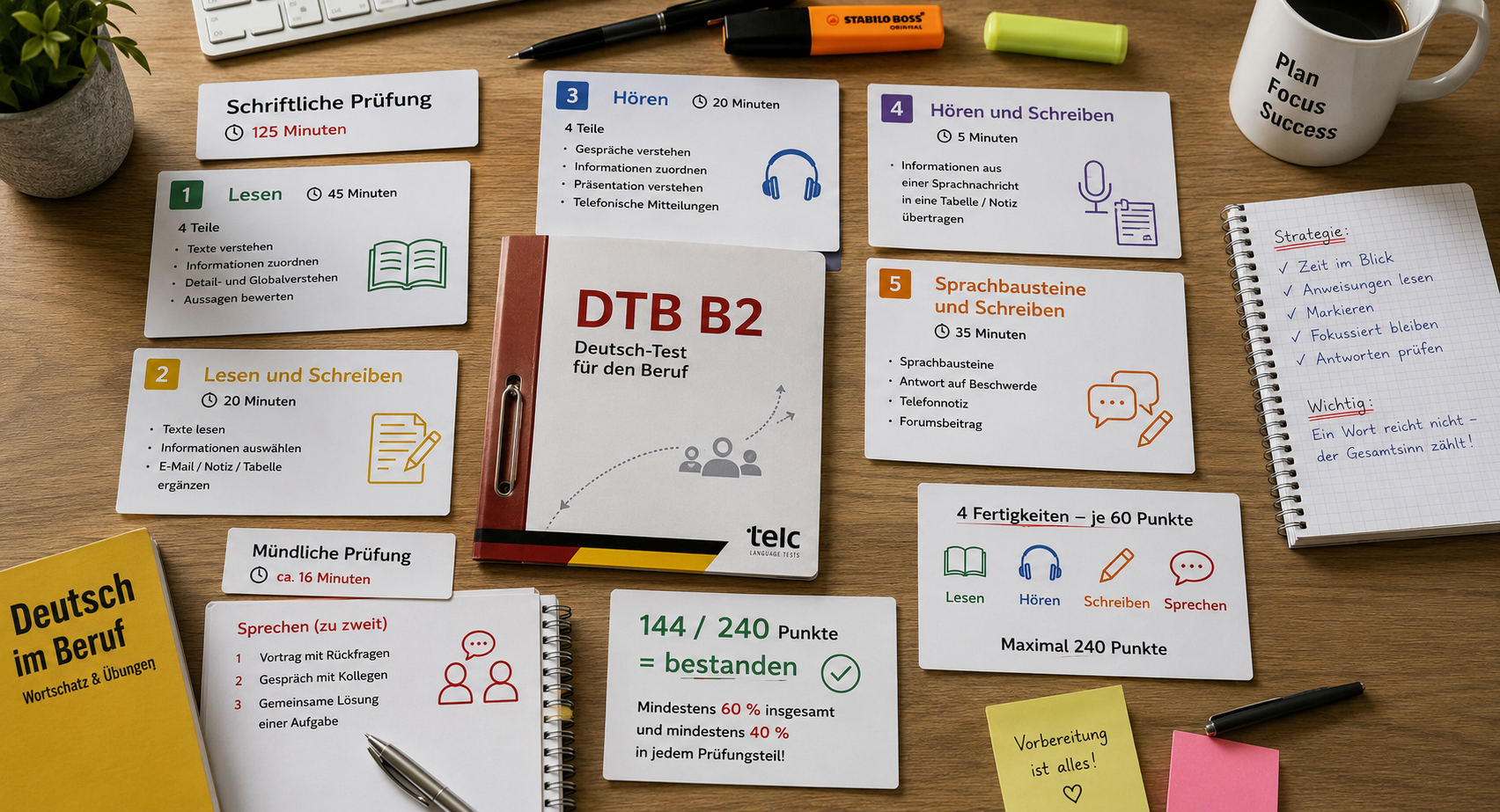
The exam format – briefly explained
In this exam section you listen to four short conversations from everyday professional life. There are six statements. Four statements are correct – one per conversation. Two statements do not match any conversation. Each conversation is played only once.
That is the real problem: no second chance. Those who are not prepared lose points – not because they do not understand the language, but because the wrong answers are so cleverly constructed.
A wrong answer does not have to sound completely wrong. It only needs to contain one single wrong word. That one word makes the entire answer wrong. This is the principle behind almost all 17 traps in this exam section.
The three basic rules you need to know
Before we explain the 17 traps, there are three overarching rules. These rules apply to all tasks in Hören Teil 2 – regardless of the topic, regardless of the conversation.
The two wrong answers are constructed so that they could fit two or even three different conversations. Anyone who does not know this falls into the same trap across multiple conversations.
You hear a word in the conversation. You see the same word in an answer. You think: correct. This is almost always a mistake. The word was deliberately placed in the wrong answer to confuse. The word alone proves nothing at all.
The beginning of a conversation usually contains mood, discussion and details. The end contains the result and the main statement. Those who only listen to the beginning very often choose the wrong answer.
Group 1: The answer comes from the wrong source
These traps occur because you do not pay attention to where a piece of information in the conversation comes from. Does it come from the current situation? Or from a previous company? From a different conversation? Old information and current information often sound the same – but they mean something different.
Trap 1: The old information sounds like the current one
In the conversation someone tells how things were at their previous company. The wrong answer describes exactly this old situation – but as if it were the current rule. You must always listen: does this apply now here? Or was it like that before somewhere else?
A new employee says: „Bei meiner alten Firma in Bremen musste ich immer sofort am ersten Krankheitstag zum Arzt gehen.” The colleague replies: „Hier ist das anders. Bei uns reicht es ab dem dritten Tag.”
Wrong answer: „Mitarbeiter müssen ab dem ersten Krankheitstag ein Attest vorlegen.”
This sounds correct – but it describes the old company. A different rule applies here. The key phrase is: „Bei meiner alten Firma”. These four words mean: this information no longer applies.
Memory tip: Listen out for words like früher, bei meiner letzten Firma, damals, bei meinem alten Job. These words signal: this does not apply here and now.
Trap 2: A word from an earlier conversation appears in a later answer
You hear a particular word in one conversation. Later this word appears in an answer for a different conversation. You think: „I know that, I heard that.” But you heard it in a different conversation – with a different topic and a different meaning.
In a conversation about moving house it is explained: „Für einen Umzug kann man Sonderurlaub beantragen.”
Later, in a different conversation about illness during holiday, a wrong answer reads: „Wer während des Urlaubs krank wird, kann Sonderurlaub beantragen.”
The word „Sonderurlaub” was heard earlier and reappears in the answer. But it belongs to a different conversation with different content. The wrong answer combines two different conversations into one false sentence.
Memory tip: Every answer belongs to one conversation. Always check: does this answer fit this conversation – or did I hear that word in a different conversation?
Group 2: You hear the wrong thing as the main point
These traps arise because a lot is said in conversations – and not everything is equally important. A detail sometimes sounds more important than the actual main statement. One person talks at length about something unimportant. One part of a programme is discussed in detail, another only briefly mentioned. You must learn: what is the main statement – and what is just background?
Trap 3: A detail sounds like the main point
In the conversation a detail is mentioned several times. It sounds important. The wrong answer describes this detail. But the actual main statement of the conversation is something else – it is only said once, briefly, at the end.
A colleague asks a female employee whether she wants to take part in the company run. He says several times: „Je schneller das Team läuft, desto besser” and „Du bist doch sportlich.”
At the end he says: „Wir brauchen noch drei Personen mit Lauferfahrung – dann sind wir komplett.”
Wrong answer: „Möglichst viele Mitarbeiter sollen am Lauf teilnehmen.”
Correct answer: „Für den Lauf werden Mitarbeiter mit Lauferfahrung gesucht.”
The words „möglichst viele” appear nowhere in the conversation. They were invented to confuse. The correct information came at the end: experience is needed, not large numbers.
Memory tip: The last sentence of a conversation is often the correct answer. Everything before it is usually the path leading there.
Trap 4: A second programme item is missed
The conversation describes a situation with two activities or two parts. The first activity is discussed at length. The second is briefly mentioned at the end. You think: there is only one activity. But the correct answer describes both together.
Colleagues are talking about a company outing. They talk for five minutes about an escape room: how difficult it is, who can take part, what is needed. At the end someone says: „Und danach gehen wir alle zusammen zum Abendessen.”
Wrong answer: „Beim Betriebsausflug lösen alle Mitarbeiter Rätsel im Escape Room.”
Correct answer: „Der Betriebsausflug hat mehrere verschiedene Programmpunkte.”
The dinner was only mentioned briefly – but it is still part of the programme. The correct answer describes the entire programme.
Memory tip: Listen right up to the very last sentence. If something new is mentioned at the end, it is part of the correct answer.
Trap 5: A loud, negative person distracts from the result
In the conversation one person is very loud and very negative. They talk at length about their problems and their resistance. You focus on this person. But the actual information of the conversation is the company decision – and this was usually stated clearly and briefly at the beginning.
Colleagues are talking about a company anniversary. Right at the beginning someone says: „Für unsere Kunden sind viele Aktionen und Rabatte geplant.”
Then a colleague complains for several minutes: „Das macht nur mehr Arbeit. Ich habe keine Energie. Das ist ungerecht.”
Correct answer: „Die Firma plant für ein Jubiläum besondere Aktionen für ihre Kunden.”
This information came at the beginning. The colleague’s complaints are loud – but they are not the main statement. They are a distraction. The company decision stands.
Memory tip: Whoever speaks loudest is not always right. Ask yourself: what is the official decision in this conversation?
Group 3: You confuse opinion and result
In real conversations people say many things: assumptions, wishes, opinions, ideas. Not all of these are the result of the conversation. You must hear the difference: what is a personal opinion? What is a decided fact?
Trap 6: An assumption sounds like a fact
Someone says: „Ich glaube, dass…” or „Vielleicht könnte man…” or „Es wäre möglich, dass…” The wrong answer describes this assumption – as if it were a fact. But a fact was never stated.
In the conversation a colleague says: „Vielleicht könnten eigene Mitarbeiter die Übersetzungen übernehmen – das wäre günstiger.”
Another person replies: „Nein, die Firma hat entschieden, eine externe Übersetzungsagentur zu beauftragen.”
Wrong answer: „Mitarbeiter übernehmen künftig die Übersetzungsaufgaben.”
Correct answer: „Die Firma arbeitet künftig mit einer externen Übersetzungsagentur.”
A colleague’s assumption is not a company decision. The real decision came afterwards – and it is the opposite of the assumption.
Memory tip: Signal words for assumptions: vielleicht, ich glaube, könnte, wäre möglich, ich denke, möglicherweise. What another person says afterwards is often the real fact.
Trap 7: The loudest opinion is not the result
Several people are speaking. One person is particularly loud or talks particularly a lot. But their opinion is not the result of the conversation. The result is what comes at the end – or what was decided by the majority or the manager.
In many conversations there is a person who objects and complains. This person talks a lot. But in the end they accept the others’ decision. The correct answer describes the result, not the resistance.
Memory tip: Always ask yourself: what is the result of the conversation? Not: who spoke the most or the loudest?
Group 4: One word makes the answer wrong
These are the most dangerous traps. Why? Because everything is correct – except for one single word. The topic is correct. The context is correct. Most of the words are correct. But one word is wrong. And that one word makes the entire sentence wrong. Many candidates do not notice the difference because they read too quickly.
Trap 8: The one wrong word
The answer describes the correct topic. But a particular word does not appear in the conversation – or the conversation says something different. You must check every single word of the answer, not just the topic.
In the conversation: a female employee was ill during her holiday. She has a doctor’s certificate. The colleague says: „Dann bekommst du diese Urlaubstage zurück. Die gehen nicht verloren.”
Wrong answer: „Wer im Urlaub krank wird, kann Sonderurlaub beantragen.”
Correct answer: „Urlaubstage, an denen man krank war, gehen unter bestimmten Umständen nicht verloren.”
The topic is the same: holiday + illness. But the word „Sonderurlaub” does not appear in the conversation. In the conversation holiday days are returned – that is something different from applying for special leave. One word – one wrong answer.
Particularly risky words and expressions:
- Numbers and quantities: fünf Personen vs. möglichst viele;
- Technical terms: Sonderurlaub vs. Urlaubstage zurück;
- Tense: muss noch gemacht werden vs. wurde bereits entschieden;
- Extreme words: alle, immer, nur, nie, jeder, niemals.
Memory tip: Does every word of this answer match the conversation? Not just the topic – every single word.
Trap 9: A rejected proposal becomes the answer
In the conversation someone makes a proposal. This proposal is discussed – and then rejected or changed. The wrong answer describes exactly this original proposal using the right words from the conversation. But the proposal is no longer valid because it was rejected.
In the conversation a colleague suggests: „Wir könnten den Drucker in den Flur stellen – dann haben wir mehr Platz.”
The others respond: „Nein, das ist zu unpraktisch. Wir lösen das anders.”
Wrong answer: „Der Drucker soll in den Flur gestellt werden.”
This proposal was rejected. It is not valid. But the answer uses the right words from the conversation – that is exactly what makes it so dangerous.
Memory tip: If a proposal is rejected in the conversation, it cannot be the correct answer. Listen out for: Nein, das geht nicht, lieber anders, das ist unpraktisch.
Trap 10: The answer sounds correct for all four conversations
Some wrong answers are written so generally that they could fit any conversation. They always sound correct – for any topic. But they do not describe a concrete situation from a specific conversation. They are too vague and too imprecise.
An answer reads: „Das Wohlbefinden der Mitarbeiter sollte in jedem Unternehmen wichtig sein.”
This sentence sounds correct – regardless of what the conversation was about. Holiday? Fits. Sick leave? Fits. Office? Fits. Hygiene? Fits. But that is precisely the problem: a sentence that fits everything fits nothing precisely. The correct answer always describes a concrete situation from a specific conversation.
Memory tip: If an answer could fit all four conversations, it is very likely wrong.
Group 5: The mood is deceptive
Conversations have a mood. Sometimes someone is enthusiastic, sometimes tired, sometimes sad. This mood creates a picture in your head – and this picture can be wrong. You follow the feeling instead of the content. This group contains three different traps: atmosphere, mood and reversal.
Trap 11: The atmosphere of the conversation distracts from the content
The conversation sounds like holiday, relaxation, summer, family, joy. The wrong answer describes exactly this atmosphere. But the actual information of the conversation is something concrete and matter-of-fact – for example: someone has to take on a task.
A colleague says cheerfully: „Nächste Woche bin ich mit der Familie am Meer in Kroatien! Ich kann es kaum erwarten.” He then asks a female colleague to write a report for him while he is away.
Wrong answer: „Viele Mitarbeiter träumen im Büro von ihrem nächsten Urlaub.”
Correct answer: „Manchmal übernehmen Kollegen Aufgaben füreinander.”
The mood is holiday excitement. But the information is: a task is being handed over. That is the main point – not the holiday excitement.
Memory tip: How does the conversation sound? Good. And now: what is concretely said and decided? Those are two different questions.
Trap 12: The general mood is confused with the main statement
The conversation has a particular mood: exhausted, motivated, frustrated, enthusiastic. A wrong answer describes this mood in general terms. But the correct answer describes a concrete fact that was stated within this mood. The mood is real – but it is not the main statement.
Several colleagues are talking about overtime. Everyone sounds tired and overloaded. Someone says: „Ich habe so viele Stunden angesammelt – ab nächstem Monat kann man sie endlich abbauen.” Another colleague says: „Ich kann das aber nur in den Schulferien machen, wegen meiner Kinder.”
Wrong answer: „Viele Arbeitnehmer wünschen sich, dass Mehrarbeit stärker anerkannt wird.”
Correct answer: „Manche Mitarbeiter können ihren Freizeitausgleich nur zu bestimmten Zeiten nehmen.”
The tiredness and overload are palpable – but they are not the main statement. The concrete information is: one colleague is constrained by time.
Memory tip: What is said? That is the main statement. How it sounds is the atmosphere. These are not the same thing.
Trap 13: A detail points to the opposite of the correct answer
In the conversation a concrete detail is mentioned. This detail sounds as if the answer were X. But the correct answer is exactly the opposite of X. The detail was deliberately chosen to lead the listener in the wrong direction. A sentence then follows that corrects everything – but many people are no longer listening attentively by that point.
Tom asks: „Muss man zur Firmenfeier etwas Besonderes anziehen?”
Lara replies: „Ich habe mir extra neue Sandalen dafür gekauft.”
This sounds like a dress code. Then Lara says: „Aber vorgeschrieben ist gar nichts. Jeder kann kommen, wie er möchte.”
Wrong answer: „Zur Firmenfeier soll man festliche Kleidung tragen.”
Correct answer: „Für die Firmenfeier gibt es keine Kleidervorschrift.”
The detail about the new sandals was the trap. The correct answer came afterwards – and it says the opposite of the detail.
Memory tip: When a detail points strongly in one direction, keep listening particularly carefully. The next sentence often corrects it.
Group 6: The logic is hidden
These four traps require logical thinking. You must not only understand what is said – but also what it means. What is a wish? What is reality? What is the cause, what is the consequence? What is the problem, what is the solution? Those who do not recognise these connections choose the wrong answer.
Trap 14: A demand sounds like a fact
The wrong answer formulates a demand: „Arbeitgeber sollten mehr tun…” or „Es muss noch überlegt werden…” But the conversation describes that the company already does this. The wrong answer sounds correct – but it is in the wrong tense.
In the conversation: „Nächsten Monat kommt ein Arzt in die Firma und impft alle, die das möchten.”
Wrong answer: „Unternehmen sollten mehr für die Gesundheit ihrer Mitarbeiter tun.”
Correct answer: „Manche Firmen bieten ihren Mitarbeitern Gesundheitsmaßnahmen an.”
The company is already doing something concrete. The wrong answer says they should do it – as if it were not yet the case. That is wrong.
Memory tip: Sollte = not yet the case. Ist, macht, tut, bietet an = already the case. Listen carefully to this difference.
Trap 15: The abstract answer sounds more important
Two answers deal with the same topic – one abstract, one concrete. The abstract one often sounds more significant. But the correct answer is always the more concrete one, which describes what was specifically said in the conversation. General statements never fit a specific conversation.
In the conversation colleagues complain: the soap in the toilet is always empty, there is no disinfectant, nobody refills it.
Abstract wrong answer: „Hygiene am Arbeitsplatz ist ein wichtiges Thema für alle Mitarbeiter.”
Concrete correct answer: „Der Arbeitgeber sollte mehr für die Hygiene im Betrieb tun.”
Both answers are about hygiene. But the concrete answer describes what was really said in the conversation: a concrete deficiency that needs to be remedied.
Memory tip: Which answer describes the situation most precisely? That is the correct one.
Trap 16: The connection between cause and consequence is hidden
In the conversation it is explained: because A happens, B follows. The correct answer describes this connection. The wrong answer describes only A or only B – without the connection. You understand the individual pieces of information, but not their relationship.
In the conversation: „Viele Kollegen haben Rückenschmerzen, weil ihr Stuhl und der Bildschirm falsch eingestellt sind. Jetzt kommt ein Experte und kontrolliert jeden Arbeitsplatz.”
Wrong answer: „Viele Mitarbeiter haben gesundheitliche Probleme.”
Correct answer: „Die Gestaltung des Arbeitsplatzes hat direkten Einfluss auf die Gesundheit.”
The wrong answer describes only the problem (back pain). The correct answer describes the connection: workplace design → health. This connection is the main statement.
Memory tip: Ask yourself: what is the cause? What is the consequence? Which answer describes exactly this connection?
Trap 17: Problem and solution are confused
The dialogue describes both a problem and a solution. One wrong answer describes the problem. Another describes the solution. You must decide: what is the main statement – the problem or the solution? In most cases the solution or the conclusion is the main statement, not the problem itself.
In the conversation: the office is very cramped. A new colleague is joining. The company has decided: the photocopier will go in the corridor so that a new desk can be set up.
Wrong answer: „Über die Neugestaltung des Arbeitsplatzes muss noch nachgedacht werden.”
Correct answer: „Es ist nicht immer einfach, Platz für neue Kollegen zu schaffen.”
The decision has already been made. There is no more thinking to be done. The wrong answer sounds like an open question – but the problem and the solution are already settled.
Memory tip: Has the problem already been solved – or is it still being thought about? Listen to the sense of time in the conversation.
All 17 trap types – overview
The following table shows all 17 trap types. Use this table when practising: if you chose a wrong answer, look up which trap type deceived you.
| # | Name of the trap | Group | Brief explanation |
|---|---|---|---|
| 1 | Old information as current | 1: Wrong source | Someone describes the rule at their old company – the wrong answer sounds like the current rule |
| 2 | Word from another conversation | 1: Wrong source | A word from an earlier conversation appears in a later wrong answer |
| 3 | Detail sounds like main point | 2: Wrong weighting | A detail is mentioned often – the actual main statement comes briefly at the end |
| 4 | Second programme item missed | 2: Wrong weighting | One activity dominates the conversation, a second is mentioned briefly – both are part of the correct answer |
| 5 | Loud resistance distracts | 2: Wrong weighting | One person objects loudly – the company decision stands nonetheless and is the correct answer |
| 6 | Assumption as fact | 3: Opinion vs. result | Someone assumes something – the wrong answer treats this assumption as a fact |
| 7 | Loudest opinion is not the result | 3: Opinion vs. result | The person who talks the most does not have the last word – the result comes at the end |
| 8 | One wrong word | 4: Linguistic precision | Everything sounds correct – but one single word is wrong and makes the entire answer wrong |
| 9 | Rejected proposal as answer | 4: Linguistic precision | A proposal was rejected in the conversation – the wrong answer describes it anyway |
| 10 | Answer fits all conversations | 4: Linguistic precision | A very general sentence that fits any topic – and therefore fits no conversation specifically |
| 11 | Atmosphere distracts from content | 5: Deception through mood | The conversation sounds like holiday or relaxation – the actual content is a concrete matter of fact |
| 12 | General mood as main statement | 5: Deception through mood | The wrong answer describes how the conversation sounds (tired, frustrated) – not what was concretely said |
| 13 | Detail points to opposite of answer | 5: Deception through mood | A detail sounds as if X applies – but the correct answer is the exact opposite |
| 14 | Demand instead of reality | 6: Hidden logic | The wrong answer says sollte – but the company already does it. Wish vs. fact |
| 15 | Abstract answer sounds more important | 6: Hidden logic | An abstract answer sounds more significant – the correct answer is always the more concrete one |
| 16 | Cause and consequence separated | 6: Hidden logic | The correct answer describes a connection (A leads to B) – the wrong one describes only A or only B |
| 17 | Problem and solution confused | 6: Hidden logic | The wrong answer describes the problem – the correct answer describes the already established solution |
The 5-step strategy for the exam
These five steps can be applied directly in the B2 Beruf exam. They are short, practical and targeted at the 17 trap types.
Step 1: Before listening – read all six answers and look for pairs
You get time to read before listening. Use this time fully. Read all six answers. Look for pairs: which two answers deal with the same topic? These two are almost always “correct answer + trap”. If you know the pair, you know what to pay attention to when listening.
Step 2: While listening – focus on the end of the conversation
The end of the conversation is the most important part. The beginning has mood and details. The end has the result. Concentrate especially on the last sentences of each conversation. The correct answer is there.
Step 3: Do not blindly trust words from the conversation
When you see a word from the conversation in an answer: be careful. This could be a word trap. The word alone proves nothing. Check: does the whole sentence match – or just the one word?
Step 4: Check every word of the answer individually
Read the answer word by word. Not just the topic – every single word. Take particular care with: numbers, technical terms, words like alle, immer, nur, nie, sollte, bereits, möglichst.
Step 5: Check the context – does this apply here and now?
Does this information apply in this company, in this conversation, now? Or does it come from a different company, an earlier situation, an assumption, a different conversation? Only information that applies here and now can be the correct answer.
1. One single wrong word makes an entire answer wrong.
2. Words from the conversation in an answer are not proof – they can be the trap.
3. Loud and long does not mean correct.
4. Mood is not content.
5. The end of the conversation is more important than the beginning.
6. Sollte is a wish. Ist, macht, tut is reality.
7. Does an answer fit all conversations? Then it fits none of them.



There are no comments for this article. Leave your comment