





Listening Part 2:
structure, assessment and typical mistakes
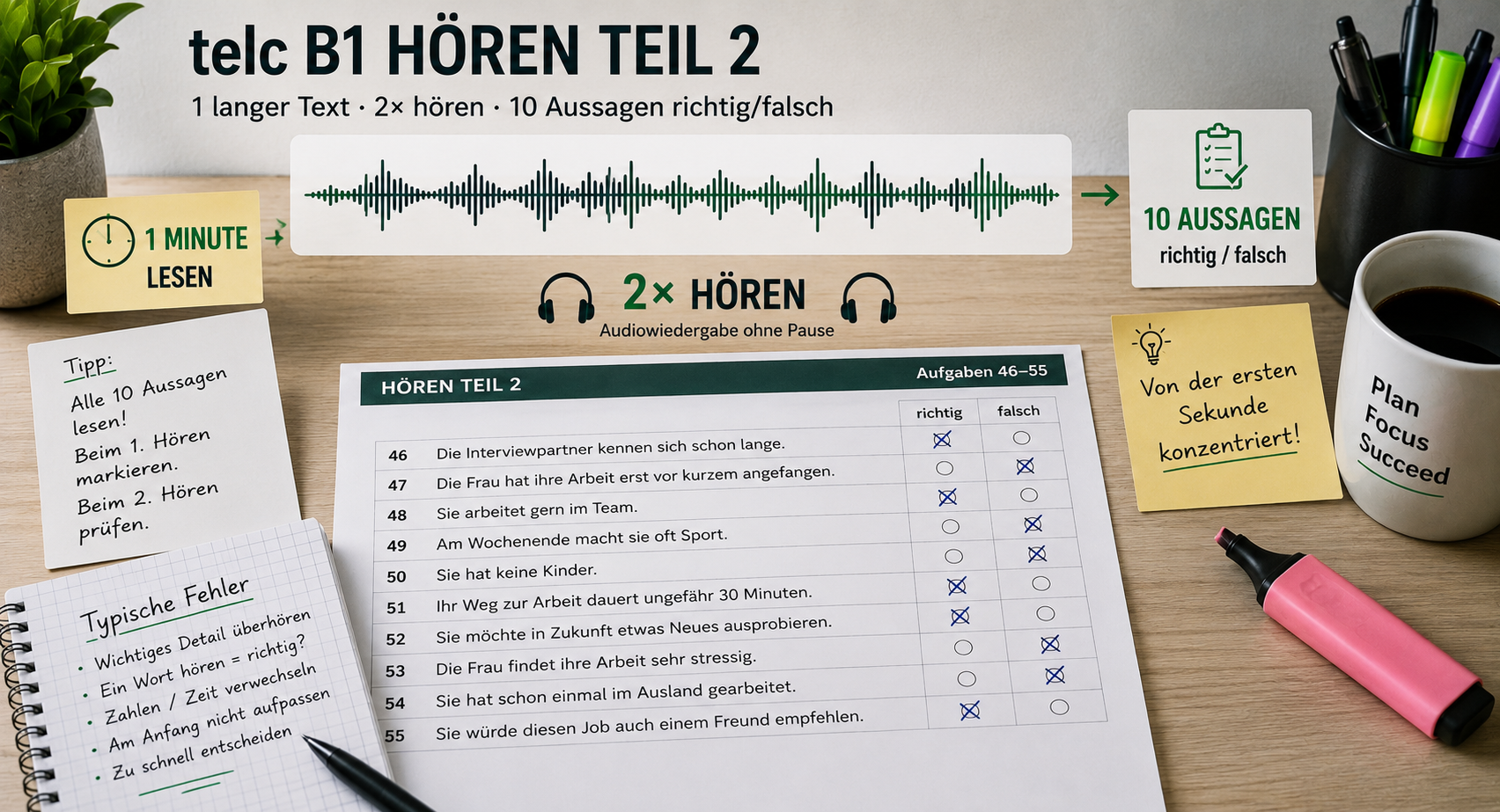
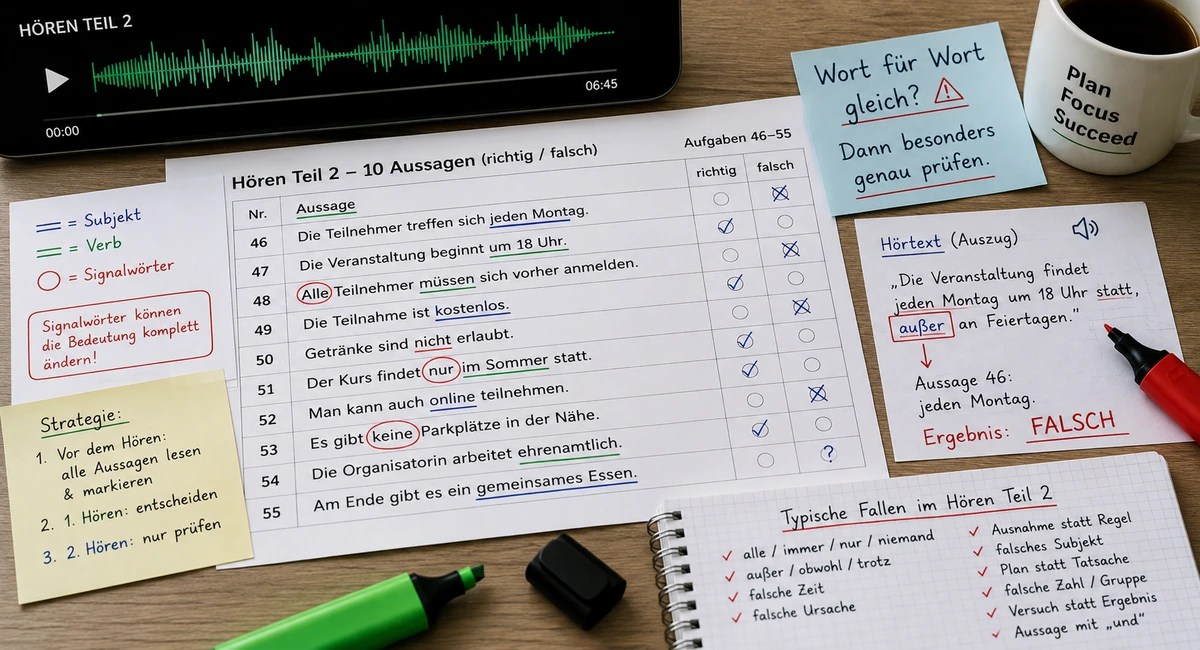
You listen to a long text and have to mark ten statements as true or false. In this article we explain exactly how this exam part is structured, how it is assessed and which mistakes learners make most often.
What Listening Part 2 is
Listening Part 2 tests what is called detailed comprehension. That means: you do not only hear the main idea of a text, but have to understand and retain precise details.
You listen to a longer text, usually an interview or a conversation between two people. For this text you get ten statements, numbered from 46 to 55. For each statement you decide: true (R) or false (F).
The most important facts at a glance
| Feature | Details |
|---|---|
| Type of text | A longer conversation, usually an interview |
| Number of items | 10 statements (number 46 to 55) |
| Answer format | True or false |
| How often you hear the text | Twice |
| Reading time before listening | About one minute for all ten statements |
You are not allowed to stop the recording during the exam. The text runs through once, then once more. That is exactly why preparation before listening is so decisive.
How the exam part proceeds
The procedure of Listening Part 2 always follows the same pattern. If you know this procedure, you will lose neither time nor nerves in the real exam.
- You get about one minute to read all ten statements before the text begins.
- The text is played for the first time. You listen attentively and tick what you already know for sure.
- The text is played a second time. Now you can decide on the remaining statements and check your first answers.
- After the second run-through you transfer your answers to the answer sheet, if you have not already done so.
Why the reading time is so important
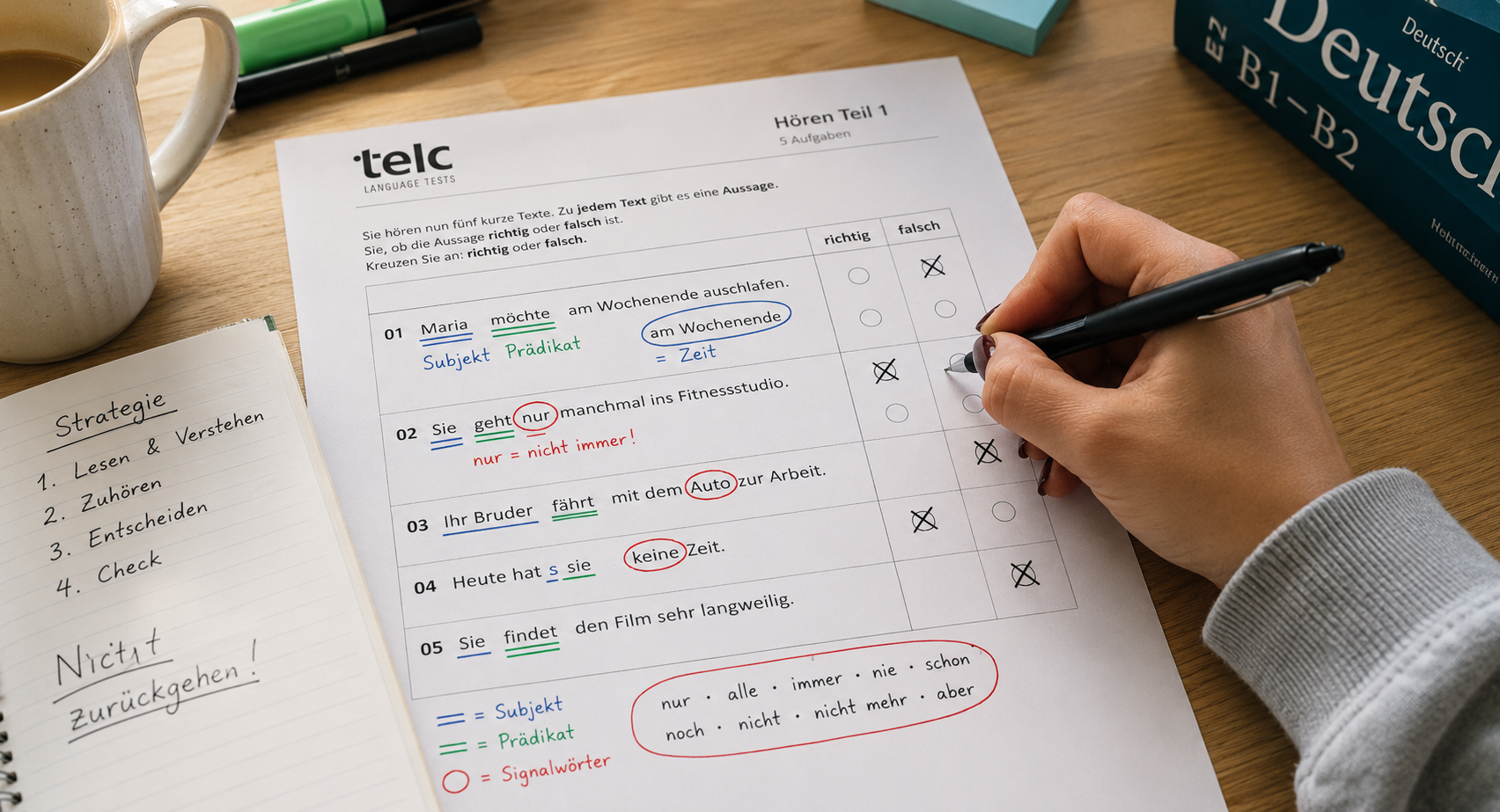
One minute sounds like very little time, but it is enough to get an overview. In this minute you should briefly consider for each statement: who does what? Are there any striking words, for example numbers, time references or words like immer (always), nur (only) or alle (all)?
In that one minute, always read all ten statements, even if you have to read quickly. Whoever reads only the first three statements misses important information in the later part of the text.
How Listening Part 2 is assessed
Listening Part 2 is a component of the whole exam part Listening B1 telc, which consists of three sections: Part 1 (global comprehension), Part 2 (detailed comprehension) and Part 3 (selective comprehension). Together these three parts make up the total score for Listening.
In Part 2 there is one point for every statement solved correctly. As there are ten statements, you can achieve a maximum of ten points in this section. Important: there are no deductions for wrong answers. That is why you should never leave a box empty, even if you are unsure.
A guessed answer can be right. An empty answer is always wrong. So it is better to tick something than to give no answer at all.
The most common mistakes learners make
From working with many learners we know the mistakes that keep coming up in Listening Part 2. The good news: almost all of these mistakes can be avoided with the right preparation.
Mistake 1: the statements are not read completely
Many learners read only the first three or four statements carefully and skim the rest. As a result, they do not listen to the right places in the text and miss important information.
Mistake 2: concentration drops in the middle of the text
The text in Part 2 is considerably longer than in Part 1 and Part 3. Many learners are still attentive at the beginning, but then get tired and lose the thread, at exactly the moment when an important piece of information comes.
Mistake 3: a single word is confused with the whole meaning
A frequent mistake is to hear a word in the text that also appears in the statement and to tick the statement as true straight away. But a single word says nothing yet about the whole sense of the sentence. The context before and after it is decisive.
Mistake 4: numbers and time references are not compared precisely enough
Numbers from the text are often retained imprecisely. A statement such as zweimal im Monat (twice a month) is quickly confused with einmal pro Woche (once a week) if you do not consciously pay attention to such details.
Mistake 5: concentration is not there yet for the first statement
Right after the recording starts, many learners need a few seconds to get used to the voice and the tempo. But it is precisely in these first seconds that the answer to the first statement often already comes.
Be one hundred per cent concentrated from the very first words of the recording, not only after a few sentences.
Checklist before training
- I know that I get ten statements and have one minute of reading time.
- I know that I hear the text twice and cannot stop it.
- I never leave a box empty, even when I am unsure.
- I am concentrated from the very first second of the recording.
- I consciously pay attention to numbers, time references and names.
In this article you have got to know the structure, the assessment and the most common mistakes. In the next article we will show you the concrete strategy for Listening Part 2 and all the typical traps that telc builds into this exam part.








There are no comments for this article. Leave your comment