





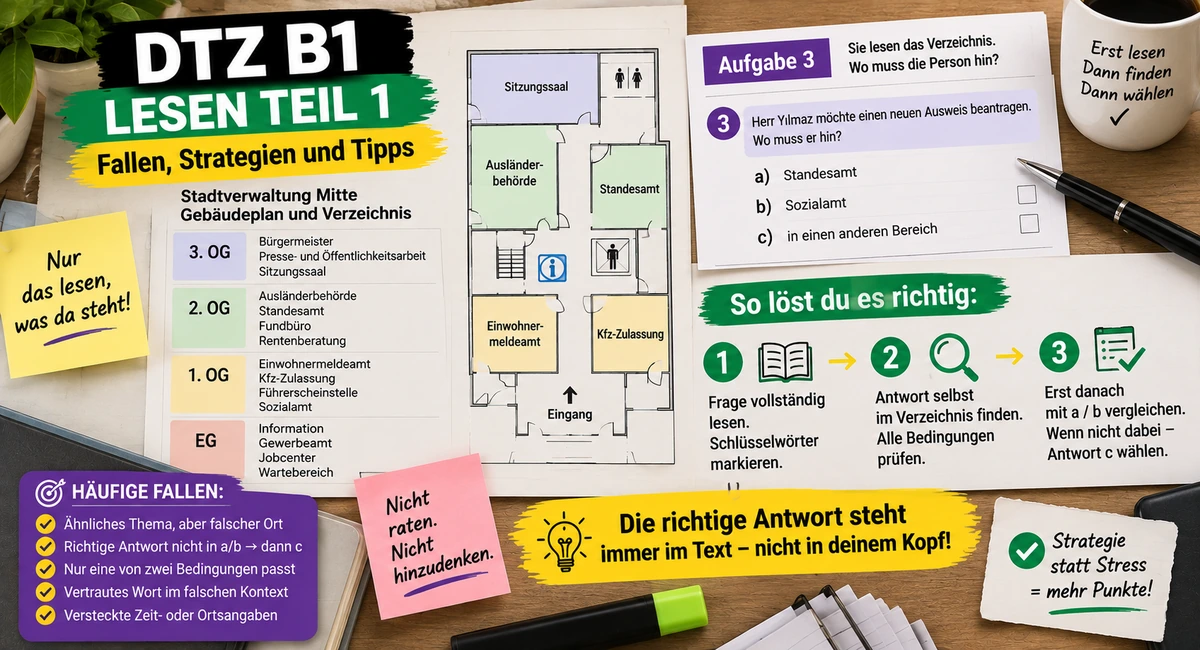
DTZ B1 Lesen Teil 1:
Traps, strategies and tips
How to read tasks precisely, avoid adding information that isn't there and find the correct answer with confidence — a complete breakdown of the format and typical mistakes.
What is DTZ B1 Lesen Teil 1 and how the task is structured
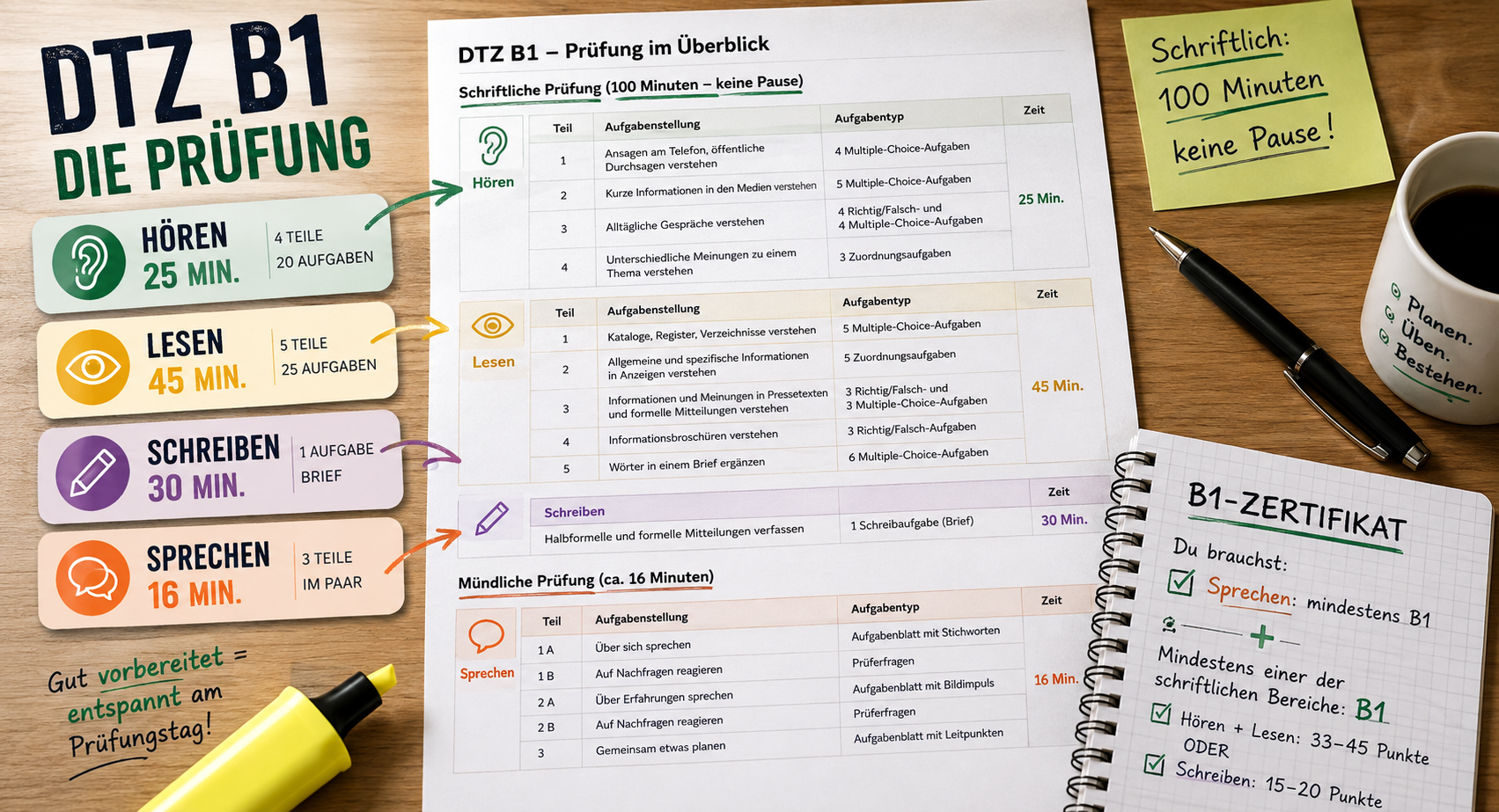
DTZ stands for Deutsch-Test für Zuwanderer, the official state German language exam at levels A2 and B1. It is taken as the final test of an integration course and covers four skills: listening, reading, writing and speaking.
Lesen Teil 1 is the first part of the Reading section. The task looks like this: you are shown a directory, a building plan, a floor table or a reference guide with sections. This could be a town hall, a hospital, a museum, an airport, a shopping centre or any other building. Then come 5 questions, each describing a specific situation involving a person. Your task is to find which section or floor they need to go to.
Task structure
Each question has three answer options:
- a — one specific section or floor;
- b — another specific section or floor;
- c — another section / another floor (= the correct answer is not given in either a or b).
It is important to understand: option c does not mean there is no answer at all. It means the correct section exists in the directory, but it was not offered as option a or b. This is a classic test of careful reading.
The task does not test grammar or knowledge of German rules — it tests whether you can read precisely and find the necessary information in real-life situations. This is exactly why the format is so practical: a town hall, a hospital, a library, a zoo — all situations anyone living in Germany will encounter.
| Parameter | Description |
|---|---|
| Number of questions | 5 |
| Text type | Directory, building plan, reference guide, section table |
| Answer options | a, b, c (c = another section, not given in a or b) |
| Time | Included in the total time for the Lesen section — 45 minutes |
| Typical topics | Town hall, hospital, museum, airport, shopping centre, university, zoo, school |
The main traps — broken down by type
The task seems simple — and that is exactly where its deceptiveness lies. The traps are set precisely and systematically. Knowing them in advance means you won't fall for them.
Trap 1 — Similar topics, but not the right place
most commonThis is the most common trap. Two sections sound similar in topic, but only one is correct. Our brain automatically picks the first familiar option — and gets it wrong.
Trap 2 — The correct answer is not offered as an option
option cThis is the mechanism of option c. The question describes a specific situation, the correct section exists in the directory, but it is given in neither option a nor option b.
Trap 3 — Only part of the condition matches
two conditionsThe question contains two conditions simultaneously. Option a fulfils the first condition but not the second. Only the correct section fulfils both conditions at once.
Trap 4 — A familiar word in the wrong context
contextYou see a key word from the question in the directory text — but it is in the wrong section. The brain latches onto the familiar word and picks it — without checking the context.
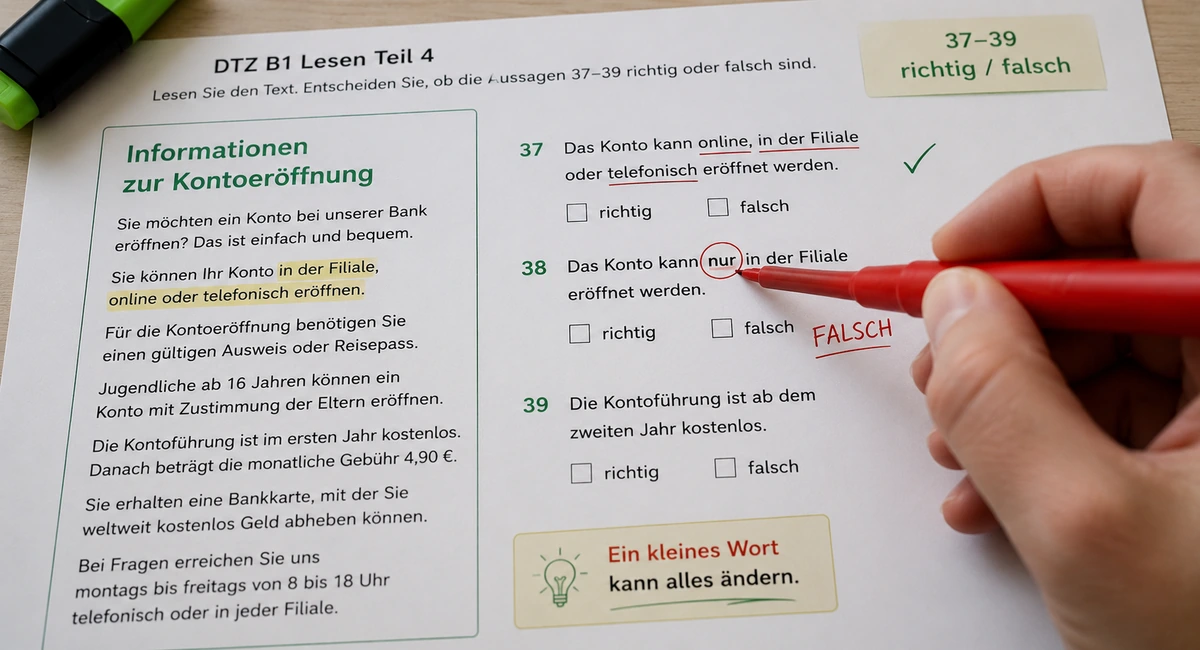
Trap 5 — Restrictions on time or conditions
hidden conditionsA section or service fits the content, but only applies at weekends, only for club members, only from a certain purchase amount. Anyone who doesn't read the conditions picks the wrong answer.
| Type of trap | How it works | How to protect yourself |
|---|---|---|
| Similar topics | Two sections sound the same but have different content | Read not the heading but the list of services in each section |
| Answer not in the options | The correct section exists but is not offered as a or b | Always check whether the correct section is in a or b |
| Two conditions | Only one section fulfils both conditions | Identify all conditions in the question and check each one |
| Word in the wrong place | The key word is in the wrong section | Read the whole context, not just one word |
| Hidden restrictions | The conditions of the service limit its applicability | Read all notes and clarifications in the directory text |
The most dangerous mistake learners make: adding information that isn't in the text
This is perhaps the most common problem in the exam — and at the same time the least noticeable. The learner is absolutely convinced they are reasoning correctly. But in reality they are working not with the task text but with their own life logic.
How this happens in practice
The question reads: „Sie suchen eine Wohnung in der Innenstadt, die Sie an Touristen vermieten können."
The learner reads it and starts thinking: "Tourists — so good transport connections are needed. And furniture. And probably internet." But the task only contains two words: Innenstadt and an Touristen vermieten. Everything else is their own thoughts, not a condition of the task.
A second example. The question says: „nicht mehr als 650 Euro Monatsmiete". The learner adds rent and Nebenkosten together and rules out a suitable advertisement. But the task contains a specific word — Monatsmiete. This means only the rent. If the total cost were meant, the text would say Warmmiete or insgesamt.
Read the question literally, word for word. Look for the same words or their synonyms in the text. If a criterion is not mentioned in the task — it does not affect the choice. Never add information that is not in the task text.
Why the brain does this — and how to stop it
Our brain automatically fills in the picture from life experience. This helps us in real life — but hinders us in the exam. DTZ tests not life experience but the ability to read precisely.
A simple test: ask yourself out loud — "Exactly where in the task text does it say what I am thinking?" If you cannot point to a specific word — you are adding information. Stop and re-read.
| What the task says | What the learner adds | The correct approach |
|---|---|---|
| Innenstadt, an Touristen vermieten | Transport, furniture, internet, convenient area needed | Look for only: city centre + possibility of renting to tourists |
| nicht mehr als 650 Euro Monatsmiete | Must add utility costs | Monatsmiete = rent only, without Nebenkosten |
| Ihr Kind möchte eine Impfung bekommen | Need a paediatrician, children's doctor, children's ward | Look for: Impfung. This could also be an adult department — read the text |
| Sie möchten Bücher ausleihen und einen ruhigen Platz finden | Any quiet room is suitable | Both conditions are needed together: book lending AND a quiet place |
The logic of the format: how to read and analyse correctly
B1 DTZ Lesen exercises Teil 1 are structured according to a single logic. Once you understand this logic, you stop guessing and start solving tasks systematically.
How the task is constructed
Each task is built according to one scheme: the situation describes a specific intention or need of a person. The directory contains the answer — but it may be hidden, paraphrased or combined from two conditions. The key point: the question and the directory text rarely use the same words. You must understand the meaning, not simply compare words.
For example: the question says „Ihr Kind möchte ein Bilderbuch kaufen" — and the directory says „Bilderliteratur, Kinderliteratur, Jugendbücher". The word Bilderbuch is not repeated — but the meaning matches.
Step-by-step solution algorithm
Read the question in full
Identify the key words and determine how many conditions the question contains — one or two.
Find the answer in the directory
Find the section that corresponds to all conditions in the question. Work with the content, not just the words.
Compare with options a and b
Check: is this section among options a or b? If yes — choose it. If no — choose c.
Many learners read options a and b first and then look for confirmation in the text. This is the wrong order. The correct approach — read the question first, then find the answer independently in the directory, and only then compare with the options.
The most common task topics
- Town hall (Rathaus): passport, registration, foreigners' office, social services, vehicle registration;
- Hospital (Krankenhaus): cardiology, surgery, radiology, paediatrics, emergency care;
- University: library, language centre, dean's office, student services, halls of residence;
- Shopping centre: shops, promotions, service points, returns;
- Airport: check-in, baggage, lost and found, food, duty-free shops;
- Museum, zoo, exhibition centre: themed sections, events, guided tours.
Practical tips for preparation and the exam
Knowing the format is good. But the ability to apply it under real exam conditions only comes through practice. Here is what genuinely helps:
During preparation
- Learn topic-specific vocabulary by subject. Each topic has its own vocabulary block. Medicine, government institutions, education, transport, retail — 20–30 key words per topic will significantly speed up your work in the exam;
- Solve tasks with analysis of mistakes. It is not enough simply to select an answer. Ask yourself: why exactly this one? Why is a wrong? Why is b wrong?
- Practise reading directories in real life. Look at building plans, service tables in clinics, notices in shopping centres;
- Practise identifying key words. In each question, underline the main words that point to the required section. Do this mechanically until it becomes a habit.
During the exam
- Read the question first, then the directory — not the other way round. This way you know what you are looking for and are not distracted by irrelevant information;
- Identify all conditions in the question. There may be one or two. The correct section must fulfil all conditions at once;
- Consciously check both options a and b. Do not guess — explain to yourself why each option does or does not fit;
- Do not rush through this task. Lesen Teil 1 is one of the simplest tasks in terms of format. Calm and precision matter more than speed.
The B1 DTZ exam tests not perfect knowledge of German but the ability to deal with real situations in Germany. Lesen Teil 1 imitates exactly this: you are in an unfamiliar place and looking for the right department. Anyone who reads calmly, systematically and precisely solves this task with confidence — even without flawless grammar.




There are no comments for this article. Leave your comment