





Listening Part 2:
the right strategy and all the typical traps
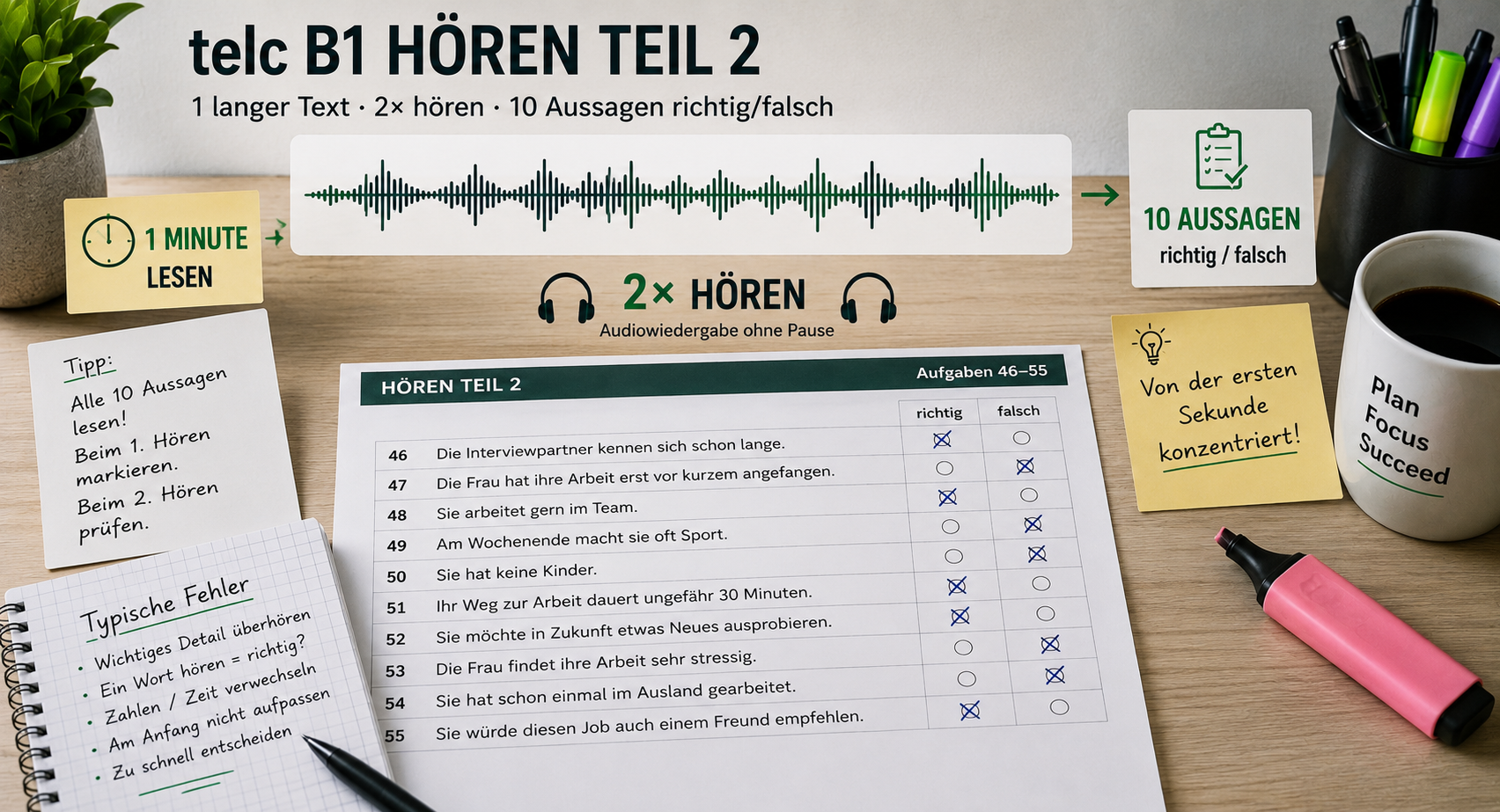
Listening Part 2 is not a game of chance. Whoever knows the strategy and the typical traps can solve far more items with confidence. In this article we show you step by step how to proceed, and explain the most important types of traps with examples.
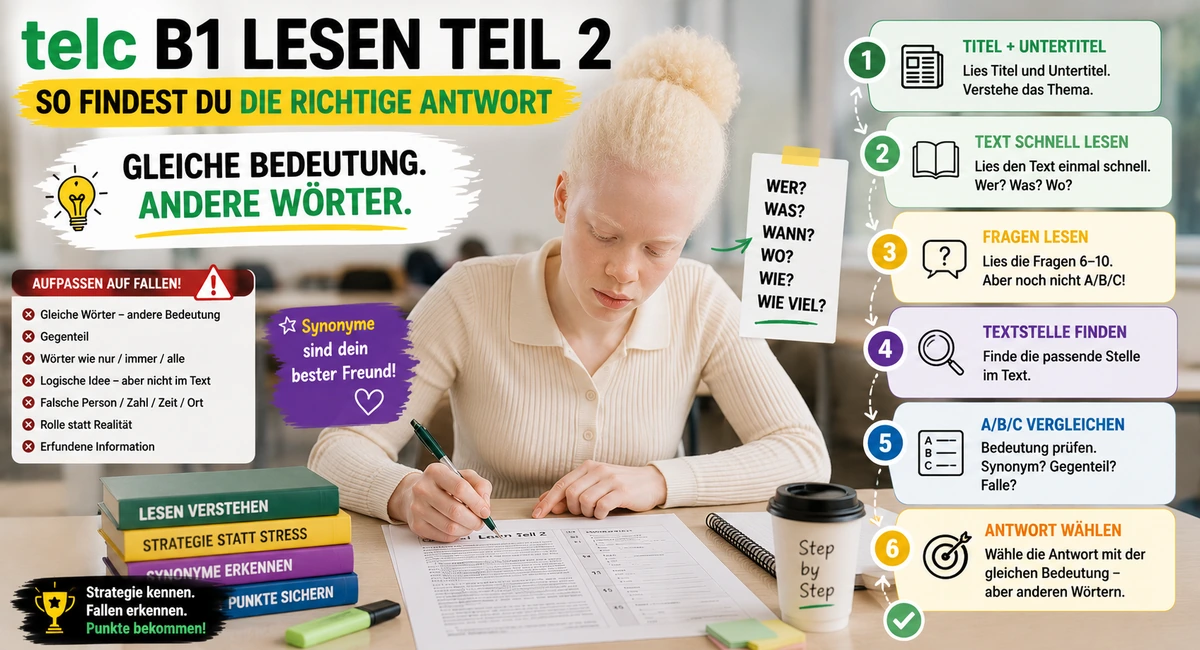
The strategy in three steps
A good strategy helps you to work calmly and systematically in the telc B1 exam, instead of simply hoping that you understand everything. The strategy consists of three clear steps.
Step 1: prepare the statements before you listen
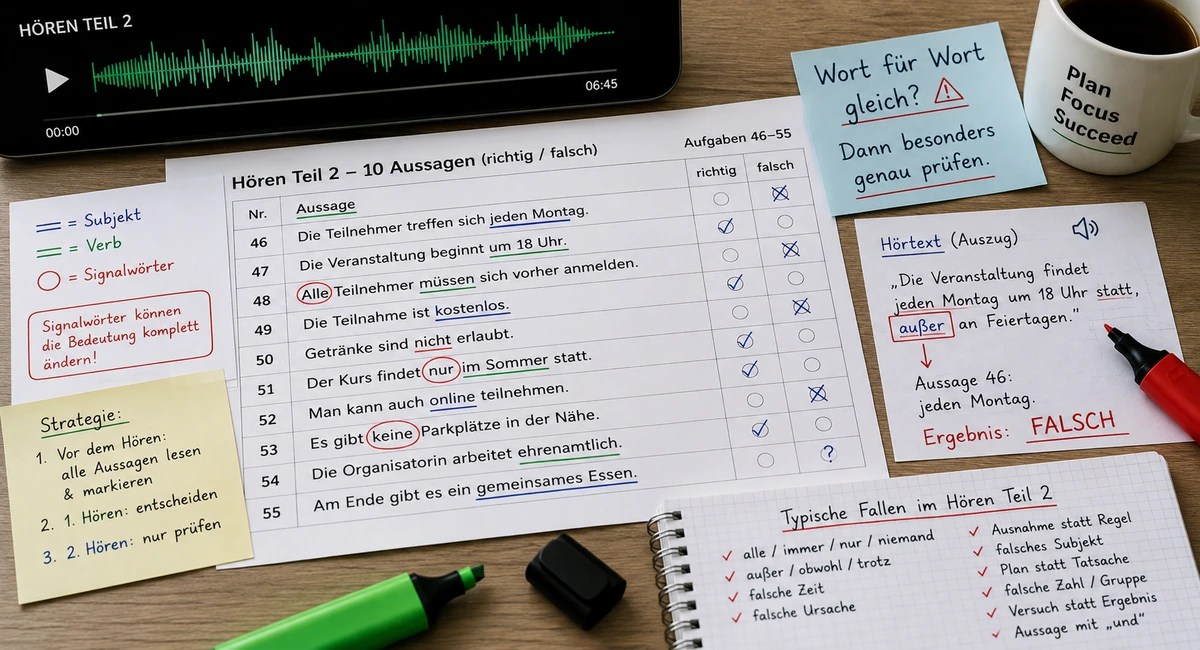
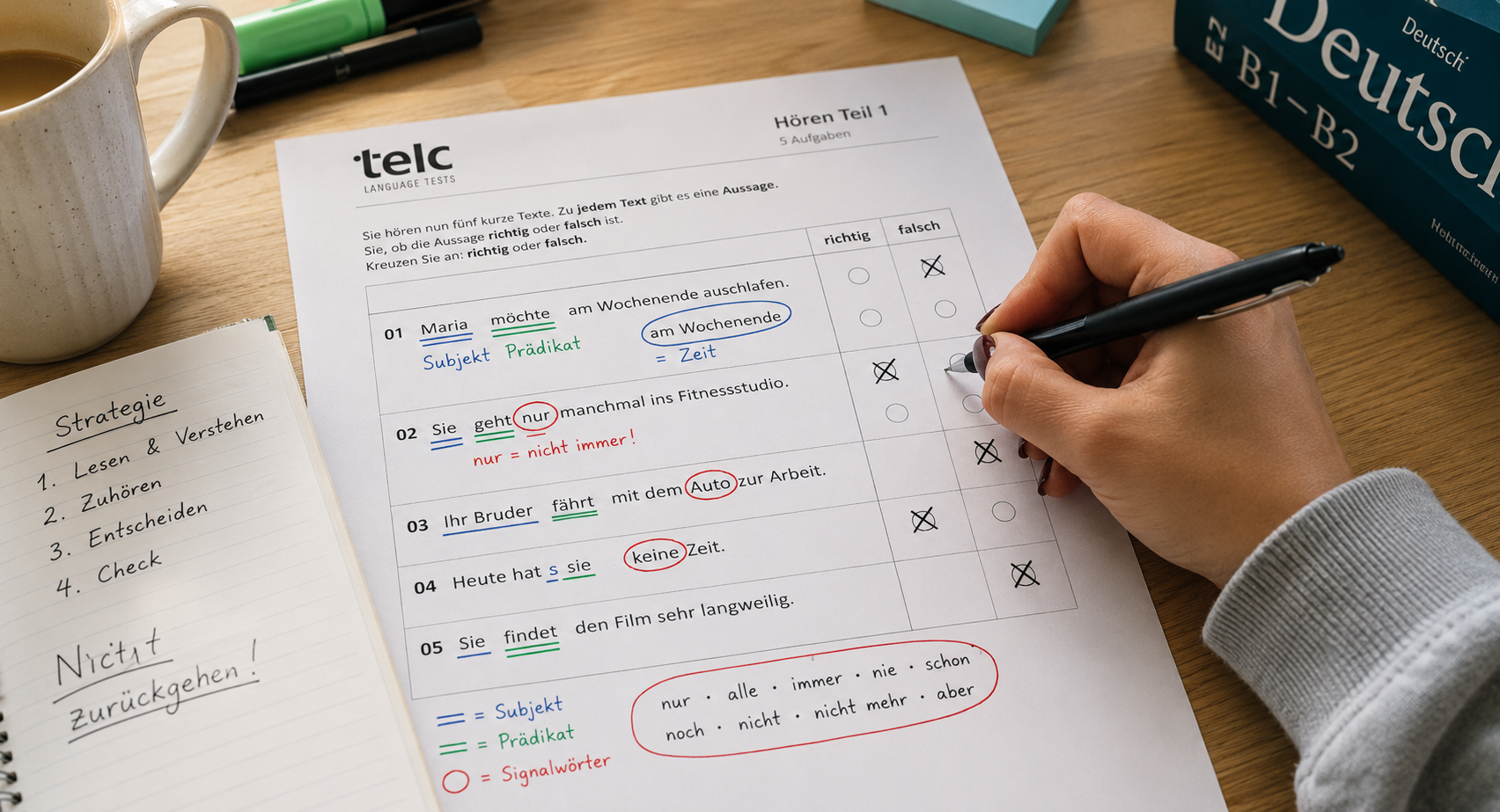
First read all ten statements carefully. In each statement, underline the subject (who acts) and the verb (what happens). Then underline all striking words, for example words like alle (all), nur (only), immer (always), nie (never), schon lange (for a long time) or exact numbers. These words are almost always important for the correct solution.
Step 2: match in a targeted way while listening
Listen to the text and mentally match each piece of information to a statement, in the order in which the statements are numbered. The text almost always follows the same order as the statements. Pay particular attention to the words you underlined beforehand, and to their synonyms or opposites in the text.
Step 3: check after the second run-through
During the second listening, check the statements you were still unsure about. Use this second run-through consciously as a check, not just as a repetition.
The subject and verb of the statement show you what you have to listen for. The underlined signal words show you where a trap is probably hidden in the text.
The most important principle: beware of a perfect match
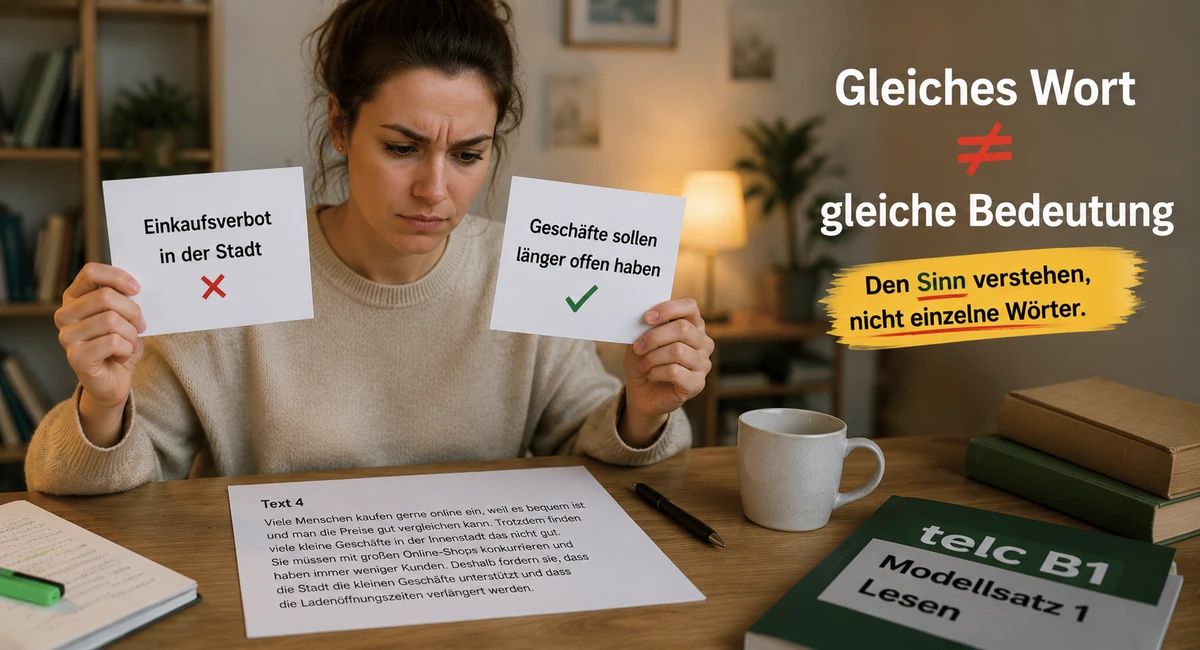
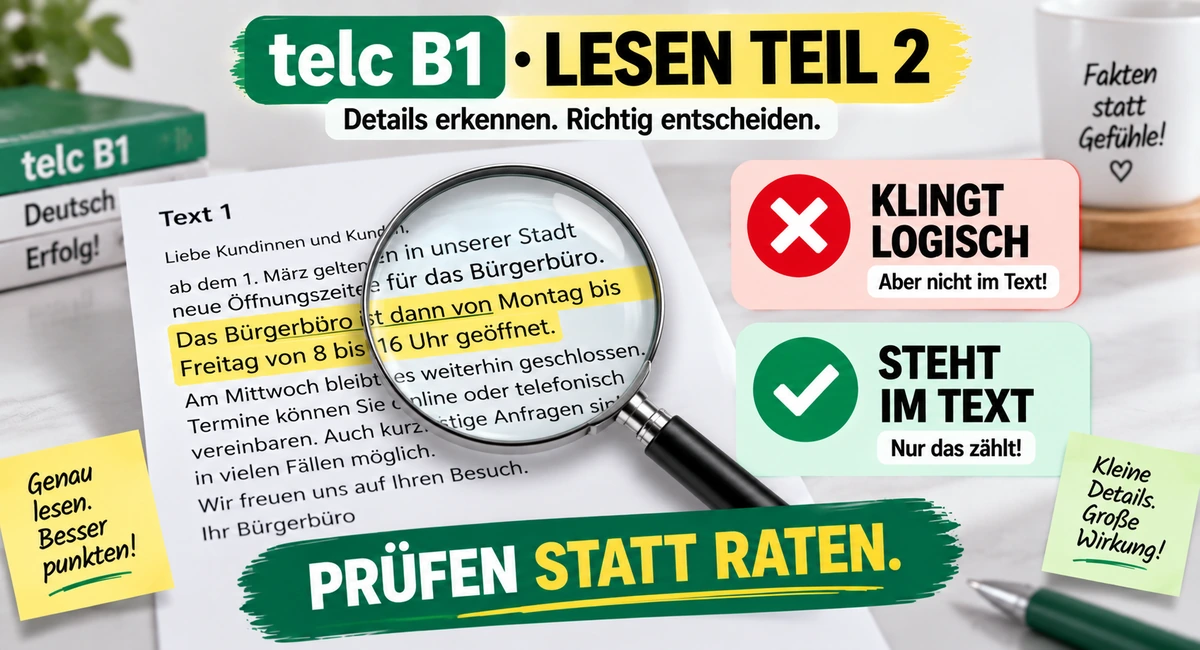
This is the most important rule in this whole exam part: if a statement sounds almost word for word the same as a sentence in the text, that is not a reliable sign that it is correct. On the contrary: it is often a warning signal.
telc almost always formulates the correct answers with different words than in the listening text, that is, with synonyms or paraphrases. If, on the other hand, a statement sounds almost identical to the text, a small word that changes the whole meaning is often hidden nearby, for example außer (except), obwohl (although) or nur wenn (only if).
A perfect word-for-word match is no proof that a statement is correct. In such a case, check especially carefully whether a small word does in fact turn the meaning around.
The opposite is just as important: a signal word like mehr als (more than) or arm (poor) does not automatically mean that the statement is wrong. Sometimes the number or the description is actually correct, even if it sounds suspicious at first. So always check the concrete logic, not just your gut feeling.
The typical types of traps with examples
Over the course of many exams, certain trap patterns repeat again and again. If you know these patterns, you recognise them much faster in the real text. All examples in this table are invented and serve only as an explanation.
Exaggeration (alle, immer, nur, niemand)
The statement uses a word that presents something as absolute. In the text, however, the reality is usually only partly true.
Statement: Der Verein finanziert sich nur durch Mitgliedsbeiträge. (The club finances itself only through membership fees.) The word nur (only) is the decisive signal word here, because it claims that there is no other source of money. In the text, the club spokesperson says that part of the money comes from fees, but the rest from the municipality and from donations. So there are several sources of money, not just one. That is exactly why the statement is false.
Time shift (früher, heute, von Anfang an)
The statement confuses an earlier point in time with the present state, or the other way round.
Statement: Der Chor hatte von Anfang an auch männliche Mitglieder. (The choir had male members from the very beginning too.) The time reference von Anfang an (from the very beginning) is the signal word here that has to be checked precisely. In the text, the director says that the choir at first consisted only of women and that the first men were admitted only twelve years later. The statement is false.
Small words with a big effect (außer, trotz, sondern)
A single small word turns the whole meaning of the sentence around.
Statement: Das Fitnessstudio bietet auch Yogakurse an. (The gym also offers yoga classes.) In the text, the manager says they offer almost every course, außer (except) yoga, because there is a specialised studio for it next door. Precisely this small word außer turns the whole meaning around: the statement is therefore false.
Wrong cause (weil, denn)
The statement names a reason for something, but a different, often opposite reason appears in the text.
Statement: Die Band hat sich getrennt, weil sie keinen Erfolg mehr hatte. (The band split up because it was no longer successful.) The word weil (because) announces a cause here that has to be checked precisely. In the text, the singer says that they are splitting up right at the peak of their success, because they don’t want to ruin this moment. So the real reason is the opposite of what the statement claims.
Exception instead of rule
A one-off, special case is presented in the statement as normal everyday life.
Statement: Im Durchschnitt bekommt der Fahrer 40 Euro Trinkgeld. (On average, the driver gets 40 euros in tips.) The phrase im Durchschnitt (on average) is the signal word here, because it claims a normal, typical value. In the text, the driver says that he once got 40 euros from a group of business people, but that this was the absolute exception; normally it is more like 10 euros a day. The statement confuses the exception with the average and is therefore false.
Wrong subject (the action is right, the person is not)
Something did actually happen in the text, but not with the person named in the statement.
Statement: Nadine hat ihre Ausbildung abgebrochen. (Nadine dropped out of her training.) The subject Nadine is the decisive point here, not the action itself. In the text, Nadine says that her colleague dropped out of the training, while she herself carried on studying normally. The action is present in the text, but it belongs to the wrong person.
Plan instead of accomplished fact
In the text, something is only discussed, considered or wished for. The statement acts as if it had already been decided or had happened.
Statement: Der Betrieb hat einen neuen Standort eröffnet. (The company has opened a new location.) The verb hat eröffnet (has opened) claims a completed fact. In the text, however, the managing director only says that they have been thinking about it for a while, but have not yet taken any concrete steps. A thought or a discussion is not yet a fact, which is why the statement is false.
Numbers that do not belong to the right group
A number from the text is correct, but in the statement it is assigned to the wrong group.
Statement: In der Stadt gibt es 3.400 Fahrradkurierinnen. (There are 3,400 female bike couriers in the city.) The number 3.400 itself comes correctly from the text, but the group it is assigned to is wrong: in the text, 3,400 is the total number of all bike couriers, and women are only a small part of that. The statement assigns the total number to the wrong group.
Attempt instead of success (versuchen zu)
The text says that someone tried to do something. The statement claims that it actually succeeded.
Statement: Der Vater war für seinen Sohn immer ein Vorbild. (The father was always a role model for his son.) In the text it says that the father always versucht (tried) to be a role model. The verb versuchen (to try) describes only an effort, not a guaranteed result. That is why the statement is false.
Compound statements with und
If a statement links two properties with und (and), both parts have to be confirmed in the text. If only one part is right, the whole statement is false.
Statement: Ihr Trainingspartner ist älter und erfahrener als sie. (Her training partner is older and more experienced than she is.) The word und (and) links two claims here, both of which have to be true. The text confirms that he is more experienced, but she explicitly says that he is exactly the same age as she is. Because the first part is false, the whole statement is false.
Place or circumstance instead of a person as the origin of an idea
The statement makes a place or a situation the supposed origin of an idea, although in the text a particular person clearly had the idea.
Statement: Die Idee für das Projekt kommt vom Busbahnhof. (The idea for the project comes from the bus station.) The subject der Busbahnhof (the bus station) is the problem here: a place cannot have an idea. In the text, the founder says that as a young man he waited at the bus station every day and observed problems there that inspired him to have his own idea. The idea comes from the person; the place was only the trigger.
| Type of trap | What you should watch out for |
|---|---|
| Exaggeration | alle, immer, nur, niemand, ausschließlich (all, always, only, nobody, exclusively) |
| Time shift | früher, heute, von Anfang an, seit, erst (earlier, today, from the very beginning, since, only) |
| Small words with a big effect | außer, trotz, sondern, obwohl, fast (except, despite, but rather, although, almost) |
| Wrong cause | weil, denn, aus diesem Grund (because, for, for this reason) |
| Exception instead of rule | einmal, die Ausnahme, normalerweise aber (once, the exception, but normally) |
| Wrong subject | Who exactly acts in the statement and in the text |
| Plan instead of fact | möchte, würde, könnte, wir denken darüber nach (would like to, would, could, we are thinking about it) |
| Numbers from the wrong group | Which group the number really belongs to |
| Attempt instead of success | versuchen zu, sich bemühen (to try to, to make an effort) |
One example in detail
Imagine an invented interview with a young racing cyclist. She says: Am Anfang durfte ich nie mit den Erwachsenen trainieren, ich musste immer nur zuschauen, bis ich mit acht Jahren endlich mitfahren durfte. (At the beginning I was never allowed to train with the adults, I always had to just watch, until at the age of eight I was finally allowed to ride along.)
One possible statement about this could be: Sie durfte von Anfang an mit den Erwachsenen trainieren. (She was allowed to train with the adults from the very beginning.) This is clearly false, because exactly the opposite is in the text: at first she was only allowed to watch.
A second statement could be: Ihr ganzes Team hat schon früh mit ihr trainiert. (Her whole team trained with her from early on.) Here too you have to check carefully who is really meant in the text, because the text is only about the adults in her family, not about a whole team.
Always pay close attention to who acts in the text and at which point in time. A detail like mit acht Jahren (at the age of eight) or nur zuschauen (only watch) decides between right and wrong.





There are no comments for this article. Leave your comment