





What Is Hören Teil 3?
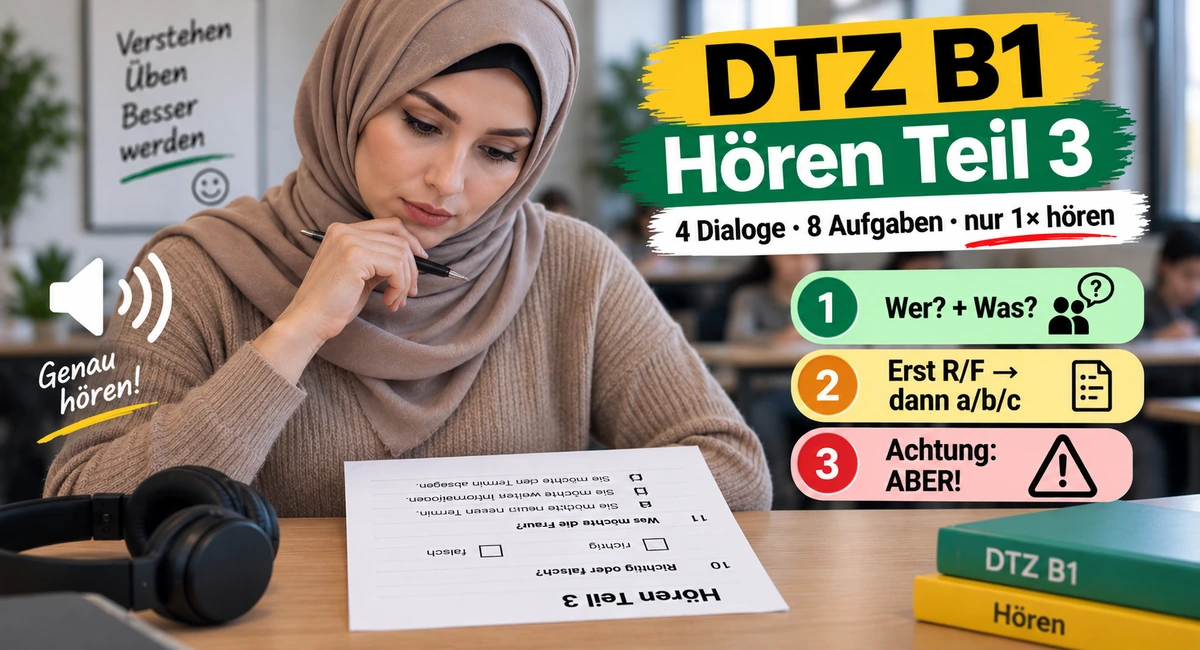
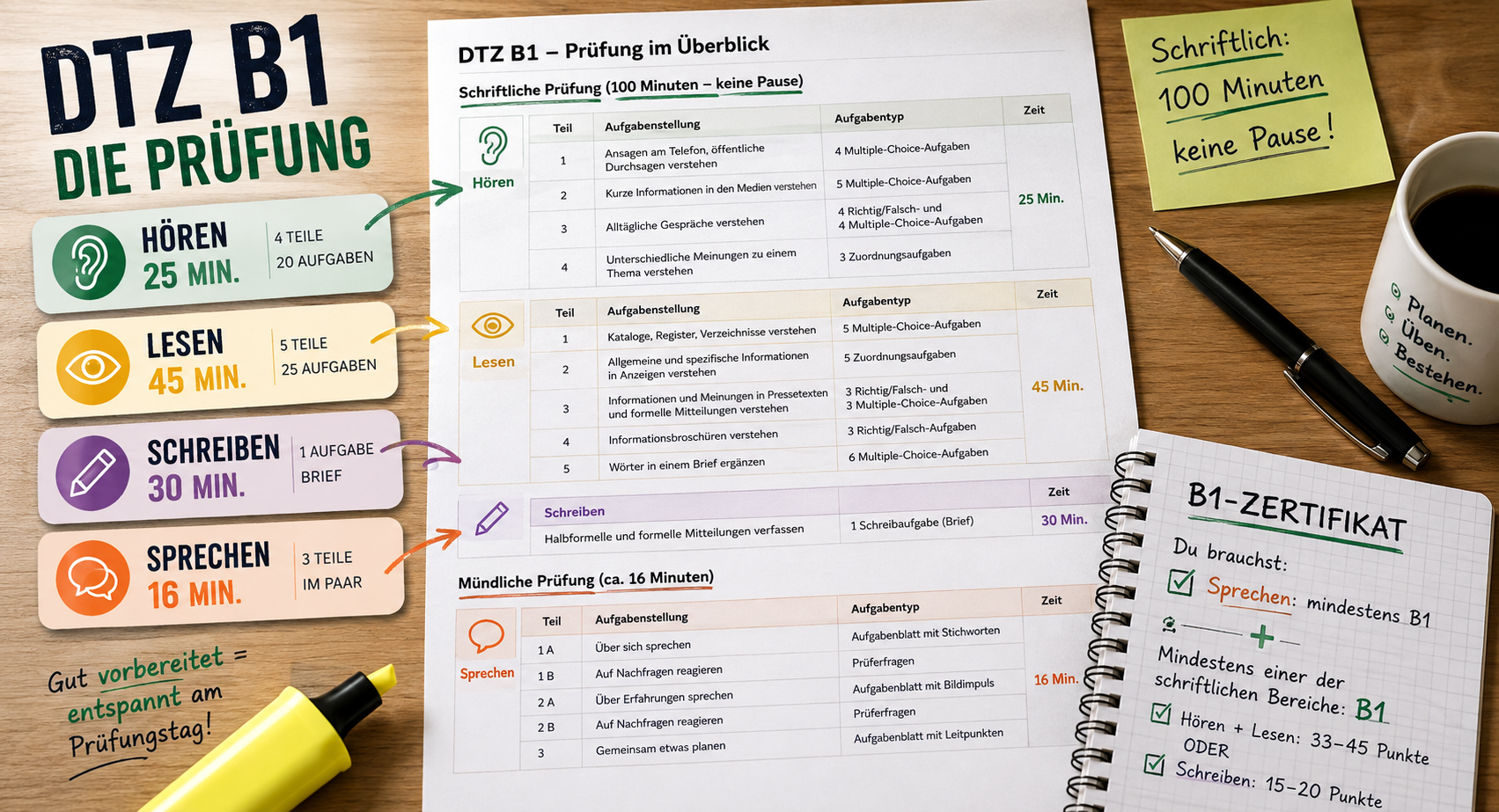
Hören Teil 3 is the third part of the Listening section in the B1 DTZ exam (Deutsch-Test für Zuwanderer). It is the most important part of the Listening section: it contains 8 out of 20 tasks, which means almost half of all points for Hören.
In this part you listen to 4 dialogues — everyday conversations from real life. Each dialogue comes with 2 tasks: one of the "Richtig/Falsch" type (true/false) and one of the "Multiple-Choice" type (choosing from three options a, b, c). The tasks are numbered from 10 to 17.
What Topics Appear in the Dialogues?
The dialogues sound as if you accidentally overheard a real-life conversation. Typical situations:
- a conversation between neighbours (about noise, help, renovation)
- a chat with a friend (about work, holidays, shopping)
- a conversation between parents and a teacher (about a child, a school event)
- discussing plans (for the weekend, a holiday, moving home)
- a conversation in a shop, at the doctor's, at the pharmacy
What Do the Tasks Look Like Exactly?
Before each dialogue you have a little time to read the tasks in your booklet. Here is what they look like (example from the official practice set):
Richtig/Falsch Task (True/False)
"Die Frau ist Ärztin." — richtig oder falsch?
You need to decide: does this statement match what you heard, or not.
Multiple-Choice Task (Choose a, b, or c)
"Die Frau sagt dem Mann, dass…"
a) die Tabletten lange wirken.
b) er mindestens drei Tabletten nehmen soll.
c) er sofort zum Arzt gehen soll.
You must choose one correct answer from three options.
Important Rules
- Each dialogue is played only once. There is no second chance.
- Each correct answer earns 1 point. The maximum for this section is 8 points.
- Points are not deducted for wrong answers. So always answer every question, even if you are not sure!
- Answers must be marked with a ballpoint pen (black or blue) on the answer sheet (Antwortbogen). Pencil is not allowed.
- If you want to correct an answer: fill in the wrong box completely and put a cross in the correct one.
Level of Difficulty
Hören Teil 3 is one of the most challenging parts of the DTZ Listening section. Unlike Teil 1 and Teil 2, where you listen to short announcements or messages from a single speaker, here two people speak at the same time, the dialogues are longer, and you need to catch not only the general meaning but also specific details of the conversation. The tasks are aimed at roughly B1 level.
The Order of the Tasks = The Order of the Conversation
A very useful detail: the tasks follow the same order as the information appears in the dialogue. The Richtig/Falsch task usually refers to the beginning of the conversation (who are these people, where are they, what happened). The Multiple-Choice task refers to the continuation of the conversation (what someone wants, what someone should do, what decision was made).
This means: focus on the first task first, then shift your attention to the second.
Hören Teil 3
Traps, Mistakes and Strategies for a Successful Exam
Why Do Many People Lose Points in Teil 3?
Most mistakes in B1 DTZ Hören do not happen because of poor German. People lose points because they fall into traps that are deliberately built into the Teil 3 tasks. If you know these traps in advance, you can avoid them.
Trap No. 1: The "Aber-Falle" (The "But" Trap)
This is the most dangerous and most common trap. In the dialogue something is said first, and then something different. The correct answer is what is said at the end, after words like aber, eigentlich, doch, stattdessen, allerdings, nein, ich meine…
Example: Günter is talking about the summer party at the kindergarten. His wife asks whether he will grill meat again. Günter replies: "Eigentlich wollte ich dieses Jahr nicht mehr grillen." Then his wife jokes that he could bake a cake instead — but Günter turns that down too.
If you hear the first word that matches one of the options — do not mark it straight away! Listen to the end.
Trap No. 2: Confusion About "Who Said What"
There are two people in the dialogue. The task asks for the opinion of one specific person. It is very easy to mix up who said what.
Example: Maria is telling Lukas about her new job. Task: "Maria sagt, dass ihre neue Chefin…" — you need to understand what Maria specifically says about her boss. If you get confused and mark what Lukas said, the answer will be wrong.
Tip: When you read the task before listening, underline the subject (who?) and the verb (what does it do?). In the example above: Maria (subject) + sagt (verb). While listening, look specifically for that person and that action — or their synonyms. This way you will not mix up whose opinion is being asked about.
Trap No. 3: The Word Is There, but the Meaning Is Different (Distraktoren)
The answer options often contain words that genuinely appear in the dialogue, but with a different meaning. This is called a "Distraktor" — a misleading option.
Example: In the dialogue a man says about a dress: "Ist vielleicht ein bisschen viel, mal eben 99 Euro…" One of the answer options reads: "Der Mann findet das Kleid nicht schön." But the man never said the dress was not nice — he said it was expensive.
Rule: If an answer option contains exactly the same word as the dialogue — be on your guard. The correct answer often uses different words with the same meaning (synonyms).
Trap No. 4: The Person Changed Their Mind
Sometimes one of the speakers first says one thing, then gets persuaded and changes their opinion. The correct answer is always the last, final decision.
Example: A woman first says: "I don't want to go to the party." Then her friend persuades her and she replies: "All right, I'll come." If the task asks "Kommt die Frau zur Party?" — the correct answer is based on the last sentence, not the first.
Trap No. 5: You Get Stuck on an Unknown Word
A word you don't know appears in the dialogue. You start thinking: "What does that mean?" — and you miss the next 2–3 sentences. Yet those sentences contained the correct information.
Golden rule: An unknown word — let it go. Don't think about it. Keep listening. A dialogue is like a train — it doesn't wait. You don't need to understand every word to answer correctly.
How to Solve Richtig/Falsch Tasks: Step-by-Step Guide
Step 1. Before Listening
Read the statement. Underline the subject and the verb — these are your reference points. For example: "Die Frau möchte das Kleid kaufen" — underline Frau and möchte kaufen. The rest (Kleid) is context that you will hear anyway.
Step 2. While Listening
Listen to the beginning of the dialogue — that is usually where the information for Richtig/Falsch is hidden. Look for the subject and verb from the task, or their synonyms.
Step 3. Pay Attention to "Small Words"
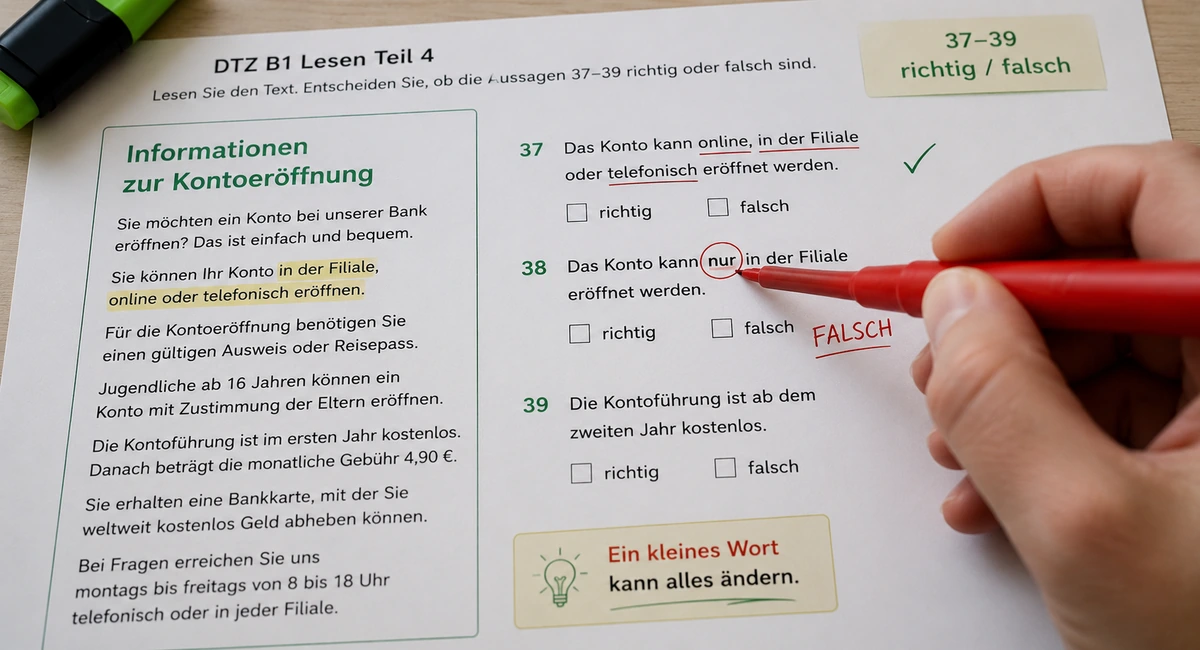
Words like nicht, kein, nie, niemand, nichts, nur, erst, schon can completely change the meaning. "Ich bin nicht zufrieden" is the opposite of "Ich bin zufrieden".
Step 4. Partially Correct = Incorrect
If the statement matches the dialogue 90%, but one detail is wrong — the answer is falsch.
Step 5. Mark Your Answer Immediately
Don't wait — switch to the second task.
How to Solve Multiple-Choice Tasks: Step-by-Step Guide
Step 1. Before Listening
Read all three options (a, b, c). Find out how they differ from each other. Often the difference is in one word or one detail — that is exactly what you need to hear.
Step 2. Process of Elimination
If you are certain that one option is wrong, cross it out. Now you have a 50/50 chance instead of 33%.
Step 3. Listen for Meaning, Not Words
The correct answer almost never repeats the dialogue word for word. It conveys the same meaning in different words. For example: in the dialogue — "billig", in the answer — "günstig" (both mean "affordable").
Step 4. If You Are Not Sure — Choose and Move On
Don't waste time on doubts. Mark the best option and switch to the next dialogue. There are no penalty points for wrong answers.
Step 5. Always Answer ALL Questions
Even if you understood nothing at all — mark any option. Chance of guessing correctly = 33%. Empty answer = 0%.
Three Phases of Exam Strategy
Phase 1 — BEFORE Listening (Pause Before the Dialogue)
Read both tasks. Underline the subject and verb. Think: "What will this conversation be about? Who do I need to listen to? What exactly am I looking for?"
Phase 2 — WHILE Listening
Listen like a detective. Look for signal words: aber, eigentlich, doch, stattdessen, allerdings. Distinguish the voices — who is the man, who is the woman, who says what. Pay attention to intonation — it often indicates whether a person agrees or not. Don't get stuck on unknown words.
Phase 3 — AFTER Listening
Check that all answers are marked on the answer sheet (Antwortbogen). Don't change answers without a good reason — your first instinct is usually right.
How to Prepare for Hören Teil 3
The best preparation is working through real tasks with explanations (Erklärung). On our website, every Hören Teil 3 task comes with a detailed explanation: why the correct answer is what it is, which trap was built in, and which signal words you needed to hear. Work through the tasks one by one and always read the Erklärung afterwards — that is exactly how you learn to understand the logic of the exam.
Don't just do tests — analyse every mistake: was it the "Aber-Falle"? Did you mix up who was speaking? Did you get stuck on an unknown word? Did you fall for a Distraktor? When you understand the type of your mistake, you stop repeating it.
The Key Takeaway
Hören Teil 3 is not a test of perfect German. It is a test of strategy and attention. Three keys to success:
- Read the tasks in advance — underline the subject and verb, and go into the dialogue with clear expectations.
- Know the traps — especially the "Aber-Falle" and Distraktoren. What matters is not the first word, but the last word in the conversation.
- Look for synonyms — the correct answer almost never repeats the text word for word.
Work through the tasks on our website, read the Erklärung for each one — and B1 DTZ Hören Teil 3 will become your strongest point in the exam!





There are no comments for this article. Leave your comment