





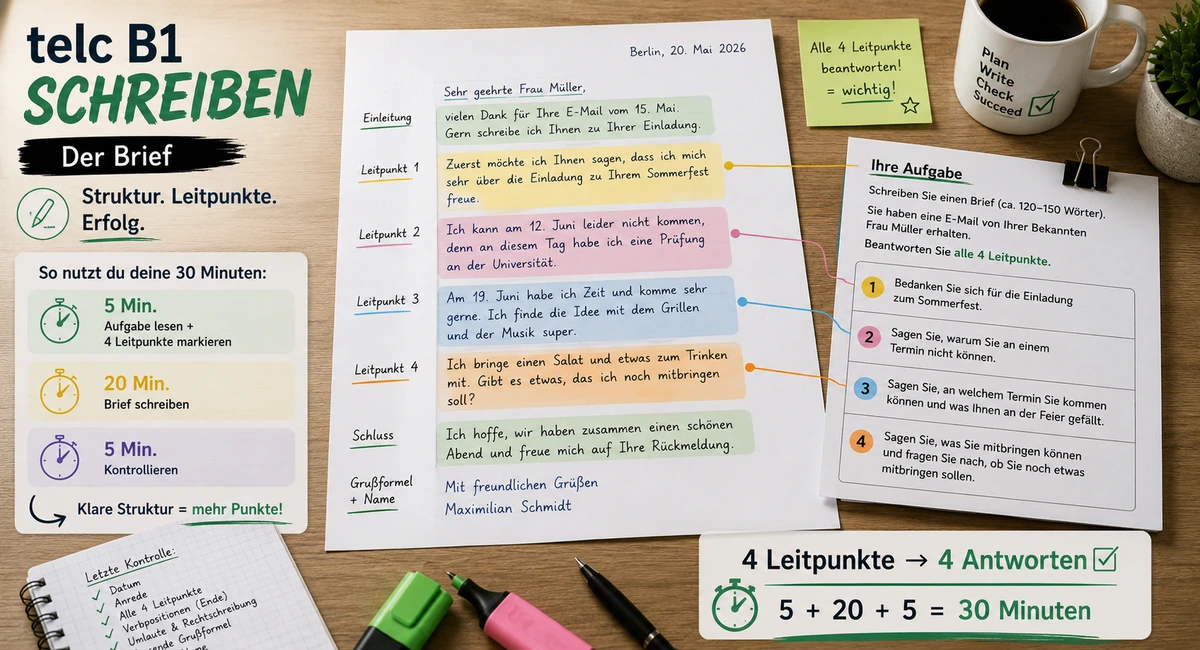
telc B1 Writing:
The letter — structure, tips and example
In the writing part of the telc B1 exam you write a letter or an email. Here you will find the perfect structure, important set phrases, the zero rule and the best tips for a good mark.
What is the writing part of the telc B1?
The writing part is the last part of the written telc B1 exam. After Lesen, Sprachbausteinen and Hören comes the Schreiben. You then have exactly 30 minutes.
In these 30 minutes you write one letter or an email. This is not a story and not an essay — just a simple letter to a person. That person can be a friend, an acquaintance or a semi-formal person (for example a landlord or a company).
The writing part gives you a maximum of 45 points. That is 15 % of the entire exam. Many candidates think: “That is not so important.” But be careful: if you score few points here, you cannot pass the written exam overall!
You only have 30 minutes for the letter. That is not much time! You therefore need to know before the exam what a good letter looks like. Learn the structure and the most important set phrases by heart — then you will manage within the time.
The task: a letter with four guided points
The task is always structured the same way. You receive two things:
- A situation: A short description or a letter/email that you have to reply to. For example: “Your friend Anna has written you a letter and would like to visit you.”
- Four guided points (Leitpunkte): These are four small topics that must appear in your letter. The Leitpunkte are questions or tasks.
Sample task
Your friend Anna has written to you. She would like to visit you in Germany. Write her a letter. Write about all four points:
- Wann ist die beste Zeit für den Besuch?
- Was kann Anna in deiner Stadt machen?
- Welche Kleidung soll sie mitbringen?
- Welches Essen magst du besonders?
You must answer ALL four Leitpunkte in your letter. If you forget one point, you will receive fewer points. If you forget two or more points, you will even receive 0 points for the entire letter!
How many words do I have to write?
There is no exact word count. But a good guideline is: approximately 80 words. That is 10 to 15 sentences. Do not write too short, but also not too long. Quality is more important than quantity!
What situations are typical?
These topics come up frequently in the exam:
- Replying to an invitation (friend, birthday, wedding)
- Planning a visit
- Organising a trip
- Asking for information (from a school, a hotel, a company)
- Apologising (e.g. for a missed appointment)
- Giving or asking for advice
How to structure a good letter
A good letter always has the same structure. If you learn this structure well, you will save a lot of time in the exam. Here are the six parts of a letter:
1. Date (Datum)
Write the date at the top right. For example:
- Dortmund, 15. Mai 2026
- Berlin, den 12.06.2026
2. Salutation (Anrede)
The salutation depends on who you are writing to:
- To a friend (du):
Liebe Anna, / Lieber Thomas, / Hallo Maria, - To a semi-formal person (Sie):
Sehr geehrte Frau Müller, / Sehr geehrter Herr Schmidt, - To a company (when you do not know a name):
Sehr geehrte Damen und Herren,
Important: After the salutation there is always a comma. After that you continue with a lower-case letter.
3. Introduction (Einleitung)
The introduction is short — only 1 or 2 sentences. Here you thank the person for their letter or explain why you are writing. Examples:
- Vielen Dank für deinen Brief!
- Es freut mich, von dir zu hören.
- Ich habe deine E-Mail gerade gelesen.
- Schön, dass du mir geschrieben hast!
4. Main body: the four Leitpunkte
This is the most important part. Here you answer the four Leitpunkte. Write 1 to 3 sentences for each point.
Important tip: You do not have to address the Leitpunkte in the same order as in the task! You can choose a logical order. For example: the easiest point first, the most important one last.
5. Closing (Schluss)
At the end you write 1 or 2 sentences. Here you can:
- Look forward to a reply: Ich freue mich auf deine Antwort.
- Wish something: Ich wünsche dir alles Gute.
- Ask for a reply: Schreib mir bald!
- In formal letters: Für Ihre Hilfe bedanke ich mich im Voraus.
6. Closing formula (Grußformel) and name
Finally a closing formula. Here too: du or Sie?
- Friends (du): Liebe Grüße, / Herzliche Grüße, / Viele Grüße,
- Formal (Sie): Mit freundlichen Grüßen,
Then leave one line blank and write your name.
Datum → Anrede → Einleitung → 4 Leitpunkte → Schluss → Grußformel → Name
Learn these seven parts by heart. In the exam you will then have more time to think about the content.
Important set phrases for the letter
Set phrases (Redemittel) are ready-made sentences and expressions. If you know them, you can simply use them in your letter. You save time and make fewer mistakes.
Set phrases for the introduction
- Vielen Dank für deinen/Ihren Brief.
- Ich habe deinen/Ihren Brief erhalten.
- Schön, von dir/Ihnen zu hören.
- Es freut mich sehr, dass du geschrieben hast.
- Ich schreibe dir/Ihnen, weil …
Set phrases for the main body
Expressing an opinion:
- Ich finde, dass …
- Meiner Meinung nach …
- Ich denke, dass …
Making a suggestion:
- Ich schlage vor, dass …
- Wie wäre es, wenn …?
- Am besten ist es, wenn du …
Explaining or giving a reason:
- … weil …
- … denn …
- Der Grund ist, dass …
- Deshalb … / Deswegen …
Showing connections between sentences:
- Zuerst … / Dann … / Danach … / Am Ende …
- Außerdem …
- Aber …
- Trotzdem …
Set phrases for the closing
- Ich freue mich auf deine/Ihre Antwort.
- Ich hoffe, ich konnte dir helfen.
- Schreib mir bald!
- Ich wünsche dir viel Spaß/Erfolg/Glück.
- Bis bald!
- Für Ihre Hilfe bedanke ich mich im Voraus. (formal)
Closing formulas
- Friends: Liebe Grüße / Herzliche Grüße / Viele Grüße / Alles Liebe
- Formal: Mit freundlichen Grüßen
An example letter — step by step
Now you can see what a good letter looks like. We work with the task from section 2:
Your friend Anna would like to visit you in Germany. Write her a letter and answer these four points:
- Wann ist die beste Zeit für den Besuch?
- Was kann Anna in deiner Stadt machen?
- Welche Kleidung soll sie mitbringen?
- Welches Essen magst du besonders?
The finished letter
Dortmund, 15. Mai 2026
Liebe Anna,
vielen Dank für deinen lieben Brief! Ich freue mich sehr, dass du mich in Deutschland besuchen möchtest.
Die beste Zeit für deinen Besuch ist der Juni. Dann ist das Wetter schön und nicht zu heiß. Außerdem gibt es im Juni viele Feste in unserer Stadt.
In Dortmund gibt es viel zu sehen. Wir können zusammen in den Zoo gehen oder am Phönixsee spazieren. Am Wochenende gibt es auch einen schönen Flohmarkt.
Bring bitte leichte Kleidung mit — ein T-Shirt und eine kurze Hose. Aber auch eine Jacke für den Abend ist wichtig, weil es manchmal kühl wird.
Ich koche gerne für dich! Mein Lieblingsessen ist Pasta. Ich kann auch einen leckeren Apfelkuchen backen — den magst du sicher!
Ich freue mich schon jetzt auf deinen Besuch. Schreib mir bald, wann du kommst.
Liebe Grüße,
Maria
Why is this letter good?
- ✅ It has a date.
- ✅ The salutation is correct (comma, then lower case continues).
- ✅ The introduction thanks the person for the letter.
- ✅ All four Leitpunkte are answered.
- ✅ The sentences are simple, clear and correct.
- ✅ There is a friendly closing.
- ✅ The closing formula fits (friend = “Liebe Grüße”).
- ✅ The letter has approximately 90 words — perfect!
Learn a model letter like this one as a structure by heart. In the exam you then only change the details. This saves you a lot of time!
How is your letter assessed?
Two assessors read your letter and award points. They assess you according to three criteria:
The three assessment criteria
| Criterion | What is assessed? |
|---|---|
| 1. Content (Leitpunkte) | Have you answered all four Leitpunkte? Does the content match the task? |
| 2. Communicative design (Kommunikative Gestaltung) | Is the letter well structured? Are the sentences logically connected? Does the language suit the reader? |
| 3. Formal accuracy (Formale Richtigkeit) | Is the grammar correct? Are spelling and sentence structure correct? |
The grades A, B, C, D
For each criterion you receive a grade from A to D:
| Grade | Meaning | Points per criterion |
|---|---|---|
| A | Very good | 5 points |
| B | Good | 3 points |
| C | Not quite sufficient | 1 point |
| D | Not sufficient | 0 points |
How does one reach 45 points?
The maximum score is 15 (3 criteria × 5 points). Plus up to 2 bonus points (Zusatzpunkte). Then everything is multiplied by 3:
(3 × 5 + 2) × 3 = 51 — but the maximum is 45 points.
Bonus points (Zusatzpunkte)
You can receive up to 2 Zusatzpunkte:
- 1 Zusatzpunkt for particularly good vocabulary (you use many different words and sentence structures).
- 1 Zusatzpunkt for particularly good content (you write in detail and in an interesting way).
But be careful: Zusatzpunkte are only awarded if all three criteria are rated at least B!
The zero rule (Null-Regel) — watch out, danger!
Now comes a very important rule. If you do not know this rule, you cannot pass the writing exam — no matter how good your letter is!
If criterion 1 (Leitpunkte) OR criterion 3 (grammar) receives grade D, then the entire letter = 0 points.
This applies even if the other criteria are very good!
When does one receive a D for criterion 1?
You receive a D for criterion 1 (Leitpunkte) if you:
- Have only answered one of four Leitpunkte
- Have not answered any Leitpunkt
- Have missed the topic entirely (you write something completely different)
Conclusion: You must answer at least three of four Leitpunkte in order to receive at least a C (1 point). And for a good grade you must answer all four Leitpunkte.
When does one receive a D for criterion 3?
You receive a D for criterion 3 (grammar) if:
- Your letter has so many mistakes that it is barely comprehensible
- You make very basic grammar mistakes multiple times
- Your sentence structure is almost always incorrect
Don’t panic! A few mistakes are no problem. A D is only awarded when the letter is really very poor. If your letter is comprehensible, you will receive at least a C or B.
Always check two things at the end:
- Have I really answered all four Leitpunkte?
- Is my letter comprehensible (even if it is not perfect)?
If both answers are “yes”, you are safe!
The best tips for the letter
Here are the most important tips for the writing exam. If you follow them, you will achieve a good mark!
Tip 1: Manage your time well
You only have 30 minutes. Plan them like this:
- 5 minutes: Read the task carefully. Mark the four Leitpunkte. Make notes.
- 20 minutes: Write the letter.
- 5 minutes: Check everything at the end.
Tip 2: Write simply but correctly
You do not have to write complicated sentences. A simple, correct sentence is better than a long sentence with mistakes.
Not like this:
„Weil das Wetter sehr schön war, obwohl meine Mutter gesagt hatte, dass es regnen würde, sind wir ins Schwimmbad gegangen.“ (too complicated, often mistakes)
Better like this:
„Das Wetter war sehr schön. Meine Mutter hat gesagt, dass es regnen würde. Aber wir sind ins Schwimmbad gegangen.“ (simple and correct)
Tip 3: Learn model letters by heart
You do not have to invent every sentence from scratch. Learn standard sentences for the Anrede, Einleitung, Schluss and Grußformel. You can use these sentences in every letter.
Tip 4: Mark all four Leitpunkte!
When you read the task, immediately underline the four Leitpunkte. After writing, check: is every point really in the letter? This is the most frequent mistake — many candidates forget one point!
Tip 5: Check at the end
In the last 5 minutes check your letter:
- Is the date at the top right?
- Is the Anrede correct (with a comma)?
- Are all four Leitpunkte answered?
- Are the verbs in the right position?
- Are the umlauts correct (ä, ö, ü, ß)?
- Does the Grußformel fit the person?
- Is your name at the end?
Tip 6: du vs. Sie — do not mix!
This is a very common mistake! When writing to a friend: always du, dich, dir, dein. When writing to a formal person: always Sie, Ihnen, Ihr. Never mix them!
The best way to get a good mark: Üben, üben, üben! Write a short letter every day. After two weeks you will write much better. Get feedback from a teacher or learning partner.


There are no comments for this article. Leave your comment