





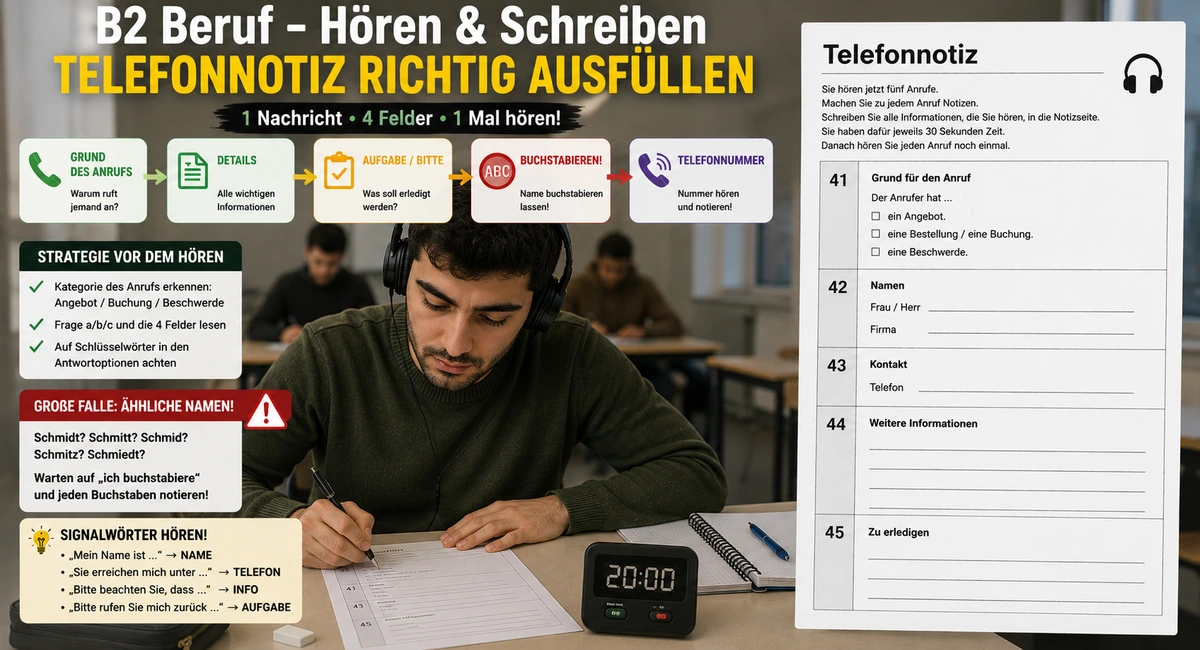
The biggest trap — similar surnames
This is the most common reason for losing points. In German, there are many surnames that sound almost identical on the phone but are written differently. If you only hear the first letters and immediately write down a name without waiting for the spelling, you will most likely write it incorrectly.
Never write the name after hearing it the first time. Always wait for the signal «Mein Name ist X, ich buchstabiere …» and then write it letter by letter. Do not guess. Do not predict.
10 surnames that are easy to confuse on the phone
Here are ten typical German surnames that sound almost the same, but can each have five different spellings. Learn this table so that you do not fall into the trap on the phone:
| Sounds like | Five possible spellings |
|---|---|
| «Schmit…» | Schmidt — Schmitt — Schmid — Schmitz — Schmiedt |
| «Maier…» | Meier — Meyer — Mayer — Maier — Mayr |
| «Hofman…» | Hoffmann — Hofmann — Hoffman — Hofman — Hofmanns |
| «Walter…» | Walter — Walther — Walder — Walters — Walthers |
| «Schweiz(t)er» | Schweizer — Schweitzer — Schwitzer — Schweisser — Schweißer |
| «Müller…» | Müller — Mueller — Möller — Mühler — Müllers |
| «Becker…» | Becker — Bäcker — Becher — Beckers — Beckert |
| «Wolf…» | Wolf — Wolff — Wulf — Wulff — Wölff |
| «Kraus…» | Krause — Kraus — Krauß — Krauss — Krautz |
| «Bauer…» | Bauer — Baier — Bayer — Bauern — Bauers |
How to avoid this trap
- Listen to every letter separately. Do not write the whole name at once, but letter by letter.
- Pay attention to double letters. Hoffmann has two f and two n. Hofmann has only one f. That makes the difference.
- Pay attention to endings with -t and -z. Schmidt ends with dt, Schmitt with tt, Schmitz with tz.
- Pay attention to the silent h. Walter is written without h, Walther with h. You cannot hear this on the phone — only during spelling.
- Learn the German alphabet for spelling by heart. A to Z — safely and quickly. Especially the difficult letters: J (jott), V (fau), W (we), Y (üpsilon), Z (zet).
Strategy step by step
Before the recording (30 seconds time)
- Read the word at the top of the form: Angebot, Beschwerde or Buchung.
- Read the question with the three answer options.
- Look briefly at the four fields: Name, Telephone, Additional information, To do.
- Breathe calmly. You now know what is coming.
During the recording
- First listen for the main statement (for the question with three answers).
- Write numbers immediately as digits: 200, 75 €, 14:30 Uhr.
- Write briefly and in your own words, not whole sentences.
- When you hear the signal «Mein Name ist …» and «ich buchstabiere», focus completely on the letters.
- When you hear the signal «Sie erreichen mich unter …», focus completely on the digits.
After the recording
- First answer the question with the three answer options.
- Complete the four fields. Add from memory what you did not manage to write down.
- Read everything once again: Is the name written the way it was spelled? Is the telephone number complete?
Write short, clear words. You are writing for a colleague, not for a teacher. Complete sentences are not necessary here. But: Write clearly enough so that another person understands the note.
Avoid common mistakes
- ❌ Writing down the name before it was spelled.
- ❌ Trying to write down the whole recording word for word.
- ❌ Writing numbers as words («fünfundsiebzig») instead of digits («75»).
- ❌ Leaving fields empty because you are unsure. Something approximate is better than nothing.
- ❌ Writing long sentences instead of short keywords.
- ❌ Ignoring the question with three answers or doing it last without concentration.
Where you can practise Listening and Writing
You can only master this task confidently through regular practice. You need different recordings, different speakers, and above all many different surnames for spelling practice. On our platform, you will find all the necessary exercises exactly in the format that also appears in the exam — with immediate evaluation of every form field.







There are no comments for this article. Leave your comment