





Goethe B1 Reading Part 1:
structure, assessment and typical mistakes
What awaits you in Goethe B1 Reading Part 1? Here you find the exact structure, the assessment and the most common mistakes – explained with simple examples.
What is Goethe B1 Reading Part 1?
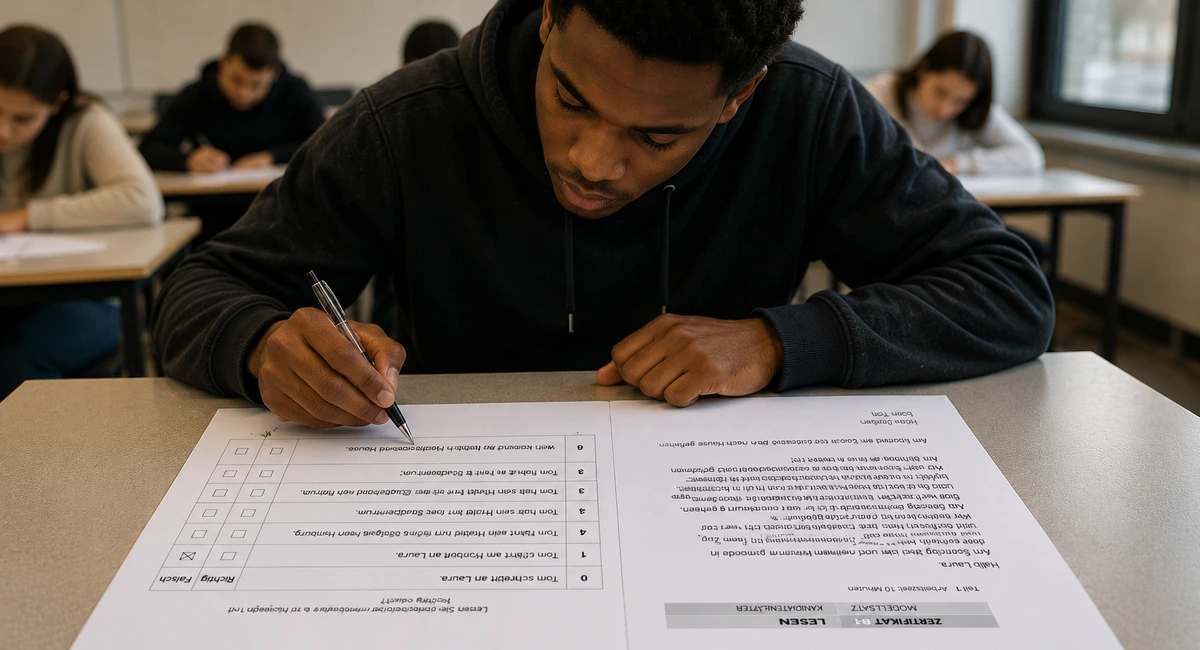
The exam Goethe certificate B1 consists of several parts. One of them is Reading Part 1. In this part you read a personal text – for example an email, a blog post or a letter. After that you solve six tasks.
The Goethe certificate B1 is an international language certificate of the Goethe-Institut. It confirms that you can speak German at level B1 of the Common European Framework of Reference (CEFR). You find official information about the structure and the assessment directly on the website of the Goethe-Institut: goethe.de – Goethe-Zertifikat B1 Aufbau.
Reading Part 1 tests whether you can understand a personal text well. You should recognise what is in the text – and what is not. That sounds simple, but there are many small traps. In this article we explain everything exactly.
👉 All exercises for the preparation for Goethe B1Structure and format
In Reading Part 1 you get a text and six statements. For each statement you have to decide: is the statement richtig (true) or falsch (false)?
The text
The text in Reading Part 1 is always a personal text. That means: a person writes about themselves, about their life or about an experience. Possible text types are:
- an email to a friend;
- an entry in a blog or diary;
- a personal letter.
The text always has a date and a signature. The topics come from everyday life: leisure, family, work, travel, sport, health and the like.
The tasks
After the text there is an example (task 0) and six tasks (1–6). With each task there is a sentence. You have to tick: Richtig or Falsch.
The statements follow the order of the text. Task 1 refers to the beginning of the text, task 6 to the end. That helps you while reading.
Time and points
| Element | Details |
|---|---|
| Text length | about 250–350 words |
| Number of tasks | 6 (+ 1 example) |
| Answer options | Richtig / Falsch (true / false) |
| Maximum score | 6 points (1 point per task) |
| Time for the whole reading section | 65 minutes (all five reading parts together) |
Assessment
The assessment of Reading Part 1 is simple: for each correct answer you get one point. For a wrong answer you get no point. There are no minus points.
Reading Part 1 is one part of the whole reading module. The reading module has five parts in total. To pass the exam, you have to reach at least 60 percent of the points in the whole reading module.
Do not leave any task empty. If you are not sure, guess. Wrong answers do not cost an additional point.
What exactly is tested?
In Reading Part 1 it is tested whether you:
- understand the content of a personal text well;
- recognise details in the text and assign them correctly;
- recognise the difference between the text content and similar but wrong statements.
Typical traps – this is how you are tested
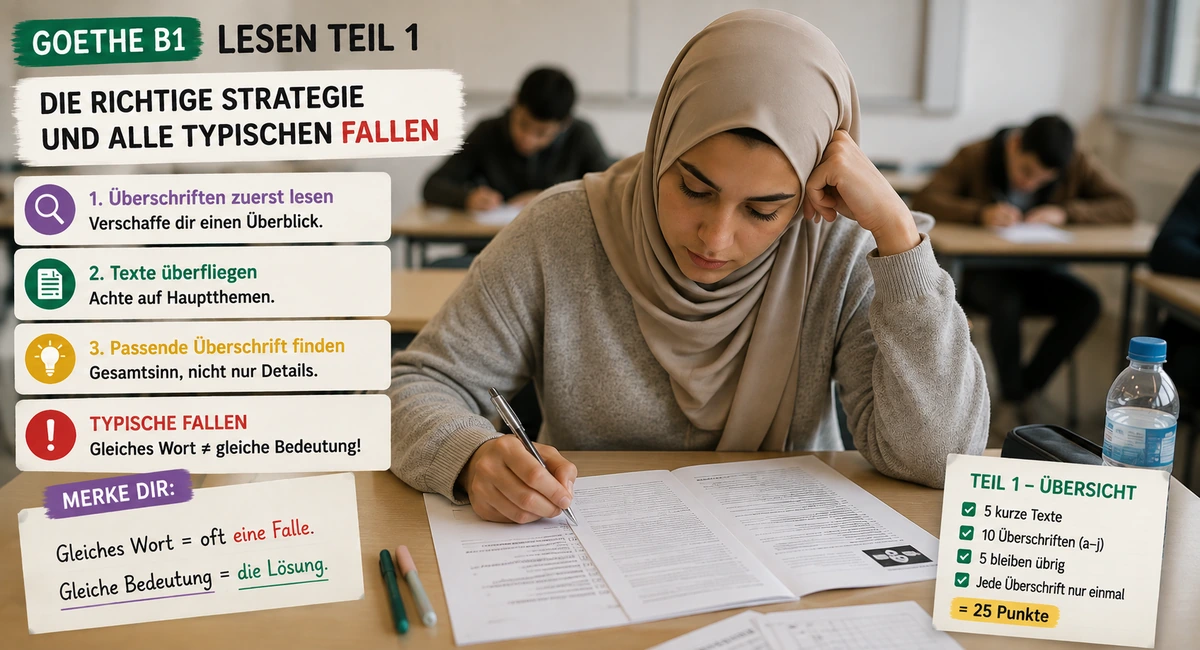
In Reading Part 1 there are always traps. These are statements that sound correct at first, but are wrong on closer reading. Whoever knows the traps makes fewer mistakes. Here are the most common types – with simple examples.
➔ Trap 1: the word appears – but the meaning is different
A word from the statement also appears in the text. Therefore you think: the statement is true. But in the text the word has a different meaning or refers to a different person.
Example: In the text it says: Mein Bruder wollte am Anfang gar nicht mitkommen. The statement reads: Die Erzählerin wollte zunächst nicht mitkommen. ✗ Falsch – it was the brother, not the narrator. The phrase wollte nicht appears in the text, but it belongs to a different person.
➔ Trap 2: the other person does something – not the protagonist
The statement says that the main person did something. But in the text someone else does it.
Example: In the text it says: Ein Mitarbeiter hat das Paket unterschrieben. The statement reads: Frau M. hat das Paket unterschrieben. ✗ Falsch – the employee signed, not Frau M.
➔ Trap 3: intention is not the same as action
The main person wanted to do something, but did not do it. The statement says she did it.
Example: In the text it says: Wir wollten eigentlich noch ins Café gehen, aber ich war zu müde. The statement reads: Sie sind nach dem Ausflug noch in ein Café gegangen. ✗ Falsch – they wanted to, but they did not do it.
➔ Trap 4: signal words – immer, nie, alle, sofort, nur
Words like immer, nie, alle, sofort, nur, schon immer make a statement very absolute. In the text there is often something different – for example manchmal or meistens.
Example: In the text it says: Früher hat er manchmal Tennis gespielt. The statement reads: Er spielt seit seiner Kindheit immer Tennis. ✗ Falsch – manchmal früher is not the same as immer seit der Kindheit.
➔ Trap 5: the negation is hidden
The meaning in the text is positive, but the statement is negative – or the other way round.
Example: In the text it says: Das Konzert hat uns sehr gut gefallen. The statement reads: Das Konzert hat ihnen nicht gefallen. ✗ Falsch – the meaning is exactly the other way round.
➔ Trap 6: Konjunktiv II – a wish is not reality
In the text there is a wish or a condition with wäre, hätte, könnte. That means: it did not really happen. But the statement describes it as a fact.
Example: In the text it says: Den Vortrag hätte ich echt noch eine Stunde lang anhören können! The statement reads: Sie hat den ganzen Nachmittag dem Vortrag zugehört. ✗ Falsch – she would have liked to, but she did not.
Konjunktiv II can also be correct! If the statement describes the wish itself – for example Sie wäre gerne länger geblieben – then it is true. The difference: the statement describes reality (✗ Falsch) or the wish (✓ Richtig).
➔ Trap 7: participation is not the same as organisation
Someone took part in an activity. But the statement says this person organised or led the activity.
Example: In the text it says: Meine Schwester hat mir von einem Lauftreff erzählt und war selbst dabei. The statement reads: Ihre Schwester organisiert einen Lauftreff. ✗ Falsch – the sister took part and told about it, but did not organise it.
➔ Trap 8: the reason is a different person or a different circumstance
The statement names a reason. But in the text the reason is a different one.
Example: In the text it says: Ich möchte abnehmen, weil ich mich besser fühlen möchte. Mein Arzt findet das auch gut. The statement reads: Er nimmt ab, weil der Arzt es gesagt hat. ✗ Falsch – he wants it himself. The doctor is only of the same opinion, but did not order it.
➔ Trap 9: a word from a different part of the text
A word or a phrase from the statement appears in the text – but in a completely different context or with a different person.
Example: In the text it says: Mein Kollege war von Anfang an dagegen. The statement reads: Sie wollten von Anfang an eine Beratungsstelle aufsuchen. ✗ Falsch – von Anfang an appears in the text, but the colleague was against it (not for it), and it is about a different person.
| Trap | Signal sign | Strategy |
|---|---|---|
| Same word, different meaning | a familiar word in the statement | Ask: in which context does the word appear in the text? |
| A different person acts | name or pronoun in the statement | Ask: who really does this in the text? |
| Intention ≠ action | wollte, ursprünglich, aber | Ask: did the person really do it? |
| Signal words | immer, alle, sofort, nur, nie, schon immer | Very absolute words are often traps – check carefully! |
| Hidden negation | positive/negative swapped | Ask: what does the text say exactly – positive or negative? |
| Konjunktiv II | wäre, hätte, könnte | Ask: did it happen or is it only wished for? |
| Participation ≠ organisation | organisiert, geleitet, veranstaltet | Ask: did the person take part or organise? |
| Wrong reason | weil, denn, deshalb | Ask: which reason does the text really name? |
| Word from a different context | familiar phrase in the wrong place | Ask: to whom and in which sense does this phrase appear in the text? |
The most common mistakes and how to avoid them
Many learners always make the same mistakes in Reading Part 1. Here are the most common ones – and how to avoid them.
✗ Mistake 1: you read only quickly and choose the first familiar word
Many see a word from the statement in the text and immediately mark Richtig. But the familiar word can be a trap. Always read the whole sentence in the text – not only the one word.
✗ Mistake 2: you confuse people
In the text there are often several people: the main person and other people (friends, siblings, colleagues). A statement says the main person did something – but in the text it was someone else. Always ask: Wer macht das wirklich? (Who really does this?)
✗ Mistake 3: you do not accept signal words as traps
Words like immer, alle, sofort, nie, schon immer, von Anfang an sound normal. But they make a statement very absolute. In the text there is often something weaker – for example manchmal or erst danach. Be especially careful with these words.
✗ Mistake 4: you understand the Konjunktiv II wrongly
Forms like hätte gern, wäre gerne, könnte often describe a wish – something that did not happen. If the statement says that something happened, and in the text it is only a wish – then the statement is wrong.
✗ Mistake 5: you do not control your time
Some learners spend too much time on one task. Then at the end they have no time left. Tip: if you are not sure about a task, tick something and move on. At the end you can come back.
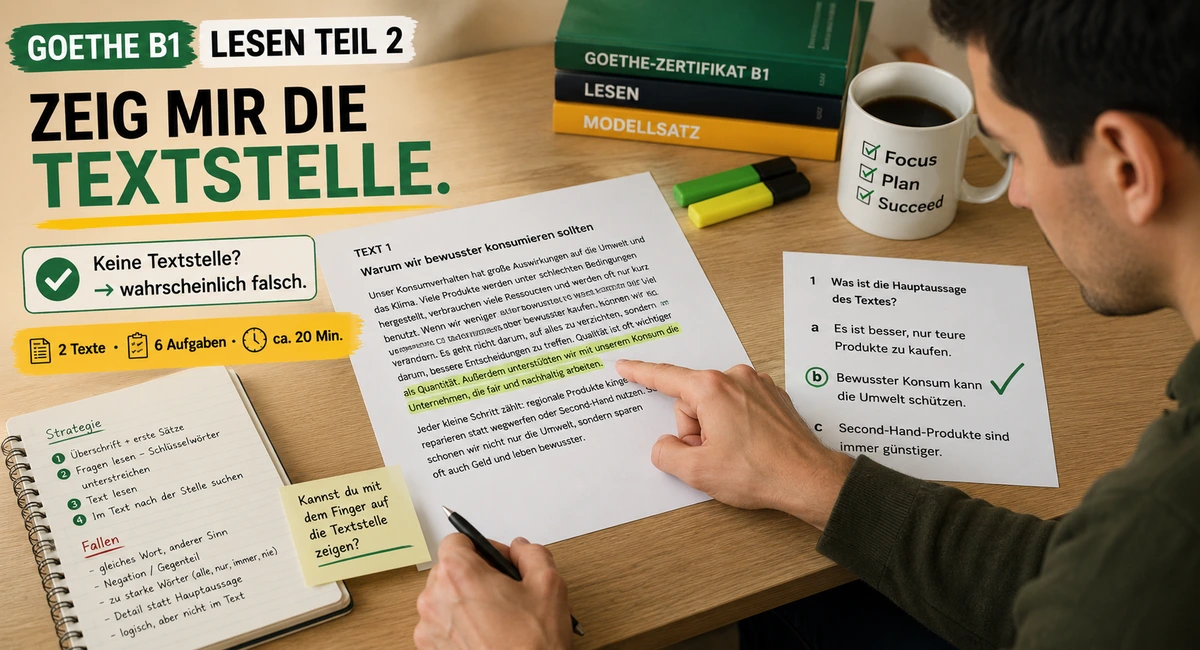
The correct answer is always clearly in the text. You do not have to invent or guess anything. If a statement is true, you can find a concrete place in the text that proves it. If you find no place in the text – the answer is probably Falsch.
5 tips for the preparation
With the right strategy you can get almost all points in Reading Part 1. Here are five tips that really help.
- Tip 1: read the statements first, then the text. This way you know what you have to pay attention to. Underline key words in the statements.
- Tip 2: look for the place in the text for each statement. The correct answer always has a place in the text as proof. No place in the text – probably Falsch.
- Tip 3: pay attention to signal words. Words like immer, nie, alle, sofort, von Anfang an in the statement are often traps. Check them especially carefully.
- Tip 4: always check: who does what? In the text there are often two or more people. A statement can attribute the action to the wrong person.
- Tip 5: practise with many texts. The more personal texts (emails, blogs, letters) you read and analyse, the better you recognise the traps.



There are no comments for this article. Leave your comment