





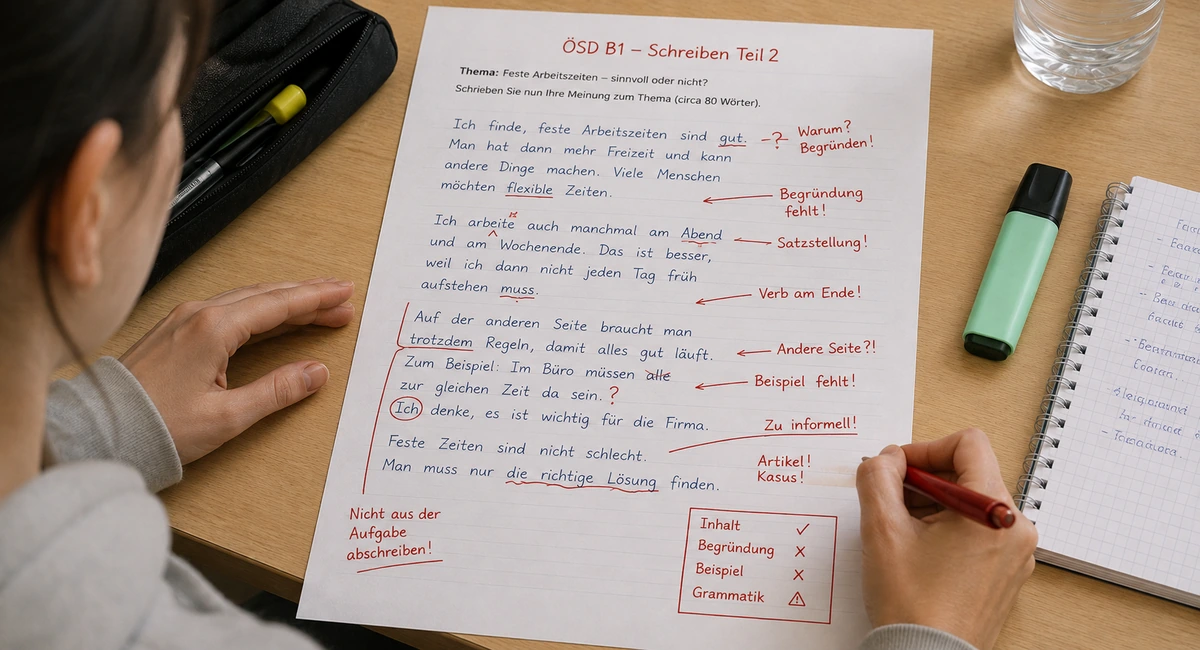
B1 ÖSD Writing Part 2:
structure, assessment and typical mistakes
Learn how Writing Part 2 in the ÖSD certificate B1 is structured, how the examiners assess it and which typical mistakes you can avoid very easily.
What is Writing Part 2 in the ÖSD certificate B1?
The Writing module in the ÖSD certificate B1 consists of three parts. Part 2 is the second part and one of the most important, because here you can get especially many points.
In Writing Part 2 you write a comment – that is, a forum or guestbook post on the internet. Your task is to give your personal opinion on a topic. You describe, give reasons and name advantages and disadvantages.
The situation is important: you write for an anonymous public on the internet, not for a friend. That is why the register is neutral. So you do not write du and you do not address the text to a specific person.
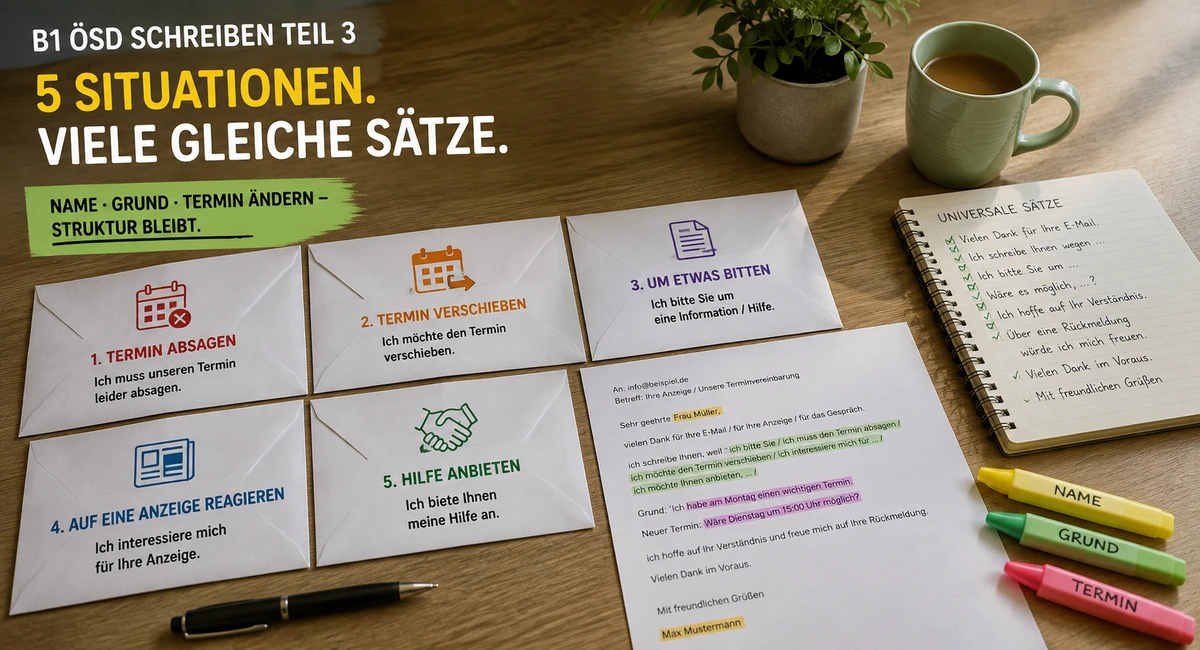
This is how the three parts differ: Part 1 is a personal email to a friend (with du). Part 2 is a neutral comment for the internet. Part 3 is a (semi-)formal message (with Sie).
Structure of the task: what to expect
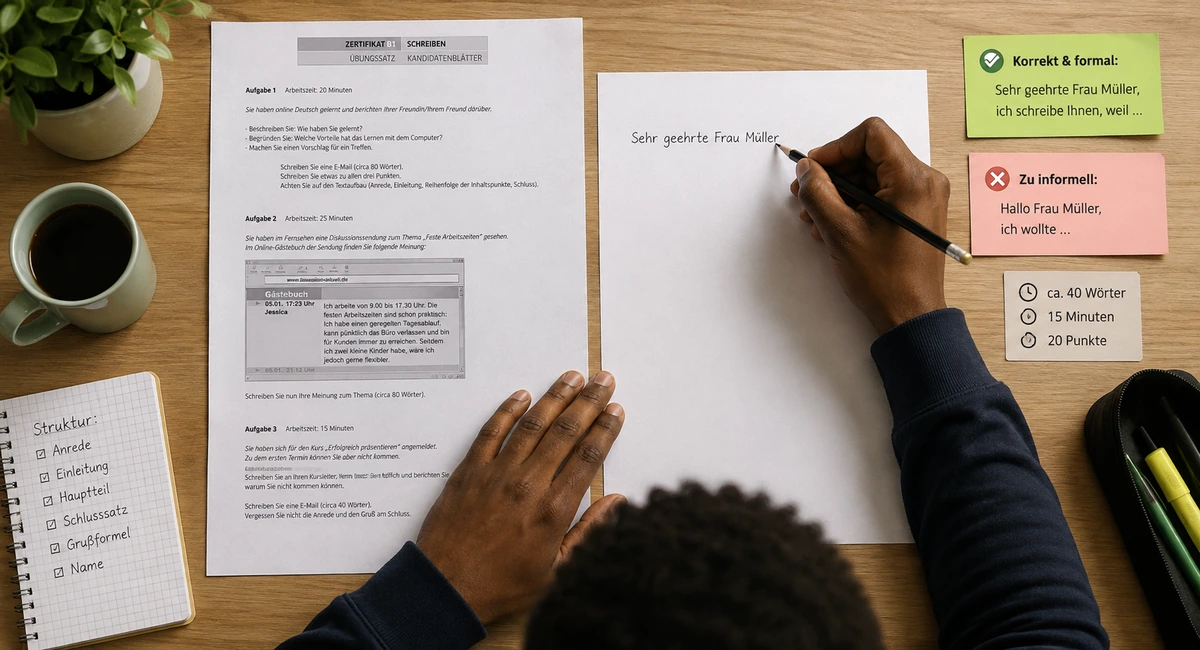
The task in Part 2 always has three parts. If you know them, you understand the task faster:
- The introductory text: here you find the topic and where it appears, for example in a programme on television.
- The given comment: another person gives their opinion in the guestbook. This text gives you ideas and useful words on the topic.
- The instruction: here you find your task, for example: Schreiben Sie nun Ihre Meinung (ca. 80 Wörter).
You do not have to respond directly to the given comment. But you may do so. Most important is that you write your own opinion clearly and understandably.
| Parameter | Detail |
|---|---|
| Text type | comment / forum or guestbook post |
| Task | express your own opinion on a topic |
| Register | neutral (no du, no specific recipient) |
| Length | about 80 words |
| Time | about 25 minutes |
| Points | maximum 40 points |
How to structure your text correctly
A clear structure helps you a lot, because the examiners also assess whether your text is well organised. It is best to write your comment in four small steps:
- Einleitung (introduction): refer to the topic and briefly give your opinion. For example: Das Thema ... finde ich sehr wichtig.
- Begründung (reasoning): explain why you think this way. Use words like weil, denn, deshalb.
- Beispiel (example): give a short example from your life. For example: Vor Kurzem habe ich ...
- Andere Seite und Schluss (other side and ending): name a counter-argument and at the end briefly state your opinion again. For example: Auf der anderen Seite ... Trotzdem denke ich: ...
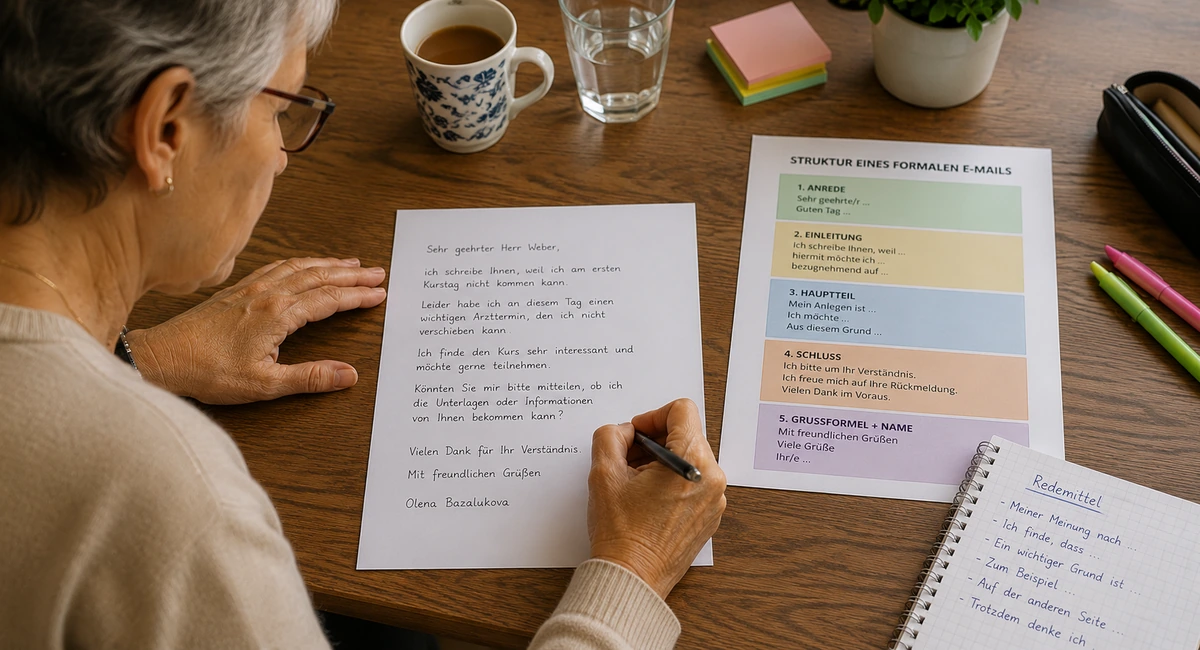
Useful set phrases
These small sentences help you structure your text clearly:
- Introducing: Das Thema ... finde ich sehr wichtig. / Ich finde die Frage ... interessant.
- Giving an opinion: Meiner Meinung nach ... / Ich bin der Meinung, dass ...
- Giving reasons: ... weil ... / ... denn ... / ... deshalb ...
- Giving an example: Vor Kurzem habe ich ... / Ein gutes Beispiel ist ...
- Other side: Auf der anderen Seite ... / Einerseits ..., andererseits ...
- Ending: Trotzdem denke ich: ... / Eine Lösung wäre ...
Do not begin every sentence with Ich. Connect your sentences with words like weil, denn, deshalb, außerdem, trotzdem. This way your text becomes more fluent and you get more points for the coherence.
The four assessment criteria
Your text is assessed by two examiners. They pay attention to four criteria. For each criterion you can get up to 10 points, so a maximum of 40 points in Part 2 together.
| Criterion | What is assessed |
|---|---|
| Erfüllung (task fulfilment) | You write on the topic, state your opinion clearly, the text is long enough and the register is neutral. |
| Kohärenz (coherence) | Your text has a clear structure with introduction and ending. The sentences are connected and the sentence beginnings are different. |
| Wortschatz (vocabulary) | You use suitable words. Important: you do not copy from the given comment. |
| Strukturen (structures) | You use the grammar correctly, for example the verb forms and the sentence structure. |
In the whole Writing module (Part 1, 2 and 3 together) there are a maximum of 100 points. You need at least 60 points to pass the module. So Part 2 is very important for your overall result.
Typical mistakes in Writing Part 2
Many participants make the same mistakes. If you know them, you can avoid them easily and get more points.
Mistake 1: wrong register
Many write as if to a friend. But Part 2 is neutral.
❌ Hallo Lisa, wie geht es dir?
✅ Das Thema ... finde ich sehr wichtig.
Mistake 2: no own opinion
Some only retell what the comment says. That is too little. State clearly what you think, and give reasons for it.
Mistake 3: no example from your own life
Many write only general sentences and give no concrete example. Yet the task expects you to also report on your own experience. A short example makes your text livelier and brings you points for the fulfilment. For example: Vor Kurzem habe ich ...
Mistake 4: copying from the given comment
If you copy whole words or parts of sentences from the prompt, you get fewer points for the vocabulary. Always formulate the ideas in your own words.
Mistake 5: the text is too short
A text that is too short is penalised. Better write a bit more than 80 words and deal with several aspects.
Mistake 6: always the same sentence beginnings
Many begin sentence after sentence with Ich. This looks simple and costs points for the coherence. Vary the sentence beginnings.
Mistake 7: no clear structure
A text without an introduction and ending is hard to read. Stick to the four steps from section 3.
Mistake 8: missing the topic or being too general
Read the task carefully and really write on the topic. Stay concrete and do not write only general sentences.
Checklist before submitting
At the end, check your text briefly with this list:
- Did I state my opinion clearly?
- Did I give reasons (weil, denn, deshalb)?
- Did I give an example?
- Do I have another side and an ending?
- Is my register neutral (no du)?
- Did I copy nothing from the prompt?
- Did I use different sentence beginnings?
- Is it about 80 words (or a bit more)?
Plan about two minutes at the end for a short correction. Read your text through again and fix small mistakes.




There are no comments for this article. Leave your comment