





telc B2 Reading comprehension:
structure, time, points and assessment
How is the Reading comprehension subtest structured? How much time do you have? How many points does each task bring and who corrects your answers? Here you will find all the rules explained simply.
What is the Reading comprehension subtest at telc B2?
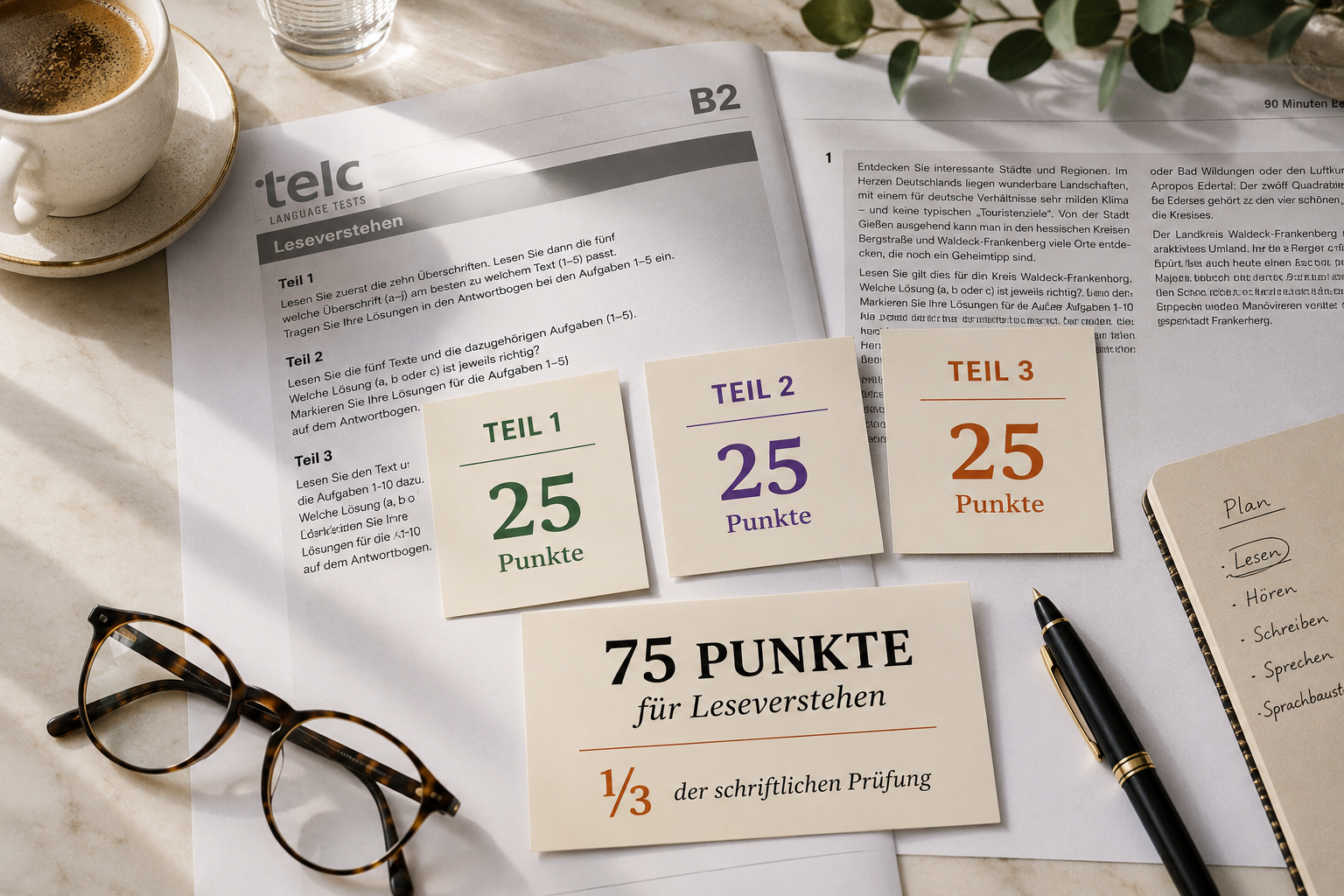
Reading comprehension is the first subtest in the telc Deutsch B2 exam. It has 3 parts and 20 tasks. You can get a maximum of 75 points. For the Reading comprehension and the Sprachbausteine (language elements) you have 90 minutes together. There is no break during this time.
The subtest does not test your grammar and does not test your vocabulary directly. It tests only one thing: can you understand German texts? According to the Common European Framework of Reference (CEFR), at level B2 that means: you understand the main content of complex texts on concrete and abstract topics. There are three different kinds of comprehension here — global, detailed and selective. Each part trains a different technique.
You mark your answers on an answer sheet. This answer sheet is not corrected by a person, but by a computer — and that has direct consequences for your strategy in the exam.
👉 Exercises for the telc B2 Reading comprehensionStructure: the three parts at a glance
The Reading comprehension subtest has three parts. Each part has a different aim, a different task type and a different number of tasks. The structure is always the same — in every exam, in every exam centre, in every country. You will also find this structure in the official practice test from telc.
| Part | Aim | Task type | Tasks | Points |
|---|---|---|---|---|
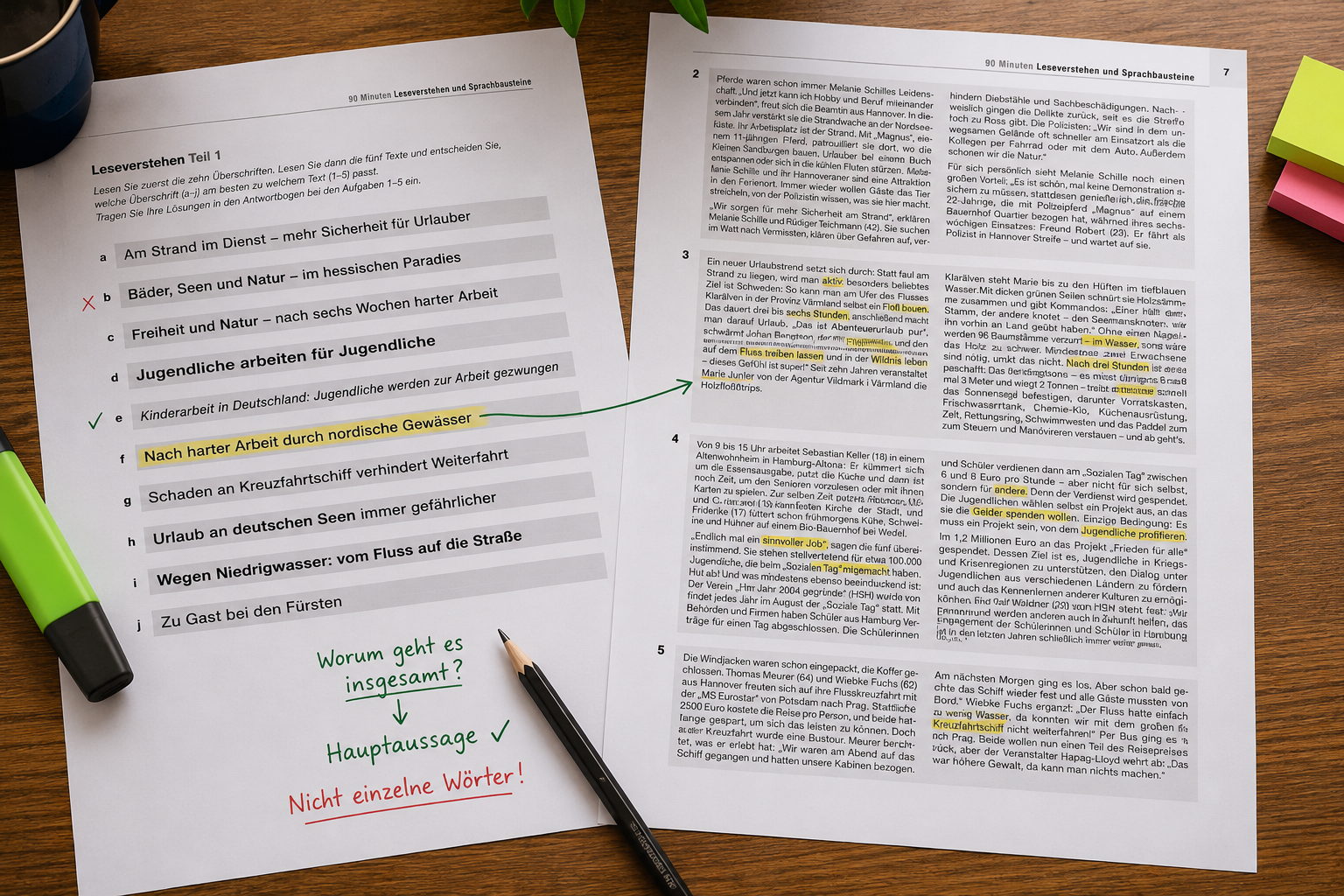
| Part 1 | Globalverstehen (global comprehension) | Matching (headings to texts) | 5 | 25 |
| Part 2 | Detailverstehen (detailed comprehension) | Multiple choice (a, b, c) | 5 | 25 |
| Part 3 | Selective comprehension | Matching (advertisements to situations) | 10 | 25 |
| Total | — | — | 20 | 75 |
What do Globalverstehen, Detailverstehen and selective comprehension mean?
These three words look complicated. But the idea behind them is very simple:
- Globalverstehen (global comprehension) (Part 1): you understand the main idea of a text. Not the details — just: what is this actually about?
- Detailverstehen (detailed comprehension) (Part 2): you understand concrete information in the text quite precisely. Here every word matters.
- Selective comprehension (Part 3): you look for a specific piece of information and ignore the rest. Like in everyday life, when you are looking for just one phone number in a list.
These three techniques are completely different. Anyone who reads Part 1 the way they read Part 2 — that is, word for word — loses time. Anyone who reads Part 2 the way they read Part 1 — that is, quickly and globally — loses points. That is why it makes sense to train each part separately.
How much time do you have for the Reading comprehension?
Short answer: there is no time just for the Reading comprehension. You get 90 minutes for the Reading comprehension and the Sprachbausteine (language elements) together. According to telc there is no break in these 90 minutes. You organise the time yourself.
That is good news, because you stay in control: you decide for yourself how much time each task gets. The only important thing is not to forget the Sprachbausteine in the process — there are another 30 points there. With a time plan in your head, these points are not lost.
The recommended times from telc
In its notes for participants, telc gives a recommended time for each task. These times are expressly only suggestions — you are allowed to divide up the 90 minutes yourself:
| Task | Recommended time | Reading style |
|---|---|---|
| Reading Part 1 | approx. 15 minutes | global |
| Reading Part 2 | approx. 20 minutes | detailed |
| Reading Part 3 | approx. 20 minutes | selective |
| Sprachbausteine Part 1 | approx. 15 minutes | — |
| Sprachbausteine Part 2 | approx. 20 minutes | — |
| Transferring onto the answer sheet | approx. 10 minutes | — |
In total you read around 3000 words in these 90 minutes.
Factor in the 10 minutes for the answer sheet right from the start. Then you work with a clear plan: around 80 minutes for the tasks and 10 minutes for the transfer. Anyone who knows this beforehand does not end up in a rush at the end.
The order is free — telc even recommends thinking beforehand about whether you would rather start with the easier or the harder tasks, or whether you would like to solve the tasks with the higher point values first.
Where does the Reading comprehension come in the course of the exam?
The written exam day has a fixed order. This way you can see immediately when you get a break and when you do not:
| Order | Subtest | Duration |
|---|---|---|
| 1 | Reading comprehension + Sprachbausteine | 90 minutes |
| 2 | Break | 20 minutes |
| 3 | Listening comprehension | approx. 20 minutes |
| 4 | Written production (letter) | 30 minutes |
So the Reading comprehension comes right at the beginning, when you are still fresh and focused. At the same time it is the longest block without a break.
Points: how much is a task worth?
Short answer: not every task is worth the same. All three parts together bring 25 points per part. But Part 1 and Part 2 have only 5 tasks, Part 3 has 10 tasks. The result:
| Part | Tasks | Points total | Points per task |
|---|---|---|---|
| Part 1 | 5 | 25 | 5.0 |
| Part 2 | 5 | 25 | 5.0 |
| Part 3 | 10 | 25 | 2.5 |
A single task in Part 1 or Part 2 is therefore worth twice as much as a task in Part 3. A mistake in Part 1 costs you 5 points, a mistake in Part 3 only 2.5 points.
In practice this means above all one thing: give Part 1 and Part 2 the calm they deserve. Anyone who stays in Part 3 for a very long time and then works through Part 2 at high speed gives away the more valuable tasks. You should of course work carefully everywhere — it is just worth consciously dividing up your time.
How important is the Reading comprehension for the whole exam?
The written telc Deutsch B2 exam has 225 points in total. This is how they are distributed:
| Subtest (written exam) | Max. points |
|---|---|
| Reading comprehension | 75 |
| Sprachbausteine | 30 |
| Listening comprehension | 75 |
| Written production | 45 |
| Written exam total | 225 |
The Reading comprehension is therefore — together with the Listening comprehension — the largest single item of the written exam: a third of all the points.
There are no minus points. A wrong answer brings zero points, an empty task also brings zero points. So you risk nothing by guessing. Never leave a task blank — not even when time is almost up.
Who corrects the Reading comprehension and how?
Short answer: no person. The Reading comprehension is one of the receptive subtests. Your answer sheet is scanned and electronically compared with the official answer key. The evaluation happens centrally at telc, not in your exam centre.
The difference from the productive parts is large:
| Subtest | Who assesses? | How? |
|---|---|---|
| Reading comprehension | Computer | Automatically, by answer key |
| Sprachbausteine | Computer | Automatically, by answer key |
| Listening comprehension | Computer | Automatically, by answer key |
| Written production | Two licensed assessors | By fixed criteria; in case of deviation the second assessment applies |
| Oral production | Trained examiners | By fixed criteria |
What this means for you in practice
- There are no half points and no subjective assessment. An answer is right or wrong. An almost right thought brings nothing.
- The computer does not think along with you. A person would understand what you mean. A scanner only sees: field marked or not marked.
Why the answer sheet is so important
This is exactly where participants lose points they had actually already earned. The text was understood correctly, the solution was correct — but the marking was not unambiguous. For the scanner that is the same as a wrong answer. Anything that is not cleanly on the answer sheet does not exist for the assessment: notes in the exam booklet are not looked at.
Filling it in cleanly is therefore not a detail, but a real part of your exam performance. You should have these rules down automatically:
- Exactly one mark per task. The computer cannot recognise two marks as one answer. You then get no point — even if one of the two was right.
- Fill in the field completely. A small dot, a tick or a faint line is not enough. And stay within the field while doing so.
- Mark with a pencil. telc expressly prescribes this: the scanner reads pencil marks without error. So bring a pencil with you — and ideally a second one as well.
- Make corrections unambiguous. If you change an answer, it must be clear which mark now applies. Half-erased or crossed-out fields are a risk. If in doubt, ask the invigilator how you should make corrections.
- Do not write anything extra on the sheet. No notes, no comments, no marks in the margin.
- Check the numbers. Check regularly whether the number on the answer sheet really matches the number of the task.
After each part, briefly check whether the number and the line still match. That takes five seconds and reliably protects you from slipping by one line during the transfer — because from that point on even all the correctly solved tasks would no longer count. Anyone who makes this brief check a habit does not even have to think about it in the exam any more. Also remember: the transfer is part of the exam time and is not added on extra.
Do you have to pass the Reading comprehension separately?
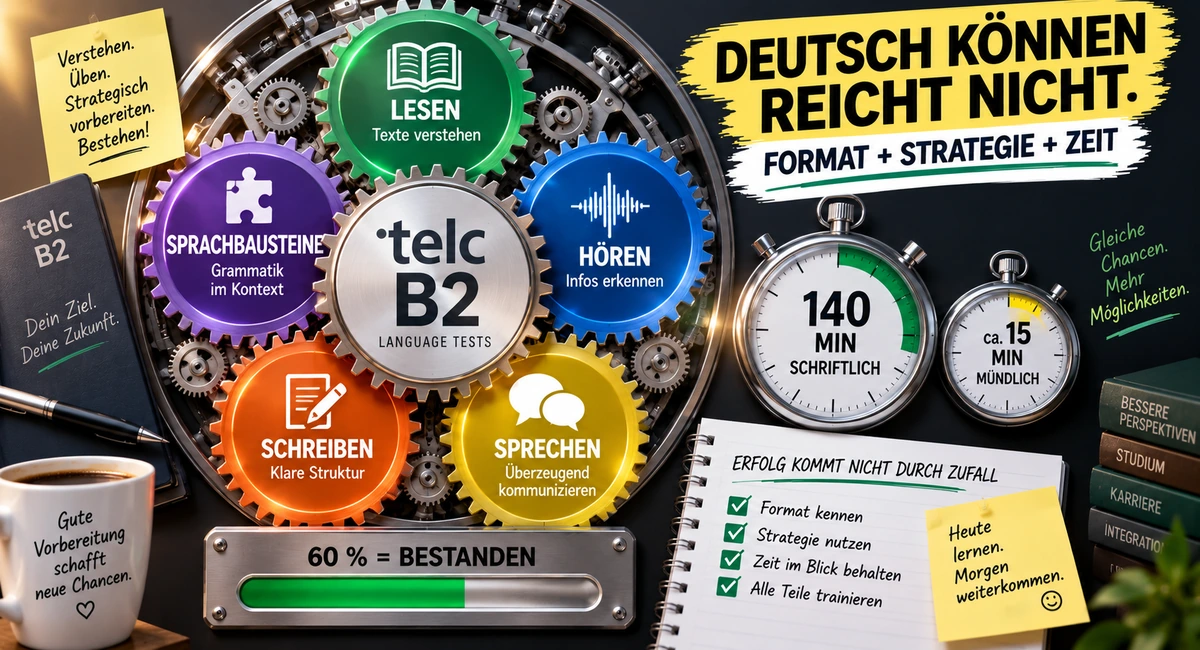
Short answer: no. At telc Deutsch B2 there is no separate pass threshold just for the Reading comprehension. The written exam is assessed as a block.
Many learners believe they have to reach 60 % in each subtest. That is not the case at telc Deutsch B2. The rule is simpler:
| Part of the exam | Max. points | Needed to pass |
|---|---|---|
| Written exam (Reading, Sprachbausteine, Listening, Writing) | 225 | 135 (60 %) |
| Oral exam (Speaking) | 75 | 45 (60 %) |
| Exam total | 300 | Both thresholds must be reached |
This has two important consequences for your preparation:
- Within the written exam, compensation is possible. You can balance out a weak Reading comprehension with Listening comprehension, Sprachbausteine and the letter. You do not have to be equally strong in every subtest.
- Between written and oral there is no compensation. 200 points in the written part do not help you if you stay below 45 points in the oral part. Both blocks are assessed separately.
If you have not passed one of the two parts of the exam, you usually do not have to repeat the whole exam. Which rules and deadlines apply here, you will find out at your exam centre.
How do you prepare for the Reading comprehension?
Short answer: first each part separately, then all parts under timed conditions. The reason is above: the three parts require three different reading techniques. Anyone who practises everything mixed together does not train any of them properly.
This order has proven itself:
- Select one part and practise it without time pressure. At the beginning it is only about understanding the pattern of the task — not about speed.
- Check every solution, including the correct ones. With a correct answer, check whether you chose it for the right reason. With a wrong answer, look for the place in the text that proves the correct solution.
- Only then bring in the clock. Orient yourself by the recommended times from section 3.
- Move on to the next part and repeat the same thing.
- At the end, practise everything in one go — all three parts, the Sprachbausteine and the transfer onto a sheet. That way you know before the exam how this block really feels.
A note for everyone who takes the digital variant of the exam: then practise on screen as well. Reading long texts on a monitor is a skill of its own, and your reading speed there is usually different from on paper.
👉 Train Part 1: matching headings👉 Train Part 2: multiple choice
👉 Train Part 3: matching advertisements
👉 Train the Sprachbausteine
👉 All exercises for the telc B2 exam
Organisational questions — which exam formats there are, what you are allowed to take into the exam room and how the exam day proceeds — you will find in the overview article on the telc B2 exam. You can download the official practice test with a complete set of tasks free of charge from the telc page on the Deutsch B2 exam.



There are no comments for this article. Leave your comment