





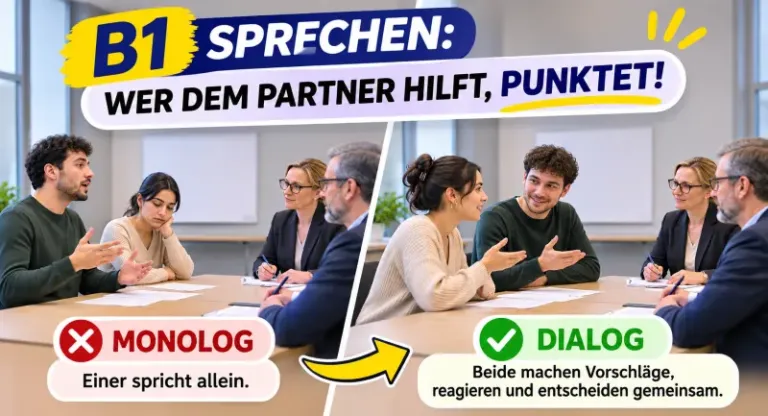
In the dialogue section of the B1 oral exam, each candidate receives an individual score – but the assessment criteria measure how well you work together. Learn how to help your partner without taking over the conversation and why doing so can actually help you earn more points.
Why does helping your partner pay off in the B1 dialogue?
In the dialogue section of the B1 oral exam, each person is assessed individually – but the criteria measure how you interact with your partner: making suggestions, responding to suggestions and keeping the conversation going. Helping your partner participate in the conversation does not take points away from them. Instead, it creates exactly the opportunities you need to demonstrate the skills being assessed.
telc states this very clearly in its official Practice Test 1 for telc Deutsch B1: Asking follow-up questions and helping each other are assessed positively. The B1 dialogue is therefore not a competition in which one person succeeds at the other's expense. As a rule, both candidates perform best when they work well together.
The information about assessment has been checked against the g.a.s.t. DTZ Practice Test 1 (June 2024), telc Deutsch B1 Practice Test 1 (13th edition, 2020) and the Goethe-Zertifikat B1 practice test for adults. The strategies and examples in this article are practical analysis, not official requirements.
Three reasons why helping your partner benefits you
- Your partner's score is not deducted from yours. In DTZ, telc and Goethe/ÖSD, two examiners assess each candidate individually. If your partner speaks better because you help them, you do not lose anything.
- You need something to respond to. You can only demonstrate your ability to respond to suggestions if your partner actually makes suggestions. A silent partner takes away the very opportunities you need to demonstrate this skill. By helping your partner, you create opportunities for yourself.
- Dominating the conversation does not give you extra speaking time. Examiners pay attention to a fair distribution of speaking time. In telc exams, the examiner intervenes if one candidate dominates too much and then addresses the person who has spoken less. If you talk without stopping, you lose control over how the conversation develops.
To find out which assessment criteria apply to DTZ, telc, Goethe and ÖSD and how many points the task is worth, read the article Gemeinsam etwas planen: Topics, Procedure and Points. Here, we focus on how you can use cooperation with your partner to improve your own performance.
Helping or taking over? The difference that determines your score
Technically, you could cover all the task points on your own: where to go, when to go, how to get there and who does what. You could say everything in 30 seconds. But from a strategic point of view, this is a missed opportunity. You have made suggestions, but you have not responded to anything, negotiated any decisions or had a real conversation. Yet that is exactly what the task is about.
Good partner support opens doors for the other person. Poor partner support takes away their opportunity to speak.
| ✅ Help that earns you points | ❌ Help that seems useful but harms your performance |
|---|---|
| Ask a question and wait for the answer | Ask a question and immediately answer it yourself |
| Offer two options to choose from | Make the decision alone and simply ask "Okay?" |
| Pick up on your partner's idea and develop it further | Continue working through your own list as if your partner had said nothing |
| Briefly suggest a missing word in the form of a question | Formulate entire sentences for your partner |
| If there is a misunderstanding, repeat your own sentence in simpler language | Correct your partner's grammar |
| Summarise the result you have reached together at the end | Constantly finish your partner's sentences |
Check each of your statements by asking yourself one question: Does this give my partner a reason to respond? If yes, you are helping. If not, you are delivering a monologue.
How can I get my partner involved in the conversation?
You can find useful expressions for making suggestions, giving reasons, agreeing and disagreeing in the article Gemeinsam etwas planen B1: Strategy, Useful Phrases and Example Dialogue. Here, we focus on just two techniques that specifically encourage your partner to participate – and give you something to respond to.
Either-or questions instead of open-ended questions
An open-ended question such as "Was meinst du?" requires your partner to find the right words independently. Under exam pressure, the answer is often just "Ja". An either-or question already provides the words needed for an answer: Your partner only has to choose and can begin with a single word. Their choice immediately gives you something meaningful to respond to.
- Fahren wir mit dem Bus oder mit dem Auto?
- Treffen wir uns lieber am Vormittag oder am Nachmittag?
- Sollen wir grillen oder ein Picknick machen?
- Was möchtest du übernehmen: das Einkaufen oder die Einladungen?
With confident partners, you will need either-or questions less often. With an uncertain partner, they are the most important tool in the entire dialogue.
Make sure you understand each other instead of correcting mistakes
If you do not understand your partner, or your partner does not understand you, ask for clarification or rephrase what you said. In telc exams, such strategies are explicitly part of successful task completion. Correcting your partner's grammar, on the other hand, does not benefit you and may make your partner feel less confident.
- Habe ich dich richtig verstanden: Du meinst, dass … ?
- Ich sage es noch einmal anders: …
- Meinst du vielleicht … ? (if your partner cannot remember a word)
If you are the second person to speak, start by responding to your partner's suggestion. Then use an either-or question to give the floor back to them. This creates a natural exchange from the beginning instead of two separate monologues.
Planning a trip at B1: The same dialogue, solo versus teamwork
Task: Your team at work would like to go on a trip together at the weekend. The two of you are organising it. Plan together: Where to go? How to get there? Food? Who does what?
Version A: One person does everything alone
- A: Ich denke, wir fahren in den Zoo. Wir nehmen den Bus, jeder bringt etwas zu essen mit, und ich schreibe allen Kollegen eine E-Mail.
- B: Ja, gut.
- A: Und am Ende machen wir ein Gruppenfoto.
- B: Ja.
All the task points have been covered – in about 20 seconds. A has made suggestions but has not responded to anything or negotiated any decisions. B has barely participated in the conversation. The conversation comes to a standstill, and the examiners have to intervene. Both candidates miss opportunities: B because they hardly speak, and A because they have had no opportunity to demonstrate their ability to respond.
Version B: Both partners work together
- A: Lass uns zuerst klären, wohin wir fahren. Ich schlage den Zoo vor, da ist für alle etwas dabei. Was meinst du?
- B: Der Zoo ist schön. Aber der Eintritt ist ziemlich teuer, glaube ich.
- A: Stimmt, daran habe ich nicht gedacht. Wie wäre es dann mit einem Ausflug an den See? Das kostet fast nichts.
- B: Ja, der See ist gut. Wir können dort grillen.
- A: Gute Idee! Und wie kommen wir hin: mit dem Bus oder mit Fahrgemeinschaften?
- B: Mit dem Bus. Nicht alle haben ein Auto.
- A: Einverstanden. Was möchtest du übernehmen: die Busverbindung heraussuchen oder die Kollegen informieren?
- B: Ich schreibe allen eine E-Mail. Und wer kauft das Essen zum Grillen?
- A: Das mache ich. Also: Wir fahren mit dem Bus an den See und grillen dort. Du informierst die Kollegen, ich kaufe ein und suche die Busverbindung heraus. Haben wir etwas vergessen?
What the examiners hear in Version B
- A changes their original suggestion after B raises an objection – from the zoo to the lake. This is a genuine response, not just agreement.
- The either-or questions make it easier for B to join the conversation. Later, B asks a question independently: The conversation becomes a genuine exchange.
- The responsibilities have been divided, and the summary shows a clear result that both partners have agreed on.
- A has demonstrated more skills in Version B than in Version A, not fewer: making suggestions, responding, managing the conversation and bringing it to a conclusion.
What should you do if your partner …?
You cannot choose your exam partner. However, you can prepare an appropriate response for common situations.
| Situation | Best response | Useful phrases |
|---|---|---|
| … talks too much | Wait for a pause, politely refer to something they have said and introduce your own idea | Darf ich dazu kurz etwas sagen? Ich finde … |
| … has misunderstood the task | Summarise the situation in one simple sentence without correcting your partner | Also, wir sollen zusammen … planen. Was ist für dich am wichtigsten? |
| … goes off topic | Briefly acknowledge what they said, then guide the conversation back to the next task point | Das ist interessant. Aber wir müssen noch klären, wie wir hinkommen. |
| … disagrees with everything | Take their objection seriously and suggest a compromise | Ich verstehe dein Argument. Wie wäre es, wenn wir beides kombinieren? |
| … makes mistakes | Do not correct them. Respond to what they mean and ask for clarification if something is unclear | Meinst du, dass wir … ? |
If your partner hardly speaks, you can find step-by-step guidance in the article How to Pass the A2–B1 DTZ Dialogue with a Weaker Partner.
You do not have to compensate for your partner's weaknesses entirely on your own. Examiners provide prompts when the conversation stalls. Your task is to perform your own part well – while giving your partner opportunities to speak.
Does this also apply to the B2 oral exam?
Yes. The same principle applies to the B2 oral exam, but the requirements are higher. In telc Deutsch B2, Part 2 (Discussion) and Part 3 (Gemeinsam etwas planen) are also speaking tasks completed with a partner. During the discussion, you are allowed and expected to express your own position. Cooperation does not mean that you have to agree. It means responding to the other person's arguments instead of simply listing your own.
The difference compared with B1: At B2 level, simply asking your partner questions is no longer enough. You should be able to pick up on their arguments, weigh them up and agree or disagree with well-founded reasons.
👉 telc B2 Speaking: Exercises for discussion and planning togetherPractising B1 dialogues with a partner
You can only learn to cooperate in a dialogue by practising with someone who does not know what you are going to say. Only then do you really have to respond spontaneously. At Vorbereitung mit BO, you can practise B1 dialogues with a real speaking partner and with the AI assistant. After registering, you can try all features free of charge for 24 hours.
👉 Practise dialogues with a real speaking partner


There are no comments for this article. Leave your comment