





B2 Beruf Reading and Writing:
Responding to a complaint
What is this task, how is it assessed and how do you write a perfect reply letter to a customer complaint – with a universal template and concrete set phrases.
What is DTB B2 Reading and Writing?
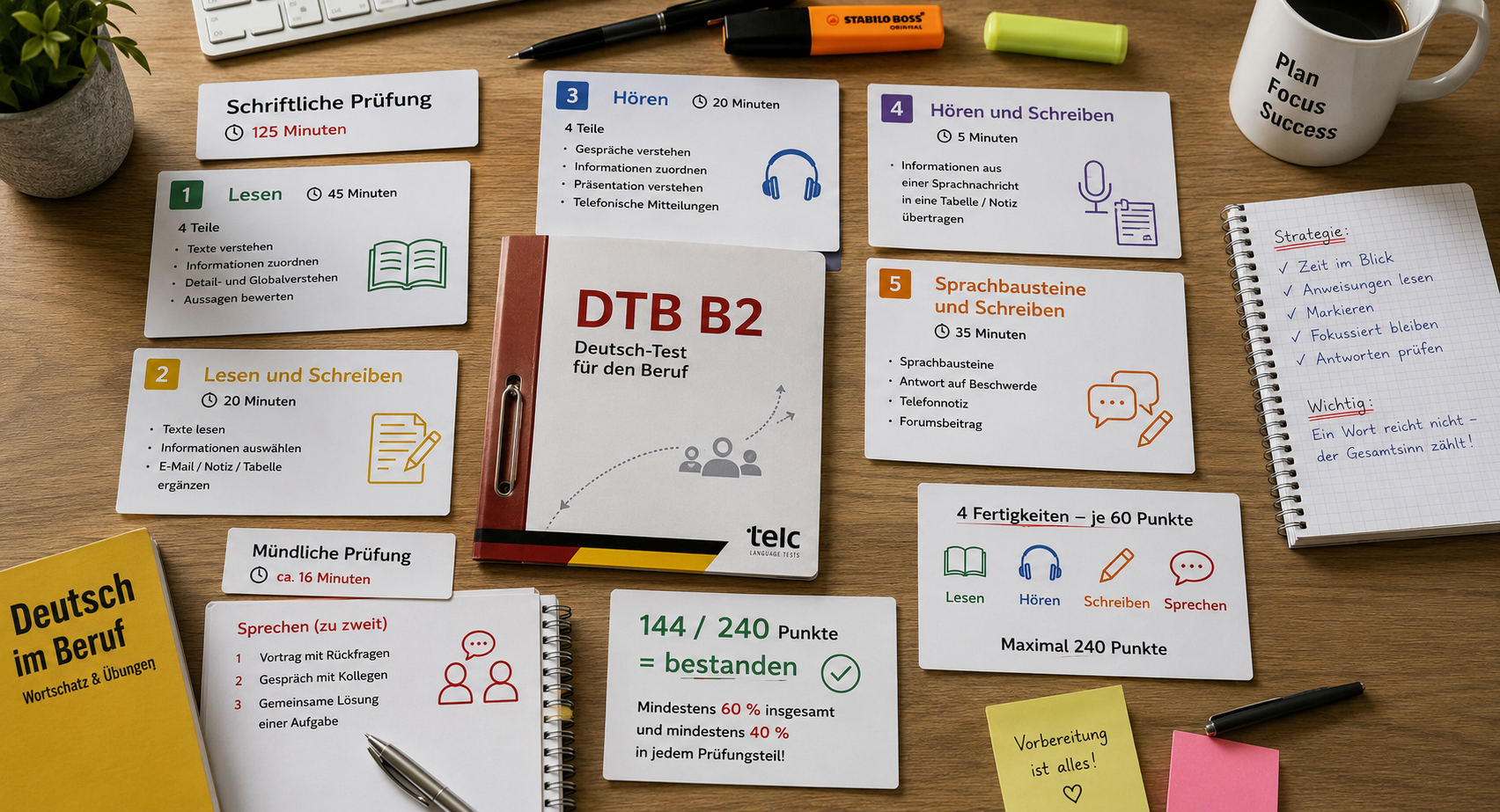
The Deutscher Test für den Beruf B2 (DTB B2) tests professional language competence at a high level. In the subtest Reading and Writing there are several tasks that require a particular skill: professional mediation.
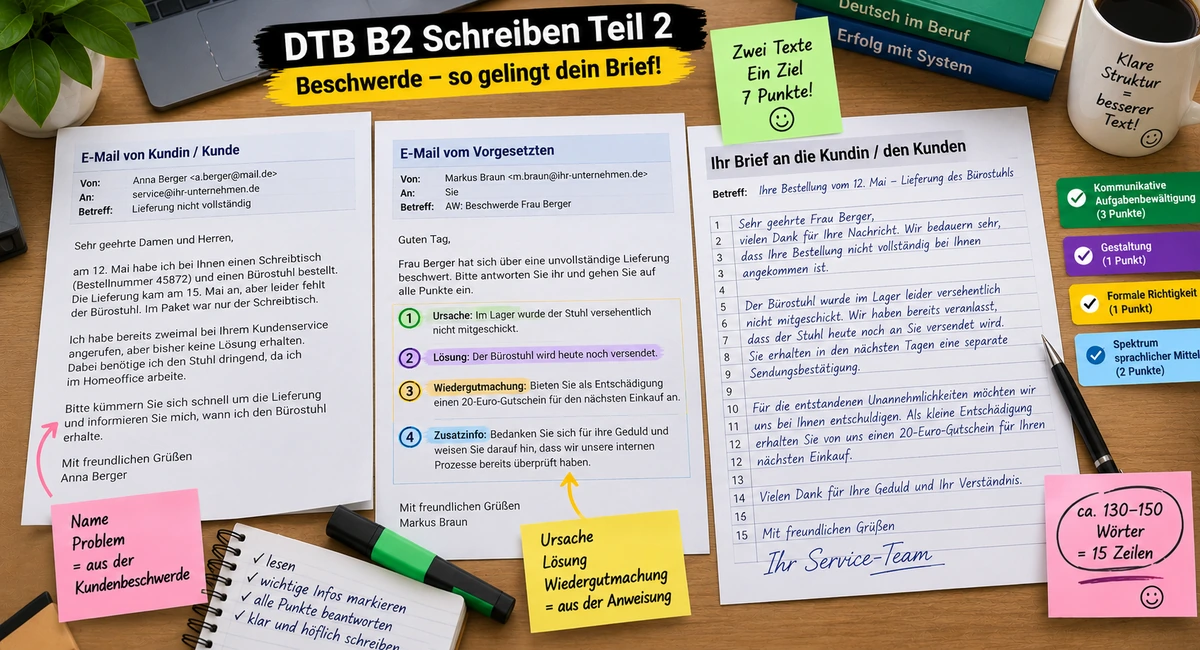
You receive two texts: a customer complaint and an internal email from your supervisor with specific instructions. Your task is to write a formal reply email to the customer in which you implement all the points from the supervisor's instructions.
This is not a creative essay or a free expression of opinion. It is a matter of professional action competence: factual, polite, solution-oriented – exactly as expected in everyday working life.
The most common mistake: candidates read only the customer complaint and ignore the supervisor's instructions. This immediately leads to a deduction of points for the most important criterion – communicative task fulfilment.
What does the customer complaint contain?
The customer describes a concrete problem: a delayed delivery, defective goods, poor service or similar. They expect a solution and frequently compensation as well. Important: from the complaint you take only the customer's name and the description of the problem – nothing more.
What does the supervisor's instructions contain?
The supervisor forwards the complaint to you and gives you precise instructions: apologise, explain the cause, offer a concrete solution, inform the customer of the discount, etc. All of these points must be included in your letter.
👉 Exercises for preparation for DTB B2 Reading and WritingOfficial assessment criteria – 7 points in detail
The reply letter is assessed according to four official criteria. The maximum score is 7 points. The minimum score to pass is 5 out of 7 points.
| Criterion | Max. points | What is assessed? |
|---|---|---|
| I. Communicative task fulfilment | 3 | All supervisor's instructions fully implemented? Formal tone? Salutation and closing formula present? |
| II. Communicative design | 1 | Logical structure, smooth transitions, text readable as a coherent whole? |
| III. Formal correctness | 1 | Grammar, spelling and punctuation largely correct? |
| IV. Range of linguistic means | 2 | B2 vocabulary distributed evenly throughout the entire text? |
The calculation is simple: 3 + 1 + 1 + 2 = 7 points. This total is always fixed – never 6, never 8.
Criterion I is the most important
With 3 out of 7 possible points, communicative task fulfilment is the decisive criterion. This is where most candidates lose the most points – because they do not implement all of the supervisor's instructions or use the wrong tone.
Assessment scale for Criterion I:
- B2 (3 points): All instructions fully and appropriately implemented, correct degree of formality, salutation and closing present.
- B1 (2 points): Instructions mostly implemented, minor shortcomings in scope or tone.
- A2 (1 point): Instructions only partially implemented or tone not consistently appropriate.
- A1 (0 points): Task barely fulfilled, essential instructions missing.
Criterion IV: the even distribution rule
B2-typical expressions must be distributed evenly throughout the entire text – not only in the middle section. If only one paragraph contains B2 features, a maximum of 1 point can be awarded.
The universal template: beginning, middle, end
The greatest advantage when writing a complaint reply letter is: you do not have to start from scratch every time. A well-developed template contains fixed parts that you always reuse, and only 4 variable slots that you take from the task texts.
Learn a template by heart. On the exam sheet you only fill in 4 slots: the addressee's name, what went wrong, the cause and measures, the remedy.
🔸 BEGINNING – fixed, always the same
The subject line and the opening are always identical. You only change the addressee's name and the problem in one sentence:
Subject: Your complaint – our response


Dear Ms/Mr [NAME FROM THE COMPLAINT],


on behalf of the company I apologise for this

inconvenience. We very much regret that

[WHAT WENT WRONG – 1 sentence from the complaint].
🔸 MIDDLE – according to the supervisor's instructions
The middle consists of two paragraphs. Paragraph 2 explains the cause and contains a reassurance. Paragraph 3 contains the concrete solution and an additional note:
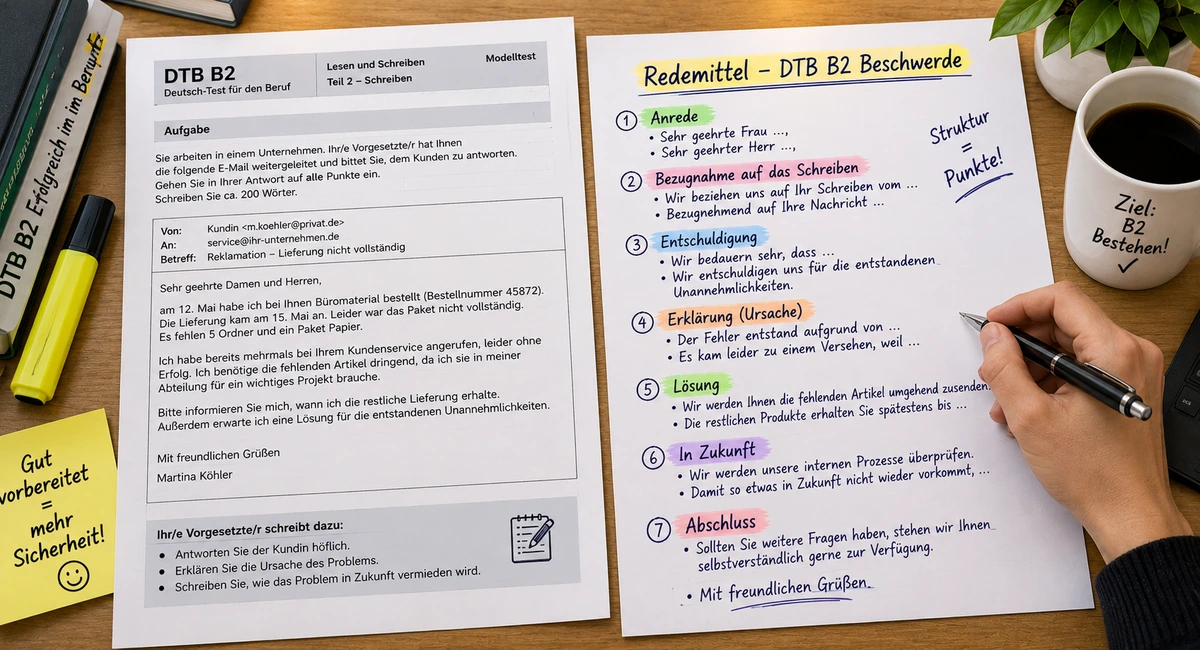
Nach eingehender Prüfung des Sachverhalts möchten wir Ihnen

mitteilen, dass [CAUSE – from supervisor's instructions].

Wir bitten um Ihr Verständnis und versichern Ihnen,

dass [MEASURE].


Im Rahmen einer Kulanzregelung bieten wir Ihnen an,

[CONCRETE MEASURE – from supervisor's instructions].

Hinsichtlich [DETAIL] möchten wir darauf hinweisen,

dass [INFORMATION – from supervisor's instructions].
🔸 END – fixed, always the same
The closing is always identical – it must be learnt by heart:
Für weitere Rückfragen stehen wir Ihnen jederzeit gern zur

Verfügung und freuen uns auf eine weiterhin erfolgreiche

Zusammenarbeit.


Mit freundlichen Grüßen

[Your name]

[Position]
The 4 variable slots at a glance
| Variable slot | Where do you take it from? |
|---|---|
| Addressee's name | From the customer complaint |
| What went wrong | From the customer complaint |
| Cause + measures | From the supervisor's instructions |
| Remedy | From the supervisor's instructions |
15 lines – why less is more
The exam sheet for the reply letter has exactly 15 lines. This corresponds to approximately 150 words. Many candidates write too much – and this harms them in several ways.
- A text that is too long physically does not fit on the sheet – the remainder is not assessed.
- Long sentences increase the risk of grammatical errors.
- Repetitions and filler words lower the linguistic level, not the other way around.
- A precise, structured letter demonstrates higher competence than a long, unclear one.
Write no more than 150 words. Always count your text when practising. A letter of 130–145 words that fulfils all criteria receives 7 out of 7 points.
The universal template is constructed in such a way that it fits exactly into 15 lines – with the 4 variable slots filled in. This is not coincidental, but the result of many test runs.
Set phrases: mandatory expressions and additional phrases
On the internet you will find hundreds of different set phrases for German business letters. This is initially helpful – but becomes a problem on the day of the exam. If you know too many different phrases, uncertainty and loss of time arise: which one do I use now? Does this fit here? Have I already used this?
Choose your set phrases, train them until they become automatic and always use the same ones on the day of the exam. This way there is no confusion, and your letter appears coherent and professional.
Mandatory features – these 6 phrases must appear in every letter
These expressions are a fixed component of the universal template. They ensure that B2 vocabulary is distributed evenly across all paragraphs:
- Nach eingehender Prüfung des Sachverhalts – after careful examination of the situation
- möchten wir Ihnen mitteilen, dass – we would like to inform you that
- Wir bitten um Ihr Verständnis – we ask for your understanding
- Im Rahmen einer Kulanzregelung – as a goodwill gesture on our part
- Hinsichtlich … möchten wir darauf hinweisen, dass – regarding … we would like to point out that
- freuen uns auf eine weiterhin erfolgreiche Zusammenarbeit – we look forward to our continued successful collaboration
Additional expressions – use at least 2
These phrases raise the linguistic level of your letter and help to fulfil Criterion IV with confidence:
- zurückzuführen ist / sind – is / are the result of
- versichern Ihnen – we assure you
- umgehend – immediately, without delay
- fachgerecht – professionally, properly
- Preisnachlass gewähren – to grant a discount
- Maßnahmen einleiten – to initiate measures
- sorgfältig prüfen – to examine thoroughly
- Kontrollmaßnahmen einleiten – to introduce control measures
- zeitnah – promptly, soon
- verbindlich – bindingly confirmed, guaranteed
Important: there are no mandatory phrases in the literal sense. Every formal, professionally typical B2 formulation counts – regardless of whether it appears on this list. What is assessed is the linguistic level, not the exact phrase.
Checklist before submission
Before you hand in the exam sheet, go through these points. A letter that fulfils all criteria receives 7 out of 7 points – regardless of the topic.
- ☑ Is the subject line present? (Your complaint – our response)
- ☑ Is the salutation with the correct name of the customer present?
- ☑ Are all points from the supervisor's instructions implemented?
- ☑ Is a concrete solution mentioned – no general platitudes?
- ☑ Are the 6 mandatory features distributed evenly throughout the text?
- ☑ Is the closing formula with name and position present?
- ☑ Is it no more than 150 words?
- ☑ Are all sentences complete – no subordinate clause without a main clause?
A letter that fulfils this checklist 100 % will in all likelihood receive 7 out of 7 points.
Advantages of training with the AI examiner
Many candidates write practice letters at home – but without feedback they do not know whether their letter is good or not. This is exactly where the AI examiner on deutsch-vorbereitung.com comes in:
- Instant feedback: you see immediately how many points your letter receives according to all 4 criteria – without having to wait for a teacher.
- Objective assessment: the system tests exactly what a real DTB B2 examiner assesses: task fulfilment, design, correctness and range.
- Concrete suggestions for improvement: the AI examiner not only explains the score, but shows precisely what is missing and how you can improve it.
- Unlimited practice: you can write one and the same task multiple times, improve the letter and see the progress immediately.
- Training without stress: you learn from mistakes in a calm environment – not only in the real exam room.
- Confidence on the day of the exam: if you have written 20–30 letters and received 7/7 each time, you enter the exam room with the finished template in your head – and without panic.




There are no comments for this article. Leave your comment