





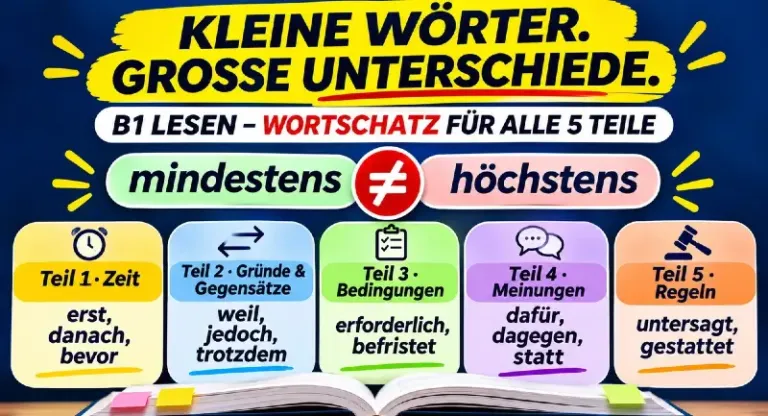
Which words you need to know confidently in B1 reading comprehension to find the correct answer – for every part of the exam, with examples from the official model test.
Short Answer: Which Words Do You Need for ÖSD B1 Reading?
For B1 reading comprehension in the ÖSD Zertifikat B1 exam, you need two types of vocabulary. First, general B1 vocabulary: words related to topics such as work, housing and leisure. Second, signal words. These are small words such as erst (not until), kaum (hardly), jedoch (however), statt (instead of) or untersagt (prohibited). They indicate whether an answer is correct or incorrect. Often, the mistake lies in one of these small words.
Each part of the exam has its own signal words:
- Part 1 (blog): words for time and sequence
- Part 2 (newspaper articles): words for reasons, contrasts and numbers
- Part 3 (advertisements): words for conditions – level, time and price
- Part 4 (opinions): words for expressing support and opposition
- Part 5 (rules and regulations): words for prohibitions, permissions and obligations
Here you will find a vocabulary list for each part. For every word, you will learn what kind of trap it can create in an exam task.
Last updated: 25 November 2026. The information about the exam sections and the examples come from the official ÖSD B1 Model Test and the ÖSD Zertifikat B1 Practice Materials (4th edition, 2026). The exam corresponds to level B1 of the Common European Framework of Reference for Languages (CEFR).
Words That Are Important in Every Part
Some words change the meaning of an entire sentence. “Er hat den Zug verpasst” (He missed the train) and “Er hat den Zug fast verpasst” (He almost missed the train) have opposite meanings. You should always highlight these words when reading.
| Word | Meaning | Example / Trap |
|---|---|---|
| fast / beinahe | almost / nearly, but not quite | “Sie hat den Termin fast vergessen” (She almost forgot the appointment) = She did not forget it. |
| kaum | hardly / almost not | “Kaum jemand kam” (Hardly anyone came) = Very few people came. |
| nicht mehr | no longer – previously yes, now no | “Er arbeitet nicht mehr dort.” (He no longer works there.) |
| noch nicht | not yet – not up to now | “Er arbeitet noch nicht dort.” (He does not work there yet.) – Perhaps later. |
| weder … noch | neither one nor the other | “weder Auto noch Fahrrad” (neither a car nor a bicycle) = No car and no bicycle. |
| nicht …, sondern … | not A, but B | The correct information comes after “sondern” (but rather). |
| nicht nur …, sondern auch … | not only A, but also B | An answer containing “nur A” (only A) is incorrect. |
| nur / lediglich / ausschließlich | only / merely / exclusively – nothing else | If the word is missing from the answer, the meaning may be different. |
| mindestens ↔ höchstens | at least ↔ at most | “mindestens 2 Stunden” (at least 2 hours) is the opposite of “höchstens 2 Stunden” (at most 2 hours). |
| gar nicht / überhaupt nicht / keineswegs | not at all / absolutely not / by no means | A strong “no” – often found in the middle of a sentence. |
Read every answer carefully, paying attention to all the small words. Ask yourself: Does the text contain “fast” (almost), “nicht” (not) or “nur” (only), but the answer does not? Or is it the other way around?
B1 Reading Part 1: Words for Time, Knowledge and Plans
In Part 1, a person describes their experiences in a blog. You decide whether six statements are true or false. The tasks often ask: When did something happen? Did the person know something or did they only think it? Did someone actually do something or did they only want to do it? Good to know: In Part 1, the tasks follow the same order as the information in the text.
Time and Sequence
- zuerst / zunächst (first / initially) = at the beginning; dann / danach / anschließend (then / afterwards / subsequently) = later
- erst (not until) = no earlier than a particular time. “Erst am Abend hat sie es gemerkt” (She did not notice it until the evening) = She did not notice anything before then.
- inzwischen (meanwhile / by now) = during the time in between / up to now
- nachdem (after) = first A, then B; bevor (before) = first B, then A
- als (when) = a single event in the past; wenn (when / whenever) = something that happens repeatedly
- sofort / sobald (immediately / as soon as) = without delay; plötzlich (suddenly) = very quickly and unexpectedly; schließlich (finally) = at the end
Knowing or Just Thinking?
- glauben / denken / vermuten (believe / think / assume) = The person is not certain.
- wissen / sicher sein / feststellen (know / be certain / establish) = The person is certain.
- merken / bemerken (notice / realise) = to see or understand something; vermissen (miss) = to notice that something is missing
- erfahren (find out / learn) = to receive information
Intention or Action?
- wollte / hatte vor / plante (wanted to / intended to / planned to) = an intention. We do not know whether it actually happened.
- versuchte (tried / attempted) = He tried to do it – possibly without success.
- schaffte es / es klappte / es gelang ihm (managed to do it / it worked / he succeeded) = It actually happened.
- stattdessen (instead) = He did something different.
In the blog, a young man finds Susanne's wallet. He wollte sie nicht (did not want to) take it to the lost property office. Stattdessen (instead), he used the bank card to find the bank. Statement 3 says: “Der Finder hatte die Brieftasche ins Fundbüro gebracht.” (The person who found the wallet had taken it to the lost property office.) The word “Fundbüro” (lost property office) appears in the text. However, it appears together with “wollte nicht” (did not want to) and “stattdessen” (instead). The statement is therefore false.
B1 Reading Part 2: Words for Reasons, Contrasts and Numbers
In Part 2, you read two newspaper articles. Each text has three questions with answer options a, b and c. The questions often ask: Why did something happen? What is the goal? What is the consequence? How many? You can find the answer with the help of linking words (connectors). Be careful: In Part 2, the order of the questions may differ from the order of the information in the text.
| Question | Words That Indicate the Answer |
|---|---|
| Why? (Reason) | weil (because), da (since), denn (because), wegen (because of), aufgrund (due to), dank (thanks to) |
| What happens as a result? (Consequence) | deshalb, daher, deswegen, darum (therefore / for this reason), sodass (so that); führen zu (lead to), sorgen für (bring about / ensure) |
| What is different? (Contrast) | aber (but), jedoch (however), allerdings (however / though), trotzdem (nevertheless), dennoch (nonetheless), obwohl (although), trotz (despite), im Gegensatz zu (in contrast to) |
| For what purpose? (Goal) | um … zu (in order to), damit (so that), das Ziel ist (the goal is), planen (plan), vorhaben (intend) |
| How many? (Approximate Number) | rund, etwa, ungefähr, ca. (around / approximately); knapp 100 = just under 100; gut 100 = just over 100 |
| More or less? | steigen (rise), zunehmen (increase), sich verdoppeln (double) ↔ sinken (fall), abnehmen (decrease), zurückgehen (decline) |
| Who says that? | laut, nach Angaben von (according to); soll (is said to): “Das Dorf soll 100 Jahre alt sein” (The village is said to be 100 years old) = People say this, but it is not certain. |
Does the question ask for a reason? Then look for weil (because), da (since), wegen (because of) or deshalb (therefore) in the text. Does the text contain aber (but), jedoch (however) or allerdings (however / though)? The important information usually comes after these words.
B1 Reading Part 3: Words Used in Advertisements
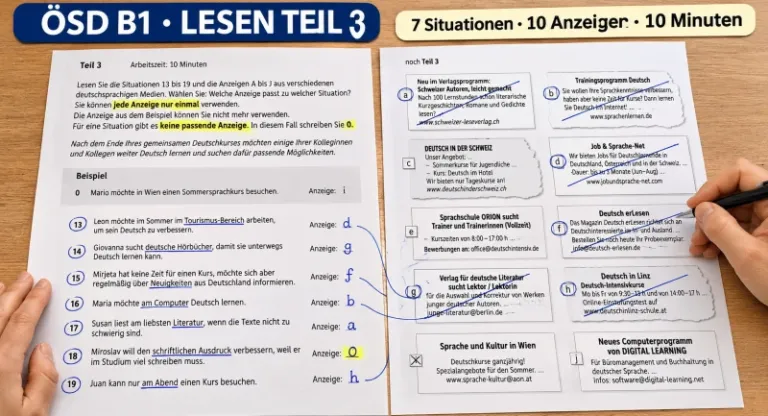
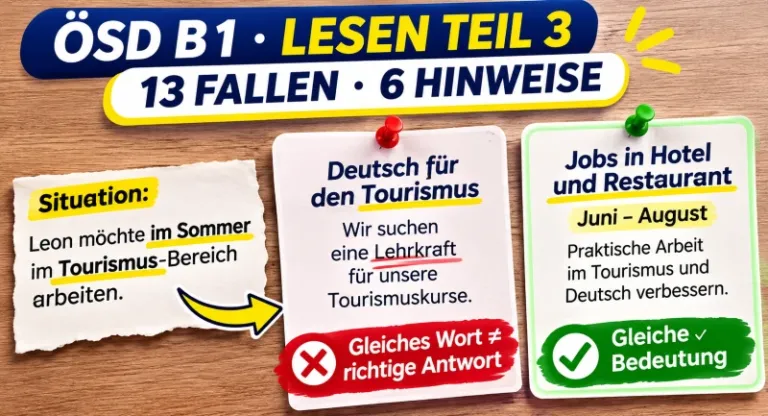
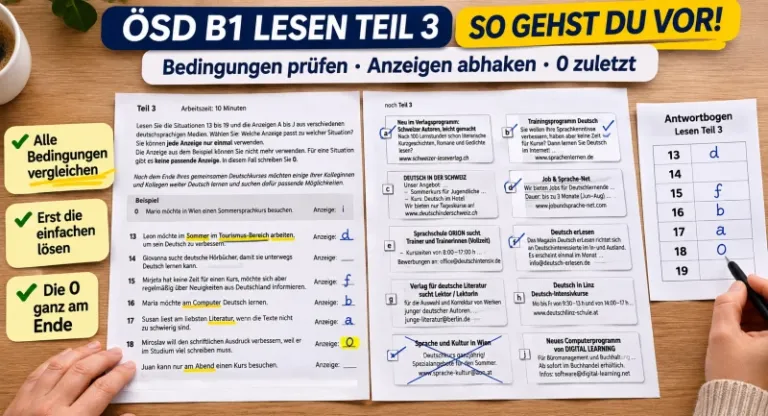
In Part 3, you read seven situations and ten advertisements. You look for the appropriate advertisement for each person. Each advertisement can only be used once. If no advertisement is suitable, write 0. An advertisement is suitable only if everything matches: the level, time, location and price. ÖSD itself advises you not to choose an advertisement simply because a few words are the same.
| What Should You Check? | Words Used in Advertisements |
|---|---|
| Level | für Anfänger (for beginners), für Fortgeschrittene (for advanced learners), Vorkenntnisse nötig / keine Vorkenntnisse nötig (prior knowledge required / no prior knowledge required), Einstufungstest (placement test) |
| Time | Abendkurs (evening course), Wochenendkurs (weekend course), Intensivkurs (intensive course), ab sofort (starting immediately), Beginn jederzeit möglich (you can start at any time), Mo–Fr (Montag bis Freitag – Monday to Friday), tägl. (täglich – daily) |
| Type | Präsenzkurs (in-person course, on-site), Online-Kurs (online course), Fernkurs (distance learning course), Kleingruppe (small group), Einzelunterricht (individual lessons) |
| Employment | Vollzeit (full-time), Teilzeit (part-time), geringfügig (in Austria: marginal employment, a small side job), befristet (fixed-term, only for a specified period) ↔ unbefristet (permanent / without a fixed end date), flexible Arbeitszeiten (flexible working hours), Berufserfahrung erwünscht (professional experience preferred) |
| Condition | Voraussetzung ist … (a prerequisite is …), erforderlich (required), ab 18 Jahren (aged 18 and over), Führerschein B (category B driving licence) |
| Price | ermäßigt (discounted / cheaper), Ermäßigung für Studierende (student discount), inkl. (inklusive = including), zzgl. (zuzüglich = plus / in addition to) |
Underline the conditions in each situation, for example, “nur am Wochenende” (only at weekends) or “ohne Vorkenntnisse” (without prior knowledge). Then check every condition against the advertisement. If one condition is not met, the advertisement is not suitable. Tick off the advertisements you have already used.
B1 Reading Part 4: Words for Expressing Support and Opposition
In Part 4, you read seven short opinions on a question, for example: “Ist die Person für ein Verbot?” (Is the person in favour of a ban?) You answer Yes or No. Words that express an opinion are important, as are words that reverse an opinion.
| In Favour (Yes) | Against (No) |
|---|---|
| dafür sein (be in favour of), unterstützen (support), gut finden (approve of) | dagegen sein (be against), ablehnen (reject), kritisieren (criticise) |
| sinnvoll (sensible / worthwhile), notwendig (necessary), richtig (right) | übertrieben (excessive), sinnlos (pointless), bringt nichts (does not help), geht zu weit (goes too far) |
| Es ist höchste Zeit, dass … (It is high time that …) / endlich (finally / at last) | Ich halte nichts davon. (I do not think much of it.) |
| Ich bin für … (I am in favour of …) | statt / anstatt … (instead of …), lieber … (would rather …), das Gegenteil erreichen (achieve the opposite result) |
Words That Hide the Actual Opinion
- zwar …, aber … (admittedly …, but …) – The actual opinion comes after “aber” (but).
- einerseits … andererseits … (on the one hand … on the other hand …) – Read to the end: Which side ultimately prevails?
- wäre, würde, hätte, sollte (would be, would, would have, should) – The person describes what would happen. “Ein Verbot würde nichts bringen” (A ban would not achieve anything) = against.
- statt / anstatt (instead of) – The person wants a different solution. Therefore, they do not approve of the first solution.
The model test discusses a ban on “Killerspielen” (violent video games). Stefan believes that a ban would have the gegenteilige Wirkung (opposite effect), because banned games become even more interesting. He is against a ban. Marius wants the minimum age requirement of 18 to be strictly enforced statt (instead of) introducing a ban. He wants strict rules, but not a ban – so the answer is also No. The word “Verbot” (ban) appears in both opinions. However, the actual opinions are indicated by “gegenteilige Wirkung” (opposite effect) and “statt” (instead of).
B1 Reading Part 5: Words Used in Rules and Regulations
In Part 5, you read rules, such as the regulations of a building or institution. In the model test, these are the rules and regulations of a vocational school. The four questions ask specifically: What is prohibited? What is permitted? What must you do? What is merely a request? The text uses difficult vocabulary similar to the language used by public authorities. The answer options use simple words. You therefore need to know which simple word corresponds to which difficult word. ÖSD warns that identical words in the text and the answer do not always mean that the answer is correct.
| Simple Word | Words Used in Rules and Regulations |
|---|---|
| verboten (prohibited) | untersagt (prohibited), nicht gestattet (not permitted), nicht erlaubt (not allowed), unzulässig (impermissible), ist zu unterlassen (must be refrained from), ist ausgeschlossen (is ruled out), kein Zutritt (no entry), Unbefugten ist der Zutritt untersagt (unauthorised persons are prohibited from entering) |
| erlaubt (allowed) | gestattet (permitted), zulässig (permissible), zugelassen (authorised), freigegeben (approved for use), berechtigt sein (be entitled to); genehmigen = gestatten = erlauben (approve = permit = allow); mit Genehmigung (with permission), nach Absprache (by prior arrangement) |
| muss (must) | verpflichtet sein (be obliged to), verbindlich (binding), erforderlich (required), notwendig (necessary), vorgeschrieben (mandatory / prescribed), Voraussetzung ist … (a prerequisite is …); ist zu + infinitive: “Der Schlüssel ist abzugeben” (The key must be handed in) = You must hand in the key. |
| Request or Advice (Not Mandatory) | es empfiehlt sich (it is advisable), es wird empfohlen (it is recommended), wir bitten darum (we kindly request), sollte (should) |
| Ausnahme (exception) | in Ausnahmefällen (in exceptional cases), ausnahmsweise (as an exception), mit Ausnahme von (with the exception of), ausgenommen (excluding), außer (except); grundsätzlich = generally / as a rule (exceptions are possible!) |
| wenn (if) | sofern (provided that), falls (if / in case), es sei denn (= unless) |
| kostenlos (free of charge) | gratis (free), unentgeltlich (free of charge), gebührenfrei (without fees), im Preis enthalten (included in the price) |
| kostet Geld (costs money) | kostenpflichtig (subject to a charge), gegen Gebühr (for a fee), eine Gebühr wird erhoben (a fee is charged), der Beitrag (contribution / membership fee), die Kaution (security deposit), das Pfand (refundable deposit), die Mahngebühr (late payment fee – money charged for being late), einmalig (one-off), monatlich (monthly) |
| bezahlen für einen Schaden (pay for damage) | ersetzen (compensate / replace), (zurück)erstatten (reimburse / refund), für den Schaden aufkommen (cover the cost of the damage) |
| nicht verantwortlich (not responsible) | keine Haftung übernehmen (accept no liability), nicht haften (not be liable), auf eigene Gefahr (at your own risk) |
| geben, anbieten (give, offer) | zur Verfügung stellen (make available), bereitstellen (provide), ist vorhanden (is available), ausleihen (lend / borrow) |
| sagen, abgeben (tell, hand in) | melden (report), mitteilen (inform / communicate), Bescheid geben (notify), abgeben (hand in), vorlegen (submit / present), vorzeigen (show) |
People and Places
The text uses different words for people than those used in the questions. Lernende (learners) or Kursteilnehmende (course participants) become Schüler (students) or Kursbesucher (course attendees) in the answer. Mitarbeitende (employees) becomes “im Zentrum arbeiten” (work at the centre). Those in charge are referred to as Leitung (management), Schulleitung (school management) or Direktion (administration). Unbefugte (unauthorised persons) are people without permission. When referring to places, Gelände (grounds) means the entire property, while im Freien means outdoors. A Spind is a locker that can be locked.
Two Words That Can Create Traps
- auf etwas achten = pay attention to something / make sure of something. “Es ist auf Ordnung zu achten” means that everything should be kept tidy. It does not mean “Sie müssen selbst aufräumen” (You must tidy up yourself).
- einschließlich = including, together with ↔ ausschließlich = exclusively, only. The words look almost identical, but they have opposite meanings.
Alcohol is prohibited under the school regulations. However, in Ausnahmefällen (in exceptional cases), the school management may permit it. The correct answer is: “kann von der Schulleitung genehmigt werden” (may be authorised by the school management). The incorrect answer is: “ist ohne Ausnahme verboten” (is prohibited without exception). It contains two words from the text – but the meaning is reversed.
Words from Austria and Switzerland
According to the task instructions, the advertisements in Part 3 come “aus verschiedenen deutschsprachigen Medien” (from various German-language media sources). Other texts may also come from Austria or Switzerland. In Part 2 of the model test, one of the texts discusses a “Velo-Rundfahrt” (cycling tour). Velo is the Swiss word for bicycle. You should know the following words:
| Austria / Switzerland | Germany |
|---|---|
| der Jänner (AT) | der Januar (January) |
| heuer (AT) | dieses Jahr (this year) |
| die Matura (AT, CH) | das Abitur (school-leaving qualification for university entrance) |
| das Spital (AT, CH) | das Krankenhaus (hospital) |
| benützen (AT) | benutzen (to use) |
| die Kassa (AT) | die Kasse (checkout / cash register) |
| die Stiege (AT) | die Treppe (stairs / staircase) |
| das Sackerl (AT) | die Tüte (bag) |
| das Velo (CH) | das Fahrrad (bicycle) |
| das Billett (CH) | die Fahrkarte (travel ticket) |
| parkieren (CH) | parken (to park) |
Improve Your Reading Comprehension: How to Learn These Words
The best way to learn signal words is not in alphabetical order, but according to how they appear in the exam. Here is how to do it:
- Learn words in pairs. erlaubt ↔ verboten (allowed ↔ prohibited), mindestens ↔ höchstens (at least ↔ at most), nachdem ↔ bevor (after ↔ before). Pairs are easier to remember. During the exam, you will immediately notice when an answer expresses the opposite meaning.
- Create a separate list for each part. This way, you will know which words to look for in each part of the exam.
- Create two columns after every exercise. Write the word from the text on the left and the corresponding word from the correct answer on the right. For example: untersagt → darf nicht (prohibited → must not), Velo → Fahrrad (bicycle). This is how you create your own vocabulary list for the exam.
- Highlight words while reading. During the exam, you are allowed to write on the task sheets. Circle words such as erst (not until), statt (instead of) or ausnahmsweise (as an exception). This will help you quickly identify where the answer is located.
- Learn topic-specific B1 vocabulary as well. Signal words only help if you understand the rest of the sentence.
👉 ÖSD B1 Reading Comprehension: All Exercises with Answers
👉 ÖSD B1 Model Test: Reading Comprehension Just Like in the Exam



There are no comments for this article. Leave your comment