





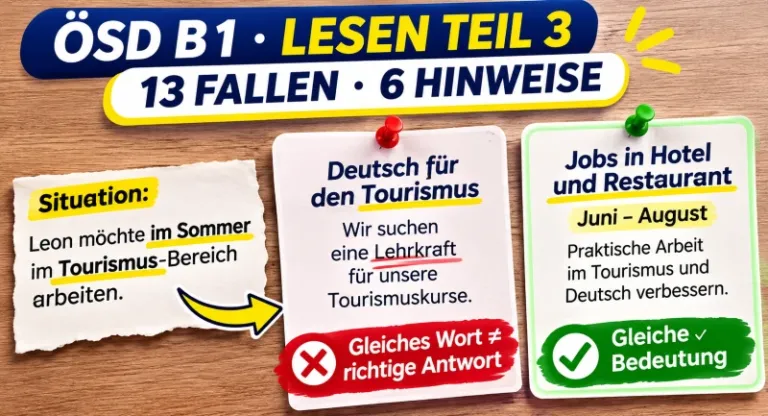
The same word in the advertisement – yet the answer is wrong? That is not bad luck. It is a trap, and the exam deliberately includes it. Here, you will learn about the 13 obvious traps and the 6 subtle clues that lead you to the correct advertisement. You will also discover common mistakes and find a test with answers.
Obvious Traps and Subtle Clues: How the Trick Works
The correct advertisement almost never repeats the words from the situation. It expresses the same meaning using different words. The incorrect advertisement, on the other hand, often uses exactly the same word as the situation – but means something different.
That is why there are two types of signals in Reading Part 3. Obvious traps immediately catch your attention: the same word, the same sentence or the same topic. They lure you towards the incorrect advertisement. Subtle clues are less noticeable: a different word with the same meaning, a date or a location. They lead you to the correct advertisement.
ÖSD also warns candidates in its official practice materials: Do not choose an advertisement too quickly simply because it contains the same words.
An Example from the Official Model Test
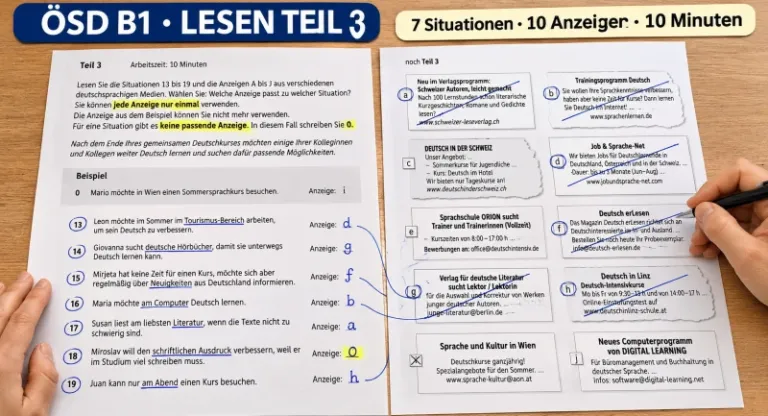
Leon wants to work in tourism during the summer and improve his German at the same time. One advertisement prominently displays “Deutsch für den Tourismus” (German for Tourism). However, it is looking for a teacher, and Leon does not want to teach. The correct advertisement is much less obvious. It offers jobs “in Hotel und Restaurant” (in hotels and restaurants) from June to August and the opportunity to improve language skills. None of the words are identical, but everything matches: summer means June to August, and tourism means hotels and restaurants.
To learn how the task is structured and how many points you can earn, read the article ÖSD B1 Reading Part 3: Structure and Assessment.
The 13 Obvious Traps – Explained Simply
An obvious trap is an advertisement that appears to match at first glance but fails to meet an important requirement. Our examples come from the official ÖSD model test and from Deutsch-Vorbereitung practice tasks that follow the same format.
Word-Based Traps
- The Echo Word. The advertisement contains the same word as the situation. However, it is about something different. Giovanna is looking for audiobooks to listen to while travelling. An advertisement mentions “Hörbücher” (audiobooks) – but a publishing company is looking for an employee. Always ask yourself: Does the person actually get what they are looking for?
- The Bait Sentence. Here, the advertisement repeats not just one word but almost an entire sentence. Mirjeta has “keine Zeit für Kurse” (no time for courses) and wants to read news from Germany. An online learning platform uses almost exactly the same sentence. However, it offers grammar lessons and exercises, not news.
Traps Involving Roles, Purposes and Activities
- The Wrong Role. The advertisement is looking for someone. However, the person in the situation is looking for a service or an offer. Mrs Novak is looking for a swimming course for her son. A swimming club mentions “Kinderschwimmen” (swimming for children) – but is looking for a licensed female swimming instructor.
- The Wrong Purpose. The topic matches, but the purpose does not. Maria wants to learn German on her computer. An advertisement promotes a “Computerprogramm in deutscher Sprache” (computer program in German). However, it is software for office work and accounting.
- The Wrong Activity. The topic is the same, but the work is different. Lena wants to work in the mountains during the summer. A mountaineering school is looking for people to guide groups on hiking trips. An officially recognised professional qualification is also required.
Traps Involving Conditions
- The Little Word “Only”. A single word or a specific time excludes the person. Juan is only available in the evening. A language school states: “Wir bieten nur Tageskurse” (We only offer daytime courses).
- The Discouraging Opening. The correct advertisement begins with information that apparently does not match. The good news appears further down. An advertisement first mentions courses “Mo bis Fr 9:30–13 h” (Monday to Friday, 9:30 a.m. to 1 p.m.). Only afterwards does it mention flexible schedules for working people.
- The Wrong Location. The offer matches, but it is in a different city or country. Mario is looking for a summer course in Vienna. An advertisement offers summer courses – but in Switzerland.
- The Missing Qualification. The advertisement requires a completed qualification. However, the person is still studying or pursues the activity as a hobby. Olga is a student and wants to work as a translator alongside her studies. The regional court requires a university degree and a state examination.
- The Wrong Time Commitment. Full-time instead of a few hours, two months instead of three weeks. Jonas only wants to work a few hours at weekends. A mountain hut is looking for staff to work five days a week.
Traps Involving Answer 0 and the Order of Answers
- The Magnet for Answer 0. The situation without a matching advertisement often has the strongest echo word in an incorrect advertisement. In the model test, this is the situation involving audiobooks from Trap 1.
- The Multiple Magnet. Several advertisements match one requirement, but none meets all the requirements. Clara wants to sing at weddings at weekends. A hotel is looking for staff for wedding celebrations, but a band provides the music. An adult education centre is looking for a choir director. At a mountain hut, guests sing together. None of the advertisements is looking for a female singer. The answer is 0.
- The Chain Error. Each advertisement can only be used once. If you assign an advertisement incorrectly, it becomes unavailable for another situation. If you assign the learning platform from Trap 2 to Mirjeta, you can no longer use it for Maria. One mistake can therefore cost you two points.
Why Does the Exam Include These Traps?
Reading Part 3 assesses whether you can identify the specific information you need. If the correct advertisement contained the same words as the situation, you could complete the task without understanding the text. The traps ensure that only candidates who genuinely understand the text earn the point.
The 6 Subtle Clues That Lead to the Correct Advertisement
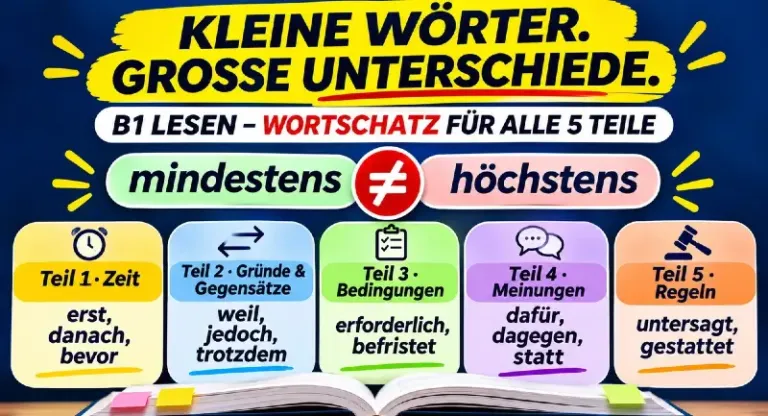
Subtle clues are paraphrases. You need to “translate” them yourself: What does this information mean for the person in the situation?
- Different Words, Same Meaning. The advertisement expresses the same information differently. “Nicht zu schwierig” (not too difficult) becomes “vereinfachte Originalversionen” (simplified original versions). “Am Computer” (on the computer) becomes “im Internet” (online). “Regelmäßig” (regularly) becomes “erscheint einmal im Monat” (published once a month).
- A Hidden Inference. The situation does not state everything directly. Someone who is only available in the evening probably works during the day. Therefore, an advertisement offering courses “für Berufstätige” (for working people) and “Termine nach Wunsch” (appointments according to individual preferences) is a suitable match.
- All Requirements Met at Once. The correct advertisement meets every requirement. In Leon's case, there are four: summer, tourism, working and improving his German. An incorrect advertisement usually meets only one of them.
- A Period of Time You Need to Calculate. The duration is not given as a number but as a range of dates. Mehmet has exactly three weeks off in August. The advertisement is looking for helpers “vom 4. bis 24. August” (from 4 to 24 August). Calculate the duration: That is exactly three weeks.
- Identifying the Location and Season from Details. An outdoor swimming pool that only opens when the temperature reaches 24 degrees means summer and warm weather only. “Mit der Straßenbahn vom Hauptplatz” (by tram from the main square) means that the location is in the city. Cable cars and mountain peaks indicate a mountainous area.
- The Field of Expertise as a Key Clue. The person's professional training matches a preference mentioned in the advertisement. Anna is training to become a physiotherapist. A spa hotel is looking for someone with “Grundwissen über Muskeln und Gelenke” (basic knowledge of muscles and joints).
The same word? Check carefully! The same meaning expressed in different words? Usually correct.
Common Mistakes in B1 Reading Comprehension
Traps are deliberately included in the exam. Mistakes result from the way you approach the task. The good news is that a simple habit can help you avoid each of these mistakes.
| Mistake | How to Recognise It | What Helps |
|---|---|---|
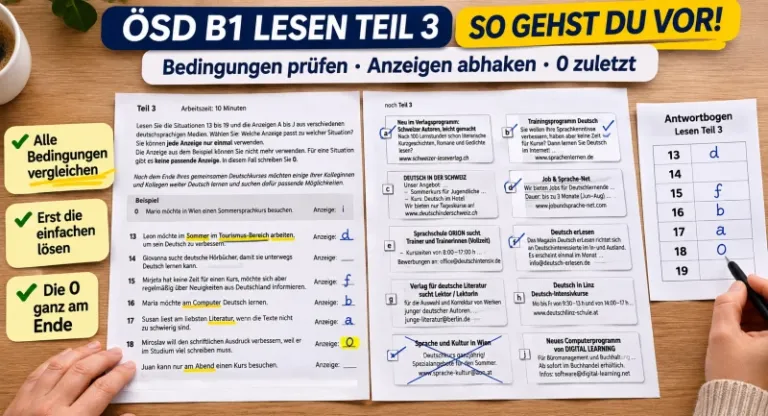
| Matching an advertisement as soon as you see the first identical word | You have chosen the advertisement before reading it to the end. | First highlight all the requirements in the situation, then compare them with the advertisement. |
| Overlooking details in the situation | Words and phrases such as “vormittags” (in the morning), “nach Feierabend” (after work), “genau drei Wochen” (exactly three weeks) or “ohne Vertrag” (without a contract) are not highlighted. | Underline the time, location, duration and restrictions in each situation. |
| Answering based on your own knowledge rather than the text | You think: “Yoga is relaxing, so it matches.” You do not check the time or the contract requirements. | Only the information stated in the advertisement counts. |
| Getting stuck on an unfamiliar word | You spend too much time trying to understand the meaning of “Inserat” (advertisement) or “in Pension” (retired). | Keep reading. The rest of the sentence often explains the word. ÖSD exams also include words used in Austria and Switzerland. |
| Assigning the same advertisement twice | The same letter appears twice on your answer sheet. | Immediately cross off advertisements you have already used. ÖSD also recommends this approach. |
| Using no 0 or using 0 twice | All seven answer fields contain a letter, or two fields contain a 0. | Count your answers at the end: There must be exactly one 0. |
| Changing an answer without checking the chain of assignments | The new advertisement has already been assigned to another situation. | Whenever you change an answer, solve the other affected situation again. |
| Spending too much time on one situation | After five minutes, you have only solved two situations. | Mark the situation you are unsure about, continue with the others and solve it by elimination at the end. |
You can find the complete 10-minute plan in the article ÖSD B1 Reading Part 3: Tips and Strategy.
B1 Reading Exam with Answers: The Trap Test
Which trap is hidden in each of these pairs? Read the situation and the advertisement, make your own decision and then compare it with the answer. The four pairs come from our sports-themed test in the ÖSD exam format.
Pair 1: Karin
Situation: Karin is 67 and has problems with her knees. She prefers to exercise at the swimming pool in the morning.
Advertisement: Running group in the city park, every Saturday at 9 a.m. “All ages are welcome: Our oldest female runner is 71!”
Answer: The Echo Word (Trap 1). The age requirement matches. However, running puts strain on the knees, and there is no swimming pool either.
Pair 2: Sabine
Situation: Sabine wants to try a relaxing sporting activity after work, but she does not want to sign a contract straight away.
Advertisement: Live video training sessions with yoga and Pilates. “Only available with an annual subscription: €19.90 per month.”
Answer: The Little Word “Only” (Trap 6). Yoga matches, but an annual subscription is a contract.
Pair 3: Jonas
Situation: Jonas wants to lose weight and would prefer to exercise at home.
Advertisement: A new app: “With our app, you can easily book your place in the exercise room or reserve a treadmill from the comfort of your home.”
Answer: The Wrong Activity (Trap 5). “From home” appears to match, but you can only make the booking from home. The actual training takes place at the gym.
Pair 4: Emre
Situation: Emre wants to play basketball with other people in an indoor sports hall at weekends.
Advertisements: An indoor tennis centre that is open “also at weekends”, a football club with matches on Saturdays, and a sports centre that is open “also on Sundays and public holidays”.
Answer: The Multiple Magnet (Trap 12). Each advertisement meets one requirement: an indoor sports hall, the weekend or a team. However, none offers basketball. The answer is 0.
👉 ÖSD B1 Reading Comprehension Exercises with Answers




There are no comments for this article. Leave your comment