





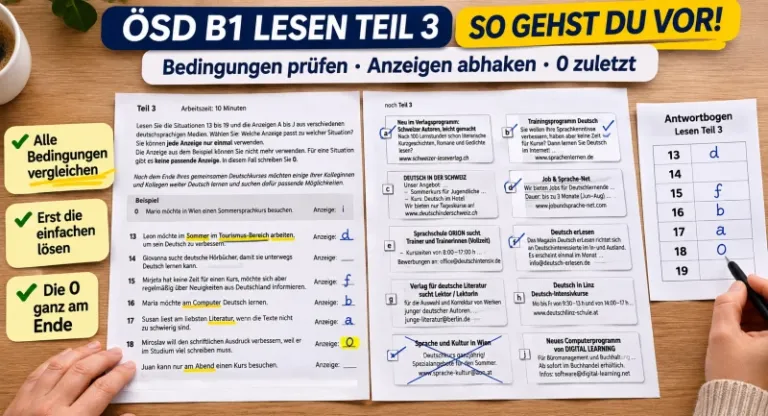
You find exactly the same word in an advertisement as in the task. Is that the correct answer? Not always! This method helps you match advertisements confidently: 14 steps, a 10-minute plan and two real examples. These tips also apply to Goethe B1.
The Most Important Tip for B1 Reading Comprehension
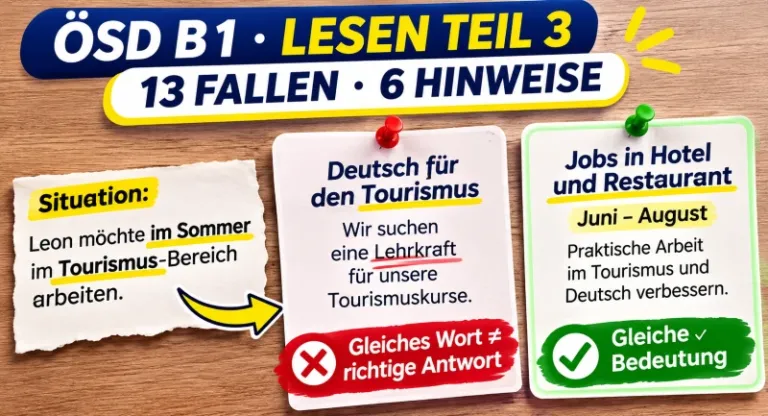
Compare requirements, not words. This is the core of the strategy for ÖSD B1 Reading Part 3. Each situation contains two or three requirements. The correct advertisement meets all of them. Finding the same word, however, is not proof that an advertisement is correct. The exam deliberately places identical words in incorrect advertisements.
You do not need to understand every sentence in detail. You are simply looking for the information that determines which advertisement is correct. This is the principle behind all the reading comprehension tips in this article.
- Structure, time and points: ÖSD B1 Reading Part 3: Structure and Assessment
- All traps with examples: ÖSD B1 Reading Part 3: Traps and Common Mistakes
- Reading sections of other exams: B1 Reading Exam: Exercises with Answers
Reading Comprehension: Matching Advertisements in 14 Steps
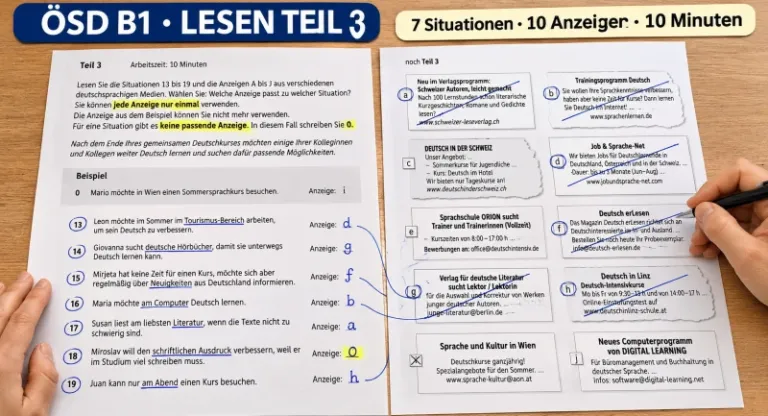
The order is simple: first understand the situations, then check the advertisements, solve the easy cases first and write 0 at the very end. In its official practice materials, ÖSD also recommends identifying the topic, underlining keywords and ticking off advertisements that have already been used.
Before You Read the Advertisements
- Read the first sentence of the task. Who is looking for something, and why? This way, you already know the general topic of all the advertisements.
- Cross out the advertisement used in the example. It has already been assigned.
- Check each advertisement: does it offer something, or is it looking for someone? An advertisement looking for a female employee only matches a person who is looking for exactly that kind of job.
- Break each situation down into two or three requirements. Ask yourself: What? When? Where? For whom? For how long? Underline these words.
While Comparing
- Choose the advertisement that meets all the requirements. Do not choose an advertisement simply because it contains the same word.
- Read every advertisement down to the last sentence. Times, locations, prices and the word “nur” (only) often appear at the very end.
- Check the eligibility requirements. Is a qualification, a licence, experience or membership required?
- Check the scope and duration. How many hours, weeks or months? Calculate the duration from the dates yourself.
- Work out the location and season from the details if they are not stated directly.
- Check the activity. Learning, teaching, supervising and organising are four different things.
When Making Your Decision
- Solve the straightforward situations first. Immediately tick off each advertisement you have used. Solve the remaining situations by eliminating unsuitable advertisements.
- Write 0 last.
- Check the chain of matches whenever you change an answer. Which situation was previously matched with this advertisement?
- Transfer all seven answers to the answer sheet immediately after Part 3, rather than waiting until the end of the module.
The 10-Minute Plan
Divide the 10 minutes into five stages. This way, you know what to do next at every minute.
| Minute | What to Do |
|---|---|
| 0–1 | Read the first sentence, cross out the example advertisement and mark advertisements that are looking for someone |
| 1–3 | Read the seven situations and underline the requirements |
| 3–8 | Read the advertisements in full, match the straightforward pairs and eliminate unsuitable advertisements for the remaining situations |
| 8–9 | Write 0 and check the chain of matches |
| 9–10 | Transfer your answers to the answer sheet |
Are you still unsure after one minute? Mark the two most suitable advertisements and move on. Once the other advertisements have been assigned, there is often only one option left.
When Should I Write 0?
Write 0 when none of the advertisements meets all the requirements. An advertisement that only matches the topic or the time is not enough.
Write 0 only after you have matched all the other situations with an advertisement. A good candidate for 0 is a situation for which several advertisements are only partially suitable. Finally, check that you have exactly one 0 and that each letter has been used no more than once.
How to Solve Two Real Exam-Style Tasks
These examples come from our practice task “Sport und Bewegung in der Freizeit” (Sport and Physical Activity in Your Free Time). It follows the same format as ÖSD B1 Reading Part 3.
Miguel Wants to Exercise in the Evening
“Miguel möchte nach der Arbeit Muskeln aufbauen, ist aber oft erst um 20 Uhr fertig.” (Miguel wants to build muscle after work, but he often does not finish work until 8 p.m.)
The requirements are clear: building muscle and being able to exercise after 8 p.m. A yoga studio immediately catches your attention. It advertises “Abendkurse für Berufstätige” (evening classes for working people). Sounds perfect? But it is not. The classes start at 6 p.m., and the studio promises relaxation, not muscle building.
A sports centre first mentions “Kurse Mo–Fr 9:00–17:00 Uhr” (classes Monday to Friday, 9 a.m.–5 p.m.). If you stop reading here, you will miss the correct answer. The next sentence says: “Freies Training mit Hanteln und Geräten: täglich 6:00–23:00 Uhr” (independent training with dumbbells and exercise equipment: daily from 6 a.m. to 11 p.m.). Dumbbells mean muscle building, and 11 p.m. means Miguel can exercise after work. Both requirements are met. This is the correct answer.
And what about the yoga studio? It remains available for another person who is looking for a relaxing form of exercise in the evening.
Tom Wants to Meet New People
“Der 25-jährige Tom ist neu in der Stadt. Er möchte draußen Sport machen und dabei Leute kennenlernen. Wettkämpfe mag er aber nicht.” (Tom is 25 years old and new to the city. He wants to exercise outdoors and meet new people at the same time. However, he does not like competitions.)
There are three requirements: exercising outdoors, meeting people and no competition. A football club attracts your attention with the sentence “Hier lernen Sie neue Leute kennen!” (Here you can meet new people!) and holds its training sessions outdoors. Two requirements are met. However, the last sentence reveals that the goal is to gain promotion to the next league. This is clearly competitive sport.
The correct answer is a running group. Its members run “durch den Park” (through the park) and “gemeinsam” (together). Afterwards, the group has coffee together, and “niemand muss gewinnen” (nobody has to win). All three requirements are met – without using a single identical word.






There are no comments for this article. Leave your comment