





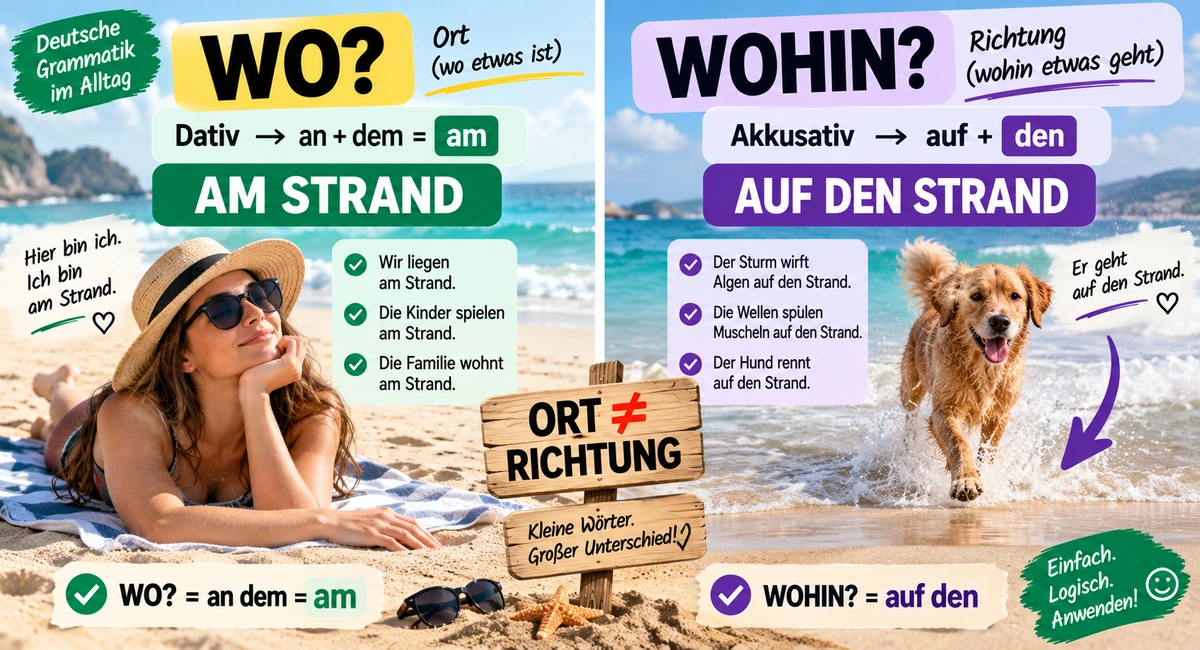
Why do we say am Strand – and when auf den Strand?
A clear rule for WO, WOHIN, dative, accusative – and contraction
an dem → am
For learners of German, am Strand and auf den Strand often seem confusing: the same noun, two different prepositions.
But the solution is surprisingly simple: the question decides.
1. WO? or WOHIN? – the starting point of every place expression
In German, the question automatically determines the case:
WO? → dative → an → an dem Strand
WO? describes a location without movement.
WOHIN? → accusative → auf → auf den Strand
WOHIN? asks about direction or destination.
This distinction is the basis for all the rules that follow.
2. Why do we say am Strand at all?
Am is not a separate preposition, but a contraction:
an + dem = am
This form occurs exclusively in the dative – that is, exactly when the question is WO?.
Other regular contractions in German:
- bei dem → beim
- in dem → im
- zu dem → zum
That is why we say:
- an dem Strand → am Strand
- an dem Fenster → am Fenster
The language simplifies a frequently used structure in this way.
3. The most effective mnemonic
This memory aid makes the rule immediately clear:
✔ WO – two letters → AN
Location, no movement, dative.
✔ WOHIN – longer → “greater” movement → AUF
Direction, destination, accusative.
This makes choosing the correct preposition practically foolproof.
4. WO? – situations without movement: am Strand
As soon as a person or an action takes place at a fixed location, the answer is automatic:
- Question: WO?
- Case: dative
- Preposition: an
- Contracted form: an dem Strand
Examples:
- Wir liegen am Strand.
- Die Kinder spielen am Strand.
- Die Familie wohnt am Strand.
There is no movement and no destination – the location itself is central.
5. WOHIN? – situations with movement: auf den Strand
As soon as something moves toward a surface or zone, we use the accusative:
- Question: WOHIN?
- Case: accusative
- Preposition: auf
- Form: auf den Strand
Examples:
- Der Sturm wirft Algen auf den Strand.
- Die Wellen spülen Muscheln auf den Strand.
- Der Hund rennt auf den Strand.
Here it is always about a destination, not a location.
6. Summary at a glance
| Question | Case | Preposition | Form | Example |
|---|---|---|---|---|
| WO? | dative | an | an dem Strand | Wir liegen am Strand. |
| WOHIN? | accusative | auf | auf den Strand | Der Wind weht Sand auf den Strand. |
The grammar is clear and consistently reliable:
WO? = an dem = am.
WOHIN? = auf den.





























































































There are no comments for this article. Leave your comment