





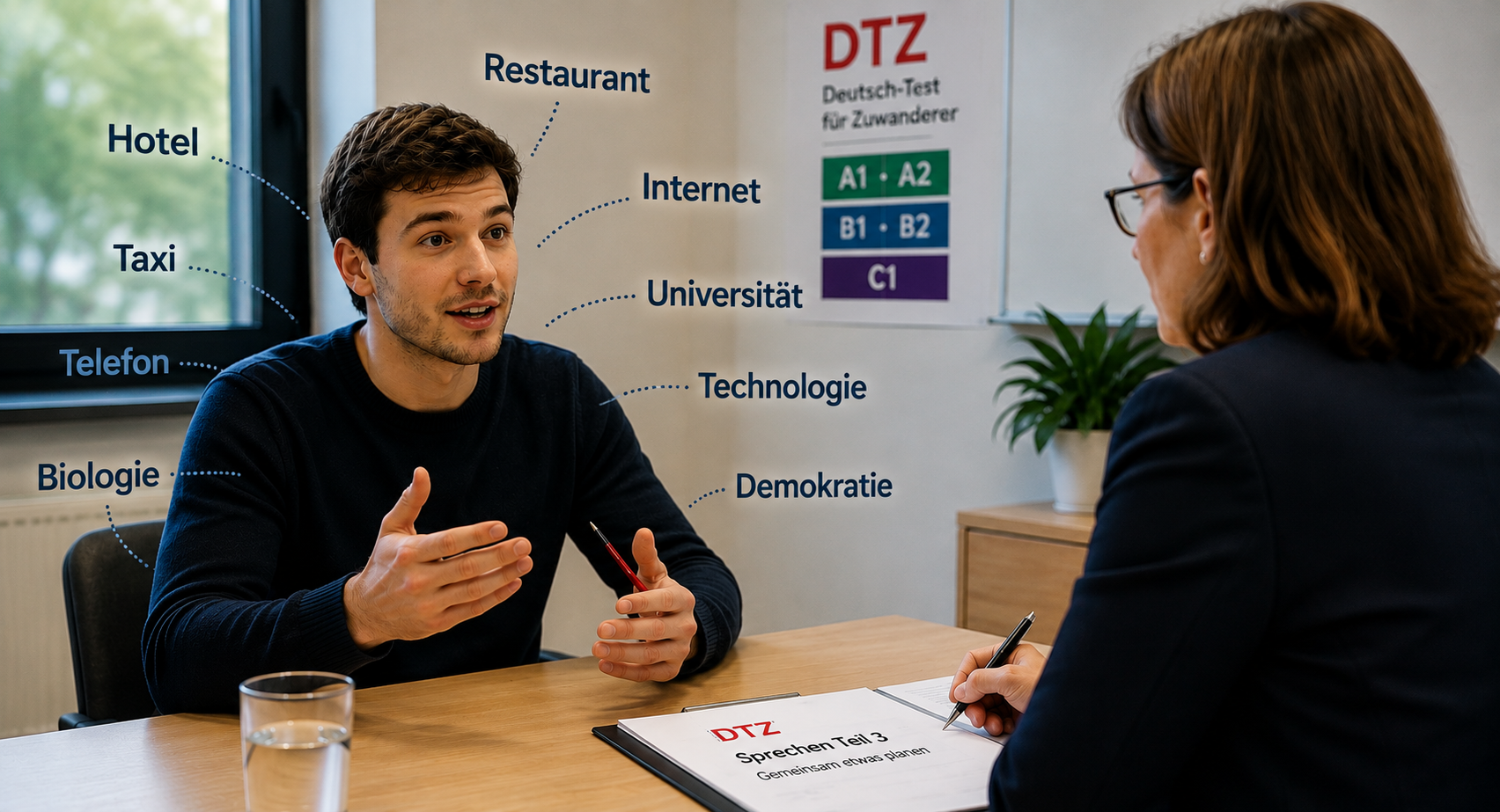
One of the main lifehacks for the Sprechen part of German exams is the active use of international words. These are words of Latin, Greek, English or French origin that appear in many world languages — both in the Indo-European and Semitic language groups. Thanks to their similar sound, these words are easily recognized, which makes communication much easier. 😊
🤔 Why does it work?
- Vocabulary richness is assessed 📚
- Fluent speech without long pauses 🗣
- The ability to express opinion, describe a picture, or lead a dialogue 💬
International words provide a ready-made vocabulary that you already know. Their use:
- saves time ⏱
- adds confidence 💪
- impresses the examiner ✨
🚦 How to use international vocabulary at different levels
🔹 A1 and A2
Typical tasks: introduction, family, everyday topics, picture description.
Useful words: Hotel, Restaurant, Taxi, Telefon, Radio, Supermarkt, Computer
🔸 B1
You need to compare, express pros and cons, discuss work and daily life.
Useful words: Universität, Internet, Programm, Email, Virus, Hospital, Kredit
🔺 B2
This level requires argumentation, analysis, and fluent speech on abstract topics like politics, science, or economics.
Useful words: Demokratie, Präsident, Psychologie, Technologie, Energie, Biologie, Industrie
📝 Tip: create your personal word list
- Write down 50–100 international words that you already know from your native language.
- Find their German equivalents – they are often identical.
- Make 2–3 example sentences for each exam topic.
📋 Examples of international words
- Telefon – تليفون / טלפון – telephone
- Hotel – هوتيل / הוטל – hotel
- Universität – يونيفرسيتي / אוניברסיטה – university
- Internet – إنترنت / אינטרנט – internet
- Demokratie – ديمقراطية / דמוקרטיה – democracy
- Präsident – بريزيدنت / פרזידנט – president
- Biologie – بيولوجيا / ביולוגיה – biology
🏁 Conclusion
If your native language belongs to the Semitic group — use it as your advantage! Don’t translate in your head — just say the word in German. The higher your level, the more topics you cover — and the more international words you can use effectively.
Main rule: Don’t be afraid to use what you already know from other languages. It’s your vocabulary capital! 🚀














































There are no comments for this article. Leave your comment