





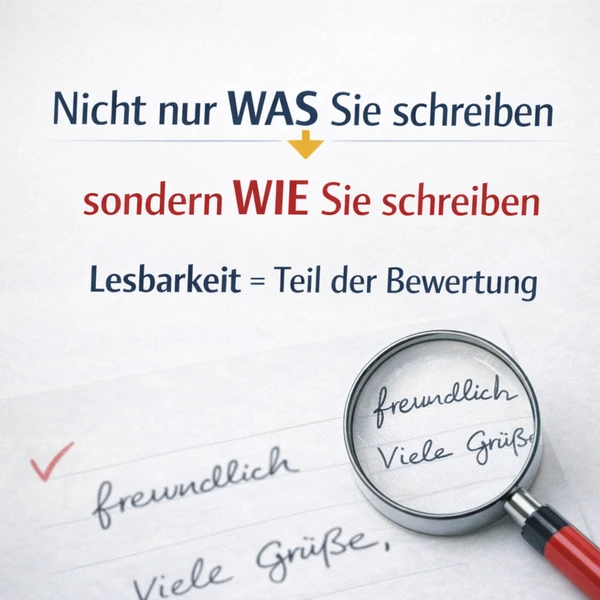
Why correct German letters are crucial in the “Writing” section of the exam
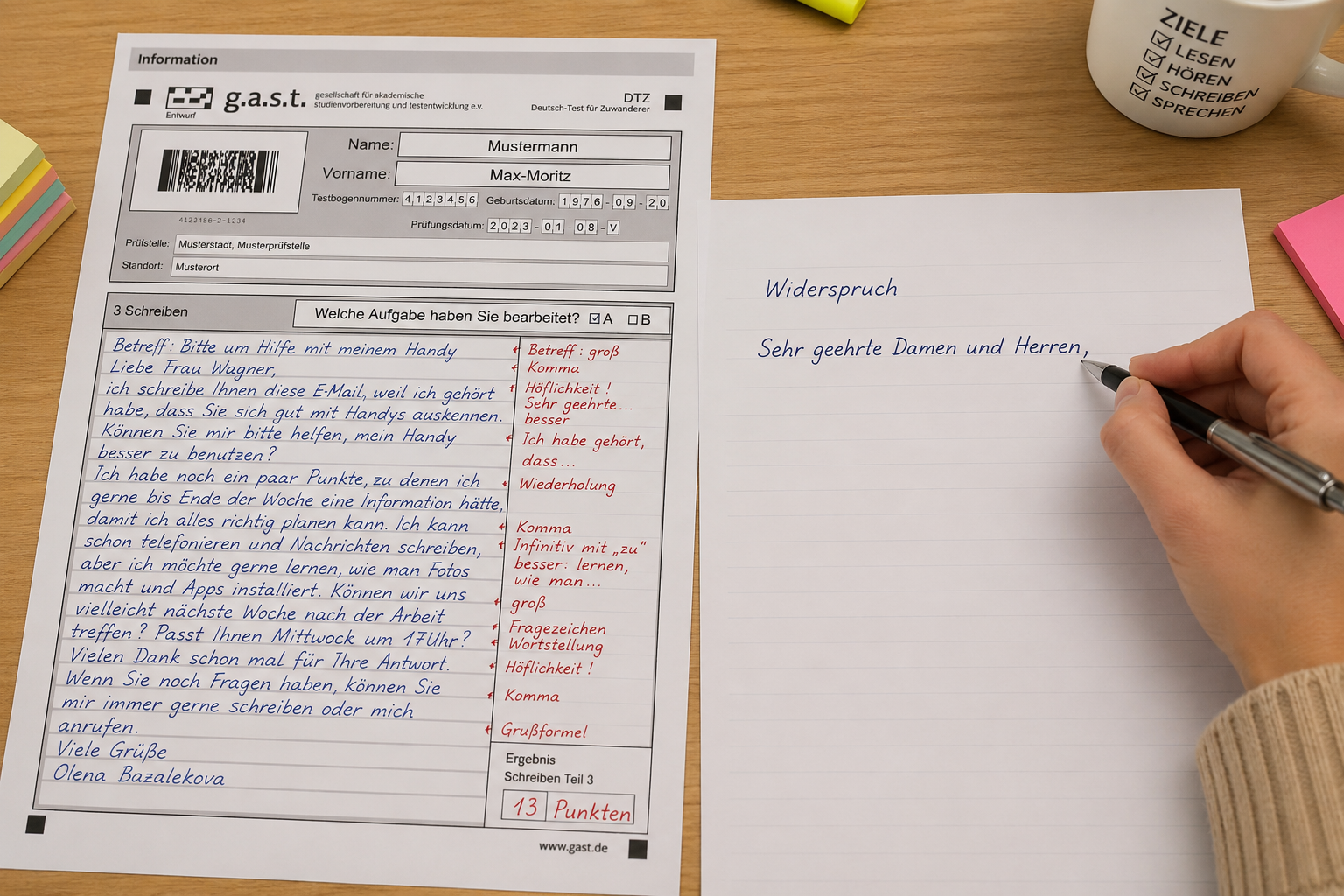
telc exams assess not only content and grammar, but also legibility. This is exactly where many candidates make a serious mistake:
- They write letters in a way that does not correspond to the official German alphabet.
- This problem is often underestimated, but it can directly lead to a deduction of points, even if the content of the text is correct.
What does “official German alphabet” mean?
In the writing section (A2, B1, B2, DTZ, B1 Beruf, B2 Beruf, telc B1, telc B2), letters must be clearly identifiable as belonging to the German printed or cursive alphabet.
This particularly affects problematic letters such as:
- w
- v
- s
- r
These letters are often:
- borrowed from other writing systems,
- over-simplified,
- or written in a non-standardized form.
Occasional deviation vs. systematic error
✅ Isolated error
If a candidate writes a letter in an atypical way only once,
→ this may be tolerated as long as the word remains clearly legible.
❌ Systematic error
However, if:
- a letter is written incorrectly throughout the text
- and this form does not belong to the German alphabet,
→ this is assessed as a violation of the legibility criteria
→ point deductions are possible even without grammar or vocabulary errors.
This applies, for example, to:
- a consistently “Latin-English” r
- a v that consistently looks like a u
- a w that looks more like two v’s or like a foreign symbol
Why is this so important for examiners?
Assessment is based on clear criteria:
- The text must be readable without interpretation.
- Examiners are not allowed to make assumptions.
- Each letter must be clearly identifiable.
A text may be good in terms of content, but if the letters are not clearly German, the overall score in the writing section will suffer.
Common misconceptions among candidates
❌ “As long as the examiner understands me”
❌ “That’s just my handwriting”
❌ “That’s not a grammar mistake”
➡ Yes, it is: it is a formal assessment criterion.
Practical recommendation for the exam
✔ Decide before the exam:
- either German block letters (print)
- or clean German cursive writing
✔ Practise specifically:
- w – v – s – r
in complete words and sentences
✔ Avoid:
- mixed letter forms
- foreign-language letter shapes
- creative abbreviations
Conclusion
In the writing section, it is not only about what you write, but also how you write it.
Anyone who consistently uses letters that are not part of the official German alphabet risks unnecessary point deductions, even with good content.
☛ Correct letters = fair assessment.
🎥 Important for your exam preparation
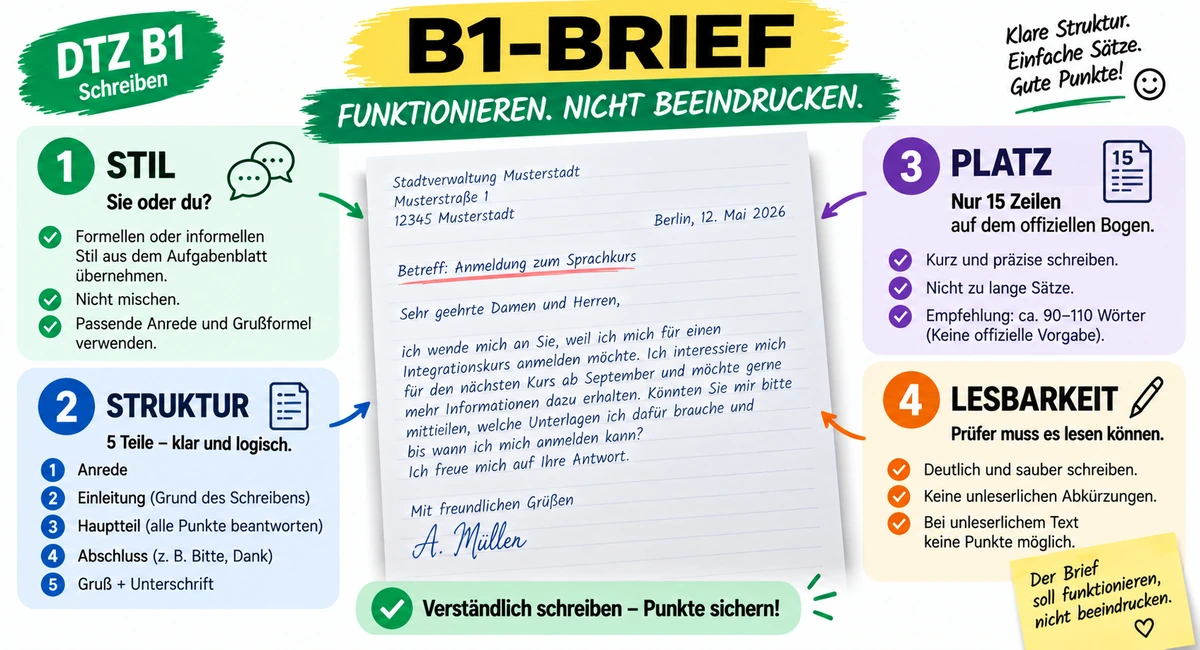
I discuss this topic and many other exam-relevant details in depth and in a practical way in my video course on letter writing “B1 DTZ Writing”.
There you will learn, among other things:
- what examiners really focus on in the writing section,
- which formal mistakes regularly lead to point deductions,
- how to write your texts clearly, confidently and in line with exam requirements,
- and how to avoid typical risks that many only recognize after failing the exam.
📌 The video is helpful for anyone preparing for DTZ, telc B1/B2 or other written German exams.
☛ You can find the video course here: https://deutsch-vorbereitung.com/product-1.html
Source
Official telc assessment guidelines ☛ https://shop.telc.net/media/catalog/product/file//5/0/5083-b01-010101_web.pdf



































































There are no comments for this article. Leave your comment